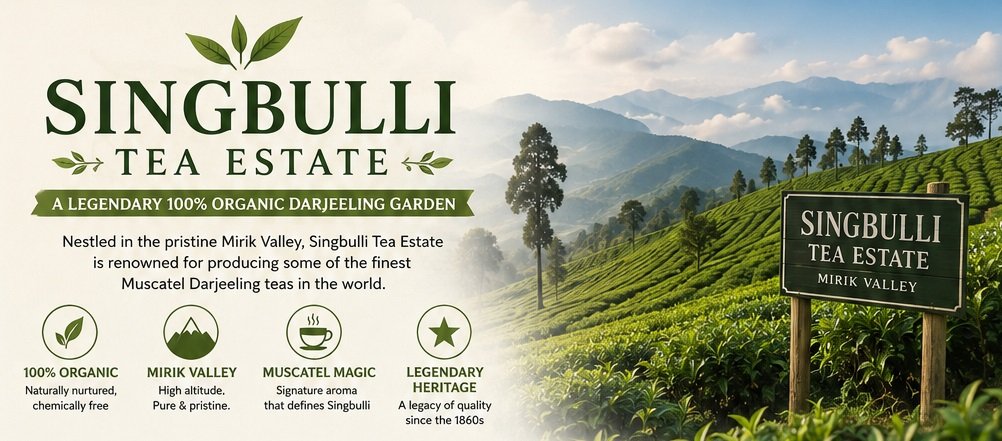
Singbulli Tea Estate: The Complete Guide to Darjeeling’s Crown Jewel of Mirik Valley
| Image | Name | Summary | Price | Buy |
|---|---|---|---|---|
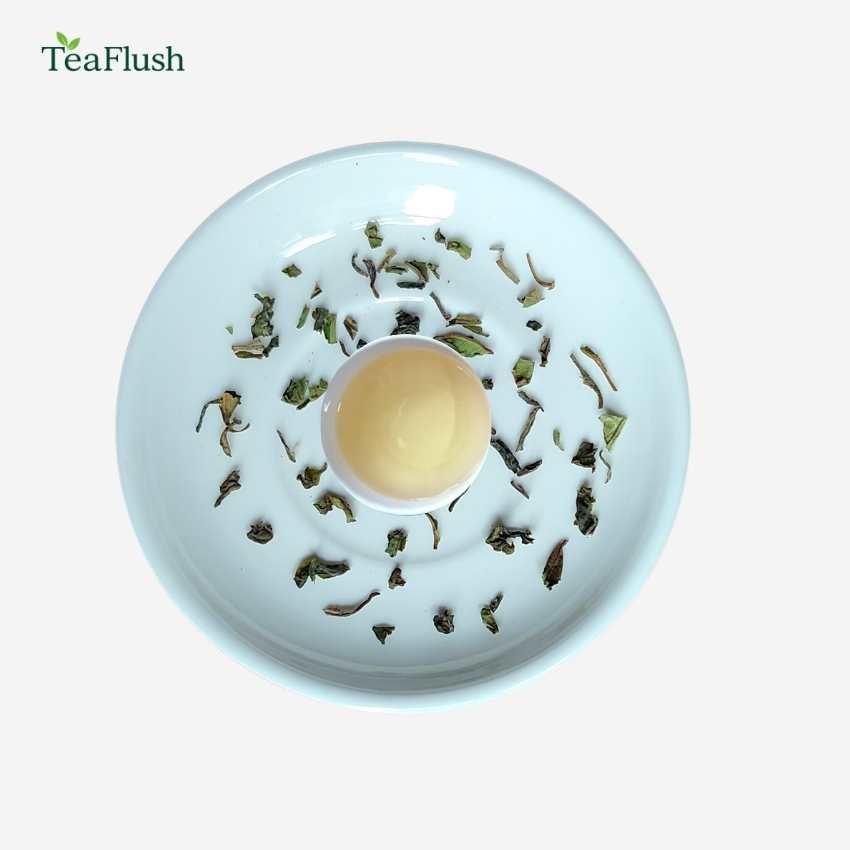 | Singbulli First Flush Tea SFTGFOP (2026) 100g | Singbulli First Flush Tea SFTGFOP-1 is an exceptionally premium, organic loose-leaf Darjeeling black tea. Sourced from the prestigious Singbulli Tea Estate near Mirik, India, this tea is celebrated by connoisseurs for its intricate, light, and highly aromatic spring harvest profiles. | ₹628,00 |
Table of Contents
1. Introduction: Why Singbulli Tea Estate Matters
In the world of fine teas, few names carry as much weight as Singbulli Tea Estate. Nestled in the misty, undulating hills of the Mirik Valley in Darjeeling, West Bengal, Singbulli is not just a tea garden — it is a living testament to over a century of artisanal craftsmanship, ecological stewardship, and an unrelenting pursuit of the perfect cup.
If you are a Darjeeling tea enthusiast, a casual tea lover looking to upgrade your palate, or someone who simply wants to understand what makes a truly world-class tea garden tick, then Singbulli deserves a prominent place in your tea education.
At TeaFlush.com, we believe that understanding a tea’s origin is the first step to truly appreciating it. And with Singbulli, there is a great deal to appreciate.
2. Location & Geography: Where the Magic Begins
“Great tea begins with exceptional terroir.”
Singbulli Tea Estate is situated in the Mirik subdivision of the Darjeeling district, in the state of West Bengal, India. It lies approximately 38–40 kilometres from Darjeeling town and 45 kilometres from Siliguri. The nearest airport is Bagdogra Airport, located about 50 kilometres from the estate — making it accessible for tea tourists and buyers alike.
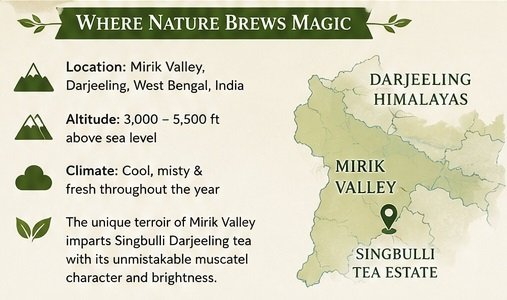
Key Geographical Facts
| Feature | Details |
|---|---|
| Region | Mirik Valley, Darjeeling District |
| State | West Bengal, India |
| Coordinates | 26°51′05″N 88°12′49″E |
| Altitude Range | 400 m to 1,350 m (approx. 1,300 ft to 4,100 ft above MSL) |
| Total Area Under Cultivation | ~474 Hectares |
| Spread | Across nine undulating hills, spanning ~22 kilometres |
| Nearest Town | Mirik |
| Nearest Airport | Bagdogra (50 km) |
What makes Singbulli’s geography extraordinary is the sheer range of its altitudes. The estate spreads across nine rolling hills, with altitude varying from lush low-altitude zones to cool, high-altitude ridges. This dramatic variation in elevation means a single estate can produce teas of vastly different characters — from bold and brisk low-grown teas to delicate, floral high-grown varieties.
The Sourenee Tea Estate borders Singbulli to the northwest, while Gayabaree (Millikthong) Tea Estate flanks most of the southern boundary. This geography — surrounded by tea on all sides and shielded by the Himalayan foothills — creates a uniquely protective microclimate ideal for tea cultivation.
The combination of altitude, soil composition, seasonal mists, and Himalayan mineral-rich water gives Singbulli teas their unmistakable character: a defining quality known in the tea world as terroir.
3. A Rich History: From British Planters to Birla Group
The story of Singbulli Tea Estate is a story of Darjeeling’s own history — one of colonial enterprise, independent ambition, and modern reinvention.
The British Founding (1924)
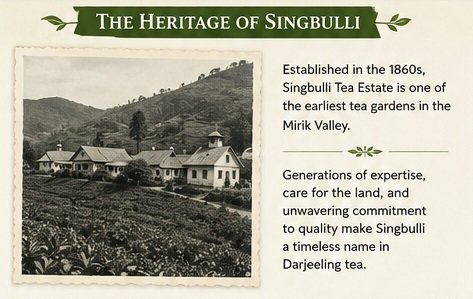
Singbulli Tea Estate was established in 1924 by British tea planters during the height of the colonial tea era in Darjeeling. This was a period when the hills of Darjeeling were being transformed into one of the most celebrated tea-producing regions on earth. The British recognised the extraordinary potential of Mirik Valley — its altitude, soil, and climate — and planted what would eventually become one of the finest tea gardens in the district.
The Transition to Indian Ownership (2003)
After decades under various management structures, Jayshree Tea & Industries Limited, part of the prestigious B.K. Birla Group of Companies, took over the management of Singbulli Tea Estate in 2003. The Birla Group, one of India’s most respected industrial conglomerates, brought with it a commitment to both quality and ecological responsibility.
In 2020, ownership transitioned further, with Manjushree Tea and India Pvt. Ltd. (Berlia) acquiring the estate, continuing the tradition of quality-first stewardship.
A Century of Legacy
In 2024, Singbulli celebrated its centennial year — 100 years of producing some of the finest Darjeeling teas the world has ever tasted. Few tea estates anywhere in the world can boast such an unbroken legacy of quality spanning a full century.
4. The Four Divisions of Singbulli Tea Estate
Singbulli Tea Estate is administratively divided into four distinct divisions, each contributing to the estate’s overall production and character:
- Singbulli Division — The core and namesake division, producing some of the estate’s most prized teas.
- Manja Division — Known for its unique micro-terroir within the broader estate landscape.
- Tingling Division — Contributing teas with their own distinct character and altitude.
- Murmah Division — Rounding out the estate’s diverse production profile.
Each division adds a different dimension to Singbulli’s total annual output of approximately 250 tonnes of tea — an impressive figure for an estate that is 100% organic and committed to hand-crafted quality.
5. The Teas of Singbulli: A Flush-by-Flush Guide
Darjeeling tea is unique in that it produces multiple harvests per year, each called a “flush.” Each flush has a distinct flavour profile shaped by the changing seasons. Singbulli excels across all of them.
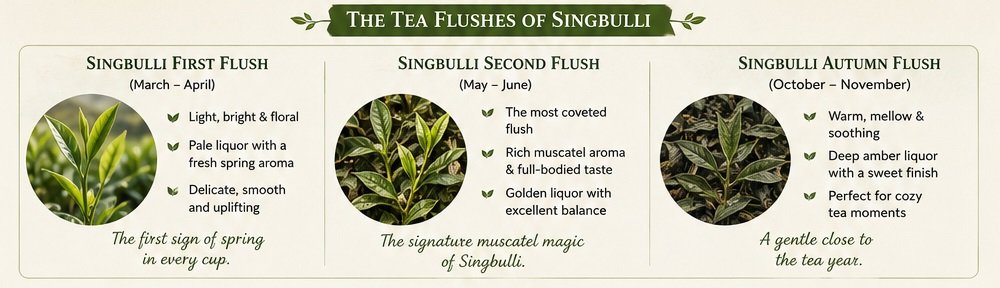
First Flush (March – April): The Spring Awakening
The Singbulli First Flush is harvested in the early spring, when the tea bushes produce their first tender new growth after the winter dormancy. This is arguably one of the most celebrated teas from the estate among connoisseurs worldwide.
Key characteristics of Singbulli First Flush:
- Dry Leaf: Delicate, lighter-coloured leaves with a greenish-golden hue
- Liquor Colour: Pale gold to light amber
- Aroma: Floral, fresh, with hints of spring blossoms
- Taste: Light-bodied, crisp, with a gentle astringency and clean finish
- Tea Type: Both China (Chinary) and Clonal varieties available
The estate produces First Flush in both China bush (Chinary) and Clonal varieties. The China seedling varieties tend to give a classic, traditional Darjeeling character, while the clonal varieties offer bolder, more structured cups. Singbulli is particularly renowned across Darjeeling’s tea community for the exceptional quality of its First Flush offerings — a quality acknowledged even by managers of competing estates.
Second Flush (May – June): The Muscatel Marvel
If the First Flush is Singbulli’s elegance, the Second Flush is its showpiece. This is where Singbulli truly earns its legendary reputation.
Harvested in early summer, the Second Flush is Darjeeling’s most celebrated harvest — and Singbulli’s version is among the most sought-after. The magic lies in the estate’s production of Muscatel teas, a uniquely Darjeeling phenomenon that results from the attack of a tiny leafhopper (Jacobiasca formosana) on the tea leaves. The plant’s defensive response to this insect creates the characteristic muscatel grape-like aroma and flavour that defines the finest Darjeeling Second Flush teas.
Key characteristics of Singbulli Second Flush:
- Dry Leaf: Bold, well-twisted black leaves with abundant silver and golden tips
- Liquor Colour: Radiant golden-amber to deep copper-orange
- Aroma: Intoxicating muscatel grape, layered with spice, cocoa powder, caramelised notes, and sweet musk
- Taste: Full-bodied, medium astringency, rich muscatel character, smooth and lingering finish
- Notable Cultivar: Tukdah 383 (a China hybrid) and AV2 Clonal
The Singbulli Second Flush is described by those who have tasted it as “an exhilarating cup that is impossible to enjoy just once.” Notes of cedar, plum, cinnamon, bitter orange, and a floral sweet finish make it one of the most complex and rewarding cups in all of Darjeeling.
Autumn Flush (October – November): The Connoisseur’s Secret
Less famous than the First and Second Flush, the Singbulli Autumn Flush (also called the autumnal) is a hidden gem. Harvested as the monsoon withdraws and the air turns crisp and clear, the Autumn Flush produces teas with:
- A particularly expressive and variegated leaf appearance
- A harmonious, mild flavour profile with less astringency
- Warm, round, and mellow notes perfect for afternoon drinking
- Excellent body with a smooth, elongated finish
The Autumn Flush appeals especially to those who find the First Flush too delicate and the Second Flush too intense — it sits beautifully in the middle, offering depth without aggression.
Specialty & Clonal Teas: Beyond the Ordinary
Singbulli is also celebrated for its Clonal teas — teas produced from selectively bred tea cultivars chosen for specific quality traits. The estate’s clonal programme produces teas under special names such as:
- Singbulli Gold — Produced from the Tukdah 383 China hybrid cultivar, this is a rare and extraordinary tea available only in tiny quantities. The flavour profile spans cinnamon, saffron, black pepper, rose water, kulfi, caramel, and overripe mango — an extraordinary sensory journey.
- Singbulli Thunder — A dedicated clonal selection celebrated among serious Darjeeling aficionados.
- Singbulli Oolong — A unique departure from the estate’s traditional black tea portfolio, this partially oxidised tea features a nutty taste with muscatel aroma, made in small batches with tightly twisted, bronze-coloured, tip-rich leaves.
6. Tasting Notes: What Does Singbulli Tea Taste Like?
Here is a comprehensive flavour reference for Singbulli teas across their varieties:
Singbulli First Flush — Tasting Profile
| Element | Description |
|---|---|
| Dry Leaf Aroma | Fresh, vegetal, spring flowers |
| Infusion Colour | Pale gold |
| First Sip | Crisp, clean, lightly astringent |
| Mid-Palate | Floral, grassy, gentle sweetness |
| Finish | Clean, refreshing, lingering floral |
| Body | Light to medium |
Singbulli Second Flush — Tasting Profile
| Element | Description |
|---|---|
| Dry Leaf Aroma | Cocoa powder, caramelised jaggery, cardamom, cloves, sweet musk |
| Infusion Colour | Radiant golden-amber to deep copper-orange |
| First Sip | Full-bodied, rich, layered muscatel |
| Mid-Palate | Cedar, plum, cinnamon, bitter orange, hazelnut |
| Finish | Floral-sweet, long, silky, slightly spiced |
| Body | Full-bodied, medium to prominent astringency |
Singbulli Gold (Special Reserve) — Tasting Profile
| Element | Description |
|---|---|
| Dry Leaf Aroma | Velvety cocoa, caramelised jaggery, green cardamom, exotic cloves, sweet musk |
| Infusion Colour | Shimmering golden-amber |
| Taste Notes | Cinnamon, saffron, black pepper, rose water, kulfi, cooked watermelon, overripe mango |
| Finish | Wintergreen, herbaceous, cooling, extraordinary |
| Rarity | Extremely limited — sometimes only 10 kg per batch |
7. Organic & Fair Trade: Singbulli’s Commitment to Sustainability
One of the most important things to know about Singbulli Tea Estate is its unwavering commitment to organic, sustainable, and ethical farming practices.
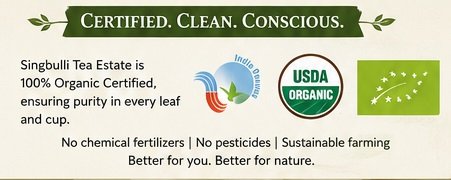
100% Certified Organic
Singbulli Tea Estate is 100% organic, certified by IMO Control — one of the world’s foremost organic certification bodies. This means:
- No synthetic pesticides are used at any stage of cultivation
- No chemical fertilisers are applied to the soil
- The entire 474 hectares is managed using only natural, ecological methods
- Soil health is maintained through compost, green manure, and natural mulching
This certification is not merely a marketing label — it reflects a deep philosophical commitment to working with nature rather than against it.
Ecological Upgradation Programmes
The estate management has actively implemented multiple programmes for soil conservation and biodiversity enhancement, including:
- Planting diverse grasses, leguminous crops, short shrubs, and tall trees in fallow land along section boundaries
- Maintaining inter-row vegetation to prevent soil erosion
- Establishing shade tree networks that regulate temperature and moisture within the garden
Fair Trade Certification
Singbulli has pursued and received Fairtrade certification, ensuring that the workers and community associated with the estate benefit from fair wages, safe working conditions, and community development programmes. This places Singbulli among the most ethically responsible tea estates in Darjeeling.
DUTCH HACCP Certification
The estate also holds DUTCH HACCP (Hazard Analysis and Critical Control Points) certification by SGS — a rigorous food safety standard that ensures every stage of processing, from leaf to cup, meets the highest hygiene and safety requirements.
8. Biodiversity & Wildlife: A Tea Garden Like No Other
Singbulli is not just a tea estate — it is a living ecosystem. Within its 474 hectares lies a nature reserve home to over 3,000 pine trees, creating a rich forested environment that shelters remarkable biodiversity.
Flora
The estate sustains an extraordinary variety of plant life:
- Over 3,000 pine trees within the nature reserve
- Diverse leguminous and shade tree species planted throughout the garden
- Seasonal wildflowers and ferns that carpet the forest floor
- Natural stream systems and water bodies feeding the plantation
Fauna
Singbulli’s forests and tea rows are home to a remarkable array of wildlife. A memorable account from veteran Darjeeling tea planter Narendra Kumar Puri captures this vividly: while driving through Singbulli in 1971 on a cold, foggy evening, a leopard leapt across his jeep — a testament to the wild, untouched character of this estate even decades ago.
The forests of Singbulli continue to shelter a variety of birds, mammals, and reptiles that coexist with the tea cultivation, making it a model for how productive agriculture and ecological conservation can thrive together.
9. Certifications: Why Singbulli Stands Apart
Here is a summary of Singbulli Tea Estate’s key certifications — a list that is rare in its completeness even among premium Darjeeling estates:
| Certification | Issuing Body | What It Means |
|---|---|---|
| 100% Organic | IMO Control | No synthetic chemicals in cultivation |
| Fairtrade | Fairtrade International | Ethical labour and community practices |
| DUTCH HACCP | SGS | Food safety and hygiene compliance |
Together, these certifications make Singbulli one of the most comprehensively certified tea estates in Darjeeling — offering buyers and tea lovers complete confidence in what they are brewing.
10. How to Brew Singbulli Tea Perfectly
Getting the best out of a world-class tea like Singbulli requires some care. Here is how to brew each style to perfection.
Singbulli First Flush (Black Tea)
| Parameter | Recommendation |
|---|---|
| Water Temperature | 80–85°C (175–185°F) |
| Quantity | 2.5g per 100ml water (1 heaped teaspoon per 8 oz) |
| Steep Time | 2–3 minutes |
| Water | Filtered or spring water (avoid re-boiled water) |
| Milk / Sugar | Best enjoyed without — let the floral notes shine |
Pro Tip: Never use boiling water for a First Flush. High temperatures scorch the delicate leaves and destroy the floral character. Let boiled water cool for 2–3 minutes before pouring.
Singbulli Second Flush (Muscatel Black Tea)
| Parameter | Recommendation |
|---|---|
| Water Temperature | 90–95°C (194–203°F) |
| Quantity | 2.5g per 100ml |
| Steep Time | 3–5 minutes |
| Water | Filtered or spring water |
| Milk / Sugar | Can be enjoyed with a touch of milk for an afternoon indulgence |
Pro Tip: For the full muscatel experience, brew at 90–95°C for a full 5 minutes. The liquor should emerge as a radiant golden-amber. Smell the leaves both before and after steeping — the aroma transformation is part of the journey.
Singbulli Oolong
| Parameter | Recommendation |
|---|---|
| Water Temperature | 85–90°C |
| Quantity | 3g per 100ml |
| Steep Time | 2–3 minutes (multiple infusions possible) |
| Milk / Sugar | Never — pure is the only way |
General Tips for All Singbulli Teas
- Always use fresh, cold, oxygenated water — never water that has already been boiled and re-boiled.
- Warm your teapot or cup before brewing to maintain temperature stability.
- Use a timer — the difference between 2 minutes and 4 minutes can mean the difference between floral and astringent.
- Experiment with ratios — different cultivar leaf sizes (China vs. Clonal) may require slightly different quantities.
11. Where to Buy Singbulli Tea
Singbulli teas are available from a growing range of reputable global tea retailers and estate-direct sources. When purchasing, look for:
- Estate-specific invoices or lot numbers (e.g., DJ-99, EXM-52) — a sign of authentic estate tea
- Flush year on the packaging — freshness is critical for Darjeeling teas
- Organic and Fairtrade certification logos
- Grade markings: SFTGFOP1 (Super Fine Tippy Golden Flowery Orange Pekoe) is the highest grade
Retailers known to carry authentic Singbulli teas span India, the UK, Germany, the United States, and beyond. Look for it at specialist Darjeeling tea boutiques, organic tea importers, and established estate-focused tea merchants.
On TeaFlush.com, we curate only estate-authentic, certified Darjeeling teas. Browse our Singbulli collection for current-flush availability and tasting notes.
12. Frequently Asked Questions
What is Singbulli Tea Estate famous for?
Singbulli Tea Estate is world-famous for its Muscatel Second Flush teas, First Flush teas, Clonal specialty teas, and Autumn Flush teas. It is one of Darjeeling’s most celebrated 100% organic estates.
Where is Singbulli Tea Estate located?
Singbulli is located in Mirik Valley, Darjeeling district, West Bengal, India — approximately 38–40 km from Darjeeling town and 45 km from Siliguri.
Is Singbulli Tea Estate organic?
Yes. Singbulli Tea Estate is 100% certified organic by IMO Control and also holds Fairtrade and DUTCH HACCP certifications.
When was Singbulli Tea Estate established?
Singbulli Tea Estate was established in 1924 by British tea planters. It has been in operation for over a century.
Who owns Singbulli Tea Estate?
The estate was managed by Jayshree Tea & Industries Limited (B.K. Birla Group) from 2003 and was subsequently acquired by Manjushree Tea and India Pvt. Ltd. (Berlia) in 2020.
How much tea does Singbulli produce annually?
Singbulli Tea Estate produces approximately 250 tonnes of tea per year, including black, green, oolong, and specialty teas.
What does Singbulli Muscatel taste like?
The Second Flush Muscatel from Singbulli is characterised by muscatel grape notes, cedar, plum, cinnamon, bitter orange, and a floral-sweet lingering finish, with a full-bodied, radiant golden-amber liquor.
What is the best flush from Singbulli?
While every flush has its fans, the Second Flush Muscatel is widely considered Singbulli’s crowning achievement. However, First Flush enthusiasts rank Singbulli’s spring harvest among the finest in all of Darjeeling.
Can I visit Singbulli Tea Estate?
Singbulli is located in the Mirik Valley and is accessible by road from Siliguri and Darjeeling. While it is primarily a working tea estate, visitors interested in tea tourism to the Mirik Valley region can experience the estate’s landscape and surroundings.
13. Final Thoughts
Singbulli Tea Estate is, without question, one of the jewels of Darjeeling’s tea crown. In a district already brimming with extraordinary gardens, Singbulli distinguishes itself through:
- A century of unbroken heritage dating to 1924
- An extraordinary terroir spread across nine hills in Mirik Valley
- World-famous Muscatel teas that define what Second Flush Darjeeling can be
- An ironclad commitment to 100% organic, Fairtrade, and HACCP-certified production
- A living nature reserve within its boundaries that speaks to its ecological conscience
- A portfolio that spans First Flush, Second Flush, Autumn Flush, Oolong, and rare Specialty teas
Whether you are steeping your very first cup of Darjeeling or you are a seasoned tea connoisseur building a curated collection, Singbulli Tea Estate belongs in your story.
At TeaFlush.com, we celebrate teas like Singbulli — teas with a soul, a story, and a taste that stays with you long after the cup is empty.
Explore more Darjeeling tea estate guides, flush-by-flush reviews, and brewing guides at TeaFlush.com.
Tags: Singbulli Tea Estate, Darjeeling Tea, Mirik Valley, Muscatel Tea, Organic Darjeeling, First Flush, Second Flush, Autumn Flush, Darjeeling Tea Estates, Indian Tea, TeaFlush
© TeaFlush.com — Your Gateway to the World’s Finest Teas