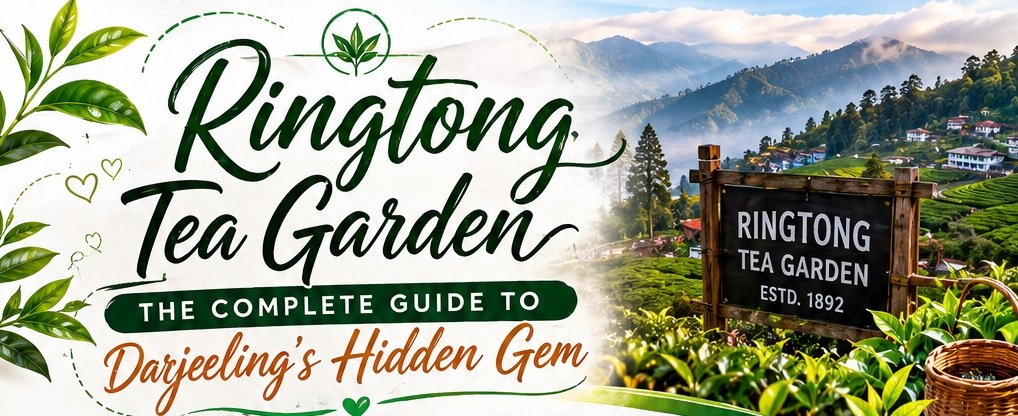
Ringtong Tea Garden: The Complete Guide to Darjeeling’s Hidden Gem
By TeaFlush.com | Updated: June 2026
“Where the first morning bell rings across misty Himalayan slopes, the world’s finest leaves are born.”
If you’re a Darjeeling tea enthusiast, you’ve likely heard whispers of Ringtong Tea Garden — one of the oldest, most storied, and lately one of the most celebrated estates in the Darjeeling hills. From its dramatic rebirth after a devastating fire to its Rainforest Alliance-certified teas beloved by connoisseurs from London to Tokyo, Ringtong is a name that demands attention. In this complete guide, we cover everything you need to know — its history, location, elevation, cultivars, seasonal flushes, flavour profiles, certifications, and how to brew Ringtong tea to perfection.
Table of Contents
What is Ringtong Tea Garden?
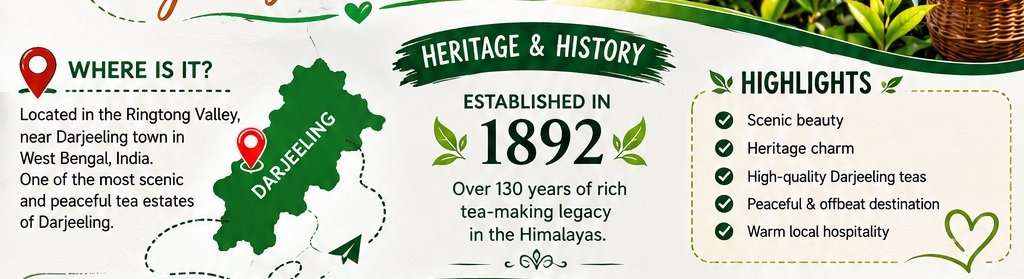
Ringtong Tea Garden is a historic single-estate tea garden located in the Sonada Valley of the Darjeeling hills, West Bengal, India. Established in 1865, it ranks among the oldest tea plantations in all of Darjeeling — a region that has earned global fame for producing what many call the “Champagne of teas.”
Situated on southwest-facing slopes spanning approximately 338 hectares, the garden sits between two legendary neighbours — Margaret’s Hope and Balason — in the northern Kurseong Valley. Administratively, it falls under the Sukhiapokhri–Jorbunglow division and is officially listed under the Darjeeling Tea growing region, meaning its teas carry the coveted Darjeeling GI (Geographical Indication) certification.
In recent years, Ringtong has risen from relative obscurity to become a garden to watch in the global specialty tea world. Its teas have found admirers among royalty, connoisseurs, and everyday tea lovers alike.
The Meaning Behind the Name
The name Ringtong carries beautiful symbolism. It is derived from the association with the “first morning bell” — the bell that rings across the tea fields at the break of dawn, calling workers to begin a new day of plucking and cultivation.
This poetic origin perfectly captures the spirit of the estate: a place where every day begins with the chime of tradition, purpose, and an unwavering dedication to craft. Interestingly, the former name of the nearby Margaret’s Hope estate was once Bara Ringtong — a historical connection that adds another layer of mystique to the name.
Location & Geography
| Detail | Information |
|---|---|
| Region | Sonada Valley, Darjeeling, West Bengal, India |
| District | Darjiling (Darjeeling) |
| Sub-division | Sukhiapokhri–Jorbunglow |
| Distance from Darjeeling Town | ~16 km |
| Nearest Town | Sonada (~1,850 m elevation) |
| Area | ~338 hectares |
| Pincode | 734224 |
| Neighbouring Estates | Margaret’s Hope, Balason |
| Valley | Northern Kurseong Valley (“Land of Orchids”) |
Ringtong sits along the legendary Hill Cart Road (National Highway 110), which winds northward from the plains of Siliguri through Kurseong and Sonada to Darjeeling town. The estate’s southwest-facing slopes catch a particularly favourable combination of sunlight, mist, and mountain air — all essential elements in crafting Darjeeling’s legendary muscatel character.
The surrounding Himalayan landscape, with views stretching toward Kangchenjunga (the world’s third-highest mountain), makes Ringtong not just a source of exceptional tea but also a breathtaking destination.
Elevation & Terroir
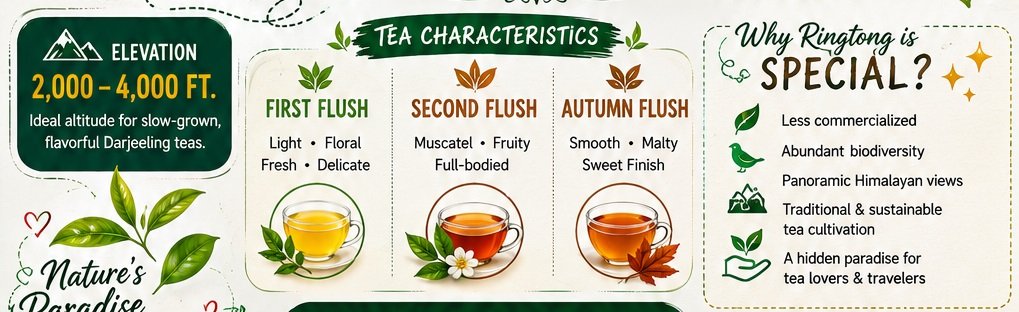
Ringtong’s teas are grown at elevations ranging from 1,000 to 1,700 metres above sea level (approximately 3,200 to 5,600 feet). This high-altitude growing environment is one of the defining factors behind the garden’s extraordinary flavour profile.
At these heights:
- Temperatures are cooler, causing tea leaves to grow more slowly and develop concentrated flavour compounds
- Mist and cloud cover are frequent, providing natural shade that enhances the delicacy of the leaf
- Diurnal temperature variation (the difference between day and night temperatures) is significant, which is key to the development of muscatel notes
- Well-drained Himalayan soils add mineral complexity to the cup
These conditions create what tea experts call terroir — the unique combination of soil, climate, altitude, and geography that gives Ringtong tea its unmistakable character. No other tea grown anywhere else in the world can replicate it.
History of Ringtong Tea Garden
Ringtong Tea Garden’s story begins in 1865, during the height of the British colonial era in India when Darjeeling’s mountain slopes were rapidly being converted into tea estates. At the time, Scottish botanist Robert Fortune had already smuggled tea saplings from China’s Zhejiang, Anhui, and Fujian provinces between 1849 and 1850 — planting the seeds (quite literally) of Darjeeling’s China cultivar legacy.
Ringtong was established with these same China-variety (Chinary) bushes, making it one of the early estates to cultivate the cultivar that would come to define Darjeeling tea’s muscatel character. For over a century, the garden produced teas that were quietly celebrated, though little documented history survives from those early decades.
Through the late 19th and most of the 20th century, Ringtong operated as a functional but relatively low-profile estate — a stark contrast to the fame it would eventually achieve after its modern revival.
The Fire, Closure & Glorious Revival (1996–2014)
In 1996, tragedy struck. A devastating fire destroyed Ringtong’s tea factory, bringing the entire operation to a halt. The garden fell dormant for nearly two decades — an entire generation during which the Darjeling tea world moved on without it.
Then, in January 2014, Ringtong was reborn.
Ringtong Tea Company Pvt Ltd, under the leadership of Kavita and Sanjay Choudhry, breathed new life into the estate. The new management didn’t simply restore what had been lost — they reimagined it. Their approach was built on high-quality specifications, sustainable cultivation practices, and a commitment to single-estate integrity that would eventually earn them international recognition.
The revival of Ringtong is one of the great comeback stories in the world of specialty tea. Within a decade of reopening, the garden began earning acclaim from critics, connoisseurs, and retailers worldwide — becoming what respected tea writer Terry Theise has called “a garden to watch” after praising Ringtong’s 2025 second flush as a “powerhouse” offering “plenty of satisfaction for lovers of in-your-face teas.”
Ownership & Management
Ringtong Tea Garden is owned and operated by Ringtong Tea Company Private Limited, led by Kavita Choudhry and Sanjay Choudhry, who have managed the estate since 2012/2014. Under their stewardship, the garden has pursued a philosophy grounded in:
- Artisan quality over mass production
- Sustainable farming practices
- Traceable, single-estate teas with full transparency
- Hand-plucking standards for leaf integrity
This owner-operated model — rare in a Darjeeling industry often dominated by large conglomerates — gives Ringtong the nimbleness to experiment with harvests, innovate in the factory, and respond to the evolving palates of the global tea community.
Tea Cultivars: The China Chinary Bush
One of Ringtong’s most distinctive features is its predominance of China cultivar (Chinary) bushes, designated by the letters CH in tea grade descriptions. These ancient cultivars trace directly back to the original saplings smuggled from China in the mid-19th century.
The China bush produces smaller, more delicate leaves than the Assam hybrid varieties used in many other gardens. They are:
- Slower-growing, allowing more flavour concentration per leaf
- More aromatic, with a natural tendency toward floral, muscatel, and fruity notes
- Lower in caffeine compared to Assam hybrids
- Sensitive to terroir — making location and altitude even more critical to the final cup
This genetic heritage is one reason why Ringtong teas — particularly their second flush muscatels — have such remarkable complexity and depth. The Chinary bush is the soul of classic Darjeeling tea, and Ringtong’s slopes are rich with it.
The Flushes of Ringtong Tea Garden
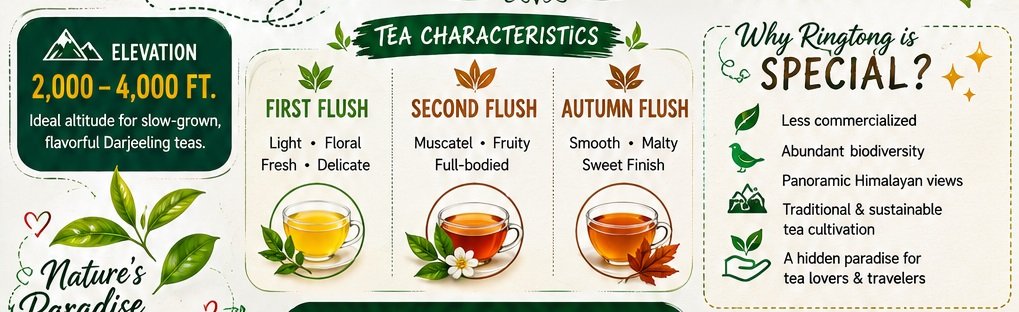
Like all Darjeeling estates, Ringtong produces teas across three main seasonal harvests, each with its own distinct character.
First Flush (Spring)
Season: March – April
The first flush is the most anticipated harvest of the year — the first plucking after winter dormancy, when tea bushes burst forth with tender new growth.
Ringtong’s first flush is processed in the modern Darjeeling first flush style, focused on preserving the spring character of the leaf. Freshly picked leaves (hand-plucked in a 1 bud + 2 leaves standard) are left to wither overnight inside the factory building, gently turned by hand multiple times to ensure even drying while keeping leaf surfaces intact. The withering reduces astringency and concentrates aroma. Oxidation is minimal — typically just 5 to 10 minutes — preserving the leaf’s fresh, green qualities.
What it looks like: Curly, medium-sized leaves in a grassy green sheen, dotted with silvery buds that release rich floral notes over a crisp citrus zest.
What it tastes like: A golden-yellow infusion with captivating scents of fresh flowers and delicately sweet notes. On the palate, harmonious nuances of muscatel with gentle grassy undertones create a deliciously complex, spring-fresh profile. The “Ringtong Delight” first flush — the estate’s flagship spring offering — is considered one of the finest first flush productions in all of Darjeeling, celebrated for its distinct fresh orange-citrus character and smooth, substantial body.
Second Flush (Summer)
Season: May – June
Many experts consider Ringtong’s second flush the crown jewel of the garden’s output. Summer brings warmer temperatures and the distinctive “green fly” (Jacobiasca formosana) — a leafhopper whose gentle feeding on the tea leaves triggers a biochemical response that creates the hallmark muscatel flavour, a character unique to Darjeeling.
Leaves are plucked to the 2 leaf + 1 bud standard at peak maturity. The longer growing period and higher oxidation result in a dramatically different cup from the first flush.
What it looks like: Brown tea leaves of varying shades contrasting beautifully with silvery, fine-haired buds — a visual testament to artisan processing.
What it tastes like: A deep copper-red infusion with an intensely seductive aroma. Ringtong’s second flush delivers powerful malt and muscatel notes, layered with ripe summer fruits and perfectly balanced by hints of honey and nuts. A subtle astringency weaves through the cup, providing structure, before giving way to a slightly spicy, lingering finish that continues to dance on the tongue long after the last sip.
As reviewed by Terry Theise in his acclaimed 2025 Summer Flush report: Ringtong is “a garden to watch” — its invoices from Tea Emporium and Nathmull’s described as “powerhouses” — with the Tea Emporium offering possessing “an extra dimension of richness.”
Autumnal Flush
Season: October – November
As summer transitions to autumn, the character of Ringtong’s teas shifts dramatically. The pronounced muscatel notes of summer give way to a softer, more introspective flavour pattern.
What it tastes like: Spicy, complex malty and roast notes take centre stage. The autumnal has lower caffeine than the summer flush, making it a particularly pleasant companion for long autumn evenings. The FTGFOP1 grade — the highest quality designation — is achieved for Ringtong’s autumnal picking, reflecting both the natural character of the late season and the artistry of those harvesting and processing the leaves.
Flavour Profiles: What Does Ringtong Tea Taste Like?
Here’s a quick reference guide to Ringtong’s flavour language across its flushes:
| Flush | Liquor Colour | Aroma | Primary Flavours | Finish |
|---|---|---|---|---|
| First Flush | Golden yellow | Fresh flowers, citrus zest | Muscatel, grassy, orange-citrus, floral nectar | Clean, light, spring-fresh |
| Second Flush | Deep copper-red | Malt, muscatel, ripe fruits | Muscatel, summer fruits, honey, nuts | Spicy, lingering, slightly astringent |
| Autumnal | Warm amber | Malt, roast, spice | Malt, roast, spice, subtle sweetness | Soft, mellow, warming |
Certifications & Sustainability
Ringtong Tea Garden holds two important certifications that speak to both its quality commitment and its environmental stewardship:
1. Rainforest Alliance Certification Awarded after the post-2014 revival, the Rainforest Alliance certification confirms that Ringtong adheres to rigorous standards for sustainable agriculture, including protection of biodiversity, responsible water use, worker welfare, and ethical business practices. This globally recognised certification has become a hallmark of Ringtong’s modern identity.
2. ISO 9002 Certification Ringtong is an ISO 9002-certified company, affirming the garden’s commitment to quality management systems across every stage of its production — from plucking to processing to packaging.
Together, these certifications make Ringtong tea a choice you can feel good about — not just because it tastes extraordinary, but because it is grown with integrity.
Visiting Ringtong Tea Garden
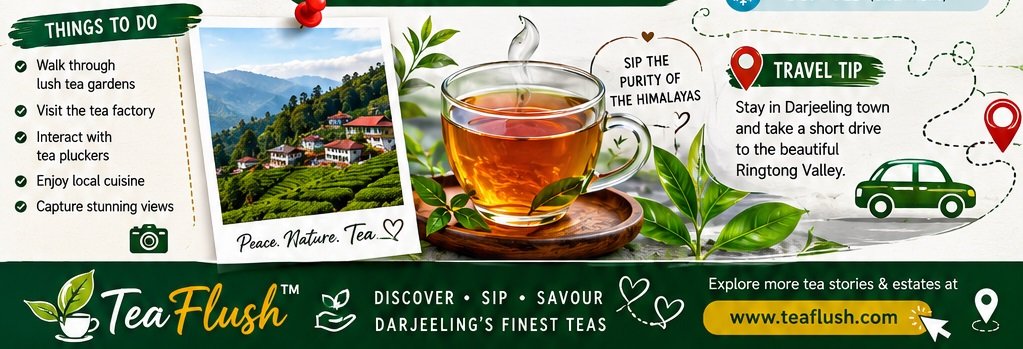
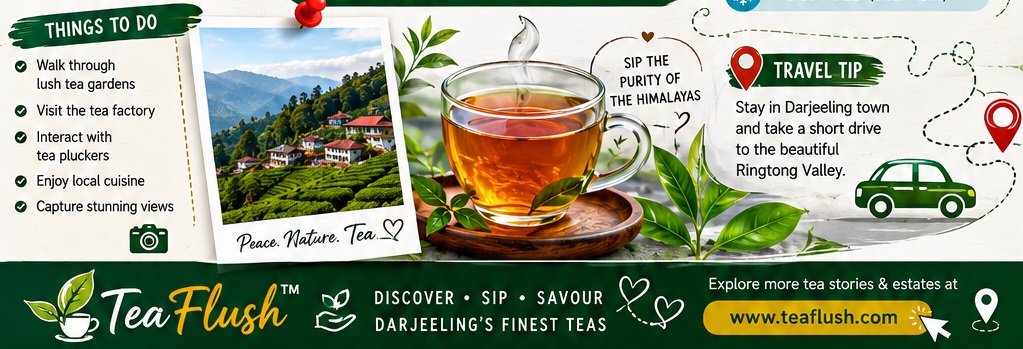
Tea tourism is growing across Darjeeling, and Ringtong welcomes visitors who want to experience the magic of a working tea estate firsthand.
What to expect on a visit:
- Guided tours of the plantation, covering cultivation techniques and the story of the estate’s revival
- Insight into tea processing — witnessing firsthand how artisan quality is achieved, from withering to rolling to drying
- Tasting sessions showcasing the garden’s seasonal teas
- Breathtaking views of the surrounding Himalayan mountains and verdant valleys — Ringtong’s panoramas of the Kangchenjunga range are simply unforgettable
How to get there: Ringtong is located approximately 16 km from Darjeeling town, accessible via the Hill Cart Road (NH 110) through Sonada. The nearest major city is Siliguri, approximately 65–70 km away. The nearest railway station is New Jalpaiguri (NJP). Local taxis and jeep-sharing services are the primary modes of transport from Darjeeling town to Sonada.
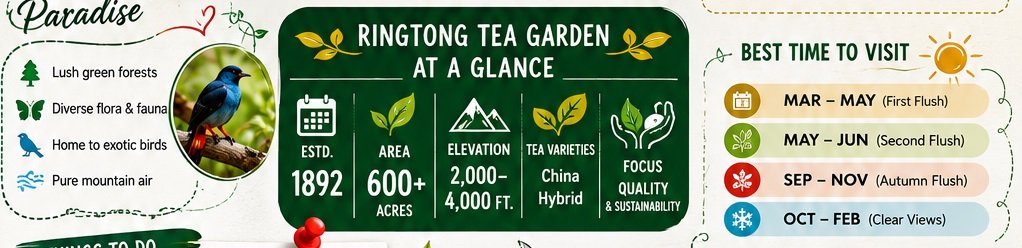
Best time to visit: Spring (March–April) for the first flush harvest, or summer (May–June) for the magical second flush muscatel season — when the garden is alive with activity, colour, and the intoxicating scent of fresh tea.
How to Brew Ringtong Tea
Getting the most from a Ringtong tea requires attention to a few simple parameters. Here are the recommended brewing guidelines:
First Flush & Second Flush (Black Tea)
| Parameter | Recommendation |
|---|---|
| Water Temperature | 90°C – 100°C |
| Amount of Leaf | 2–3 grams per 100 ml of water |
| Steep Time | 1–2 minutes (first flush) / 2–3 minutes (second flush) |
| Number of Infusions | 2–3 infusions possible |
| Vessel | Porcelain or glass teapot / infuser |
| Water | Filtered or spring water for best results |
Pro Tips from TeaFlush:
- Avoid over-steeping — Darjeeling teas, especially Ringtong’s delicate first flush, can turn astringent quickly
- Enjoy the first flush without milk to fully appreciate its floral complexity
- The second flush can be enjoyed with a small splash of milk, though purists prefer it black to appreciate the full muscatel profile
- Multiple infusions are encouraged — Ringtong’s high-quality whole leaves perform admirably on a second and even third steep
Where to Buy Ringtong Tea
Ringtong tea is available through several reputable online retailers who source directly from the estate each season:
- Teabox — offers fresh seasonal invoices of Ringtong’s first flush and second flush
- Siam Tea Shop — carries an excellent range including first flush Spring Blessing and second flush FTGFOP1
- Darjeeling Tea Boutique — stocks Ringtong muscatels and seasonal editions
- Nathmull’s — one of Darjeeling’s oldest tea merchants, known for their Ringtong second flush invoices
- Parchmen & Co — offers the Chinary-grade Ringtong SFTGFOP1 CH RFA
- Mayukh Tea — carries the acclaimed “Ringtong Delight” first flush
TeaFlush Tip: Look for teas labelled with “CH” (China cultivar) and “RFA” (Rainforest Alliance) in the grade description for authentic, certified Ringtong estate teas. Fresh seasonal invoices typically become available in March–April (first flush) and May–July (second flush).
Ringtong vs. Other Darjeeling Estates
How does Ringtong compare to some of Darjeeling’s other celebrated gardens?
| Estate | Known For | Character vs. Ringtong |
|---|---|---|
| Margaret’s Hope | Muscatel second flush | Similar muscatel profile; Margaret’s Hope often fruitier |
| Castleton | World-famous muscatel, auction records | Castleton tends to be richer, heavier; Ringtong more balanced |
| Jungpana | Intense floral first flush | Jungpana more delicate floral; Ringtong has more body |
| Arya | Clonal teas (Ruby, Diamond) | Arya is more experimental; Ringtong is classically Chinary |
| Makaibari | Pioneer of organic/biodynamic Darjeeling | Makaibari is entirely organic; Ringtong is Rainforest Alliance certified |
Ringtong’s distinct position is as a classically structured, full-flavoured Darjeeling with a Chinary character that rewards both new tea drinkers and seasoned connoisseurs. Its post-revival teas have an energy and quality that outpaces many more famous names.
Frequently Asked Questions
Q: What does “Ringtong” mean?
A: Ringtong means the “first morning bell” — the bell that signals the start of a new working day in the tea fields.
Q: When was Ringtong Tea Garden established? A: The garden was established in 1865, making it one of the oldest tea estates in Darjeeling.
Q: Why did Ringtong Tea Garden close? A: A fire destroyed the tea factory in 1996, leading to the garden’s closure. It was revived in January 2014 by Ringtong Tea Company Pvt Ltd under Kavita and Sanjay Choudhry.
Q: Is Ringtong Tea Garden organic? A: Ringtong is Rainforest Alliance certified, following sustainable agricultural practices. It is also ISO 9002 certified. While not marketed as fully organic, its sustainable farming approach meets rigorous international standards.
Q: What cultivar does Ringtong Tea Garden use? A: The majority of Ringtong’s tea bushes are the China cultivar (Chinary/CH), the same genetic stock smuggled from China by Robert Fortune in 1849–1850 that forms the backbone of classic Darjeeling tea.
Q: What is the best Ringtong tea to try first? A: For first-time buyers, the second flush muscatel is the most iconic and easiest to appreciate. If you prefer delicate, floral teas, start with the first flush “Spring Blessing” invoices.
Q: How many flushes does Ringtong produce? A: Three — First Flush (spring, March–April), Second Flush (summer, May–June), and Autumnal Flush (October–November).
Q: Is Ringtong Tea Garden open to visitors? A: Yes, visitors can tour the plantation, learn about cultivation and processing, attend tastings, and enjoy stunning Himalayan views.
Q: Where is Ringtong Tea Garden located? A: In the Sonada Valley of Darjeeling, West Bengal, approximately 16 km from Darjeeling town, in the Sukhiapokhri–Jorbunglow administrative division.
Final Thoughts
Ringtong Tea Garden is more than a tea estate — it is a story of resilience, craft, and the enduring magic of Darjeeling’s hills. From its founding in 1865 through decades of quiet operation, through the tragedy of a factory fire and two decades of dormancy, to its triumphant revival in 2014, Ringtong has emerged as one of the most exciting and celebrated gardens in contemporary Darjeeling.
Its teas — whether the luminous, flower-kissed first flush or the powerful, muscatel-drenched second flush — carry within them the altitude, the ancient Chinary bushes, the misty Himalayan air, and the story of a garden reborn.
At TeaFlush.com, we believe that every great cup of tea tells a story. Ringtong’s story is one of the finest.
Enjoyed this deep dive into Ringtong Tea Garden? Explore more stories, reviews, and brewing guides from Darjeeling and beyond at TeaFlush.com.
Tags
Ringtong Tea Garden · Darjeeling Tea · Darjeeling First Flush · Darjeeling Second Flush · Muscatel Tea · Darjeeling Tea Garden · China Chinary Cultivar · Rainforest Alliance Tea · Single Estate Tea · Sonada Valley Tea · Indian Tea · TeaFlush
© 2026 TeaFlush.com — All rights reserved. For educational and informational purposes.