Published on TeaFlush.com | Your Complete Tea Resource
There are teas that are fashionable. There are teas that are celebrated. And then there is English Breakfast Tea — a tea so embedded in daily life, so central to morning ritual, so fundamentally British in its identity, that in England, it is simply referred to as “a cup of tea.”
No qualifier needed. When an English person says they are putting the kettle on, this is the tea they mean.
English Breakfast Tea is the most consumed tea in the United Kingdom, the most widely recognised tea blend in the world, and — despite its modest, everyday reputation — a tea with an extraordinary and frequently misunderstood history, a complex blend composition that varies by brand and region, a robust set of science-backed health benefits, and a brewing art that most people, even dedicated tea drinkers, have never fully explored.
This guide covers all of it. From the 1843 New York tea merchant who may have created it, to Queen Victoria’s role in popularising it, to the precise differences between Assam, Ceylon, and Keemun components, to the L-theanine science that explains why your morning cup feels so differently from your morning coffee — this is the most complete English Breakfast Tea guide you will find.
Welcome to Tea Flush Let us begin.
Table of Contents
What Is English Breakfast Tea?
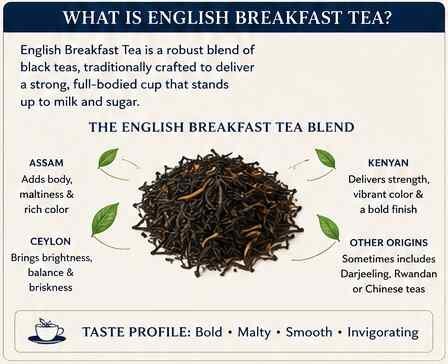
English Breakfast Tea is a strong, full-bodied black tea blend traditionally associated with British culture. The name “English Breakfast” refers to the tea’s historical connection to hearty British breakfasts, which were designed to complement the robust nature of the tea. English Breakfast Tea is typically made from a blend of black teas sourced from different regions, most commonly from India, Sri Lanka, and Africa.
But to call it simply a “blend of black teas” is to undersell what makes English Breakfast remarkable. It is a blend designed with intention — one where multiple teas from different growing regions contribute specific, complementary characteristics that, together, produce something greater than any single-origin tea could achieve alone:
- Assam provides the bold, malty backbone and the deep amber colour
- Ceylon (Sri Lanka) adds brightness, freshness, and a clean briskness
- Kenya contributes strength, colour, and a smooth earthiness
- Keemun (China) — in some blends — adds a distinctive winey depth and floral character
The genius of the blend is that it is simultaneously strong enough to cut through milk, complex enough to be interesting plain, and consistent enough to taste reliably “right” every single morning — regardless of the season, the weather, or the tea drinker’s mood.
No Fixed Recipe
There’s no single set recipe to make an English Breakfast tea blend. Breakfast tea is more of a feeling: a bold, brisk black tea designed to start your day right.
This absence of a fixed recipe is both what makes English Breakfast Tea fascinating and what makes buying it confusing. Different brands, different regions, and different tea masters create their own blends under the same name — sometimes radically different from one another. A Twinings English Breakfast, a Yorkshire Tea, a Fortnum & Mason English Breakfast, and an independent artisan blend may share the same name while offering quite different experiences.
Understanding the components — and knowing what to look for — allows you to find the English Breakfast that is truly your English Breakfast.
Part 1: The History of English Breakfast Tea
The history of English Breakfast Tea is a story of unexpected origins, colonial ambition, royal endorsement, and an accidental New World creation that crossed an ocean to define a nation’s morning ritual.
Tea Arrives in Britain: Catherine of Braganza, 1662
The story of how tea became Britain’s national drink is quite fascinating. It all started when Catherine of Braganza arrived from Portugal to marry Charles II in the 1600s, bringing with her an absolute love for tea. Back then, tea was an exotic luxury, a beverage that most Brits had never tasted — a fact that might seem unimaginable in today’s tea-loving Britain! Due to her influence, Catherine’s passion for tea swiftly made it the drink of choice among the aristocracy. By the 1700s, tea became a part of everyday life for all Britons. What began as a royal preference became a daily ritual deeply ingrained in British life and culture.
This is the foundational origin story of British tea culture. Tea did not begin as the working-class morning beverage we associate with it today — it arrived in England as an aristocratic luxury, carried by a Portuguese princess. The transformation from royal novelty to national necessity took roughly a century, driven by the British East India Company’s aggressive trade expansion and the gradual reduction in tea prices as supply increased.
The East India Company and the Tea Empire
The British East India Company’s dominance of Asian trade routes gave Britain unparalleled access to tea — first from China, then increasingly from India and Ceylon as the Company established and expanded its own colonial tea plantations from the 1840s onwards.
English Breakfast was introduced to America by the British East India Company.
The Company’s commercial interests directly shaped what “English Breakfast Tea” would become: a blend specifically engineered from teas grown within the British colonial sphere — Assam in India, Ceylon in Sri Lanka, and eventually Kenya in East Africa.
The Scottish Origin Story: Robert Drysdale and the Breakfast Blend
Here is the detail that surprises most people: the concept of “Breakfast Tea” — a strong black tea blend designed specifically to accompany the morning meal — may not have originated in England at all.
Robert Drysdale in Edinburgh developed a strong black tea blend and marketed it as a breakfast beverage. The story goes that Queen Victoria brought some of this blend from Scotland back to England, so the concept of English Breakfast tea was born.
Robert Drysdale of Edinburgh created a robust morning tea blend in the mid-19th century and marketed it as a breakfast accompaniment. When Queen Victoria tasted it during one of her regular visits to Scotland — where she spent considerable time at Balmoral Castle — she reportedly loved it so much that she brought it back to the English court, where it quickly spread through aristocratic circles and was subsequently named “English Breakfast Tea.”
This story, if accurate, means Britain’s most quintessentially English tea was actually a Scottish invention. A delightfully inconvenient historical irony.
The New York Origin: Richard Davies, 1843
The most thoroughly documented historical account of English Breakfast Tea’s origins places it not in England or Scotland, but in New York City.
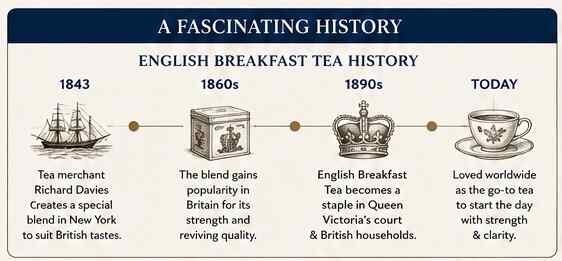
An additional account (referencing a period-era Journal of Commerce article) dates the blend to 1843 and a tea merchant named Richard Davies in New York City. Davies, an English immigrant, started with a base of Congou and added a bit of Pekoe and Pouchong. It sold for 50 cents per pound (equivalent to $16.87 per pound in 2024), and its success led to imitators, helping to popularize the name.
Richard Davies — an English-born tea merchant operating in New York — created a blend of Congou (a Chinese black tea), Pekoe, and Pouchong and sold it as “English Breakfast Tea.” The blend was commercially successful, inspired imitators, and the name spread. Given Davies’ English background, the name was both a marketing nod to his heritage and an accurate descriptor of the tea’s intended use: a strong, invigorating brew to accompany the morning meal.
Popularized by Queen Victoria, English Breakfast was created to be a hearty black tea blend which is complemented by cream and sugar. Invented in 1843, the blend is comprised from tea gardens across the British Empire, including Assam (India), British Ceylon (Sri Lanka), and Kenya.
The Victorian Popularisation
However English Breakfast Tea came to exist — whether through Drysdale’s Edinburgh blend, Davies’ New York creation, or a combination of both origins feeding off each other — its popularisation in Britain is strongly linked to Queen Victoria’s reign (1837–1901). The Queen’s endorsement of specific teas, blends, and tea rituals had an extraordinary influence on aristocratic and eventually mass tea culture.
The Victorian era also coincided with the dramatic expansion of India’s tea industry — particularly Assam, where large-scale commercial tea cultivation began in the 1840s and grew explosively through the latter half of the 19th century. Assam tea’s bold, malty character became the backbone of the English Breakfast blend, while Ceylon tea — developed after a catastrophic coffee blight destroyed Ceylon’s coffee industry in the 1870s and forced a rapid conversion to tea — added brightness and body.
The 20th Century: From Class Marker to National Institution
Through the early 20th century, tea drinking in Britain democratised completely. What had begun as an aristocratic luxury became a working-class staple — the morning cup that started the factory shift, the afternoon break that punctuated the working day, and the pot that was put on in every domestic crisis from bereavement to power cuts to the announcement of war.
During both World Wars, tea was so essential to British morale and productivity that it was rationed — and the government went to extraordinary lengths to ensure its supply continued. Tea was considered not a luxury but a functional necessity.
English Breakfast Tea — robust, reliable, comforting, and perfect with milk — became the embodiment of this national tea culture.
Part 2: What Goes Into English Breakfast Tea — The Blend Components
Understanding English Breakfast Tea means understanding the individual teas that are blended to create it. Each component contributes specific characteristics that together produce the classic English Breakfast profile.
🍵 Assam Tea (India) — The Bold Backbone
Origin: Assam Valley, northeastern India
Cultivar: Camellia sinensis var. assamica
Processing: CTC (Crush-Tear-Curl) or orthodox
Character: Bold, malty, full-bodied, deep amber colour
Assam is the workhorse of the English Breakfast blend and usually its largest component by proportion. Grown at low altitude in the hot, humid Brahmaputra Valley — the world’s largest tea-growing region — Assam tea is processed using the CTC method that produces small, uniform pellets that brew quickly, strongly, and consistently.
Assam provides:
- The malty, robust base that gives English Breakfast its characteristic depth
- The deep amber to dark brown colour that makes the brew visually distinctive
- The body that allows it to stand up to milk without being diluted
- The caffeine punch that makes it an effective morning energiser
Finding malty Assam tea too strong, they started blending it with milder teas for a more balanced brew. This is the origin story of the English Breakfast blend in miniature — Assam alone was too intense for everyday British tastes, but its bold character needed to form the core of any serious breakfast tea.
🍵 Ceylon Tea (Sri Lanka) — Brightness and Briskness
Origin: Sri Lanka (formerly British Ceylon)
Cultivar: Camellia sinensis var. sinensis (and hybrids)
Character: Bright, clean, brisk, fruity, medium body
Ceylon tea — grown in Sri Lanka’s central highlands at varying altitudes — contributes the brightness and briskness that prevents English Breakfast from feeling heavy or oppressive. Its cleaner, more citrusy character lifts the blend and gives it the refreshing quality that makes the second and third cup as enjoyable as the first.
Ceylon provides:
- Brightness and freshness — a clean, lively quality
- Briskness — the characteristic “bite” of a well-made black tea
- Citrus and floral notes — softening the intensity of Assam
- Lighter body — balancing Assam’s heaviness
The best Ceylon teas for English Breakfast blends come from the Uva and Dimbula regions of Sri Lanka, where altitude, temperature variation, and specific soil conditions produce teas with exceptional brightness and a characteristic “coppery” liquor.
🍵 Kenyan Tea — Strength, Colour, and Consistency
Origin: Kenya (primarily the Rift Valley highlands)
Processing: Mostly CTC
Character: Strong, bold, bright, deeply coloured, full-bodied
Kenya became a major tea-producing nation in the 20th century, and Kenyan teas — processed almost exclusively using the CTC method — are among the strongest, most consistent, and most colourful teas in the world. They produce a very dark, almost burgundy liquor and an exceptionally strong brew.
English breakfast tea is a traditional blend of black teas originating from Assam, Ceylon and Kenya.
Kenyan tea provides:
- Deep colour — the characteristic rich amber of a well-made English Breakfast
- Strength — ensuring the tea remains robust even when diluted with milk
- Consistency — Kenyan CTC teas are highly standardised, providing blenders with reliable, predictable raw material
- Affordability — enabling mass-market brands to produce reliable quality at accessible prices
🍵 Keemun Tea (China) — Depth, Winey Character, and Complexity
Origin: Qimen (Keemun), Anhui province, China
Processing: Orthodox
Character: Winey, fruity, floral, slightly smoky, complex
Keemun is used in English Breakfast blends less universally than Assam, Ceylon, or Kenya — but it is the component that adds the most distinctive character when present.
Although some say it’s the base for a classic blend, Keemun teas from China are not always used; American blenders tend to use them more.
Keemun provides:
- Winey, fruity depth — a distinctly Chinese character that adds complexity
- Floral notes — a delicate orchid-like fragrance
- Slight smokiness — earthiness that adds intrigue
- Reduced astringency — Keemun is naturally lower in tannins, smoothing the blend
Classic British blends from Twinings and Fortnum & Mason traditionally included a significant Keemun component, giving older English Breakfast recipes a more complex, wine-like depth. Many modern mass-market blends have reduced or eliminated Keemun, replacing it with more affordable Assam and Kenya — a cost-driven decision that has subtly changed what “English Breakfast” tastes like over the decades.
Part 3: English Breakfast vs. Irish Breakfast vs. Scottish Breakfast
English Breakfast Tea is part of a family of “breakfast tea” blends — each originating from the British Isles but with distinct character differences.
| Feature | English Breakfast | Irish Breakfast | Scottish Breakfast |
|---|---|---|---|
| Primary Component | Assam + Ceylon + Kenya (balanced) | Assam-heavy | Assam-heavy (strongest overall) |
| Keemun? | Often yes | Rarely | Rarely |
| Body | Full but balanced | Very full, hearty | Full to very full |
| Strength | Medium-strong | Strong to very strong | Very strong |
| Colour | Deep amber | Very dark amber | Very dark |
| Flavour | Balanced, malty, bright | Robust, malty, bold | Boldest, most intense |
| With milk? | Yes | Almost always | Almost always |
| Best time | Morning | Specifically breakfast | Specifically breakfast |
| Character summary | Versatile all-day tea | The builder’s tea | Seriously strong |
Irish Breakfast Tea uses Assam tea, providing a more robust tea. If English Breakfast is a fortissimo, Irish Breakfast is a fortissimo with pedal down, and Scottish Breakfast turns the amplifier up further still. For those who find English Breakfast slightly too refined, the Irish and Scottish variants offer a more uncompromising experience.
Part 4: The Flavor Profile of English Breakfast Tea
What Does English Breakfast Tea Taste Like?
English Breakfast tea is also known for its smooth, full-bodied flavor with floral undertones, pairing well with a full English breakfast or a simple piece of toast.
Let us break down the full sensory profile in detail:
Dry Leaf Appearance Most English Breakfast teas use a blend of CTC (Crush-Tear-Curl) pellets from Assam and Kenya, sometimes mixed with orthodox broken-leaf Ceylon. The dry leaves are dark brown to black, small and uniform if CTC-dominated, or slightly larger and more irregular if orthodox components are included. High-quality artisan blends may show more variation and visible leaf structure. A rich, malty aroma rises from the dry leaf.
Liquor Colour Deep amber to rich copper-brown — one of the most immediately recognisable and satisfying colours in the tea world. Held to light, a well-brewed English Breakfast liquor glows with warm amber depth. Add milk and it transforms to a creamy, warm caramel tone that is deeply comforting.
Aroma Rich, warm, and inviting — the aroma is the first promise of the morning cup. Dominant notes are:
- Malt — the signature Assam backbone; warm, bready, comforting
- Earthiness — grounded and familiar
- Light floral — particularly in blends with Keemun or high-quality Ceylon
- A hint of fruit — dried fruit, sometimes subtle raisin or plum
Flavour Bold, full-bodied, and satisfying — designed to be enjoyed rather than analysed. The flavour unfolds as:
- Entry: Immediate, assertive — the malty Assam quality arrives first
- Mid-palate: Warm depth, slight astringency, earthy richness
- Finish: Clean briskness from the Ceylon component; lingering malty warmth
When drunk plain, there is a pleasant, natural sweetness to quality English Breakfast — particularly in blends with Keemun or high-grade Ceylon. The astringency is present but not harsh; it is the clean, refreshing kind that makes the next sip welcome.
With Milk Adding a small amount of whole milk — about 20–30 ml per 240 ml cup — transforms the experience: softening the astringency, amplifying the malty sweetness, and creating the creamy, warming character that generations of British people have associated with comfort, reliability, and home.
Mouthfeel Full-bodied and satisfying — the kind of mouthfeel that justifies the word “hearty.” Not as light as a Darjeeling, not as tannic as an old-growth Assam, but confidently, warmly full. The sort of tea that feels like it is doing something for you.
How English Breakfast Compares to Other Famous Teas
| Tea | Body | Flavour | Milk? | Best Time | Character |
|---|---|---|---|---|---|
| English Breakfast | Full | Malty, bold, balanced | Yes | Morning | Dependable, comforting, versatile |
| Earl Grey | Medium | Floral, bergamot, citrus | Optional | Afternoon | Elegant, aromatic, distinctive |
| Darjeeling First Flush | Light | Floral, delicate, complex | Never | Morning | Refined, seasonal, nuanced |
| Assam Single Estate | Very full | Intensely malty, robust | Yes | Morning | Powerful, straightforward |
| Ceylon Single Estate | Medium | Bright, fruity, brisk | Optional | Afternoon | Fresh, clean, versatile |
| Oolong | Medium | Floral, fruity, complex | No | Afternoon | Nuanced, layered, Asian |
| Green Tea | Light | Grassy, vegetal, fresh | Never | Any time | Delicate, health-forward |
Part 5: The Health Benefits of English Breakfast Tea
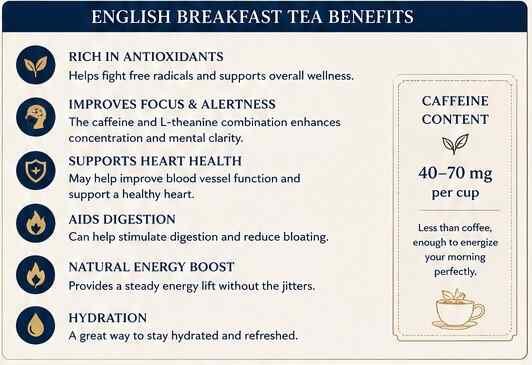
English Breakfast Tea is more than a morning ritual — it is a genuinely health-supporting beverage, backed by a substantial body of nutritional research. Black teas have a whole army of antioxidants — catechins, theaflavins, thearubigins are groups of polyphenols that are a type of antioxidant, all found abundantly in black teas. And since English Breakfast tea is basically made up of a number of black tea variants, it is a great source of antioxidants that promotes the overall health of a person with time.
Here is a detailed breakdown of every major health benefit:
1. Powerful Antioxidant Protection
Think of the antioxidants inside — a group of compounds known as flavonoids — as your body’s personal defence team. As you go about your day, your cells face all sorts of little stresses, and these flavonoids are there to help protect them from damage. Two key players in your brew make all the difference: Flavonoids, which are celebrated for helping to keep your heart and circulatory system in good nick by supporting healthy blood vessels, and theaflavins and thearubigins — formed from catechins as the leaves oxidise — the real heroes behind the rich, amber colour and robust flavour of your English Breakfast tea. They are also antioxidant powerhouses in their own right.
These antioxidants — particularly theaflavins and thearubigins, which are unique to black tea and form during the oxidation process — neutralise free radicals, reduce oxidative stress, and protect cells from damage linked to ageing, inflammation, and chronic disease.
2. Heart Health Support
A 2003 study suggests that drinking black tea can reduce LDL (bad) cholesterol in your body by about 11%. LDL cholesterol levels get controlled by a lipoprotein that takes cholesterol toward our body’s cells rather than away from it. This ‘bad’ cholesterol needs to get reduced, or otherwise, a person can face the risk of stroke or heart attack. Thankfully, English breakfast tea has extensive amounts of antioxidants like theaflavins and thearubigins that help reduce LDL cholesterol.
English breakfast tea, not just figuratively, but quite literally contributes to healing hearts! Some studies show that it may open up blocked arteries, reducing the risk of a stroke. Black tea also lowers blood glucose and triglyceride levels in the body, promoting overall heart health.
3. Calm Focus Through Caffeine + L-Theanine
This is the defining difference between your morning tea and your morning coffee — and the reason so many people find tea a more comfortable, sustainable morning energiser.
Beyond the antioxidants, English Breakfast tea contains a remarkable amino acid called L-theanine. This is the secret behind that unique feeling of ‘calm alertness’ you only get from tea. While a coffee might give you a sharp jolt of energy, tea offers a much smoother, more sustained lift. L-theanine works in harmony with caffeine, enhancing focus while also promoting a sense of relaxation. It beautifully rounds off the sharp edges of caffeine, helping you sidestep the jitters and the dreaded post-coffee crash.
“L-theanine works alongside caffeine to support a calm but alert state of focus, which is one reason many people find tea provides a gentler lift compared to coffee.”
The science is straightforward: L-theanine increases alpha-wave activity in the brain (associated with relaxed alertness) while caffeine increases beta-wave activity (associated with alertness and focus). Together, they produce a neurological state that is distinct from either compound alone — focused, calm, and sustained. No cortisol spike. No crash. Just steady, comfortable morning clarity.
4. Mental Alertness and Cognitive Function
Flavonoids contained in black teas may improve memory and learning. Ingested in moderation, caffeine can demonstrably improve certain aspects of memory and learning. Since caffeine is a stimulant, it is best taken moderately; black tea has half the caffeine of coffee, which means black tea can act as a gentler way to help us wake up in the morning.
Both beverages had similar effects on alertness and cognitive performance. But the tea had one big advantage over coffee: It had enough caffeine to aid performance, but not so much that it disrupted sleep.
The caffeine in English Breakfast Tea — typically 40–70 mg per cup — is precisely in the range where cognitive benefits are maximised without the anxiety, restlessness, or sleep disruption associated with higher caffeine doses.
5. Gut Health and Digestive Support
Black teas contain polyphenols which make room for the good bacteria in the gut. Plus, English breakfast tea is rich in minerals and vitamins such as potassium and folate which strengthen your body’s natural resistance to diseases, making you less vulnerable.
The theaflavins in black tea act as prebiotics in the large intestine — feeding beneficial bacteria (Bifidobacterium, Lactobacillus) that regulate digestion, immune function, and metabolic health. Regular consumption of black tea has been associated with a more diverse, healthier gut microbiome.
6. Blood Sugar Regulation
The antioxidants like polyphenols in black tea help keep the hormone insulin in check. Insulin is responsible for handling fat storage and glucose in your body. When your body becomes resistant to insulin, it may lead to increased levels of blood sugar, thus causing diabetes. Therefore, make sure to have a cup of English breakfast tea daily, and you will be able to prevent diabetes for a long time.
7. Stress Reduction and Immune Support
Over time, relaxation and stress reduction benefits the entire body. From a boosted immune system to clearer thinking and even slower signs of aging, an ongoing state of calm lends itself to overall wellness in a number of ways. Beginning the day with a cup of English breakfast tea instead of coffee is a wise way to reduce our caffeine intake without giving up a beloved morning ritual.
8. Skin Health and Anti-Ageing
The list of English Breakfast tea skin benefits is a deal sealer! Rich in flavonoids and antioxidants, it does wonders for your skin and overall health. The brews help slow the signs of aging. Black tea, in general, gives you a youthful glow by targeting skin infections and blemishes.
9. Cancer Research: Early Promising Findings
Although more research is needed, English breakfast tea may help fight cancer. Researchers from Rutgers University published a study on the properties of TF-2, a chemical in black tea that can induce cancer cells to self-destruct without harming normal cells in the process. Studies are ongoing, but early findings are promising.
Nutritional Profile at a Glance
| Nutrient / Compound | Per 240 ml unsweetened cup | Benefit |
|---|---|---|
| Calories | 2–5 kcal | Effectively zero-calorie beverage |
| Caffeine | 40–70 mg | Energy, focus, alertness |
| L-Theanine | ~25–30 mg | Calm focus, stress reduction |
| Theaflavins | Significant | Antioxidant, cardiovascular, prebiotic |
| Thearubigins | Significant | Antioxidant, colour, body |
| Catechins | Moderate | Antioxidant, metabolic |
| Potassium | ~88 mg | Electrolyte balance, heart health |
| Flavonoids total | High | Cardiovascular, anti-inflammatory |
| Fluoride | Trace amounts | Dental health |
Note: Adding milk adds calcium, protein, and calories. Adding sugar adds empty calories. Optimal health benefits come from unsweetened or lightly sweetened consumption.
Part 6: English Breakfast Tea vs. Coffee
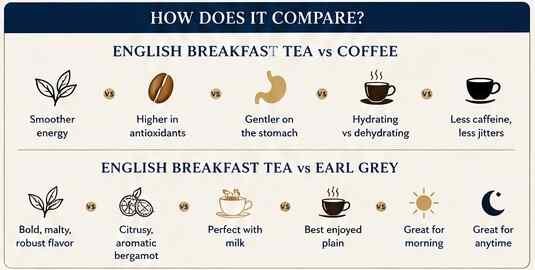
For millions of people, the morning choice is binary: tea or coffee. Here is an honest, science-backed comparison:
| Attribute | English Breakfast Tea | Coffee (drip/filter) |
|---|---|---|
| Caffeine per 240 ml | 40–70 mg | 80–120 mg |
| L-Theanine | Yes (25–30 mg) | None |
| Energy effect | Smooth, sustained, calm | Sharp, intense, sometimes jittery |
| Post-drink crash | Minimal to none | Common |
| Sleep impact | Lower (less caffeine) | Higher, particularly afternoon/evening |
| Antioxidant type | Theaflavins, thearubigins, catechins | Chlorogenic acids, polyphenols |
| Gut health | Prebiotic theaflavins | Some benefits, but also high acidity |
| Stomach acidity | Lower | Higher — can aggravate acid reflux |
| Calories (plain) | ~2–5 kcal | ~2–5 kcal |
| With additions | Milk (moderate cals) | Often milk + flavoured syrups (high cals) |
| Dental health | Moderate tannins | High acidity, enamel concerns |
But technically, black tea has much less caffeine than coffee, therefore, you get to avail the benefits of caffeine without facing the jitters and other disadvantages that come with a larger dose.
They do just as good a job of shaking you out of your sleepy daze and into work mode that coffee does, minus the much-dreaded wave of jitters.
The summary: English Breakfast Tea is not a lesser coffee — it is a genuinely different morning experience. Lower caffeine, the presence of L-theanine, lower acidity, and theaflavin prebiotics make it in many ways the more sophisticated and body-friendly morning option. The trade-off is intensity — if you need a powerful caffeine kick, coffee delivers more. If you want sustained, jitter-free energy with significant health benefits, English Breakfast Tea is the superior choice.
Part 7: How to Brew the Perfect Cup of English Breakfast Tea
English Breakfast Tea rewards correct brewing — but many people have been making the same small errors for years without realising it. Here is the complete, scientific guide to the perfect cup.
The Non-Negotiables
Water quality matters enormously. The flavour of English Breakfast Tea is significantly affected by water hardness and chlorine content. Heavily chlorinated tap water suppresses the malty aromatics and creates a flat, slightly chemical aftertaste. Filtered water or good still mineral water makes a measurable difference.
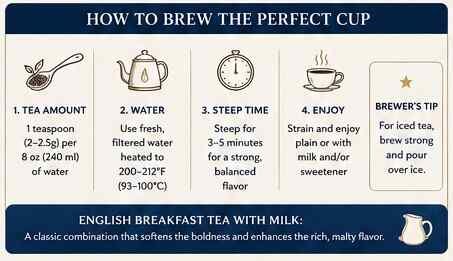
Water temperature: 95–100°C — full boiling. Unlike green tea, white tea, or first flush Darjeeling, which require lower temperatures to avoid bitterness, English Breakfast Tea is a fully oxidised black tea that requires boiling or near-boiling water to extract its full character. Under-temperature water produces a weak, watery, under-extracted cup.
Steeping time: 3–5 minutes. Too short and the cup is weak and watery. Too long (over 5 minutes) and it becomes bitter and over-tannic. 3–4 minutes for a standard strength; 4–5 minutes if you prefer a stronger brew.
Complete Brewing Guide
| Parameter | Recommendation | Why |
|---|---|---|
| Water | Fresh, filtered — soft to neutral | Removes chlorine; preserves malty aromatics |
| Temperature | 95–100°C — full boil | Fully extracts the theaflavins and flavour compounds |
| Tea quantity | 1 teaspoon loose leaf (2–3 g) per 240 ml | Standard strength; adjust to taste |
| Tea bag | 1 bag per 240 ml | Always remove within the steep time |
| Steep time | 3–4 minutes (standard); 4–5 (strong) | 3 min: brighter, lighter; 5 min: bolder, more tannic |
| Pre-warming | Always warm the teapot or cup first | Maintains temperature during steeping |
| Milk | Optional — 20–30 ml whole milk per cup | Add AFTER steeping (not during) |
| Sugar/honey | Optional — 1 teaspoon if desired | Best reduced or eliminated for health benefits |
| Lemon | Optional — a slice or squeeze | Skip milk if adding lemon — they curdle |
The Great Milk Debate: Before or After?
The British debate over whether to add milk before or after pouring the tea is centuries old. The answer, scientifically and practically, is: milk after.
Historically, adding milk first (MIF — Milk In First) was done to protect fine porcelain from thermal shock — when only the wealthy could afford high-quality cups, milk was added first to cool the tea before pouring to prevent the cup from cracking. Today, adding milk after allows you to control the exact amount and observe the tea’s strength before diluting it.
Step-by-Step Brewing Instructions
For the perfect pot of English Breakfast Tea:
- Fill the kettle with fresh, filtered cold water and bring to a full boil
- Pre-warm the teapot — fill with hot water, swirl, and discard
- Measure 1 heaped teaspoon of loose leaf (or 1 tea bag) per 240 ml plus one “for the pot”
- Pour the boiling water immediately — do not let the kettle stand
- Place the lid on the teapot and steep for 4 minutes
- Pour through a fine strainer into a pre-warmed cup
- Add milk if desired — pour tea first, then milk to taste
- Stir gently once if adding milk or sugar
For a single mug (tea bag):
- Boil fresh water
- Pre-warm the mug with hot water, discard
- Add one tea bag
- Pour boiling water immediately
- Steep for 3–4 minutes
- Remove tea bag — do not squeeze (squeezing releases excess tannins and bitterness)
- Add milk to taste
The Biggest Brewing Mistakes
| Mistake | Effect | Fix |
|---|---|---|
| Using water that’s not boiling | Weak, watery, under-extracted cup | Always use freshly boiling water |
| Over-steeping | Harsh, bitter, astringent | Set a timer; remove bag/strain at 4 min |
| Squeezing the tea bag | Bitter, tannic surge at the end | Lift and discard without squeezing |
| Using hard tap water | Flat, chalky flavour | Filter your water |
| Adding milk to green or white tea | Suppresses antioxidants | Only add milk to fully oxidised black teas |
| Using stale tea | Flat, musty, lifeless flavour | Store properly; use within 18–24 months |
| Not pre-warming the pot/cup | Temperature drop kills extraction | Always warm vessels first |
Part 8: Milk, Sugar, Lemon — How to Drink English Breakfast Tea
With Milk
The classic British way. Milk softens the astringency, amplifies the malty sweetness, and creates the warm, creamy character generations of British people associate with comfort and morning.
Which milk works best?
| Milk Type | Effect on English Breakfast |
|---|---|
| Whole milk | Classic — rich, creamy, amplifies malty sweetness |
| Semi-skimmed | Standard UK choice — slightly lighter body |
| Oat milk | Creamy, slightly sweet — excellent plant-based option |
| Almond milk | Lighter, nutty notes — pleasant but thinner body |
| Soy milk | Richer than almond, good body — can slightly curdle with very hot tea |
| Coconut milk | Bold, tropical note — unusual but interesting |
| Condensed milk | Very sweet, very rich — Southeast Asian style |
Plain (No Milk)
English Breakfast without milk is a different but equally valid experience — cleaner, more austere, revealing the tea’s natural flavour complexity more directly. The astringency is more present, the malty depth is more pronounced, and the theaflavin-driven colour is in full display. Many tea connoisseurs prefer it this way.
With Lemon
Adding a slice of fresh lemon or a squeeze of lemon juice — no milk — creates a brighter, more refreshing cup. The citric acid lifts the flavour, reduces perceived astringency, and adds vitamin C. A traditional Eastern European and Middle Eastern way of drinking black tea.
With Sugar or Honey
A small amount of raw sugar or honey softens astringency and makes the malty depth more accessible. Use minimally for health-conscious consumption — or wean yourself off gradually if you have been adding sugar for years. Quality English Breakfast tea from good estates needs no sugar to be satisfying.
Part 9: Food Pairings for English Breakfast Tea
English Breakfast Tea was specifically designed to accompany food — the “Full English” breakfast that gave it its name. But its pairing versatility extends far beyond the morning plate.
The Classic Full English Pairing
The traditional full English breakfast — bacon, eggs, sausage, baked beans, grilled tomatoes, mushrooms, and toast — was the original context for this tea. The bold, malty character cuts through the richness of fried foods, the astringency cleanses the palate between bites, and the milk softens the transition between rich savoury flavours and the tea’s own depth.
Breakfast Pairings
| Food | Why It Works |
|---|---|
| Buttered toast | The simplest, most reliable English Breakfast pairing — malty tea + butter = morning perfection |
| Full English breakfast | The original pairing — bold tea cuts through fried richness |
| Scrambled eggs on toast | Creamy, savoury — tea’s astringency provides clean contrast |
| Porridge with fruit | Wholesome and comforting — tea’s warmth complements perfectly |
| Croissant | Buttery flakiness + malty tea = European-British morning fusion |
| Granola and yoghurt | Fresh, clean contrast to the tea’s depth |
Afternoon and Snack Pairings
| Food | Why It Works |
|---|---|
| Shortbread biscuits | Buttery sweetness balances the tea’s astringency beautifully |
| Fruit cake / bara brith | Rich dried fruit mirrors the malty depth of the tea |
| Victoria sponge | The classic British teatime cake — strawberry jam and cream with English Breakfast |
| Scones with clotted cream | The definitive cream tea pairing |
| Digestive biscuits | Wholesome and comforting — the everyday British biscuit-and-tea ritual |
| Mature cheddar on crackers | Sharp cheese + bold tea — a satisfying savoury option |
| Dark chocolate | 70%+ cocoa dark chocolate mirrors the tea’s depth and bitterness |
Foods to Avoid Pairing
| Food | Why It Clashes |
|---|---|
| Very delicate desserts (light mousses, delicate pastry cream) | English Breakfast overpowers subtle flavours |
| Strongly spiced foods | Competing boldness creates confusion rather than harmony |
| Sushi or very clean Japanese food | Cultural and flavour disconnect — Japanese green tea is the right choice |
| Citrus desserts with milk tea | Lemon and milk in combination cause curdling |
Part 10: Types and Varieties of English Breakfast Tea
Not all English Breakfast Teas are created equal. The category spans everything from mass-market tea bags to hand-blended artisan loose-leaf teas of extraordinary quality.
By Format
Tea Bags The most common format in the UK and globally. Convenient, consistent, and perfectly adequate for everyday morning drinking. Quality ranges enormously — from economy supermarket bags to premium pyramid bags with higher-grade whole-leaf tea.
Quality tip: Pyramid bags allow greater leaf expansion and deliver better flavour than flat, cramped bags. If drinking English Breakfast from bags daily, upgrading to pyramid bags makes a noticeable difference.
Loose Leaf The format favoured by tea enthusiasts and those who want maximum flavour. Loose leaf allows full leaf expansion, releases more aromatic compounds, and typically uses higher-grade tea than bags. Requires an infuser, strainer, or teapot with built-in straining.
Organic English Breakfast Certified organic teas offer traceability and special flavor notes. Organic English Breakfast blends use teas grown without synthetic pesticides or fertilisers, certified by bodies like USDA Organic, EU Organic, or Soil Association. They often have a slightly different flavour profile — sometimes described as “cleaner” or “more vivid” — and appeal to health-conscious and sustainability-focused consumers.
Decaffeinated English Breakfast A growing category for those who love the flavour of English Breakfast but need to limit caffeine — evening drinking, pregnancy, or caffeine sensitivity. Decaffeination processes (CO2, ethyl acetate, or water-process) vary in how much they affect flavour; CO2-process decaf retains the most original character.
By Blend Style
| Style | Description | Best For |
|---|---|---|
| Classic balanced blend | Balanced Assam + Ceylon + Kenya | Everyday drinking, general appeal |
| Assam-forward | Heavier on malty Assam | Those who prefer stronger, more robust |
| Ceylon-forward | Brighter, more brisk | Those who prefer lighter, fresher |
| Keemun-including | Complex, winey depth | Connoisseurs, black tea enthusiasts |
| Single-origin style | Primarily one estate or region | Tea explorers, terroir appreciation |
| Organic blend | Certified organic components | Health-focused, sustainability-minded |
Notable English Breakfast Tea Brands
| Brand | Style / Notes |
|---|---|
| Twinings | The most internationally recognised; classic balanced blend with Keemun influence |
| Yorkshire Tea | UK’s best-selling brand; Assam-forward, strong, specifically blended for Yorkshire’s soft water |
| PG Tips | UK household name; full-bodied, strong, mass-market |
| Fortnum & Mason | Premium; the gold standard for classic English Breakfast, strong Keemun component |
| Harney & Sons | US premium; clean, well-balanced |
| Teapigs | Whole-leaf pyramid bags; higher quality, modern brand |
| Taylor’s of Harrogate | Yorkshire-based; full-bodied, reliable quality |
Part 11: Caffeine in English Breakfast Tea
Since English Breakfast tea is made of all black tea variants, it is high to moderate in caffeine content and gives you the right amount of boost to start your mornings afresh.
English Breakfast Tea has caffeine, usually less than coffee. Factors like steeping time, leaf size, and blend composition affect caffeine levels.
Caffeine Content Guide
| Source | Caffeine per 240 ml |
|---|---|
| English Breakfast Tea (standard steep) | 40–70 mg |
| English Breakfast Tea (strong, 5 min steep) | 60–90 mg |
| Drip coffee | 80–120 mg |
| Espresso (single shot) | 60–75 mg |
| Green Tea | 25–45 mg |
| White Tea | 15–30 mg |
| Decaf English Breakfast | 2–5 mg |
The FDA has mentioned 400 mg per day of caffeine to be a safe amount for consumption for healthy adults, which really amounts to around 7 to 8 cups of black tea per day. But to be on the safe side, 2–3 cups a day is a good amount.
Variables That Affect Caffeine Extraction
- Steeping time — longer = more caffeine; 5 minutes vs 2 minutes can double extraction
- Water temperature — hotter = more caffeine; boiling extracts more than 80°C water
- Leaf grade — smaller CTC particles extract caffeine faster than larger orthodox leaves
- Leaf quantity — more tea = more caffeine; standard is 2–3 g per 240 ml
Part 12: Storing English Breakfast Tea
Proper storage protects the flavour and freshness of your tea. English Breakfast, unlike delicate first-flush Darjeeling, has a reasonable shelf life — but still degrades with improper storage.
| Principle | How |
|---|---|
| Airtight container | Use a tin, opaque canister, or resealable foil pouch — tea absorbs oxygen and odours |
| Away from light | Sunlight and UV degrade the polyphenols and aromatic compounds |
| Away from heat | Store in a cool cupboard, not near the kettle or stove |
| Away from moisture | Never in the refrigerator (condensation) unless vacuum-sealed |
| Away from strong odours | Tea readily absorbs nearby smells — keep away from coffee, spices, and cleaning products |
| Shelf life | Loose leaf: 18–24 months |
Frequently Asked Questions
Q: What exactly is English Breakfast Tea made of?
English Breakfast Tea includes teas from: Assam (India) — provides bold flavour and body; Ceylon (Sri Lanka) — adds freshness and bright notes; China (Keemun) — contributes earthy notes and colour. The combination creates a beverage that is strong, rich, and full of character. Kenya is also commonly included in modern blends.
Q: Is English Breakfast Tea the same as black tea?
English Breakfast Tea is a type of black tea — specifically a blend of multiple black teas. Black tea is the broader category; English Breakfast is a specific blended style within it. All English Breakfast Tea is black tea, but not all black tea is English Breakfast.
Q: How much caffeine is in English Breakfast Tea?
Approximately 40–70 mg per 240 ml cup at standard brewing strength — roughly half to two-thirds the caffeine of a cup of drip coffee (80–120 mg). Steeping for longer increases caffeine extraction.
Q: Should I drink English Breakfast Tea with milk? It is a matter of personal preference — but the blend was specifically designed to complement milk. Milk softens astringency, amplifies malty sweetness, and creates the classic British breakfast tea experience. For health benefits of tea, plain tea preserves the antioxidant compounds better — milk proteins bind to catechins and may reduce their bioavailability.
Q: What is the difference between English Breakfast and Earl Grey? English Breakfast is a pure black tea blend — bold, malty, and unflavoured. Earl Grey is a black tea (usually Chinese or Indian) flavoured with bergamot oil from the bergamot orange. Earl Grey has a distinctive floral-citrus character; English Breakfast is straightforward, robust, and tea-forward.
Q: Can I drink English Breakfast Tea at night? Due to its caffeine, it’s best enjoyed in the morning or early afternoon unless you choose decaf. If you are caffeine-sensitive, avoid English Breakfast after 2–3 PM. Decaffeinated versions are available for evening drinking.
Q: Is English Breakfast Tea good for weight loss? As a near-zero-calorie beverage when drunk plain, English Breakfast Tea supports weight management by providing a satisfying, filling, warming drink with no caloric load. Its theaflavin antioxidants also support gut microbiome health linked to metabolic regulation. However, it is less directly metabolically active than green tea or matcha for fat oxidation.
Q: What is the best English Breakfast Tea? It depends on preference. For everyday value: Yorkshire Tea or PG Tips. For quality loose leaf: Fortnum & Mason, Twinings Loose Leaf. For premium artisan blend: independent tea merchants with direct-sourced components. For the most historically accurate recipe (with Keemun): Fortnum & Mason or Twinings Original English Breakfast.
Q: Where did English Breakfast Tea originate? An account dates the blend to 1843 and a tea merchant named Richard Davies in New York City. Davies, an English immigrant, started with a base of Congou and added a bit of Pekoe and Pouchong. A parallel Scottish origin story credits Robert Drysdale of Edinburgh, whose blend Queen Victoria reportedly brought back to England. Both accounts likely contributed to the blend’s development and the popularisation of the name.
The TeaFlush Perspective: Why English Breakfast Endures
Fashion in tea comes and goes. Matcha lattes, bubble tea, silver needle, single-origin micro-lots — each era has its darling. And yet English Breakfast Tea endures. Not through nostalgia alone, though nostalgia plays its part. It endures because it does what it promises, every single time.
It is there when you have slept badly and need to function. It is there when the morning is cold and the day ahead is long. It is there when someone you love is in hospital and someone else puts the kettle on because they do not know what else to do. It is there in every office kitchen and every B&B breakfast table and every motorway service station in the country.
This reliability — this consistent, daily, unpretentious delivery of warmth, comfort, and gentle clarity — is not a small thing. In a world that changes constantly, the cup that tastes the same as it did yesterday and as it will tomorrow is a form of stability that matters.
And underneath that comforting reliability: 40–70 mg of caffeine and L-theanine working in concert; theaflavins protecting your cardiovascular system; polyphenols feeding your gut microbiome; antioxidants fighting free radicals. Doing all of that while tasting extraordinary with a splash of whole milk and two minutes of quiet.
That is English Breakfast Tea. That is why it is not going anywhere.
Explore more tea guides, brewing tutorials, and wellness content at TeaFlush.com
Tags: English Breakfast Tea, black tea guide, how to brew English Breakfast Tea, English Breakfast Tea history, English Breakfast Tea benefits, English Breakfast Tea caffeine, English Breakfast Tea vs coffee, English Breakfast Tea vs Earl Grey, Assam tea, Ceylon tea, Keemun tea, tea blends, British tea culture, morning tea, tea with milk, theaflavins, L-theanine, tea antioxidants
Disclaimer: The health information in this article is for educational purposes and does not constitute medical advice. Consult a healthcare professional for personalised health guidance.