Camellia Sinensis: The Complete Guide to the Tea Plant Behind Every Cup
Published on: TeaFlush.com | Category: Tea Science & Origins | Reading Time: ~15 minutes
Table of Contents
What Is Camellia Sinensis?
If you have ever sipped a cup of green tea, black tea, white tea, oolong, pu-erh, or yellow tea, you have experienced the gift of a single extraordinary plant — Camellia sinensis.
Despite the vast diversity of teas on the market, every “true tea” originates from the same botanical source: Camellia sinensis, a flowering evergreen shrub native to East and Southeast Asia. The name itself tells a story — Camellia honors Georg Joseph Kamel, a Jesuit botanist, while sinensis is Latin for “from China.”
Understanding Camellia sinensis is the foundation of understanding tea itself — its flavors, its chemistry, its health properties, and its cultural significance across civilizations.
The Botanical Profile
| Property | Details |
|---|---|
| Kingdom | Plantae |
| Order | Ericales |
| Family | Theaceae |
| Genus | Camellia |
| Species | C. sinensis |
| Common Names | Tea plant, tea tree, tea shrub |
| Native Range | Southwest China, Northeast India, Southeast Asia |
| Growth Habit | Evergreen shrub or small tree |
| Height (wild) | Up to 9 metres (30 feet) |
| Height (cultivated) | Kept at 1–1.5 metres for easy harvesting |
| Lifespan | 30–50 years commercially; wild plants can live 1,000+ years |
Leaves
The leaves of Camellia sinensis are the prized part of the plant. They are:
- Elliptical to lanceolate in shape, tapering to a fine point
- Dark glossy green on the upper surface, lighter underneath
- Serrated edges — a distinctive identifying feature
- Alternately arranged along the stem
- Typically 4–15 cm long and 2–5 cm wide
- Rich in tannins, polyphenols, caffeine, and essential oils
The youngest leaves and the unopened bud — called the “flush” — are the most prized for tea-making, producing the finest and most delicate flavors.
Flowers
Camellia sinensis produces beautiful small, white, fragrant flowers with 5–9 petals and a cluster of yellow stamens at the centre. They typically bloom in autumn through early winter. While the flowers are ornamental and fragrant, they are rarely used in tea production.
Root System
The plant develops a deep taproot system that allows it to access water and nutrients from lower soil layers — one reason it thrives on hilly, well-drained terrain where other crops may struggle.

History and Origins
The Ancient Beginnings
The story of Camellia sinensis begins in the misty mountains of Yunnan Province, China — a region still considered the genetic homeland of the tea plant. Archaeological and genetic evidence suggests that tea was first consumed as far back as 2,737 BCE, according to Chinese legend attributed to Emperor Shen Nong.
For millennia before the world knew about tea, indigenous communities in Yunnan and neighboring regions of Myanmar, Thailand, Laos, and northeastern India cultivated and consumed the leaves of wild tea trees — sometimes chewing them raw, sometimes brewing them, sometimes fermenting them as food.
The Spread of Tea Culture
- ~200 BCE – 600 CE: Tea becomes established as a beverage in China during the Han and Tang Dynasties
- 600–900 CE: Tea cultivation spreads to Japan, brought by Buddhist monks who recognized its ability to aid meditation and alertness
- 1600s: Dutch and Portuguese traders introduce tea to Europe, making it a luxury commodity
- 1700s: The British East India Company begins the global tea trade, sparking an industry that would reshape geopolitics
- 1823: Scottish explorer Robert Bruce discovers wild tea trees growing in Assam, India — confirming that Camellia sinensis had a native range far beyond China
- 1840s: Large-scale commercial cultivation begins in British India (Assam, Darjeeling) and Ceylon (Sri Lanka)
Today, tea is the second most consumed beverage in the world after water, with global production exceeding 6 million metric tonnes annually.
The Two Major Varieties
While Camellia sinensis is one species, it has two primary botanical varieties that form the backbone of the global tea industry:
1. Camellia sinensis var. sinensis (Chinese Variety)
- Origin: Yunnan, Fujian, and Zhejiang provinces of China
- Leaf size: Small to medium
- Appearance: Compact shrub, smaller leaves with fine serration
- Cold hardiness: High — tolerates frost and cool mountain climates
- Caffeine content: Relatively lower
- Best suited for: Green teas, white teas, oolongs, high-mountain teas
- Famous cultivars: Longjing, Biluochun, Tieguanyin, Da Hong Pao
The Chinese variety is considered more nuanced and aromatic, producing teas with floral, grassy, and vegetal notes. Its ability to thrive at high altitudes makes it the plant behind many of the world’s most prized artisan teas.
2. Camellia sinensis var. assamica (Assam Variety)
- Origin: Assam region of northeastern India
- Leaf size: Large, broad leaves (up to 20 cm)
- Appearance: Tree-like growth habit with larger, thicker leaves
- Cold hardiness: Low — thrives in warm, humid, tropical climates
- Caffeine content: Higher
- Best suited for: Black teas, pu-erh, CTC teas, strong breakfast blends
- Famous regions: Assam, Kenya, Sri Lanka
The Assam variety is robust and high-yielding, producing bold, malty, full-bodied teas ideal for the kind of strong cup that pairs beautifully with milk. It forms the backbone of most commercial blended teas globally.
Other Notable Varieties
Beyond these two major varieties, botanists and tea growers recognize several others:
- Camellia sinensis var. cambodiensis — Found in Cambodia and Vietnam; rarely used commercially
- Camellia taliensis — A wild relative found in Yunnan; used in some pu-erh production
- Camellia ptilophylla — A caffeine-free relative; sometimes called “cocoa tea”
Thousands of cultivars (clonal varieties) have also been developed through selective breeding and clonal propagation, each optimized for specific flavor profiles, climates, or yield.
How Camellia Sinensis Is Grown
Climate Requirements
Camellia sinensis is a subtropical plant with specific climate preferences:
- Temperature: 13°C to 29°C (55°F to 85°F) ideal; the Chinese variety tolerates near-freezing temperatures
- Rainfall: 1,500–2,500 mm annually, well distributed throughout the year
- Humidity: High humidity is preferred, particularly during the growing season
- Altitude: Sea level to over 2,400 metres; higher altitudes generally produce more complex, nuanced teas due to cooler temperatures and slower leaf growth
- Sunshine: Bright but filtered light is ideal; full exposure can stress the plant
Soil Requirements
- pH: 4.5 to 6.0 (slightly acidic — a critical requirement)
- Type: Well-draining, loamy soils rich in organic matter
- Depth: Deep soils that allow the taproot to develop
- Drainage: Excellent drainage is essential; waterlogged roots will quickly kill the plant
This is why tea gardens are most often found on hillsides and sloping terrain — natural drainage, misty air, and morning clouds all contribute to exceptional tea quality.
Propagation
Camellia sinensis can be propagated in two main ways:
1. Seed Propagation
- Traditional method, results in genetic variation
- Seeds must be fresh (viability drops quickly)
- Takes longer to establish — plants may not be ready for harvest for 4–7 years
- Produces plants with deeper taproots and sometimes greater resilience
2. Vegetative (Clonal) Propagation
- Modern commercial standard
- Stem cuttings from a selected mother plant are rooted
- Ensures consistent flavor and yield characteristics
- Plants are ready for harvest sooner — typically 2–3 years
- Widely used in Assam, Kenya, and Sri Lanka
Cultivation Practices
Planting: Young tea plants are typically started in nurseries and transplanted to fields at 12–18 months of age. Rows are spaced 1–1.5 metres apart, with plants 60–90 cm apart within rows.
Pruning: Regular pruning — called “skiffing” (light trim) or “tipping” — keeps bushes at harvest height (around waist level) and encourages the growth of fresh shoots and buds. Deep rejuvenation pruning may be done every 40–50 years on mature plants.
Shading: Some teas, notably Japanese matcha and gyokuro, require deliberate shading of the plants 20–30 days before harvest. Shading increases chlorophyll, reduces catechins (making the tea less bitter), and boosts L-theanine — the amino acid responsible for tea’s calming, umami quality.
Fertilization: Nitrogen-rich fertilizers are favored, as nitrogen promotes leafy growth. Organic inputs such as compost and green manures are increasingly common in specialty and certified organic gardens.
Pest and Disease Management: Camellia sinensis faces threats from tea mosquito bugs, tea mites, blister blight, and grey blight. Integrated pest management (IPM) and biological controls are increasingly preferred over conventional pesticides, especially in certified gardens.
Harvesting
The Flush System
Tea harvesting is organized around “flushes” — periods of active new growth:
| Flush | Timing | Characteristics |
|---|---|---|
| First Flush | Spring (March–April) | Most prized; delicate, fresh, aromatic |
| Second Flush | Early summer (May–June) | Full-bodied, muscatel notes (especially Darjeeling) |
| Monsoon/Rain Flush | July–September | Higher yield, lower quality; often used in blends |
| Autumn Flush | October–November | Rich, smooth, less astringent |
Plucking Standards
The name TeaFlush honours this very cycle — the natural rhythm of the tea plant as it pushes out new growth flush by flush through the seasons.
- Fine plucking (Two and a bud): The top two leaves and the unopened bud — produces premium teas
- Medium plucking: Three leaves and a bud — common in standard commercial production
- Coarse plucking: Four or more leaves — lower grade, often used in CTC and tea bags
Most high-quality teas are still hand-plucked, particularly in countries like Japan, Darjeeling (India), and China’s artisan gardens. Mechanical plucking is used extensively in Kenya, Sri Lanka, and large Assam estates for efficiency.
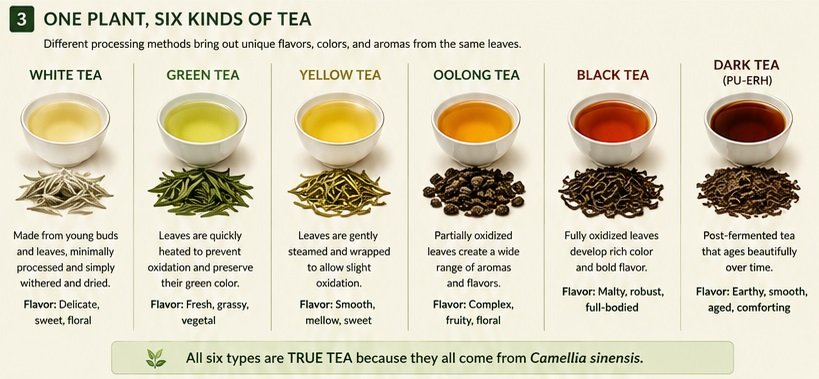
From Leaf to Cup: How One Plant Makes Six Teas
One of the most remarkable facts about Camellia sinensis is that the same plant produces all six major categories of tea. The difference lies entirely in how the leaves are processed after picking — specifically, how much oxidation is allowed to occur.
Oxidation is a chemical reaction triggered when the cell walls of the tea leaf are broken (by rolling, bruising, or cutting), exposing enzymes to oxygen. This process transforms the leaf’s polyphenols, altering color, flavor, and aroma dramatically.
1. White Tea — Minimal Processing
- Oxidation: 0–15%
- Process: Leaves (typically buds or young leaves) are simply withered and dried — either in sunlight or with gentle heat
- Flavor profile: Delicate, sweet, subtly floral, honeyed
- Famous types: Bai Hao Yinzhen (Silver Needle), Bai Mudan (White Peony)
2. Yellow Tea — Slight Oxidation with “Yellowing”
- Oxidation: 10–20%
- Process: Like green tea, but with an additional slow-drying step called men huan (sealed yellowing) that mutes the grassy notes
- Flavor profile: Mellow, smooth, slightly sweet with less astringency than green
- Famous types: Junshan Yinzhen, Huoshan Huangya
3. Green Tea — No Oxidation
- Oxidation: 0–5%
- Process: Leaves are quickly heated (either pan-fired as in China, or steamed as in Japan) immediately after picking to deactivate enzymes and halt oxidation, then rolled and dried
- Flavor profile: Fresh, grassy, vegetal, sometimes nutty or oceanic
- Famous types: Longjing, Gyokuro, Sencha, Matcha, Biluochun
4. Oolong Tea — Partial Oxidation
- Oxidation: 15–85%
- Process: Leaves are withered, lightly bruised at the edges, partially oxidized, then fired to stop the process. The wide oxidation range creates enormous flavor diversity
- Flavor profile: Ranges from floral and light (lightly oxidized) to fruity, toasty, and complex (heavily oxidized)
- Famous types: Tieguanyin, Da Hong Pao, Oriental Beauty, Ali Shan
5. Black Tea — Full Oxidation
- Oxidation: 80–100%
- Process: Leaves are withered, fully rolled (or CTC — cut, torn, curled), allowed to fully oxidize until they turn dark copper-brown, then fired dry
- Flavor profile: Bold, malty, robust, sometimes brisk, fruity, or earthy depending on origin
- Famous types: Assam, Darjeeling, Ceylon, Keemun, Yunnan Dian Hong
6. Pu-erh Tea — Microbial Fermentation
- Oxidation + Fermentation: Post-production microbial process
- Process: After an initial green tea-like processing, leaves are either aged naturally over years (sheng/raw pu-erh) or subjected to accelerated “wet piling” fermentation (shou/ripe pu-erh)
- Flavor profile: Earthy, woody, dark fruit, smooth, complex — improves with age like fine wine
- Famous types: Yunnan Sheng Pu-erh, Menghai Shou Pu-erh

Chemical Composition and Health Benefits
Camellia sinensis leaves are a biochemical treasure chest. The compounds they contain have been studied extensively by scientists around the world for their remarkable health-promoting properties.
Key Bioactive Compounds
1. Polyphenols and Catechins
The most studied compounds in tea. Catechins are a subclass of polyphenols that act as powerful antioxidants, neutralizing free radicals that damage cells.
Major catechins in green tea:
- EGCG (Epigallocatechin gallate) — The most abundant and most studied; associated with anti-cancer, anti-inflammatory, and metabolic effects
- EGC (Epigallocatechin)
- ECG (Epicatechin gallate)
- EC (Epicatechin)
In black and oolong teas, catechins are partially or fully oxidized into theaflavins and thearubigins — large, complex molecules that give black tea its dark color and malty, astringent character. These also carry significant antioxidant activity.
2. Caffeine
Camellia sinensis naturally synthesizes caffeine as a defence mechanism against insects. In the human body, caffeine:
- Blocks adenosine receptors, reducing fatigue and increasing alertness
- Stimulates the central nervous system
- Improves focus, reaction time, and mood
Typical caffeine content per 8 oz (240 ml) cup:
| Tea Type | Caffeine (approximate) |
|---|---|
| White Tea | 15–30 mg |
| Yellow Tea | 25–45 mg |
| Green Tea | 25–45 mg |
| Oolong Tea | 30–50 mg |
| Black Tea | 40–70 mg |
| Matcha (2g powder) | 60–80 mg |
| Coffee (for reference) | 80–120 mg |
3. L-Theanine
Perhaps the most unique compound in tea — an amino acid found almost exclusively in Camellia sinensis (and a few mushroom species). L-theanine:
- Promotes alpha brain wave activity, associated with a calm, alert mental state
- Works synergistically with caffeine — the famous “calm alertness” of tea comes from this combination
- Reduces anxiety without causing drowsiness
- Enhances focus and attention
- Is found in highest concentrations in shade-grown teas like matcha and gyokuro
4. Minerals and Vitamins
Camellia sinensis leaves are naturally rich in:
- Fluoride — promotes dental health (though excessive consumption can be a concern)
- Manganese — supports bone health and enzyme function
- Potassium — supports cardiovascular function
- Vitamin C — particularly in fresh/green teas; partially destroyed by oxidation
- Vitamin B complex — including B2 (riboflavin), B3 (niacin), and B9 (folate)
- Vitamin K — relevant for people on blood-thinning medications
- Zinc, copper, and selenium — trace minerals with antioxidant roles
Evidence-Based Health Benefits
Research into the health effects of Camellia sinensis has produced a compelling body of evidence:
Cardiovascular Health Multiple large population studies have found associations between regular tea consumption and reduced risk of heart disease, stroke, and hypertension. Catechins and theaflavins appear to support healthy cholesterol levels, reduce LDL oxidation, and improve blood vessel function.
Metabolic and Weight Management EGCG has been shown to support fat oxidation and improve insulin sensitivity in multiple clinical studies. Green tea extract is one of the most evidence-backed ingredients in weight management supplementation.
Brain Health and Cognitive Function The caffeine-theanine combination has demonstrated improvements in attention, memory, and reaction time in controlled trials. Long-term tea consumption has been associated with reduced risk of cognitive decline and neurodegenerative diseases in observational studies.
Blood Sugar Regulation Several studies suggest that compounds in both green and black tea may help moderate blood glucose spikes after meals and improve insulin sensitivity — making tea potentially beneficial for people managing or at risk for type 2 diabetes.
Gut Microbiome Support Tea polyphenols act as prebiotics, selectively feeding beneficial gut bacteria (particularly Lactobacillus and Bifidobacterium species) while inhibiting pathogenic bacteria. This effect appears across both green and black tea.
Anti-Cancer Properties (Preliminary) Laboratory and animal studies have shown remarkable anti-cancer activity for EGCG and other catechins. Human clinical evidence is still being developed, but the mechanistic basis is well-established. Tea polyphenols appear to inhibit tumor cell growth, promote apoptosis (programmed cell death), and reduce oxidative DNA damage.
Oral Health Fluoride, catechins, and antibacterial compounds in tea contribute to reduced bacterial growth in the mouth, lower risk of cavities, and inhibition of the bacteria responsible for gum disease.
⚠️ Note: While the research on tea and health is promising, tea is not a medicine. Always consult a healthcare professional for medical advice.
Major Tea-Growing Regions
Camellia sinensis is cultivated today in over 50 countries. Here are the most important:
China 🇨🇳
The birthplace of tea and still the world’s largest producer. China produces the extraordinary breadth of tea types — green, white, yellow, oolong, black, and pu-erh. Notable regions include Yunnan, Fujian, Zhejiang, Anhui, and Sichuan.
India 🇮🇳
The world’s second-largest producer, famous for three iconic regions:
- Assam — Large-leaf assamica variety; bold, malty black teas
- Darjeeling — The “Champagne of teas”; delicate muscatel first-flush teas
- Nilgiris — South Indian high-altitude teas with bright, brisk character
Sri Lanka 🇱🇰
Formerly Ceylon, now producing the famous Ceylon teas — known for their bright, citrusy, brisk character at various altitude grades (High Grown, Mid Grown, Low Grown).
Japan 🇯🇵
Japan grows almost exclusively green tea, producing some of the world’s most refined and distinctive teas: Sencha, Gyokuro, Matcha, Hojicha, Genmaicha, Kabusecha. Japanese tea culture emphasizes meticulous craftsmanship and minimal-intervention quality.
Kenya 🇰🇪
Africa’s largest tea producer and a global giant in CTC black tea production. Kenyan teas are known for their bright coppery infusion, strong flavor, and affordability — forming the base of many popular commercial blends.
Taiwan 🇹🇼
Renowned for exceptional oolongs — particularly High Mountain (Gaoshan) teas, Dong Ding, and the lightly oxidized, highly aromatic Alishan teas. Taiwan’s tea culture has produced some of the world’s most sophisticated oolong craftsmanship.
Other Notable Producers
- Nepal — Darjeeling-adjacent region producing fine orthodox teas
- Vietnam — Ancient tea culture with both unique varietals and Chinese-style teas
- Georgia (Caucasus) — Europe’s primary tea-growing country
- Indonesia — Java and Sumatra produce significant commercial tea volumes
- Turkey — Produces the unique, strong Turkish black tea (çay)
- Iran, Bangladesh, Myanmar, Thailand — All have established or growing tea industries
How to Grow Camellia Sinensis at Home
Growing your own tea plant is a deeply rewarding experience — and entirely achievable in the right conditions.
What You Need
- A healthy Camellia sinensis plant or seeds (from a reputable nursery; specify Chinese variety for cooler climates)
- Acidic, well-draining potting mix (pH 4.5–6.0; use ericaceous/acid compost or mix peat/pine bark with standard compost)
- A large container (at least 45 cm / 18 inches diameter) if growing in a pot
- Bright, indirect light (a few hours of direct morning sun is ideal)
- Consistent watering — keep soil moist but never waterlogged
- Patience — allow 2–3 years before significant harvesting
Step-by-Step Guide
Step 1: Choose Your Variety For temperate climates (UK, northern USA, Europe), choose var. sinensis — it tolerates frost down to around -10°C (14°F) when established. For warm, humid climates (southern USA, Southeast Asia, tropical regions), var. assamica will thrive outdoors.
Step 2: Soil and Pot Preparation Fill a large pot with ericaceous (acid) compost. Ensure drainage holes are clear. Add a layer of gravel or broken crocks at the base. Mix in some perlite for extra drainage.
Step 3: Planting Plant at the same depth as in the nursery pot. Firm in gently and water thoroughly.
Step 4: Position Place in a sheltered spot with morning sun and afternoon shade. Avoid cold winds. Bring indoors or into a greenhouse during severe frost if in a pot.
Step 5: Watering and Feeding Water regularly with rainwater or filtered water (tap water’s lime/alkalinity can raise soil pH over time). Feed with an ericaceous fertilizer or liquid seaweed during the growing season (spring–summer).
Step 6: Pruning In spring, prune lightly to encourage bushy growth. Removing the growing tip stimulates lateral branches and more harvestable shoots.
Step 7: Your First Harvest Resist harvesting heavily for the first 2 years. In year 3 and beyond, pick the top two leaves and bud as new flushes appear. Process immediately (see below).
Making Your First Cup: A Basic Home Green Tea
- Harvest two leaves and a bud per stem
- Wither for 1–2 hours at room temperature on a clean towel
- Pan-fire: In a dry, hot wok or skillet, toss the leaves over medium-high heat for 5–8 minutes until they smell toasty and grassy and feel slightly dry
- Roll: While still warm, gently roll the leaves between your palms to shape them
- Dry: Spread on a tray and allow to cool and dry fully
- Brew: Steep 2–3 grams in 80°C (176°F) water for 2–3 minutes
- Enjoy: Your very own, home-grown cup of green tea
Camellia Sinensis vs. Herbal Teas
A common point of confusion — and worth clarifying clearly:
“True teas” come exclusively from Camellia sinensis. This includes:
- Green tea
- Black tea
- White tea
- Oolong tea
- Yellow tea
- Pu-erh tea
Herbal teas (tisanes) are infusions made from any other plant — herbs, flowers, fruits, roots, or spices:
- Chamomile, peppermint, rooibos, hibiscus, ginger, echinacea, etc.
These may be delicious and healthful in their own right, but they are not teas in the botanical sense — they contain no Camellia sinensis.
The key practical differences:
| True Tea (Camellia sinensis) | Herbal Tisane | |
|---|---|---|
| Caffeine | Present (naturally) | Absent (unless blended) |
| L-Theanine | Present | Absent |
| Catechins/EGCG | Present | Absent |
| Oxidation range | Wide (white to pu-erh) | N/A |
| “Flush” concept | Yes | No |
At TeaFlush, we celebrate the extraordinary range of what Camellia sinensis can produce — from the most delicate silver needle white tea to the deepest aged pu-erh. That range is the whole point.
Sustainability and Conservation
Wild Tea Trees Under Threat
The ancient wild tea trees of Yunnan, Myanmar, and Assam — some hundreds or even thousands of years old — face growing pressure from commercial demand, habitat loss, and climate change. These genetic reservoirs are irreplaceable: they carry the ancestral diversity from which all cultivated tea descends.
Organizations like the Global Tea Initiative and various academic institutions are working to document, protect, and study these wild populations before they are lost.
Climate Change and Tea
Rising temperatures, shifting monsoon patterns, and unpredictable frosts are already affecting tea quality and timing in key regions:
- Darjeeling first-flush windows are shifting earlier and becoming less predictable
- High-altitude gardens in Kenya face increasing temperature stress
- Unusual frosts in Chinese tea regions periodically devastate early spring harvests
Long-term adaptation strategies include developing more climate-resilient cultivars, shifting cultivation to higher altitudes, and changing harvest timing.
Sustainable Farming Practices
The specialty tea world is increasingly embracing:
- Organic certification — eliminating synthetic pesticides and fertilizers
- Rainforest Alliance and Fairtrade certification — ensuring environmental standards and fair wages for tea workers
- Shade-grown cultivation — preserving biodiversity and soil health
- Agroforestry — integrating tea with trees and other crops
- Regenerative agriculture — building soil carbon and water retention
When you choose sustainably sourced teas, you are directly supporting the health of the ecosystems and communities that make exceptional tea possible.

Frequently Asked Questions
Q: Is Camellia sinensis the same as a camellia flower?
Yes and no. Camellia sinensis belongs to the same genus as ornamental camellias (Camellia japonica, Camellia sasanqua), and it does produce small white flowers. However, the ornamental camellias are different species — their leaves are not used to make tea.
Q: How long does a Camellia sinensis plant live?
Commercial tea plants are typically productive for 30–50 years before being replaced or rejuvenated. However, wild Camellia sinensis trees in Yunnan can live for 500–1,000 years or more. A wild tree in Yunnan’s Fengqing County is estimated to be over 3,200 years old.
Q: Can Camellia sinensis grow in the UK or northern Europe?
Yes! The Chinese variety is surprisingly cold-hardy. Several UK tea gardens exist, including the Tregothnan Estate in Cornwall, which has been producing commercial English tea since 2005. Container growing in a greenhouse or conservatory works well in colder climates.
Q: Why does high-altitude tea taste better? At higher altitudes, cooler temperatures slow leaf growth, giving the plant more time to develop complex flavor compounds. Mist and cloud cover reduce harsh UV radiation, and cooler nights allow flavor precursors to concentrate in the leaf. The result is greater complexity, more delicate flavors, and often a natural sweetness.
Q: Is tea from Camellia sinensis safe to drink every day? For most adults, 3–5 cups per day of tea is considered safe and potentially beneficial. Those sensitive to caffeine, pregnant women, or people on certain medications (such as blood thinners, due to vitamin K content) should moderate their intake or consult a doctor.
Q: Why does my green tea taste bitter? Bitterness usually comes from brewing at too high a temperature or for too long. Green tea should be brewed at 70–85°C (160–185°F) for 1–3 minutes. Boiling water destroys delicate flavors and extracts excess tannins, causing bitterness.
Q: Does Camellia sinensis produce seeds? Yes. The plant produces round, hard seeds (similar in size to a small chestnut) inside a leathery seed pod. Tea seeds contain a significant proportion of oil — camellia seed oil (tea seed oil) — used in cooking, cosmetics, and as a traditional lubricant for tools.
Final Thoughts
Camellia sinensis is one of humanity’s oldest and most remarkable plant companions. From the ancient forests of Yunnan to the terraced gardens of Darjeeling, from the misty high mountain oolongs of Taiwan to the bold CTC estates of Kenya — a single species has shaped cultures, economies, health practices, and daily rituals across the entire globe.
Every flush of new growth on a tea bush is a small miracle of nature. The interplay of soil, climate, altitude, season, and human craft transforms those simple leaves into something that has brought comfort, ceremony, and connection to people for thousands of years.
At TeaFlush.com, we believe that understanding the plant is the beginning of a deeper relationship with your cup. The more you know about Camellia sinensis — its biology, its varieties, its journey from leaf to liquor — the more every sip becomes a conscious, extraordinary experience.
Explore our collection of single-origin teas, each sourced directly from gardens where Camellia sinensis is grown with intention and care.
Further Reading on TeaFlush.com
- How Terroir Shapes Tea Flavor
- The Six Types of True Tea Explained
- A Beginner’s Guide to Tea Tasting
- Understanding Tea Grades and Quality Indicators
- The Health Benefits of Green Tea: What the Science Actually Says
© TeaFlush.com — Your trusted source for single-origin teas, tea education, and everything Camellia sinensis.
Meta Title: Camellia Sinensis: The Complete Guide to the Tea Plant | TeaFlush.com
Meta Description: Discover everything about Camellia sinensis — the plant behind every cup of tea. Explore its history, varieties, growing conditions, health benefits, and how one plant makes six different teas. The ultimate guide from TeaFlush.com.
Primary Keyword: Camellia sinensis Secondary Keywords: tea plant, Camellia sinensis var sinensis, Camellia sinensis var assamica, tea plant health benefits, how tea is made, types of true tea, growing Camellia sinensis, tea plant guide