Published on TeaFlush.com | Your Complete Tea Resource
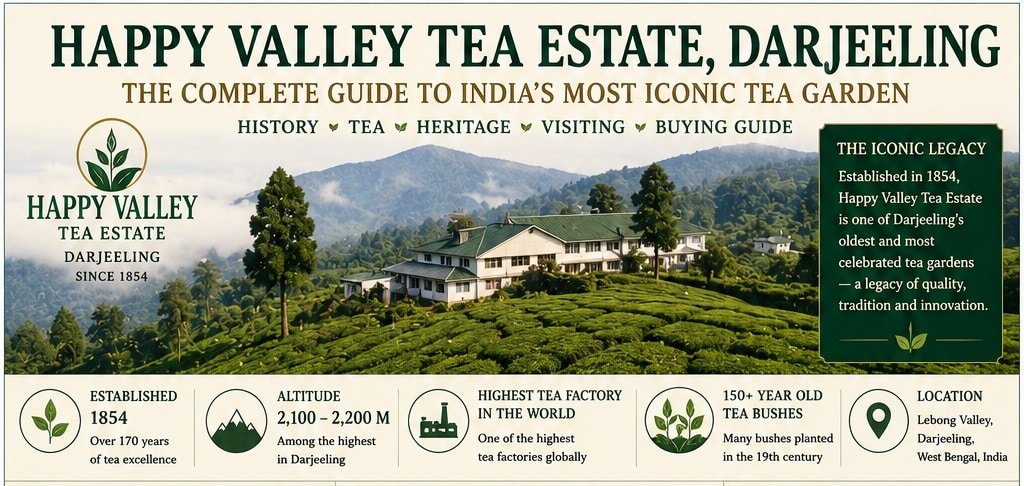
Three kilometres north of Darjeeling town, just below the Hill Cart Road that winds up toward the centre of this Himalayan hill station, a sign marks the entrance to one of the most historically significant tea estates in the world.
Happy Valley Tea Estate — established in 1854, spread across 177 hectares of high-altitude Himalayan terrain at 2,100 metres above sea level, home to tea bushes that have been growing for up to 150 years — is Darjeeling’s second oldest operational tea garden and the most visited tea estate in India.
But the numbers alone do not capture what makes Happy Valley exceptional. It is the combination of extraordinary heritage — a founding story that began with an English planter’s vision, an Indian aristocrat’s transformation, and a name that has outlasted both of them — with present-day vitality that includes some of the finest organic first and second flush teas in Darjeeling, a factory that doubles as a living museum of tea manufacturing history, hand-rolled teas sold at Harrods in London, and an immersive visitor experience that has introduced generations of travellers to the extraordinary journey from leaf to cup.
Table of Contents
At TeaFlush, we believe that the story behind every cup enriches the drinking of it. So here — in every detail — is the complete guide to Happy Valley Tea Estate, Darjeeling.
What Does “Happy Valley” Mean?
The name Happy Valley was given to the estate in 1929 by Tarapada Banerjee when he merged two neighbouring tea gardens — Wilson Tea Estate and Windsor Tea Estate — into a single, expanded property. The name reflects the topography and atmosphere of the land itself: a verdant valley nestled between Himalayan ridges, filled with the lush green rows of tea bushes, the sound of workers moving through the garden, and the cool, mist-laden air that has defined Darjeeling’s identity for centuries.
Happy Valley is not simply a marketing name. As soon as we set foot in this lush tea garden, we could see why it was called Happy Valley — everyone was so smiley and happy to show us around the tea factory where the delicate tea leaves are processed, said Marie-Claude Dessureault, Head of Tea at DAVIDsTEA’s Montreal headquarters, after visiting the estate.
The name has endured for nearly a century because it captures something true: this is a place where work, land, and community are inseparably woven, and where the particular happiness of meaningful, skilled labour in a beautiful environment is palpable to every visitor.
Quick Reference: Happy Valley Tea Estate at a Glance
| Detail | Information |
|---|---|
| Full Name | Happy Valley Tea Estate |
| Original Name | Wilson Tea Estate (1854–1903); renamed Happy Valley 1929 |
| Established | 1854 |
| Historical Status | Darjeeling’s second oldest tea estate |
| Location | 3 km north of Darjeeling town, Darjeeling district, West Bengal, India |
| Coordinates | 27°03′08″N 88°15′31″E |
| Altitude | 2,100 metres (6,900 feet) above sea level |
| Total Area | 177 hectares (440 acres) |
| Annual Production | ~50,000 kg of premium organic teas |
| Workers | 1,500+ permanent employees |
| Founding Owner | David Wilson (English planter) |
| Subsequent Owner | Tarapada Banerjee (1903), renamed estate Happy Valley (1929) |
| Later Owner | Sanjay Bansal / Ambootia Group (2008–2022) |
| Current Owner | Lemongrass Organic Tea Estates Pvt. Ltd. (Sushil Agarwal) |
| Tea Bush Age | 80–150 years (minimal replanting) |
| Organic Status | Certified organic; recognized as India’s first organic tea garden |
| Factory Status | One of the highest tea factories in the world |
| Notable Achievement | Hand-rolled teas sold at Harrods (London) and Mariage Frères (Paris) |
| GI Certification | Darjeeling GI Certified (Tea Board of India) |
| Tourism | Factory tours, garden walks, tasting sessions, nature walks, museum |
| Visiting hours | Monday to Sunday, 9:00 AM to 6:00 PM |
| Guided tours | 9:30 AM to 4:30 PM daily |
Part 1: The Complete History of Happy Valley Tea Estate
The Context: Darjeeling’s Tea Industry in 1854
By 1854, the Darjeeling tea industry was still in its infancy. The three founding estates — Tukvar (1852), Steinthal (1852), and Aloobari (1852–1856) — had just proven that high-altitude Himalayan cultivation was commercially viable. The British colonial administration was actively encouraging new planters to establish gardens in the district, offering land on favourable terms.
It was into this pioneering moment that David Wilson arrived.
1854: David Wilson and the Wilson Tea Estate
David Wilson, an Englishman, had named the garden Wilson Tea Estate and by 1860 had started cultivation of tea.
Established in 1854, it is Darjeeling’s second oldest tea estate. Spread over 177 hectares (440 acres), it is situated at a height of 2,100 metres (6,900 ft) above sea level, 3 kilometres (1.9 mi) north of Darjeeling, and employs more than 1500 people.
Wilson’s choice of location was prescient. The site he selected — just three kilometres from Darjeeling town, on a northward-facing slope at 2,100 metres — placed his garden in one of the highest growing positions of any Darjeeling estate. At a height of 2,100 metres (6,900 ft), it is also one of the highest tea factories in the world.
This extreme altitude would prove both challenging and exceptional: challenging because the cool, sometimes frosty conditions slowed growth and reduced yield compared to lower estates; exceptional because those same conditions created the concentrated, aromatic, intensely characterful teas that would eventually reach the shelves of Harrods.
At the entrance of the factory, there is a board that still shows the year of original establishment along with the name of the estate. This original board — still hanging at the factory entrance more than 170 years later — is one of the most quietly moving artefacts in all of Darjeeling’s tea heritage.
1903: Tarapada Banerjee — The Indian Transformation
In 1903, the estate was taken over by an Indian, Tarapada Banerjee, an aristocrat from Hooghly.
This transition — from an English colonial planter to an Indian aristocrat — is significant. Tarapada Banerjee was a man of considerable social standing from the Hooghly district of Bengal. His acquisition of Wilson Tea Estate in 1903 placed him among the first Indian entrepreneurs to take ownership of a colonial-era Darjeeling tea garden.
Wilson Tea Estate gained a reputation as one of the most esteemed tea gardens in Darjeeling under Banerjee’s guidance. Banerjee did not merely maintain what Wilson had built — he elevated it, bringing the care and commercial ambition of a new ownership generation to a garden that had already proven its quality.
1929: The Windsor Merger and the Birth of “Happy Valley”
T.P. Banerjee bought another adjacent tea estate called Windsor Tea Estate in 1929, combined the two and renamed the whole estate as Happy Valley Tea Estate that spans across more than 270 acres.
The merger of Wilson Tea Estate and Windsor Tea Estate in 1929 created the single entity we know today as Happy Valley Tea Estate. By combining the two adjacent properties, Banerjee expanded both the garden’s area and its growing range — bringing together two sets of old China-variety tea bushes whose combined heritage now stretches back 150 years or more.
The name “Happy Valley” — chosen by Banerjee himself — has proven one of the most enduring and evocative names in Indian tea history.
The G.C. Banerjee Era
G.C. Banerjee was the next owner of Happy Valley Tea Estate. He with his wife Annapurna Devi and three daughters (Nonimukhi, Monmaya and Savitri) lived there for some time.
The Banerjee family’s multi-generational stewardship of Happy Valley through the mid-20th century gave the estate a continuity and depth of attachment that purely corporate ownership rarely achieves. The image of a family living on the estate — the children growing up among the tea rows, the daily rhythms of plucking and processing shaping the household calendar — connects Happy Valley to a tradition of personal, familial land stewardship that defines the finest Darjeeling estates.
2008: The Ambootia Group Acquisition
Since 2008, the tea estate has been taken over by Sanjay Bansal.
Sanjay Bansal — the same visionary who transformed Ambootia Tea Estate from a sick unit into the world’s largest Demeter-certified biodynamic tea producer — acquired Happy Valley in 2008. Under his stewardship, the estate deepened its commitment to organic farming practices, maintaining the chemical-free approach that had made its teas internationally distinctive.
The Ambootia Group at its peak managed over a dozen Darjeeling estates, with Happy Valley as one of the crown jewels of the portfolio.
2022: Lemongrass Organic Tea Estates
Following financial difficulties at the Ambootia Group in 2022, the estate was transferred to Lemongrass Organic Tea Estates Pvt Ltd (LOTEPL).
This Darjeeling tea garden is presently owned by Mr. Sushil Agarwal of the Lemongrass Tea Estates Pvt. Ltd., which also owns the following tea estates.
The transition to Lemongrass Organic Tea Estates Pvt. Ltd. reflects the broader challenges facing Darjeeling’s tea industry — economic pressures, labour costs, climate variability, and global market competition. Under the new management, Happy Valley continues to operate as an organic estate, maintaining its quality standards and its commitment to the 1,500+ workers who depend on the garden for their livelihoods.
Part 2: Geography and Terroir — What Makes Happy Valley’s Location Exceptional
The Highest Tea Factory in the World
At a height of 2,100 metres (6,900 ft), Happy Valley is one of the highest tea factories in the world.
This distinction — one of the world’s highest operational tea factories — is not merely a curiosity. It has profound practical implications for the character of teas produced here.
At 2,100 metres above sea level:
Growth is dramatically slowed. Cool temperatures — rarely exceeding 18–20°C even in the warmest months, and regularly dropping below 5°C at night — mean the tea plants at Happy Valley grow much more slowly than those at lower-altitude Darjeeling estates. Slow growth concentrates flavor compounds in fewer, more metabolically active cells — producing teas of greater complexity and aromatic intensity per leaf.
The harvest begins later. Happy Valley Tea Estate is a high-altitude tea estate with late output. Because of the cold, the tea bushes at Happy Valley remain dormant longer than lower-altitude gardens. The first flush at Happy Valley often begins two to three weeks later than estates at 900–1,200 metres — but what emerges from that extended dormancy is worth the wait: concentrated, aromatic spring buds packed with L-theanine and EGCG that have been accumulating through a longer winter.
UV radiation is higher. At 2,100 metres, UV levels are meaningfully elevated compared to lower-altitude tea regions. The tea plant responds to UV stress by producing more polyphenols and flavonoids — the very compounds that give Happy Valley teas their antioxidant richness and complex flavour.
The mist is longer and denser. Morning mist at 6,900 feet settles more heavily and lingers longer than at lower elevations — wrapping the tea rows in cool, moisture-laden air for hours each morning. This daily mist contributes to the characteristic “Himalayan freshness” in Happy Valley teas that distinguishes them from lower-altitude Darjeeling gardens.
The 150-Year-Old Bushes: A Living Legacy
The bushes in the garden are very old — the minimum age is 80 years, and some are 150 years old. Very little re-plantation has been done in the recent past.
This is one of the most extraordinary facts about Happy Valley: its tea bushes have been growing, largely undisturbed, for between 80 and 150 years. The minimal replanting philosophy means the garden retains a very high proportion of the original China-variety (Camellia sinensis var. sinensis) plants that David Wilson and Tarapada Banerjee established.
Old-growth tea plants develop root systems that penetrate deep into the Himalayan substrate — accessing mineral layers and moisture reserves that younger plants cannot reach. The result is a tea of greater mineral depth and complexity — a quality that experienced tasters can identify in the cup but that no amount of modern viticulture can shortcut.
Some of the grapes they use had been there for over a century. The century-old bushes at Happy Valley are its most irreplaceable asset — a living inheritance from 1854 that no new planting could replicate for decades.
Proximity to Darjeeling Town: The Accessibility Advantage
Happy Valley Tea Estate is the closest estate to Darjeeling town and the most convenient one to reach. Located just below Hill Cart Road, it is 3 kilometres away from Darjeeling.
This proximity — just 3 km from central Darjeeling, walkable from most of the town’s hotels and guesthouses — makes Happy Valley the natural first choice for visitors who want to experience a working tea estate without extensive travel. It is the gateway garden of Darjeeling: the place where most people’s tea estate experience begins, and where, for many, the love affair with Darjeeling tea is kindled.
Part 3: The Teas of Happy Valley — A Complete Sensory Guide
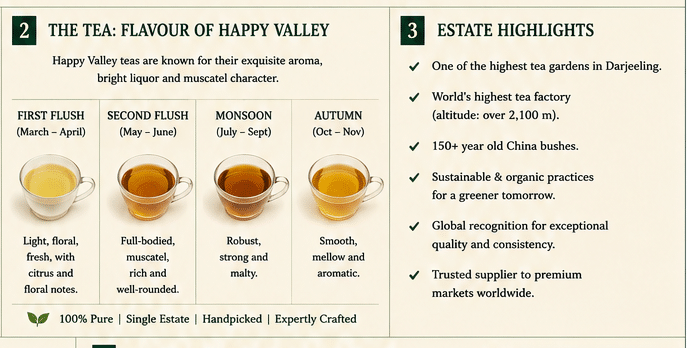
The best quality tea at Happy Valley Tea Estate is known as SFTGFOP (Super Fine Tippy Golden Flowery Orange Pekoe) which is normally produced during the first flush or sometimes as Supremo (second flush). Within this there are variations like White tea, Green tea and Black tea.
Happy Valley produces teas across all four seasonal flushes, in multiple tea types, and at various quality grades. Here is the complete guide to everything produced at this exceptional estate.
🌱 First Flush — The Estate’s Crown Achievement
Season: Mid-March to late April (later than lower-altitude estates due to the high elevation)
Grade: SFTGFOP1 (Super Finest Tippy Golden Flowery Orange Pekoe, Grade 1)
Character: Floral, delicate, lightly oxidised — the most celebrated tea of the estate
First Flush Darjeeling has a fresh and fragrant floral aroma, is lively and lightly astringent — delicate and fragile, with grey-green sheen on the tea leaves.
Their First Flush tea, harvested in early spring, offers a delicate floral aroma and a captivating golden hue that tea enthusiasts treasure. This prized variety represents the year’s first plucking and delivers an unmatched fresh taste.
Dry Leaf Appearance: The first flush leaves at Happy Valley carry the characteristic grey-green sheen of lightly oxidised Darjeeling — fine, twisted whole leaves with abundant silver and golden tips from the AV2 and China-variety clonal bushes. The grey-green colouration indicates the minimal oxidation that preserves both the fresh character and the high EGCG and L-theanine content.
Liquor Colour: A pure-grade organic blend with a very aromatic and complex flavor profile. The liquor is pale gold to light amber — sometimes almost clear with a faint greenish tinge in the most lightly oxidised lots. Beautiful and luminous in a glass cup.
Aroma: Intensely floral — orchid, jasmine, white blossom — with a clean Himalayan freshness that speaks directly to the altitude. The 2,100-metre elevation gives Happy Valley first flush a particularly clean, crystalline quality in its aromatics that lower-altitude gardens struggle to replicate.
Flavour: Fresh, delicate, and brisk — with a light but satisfying astringency that refreshes rather than dries. The high-altitude concentration of flavour compounds means Happy Valley first flush has a notable presence in the cup despite its pale colour. Notes of green apple, spring herbs, and a subtle floral sweetness characterise the finest SFTGFOP1 lots.
The Late Harvest Advantage: Because Happy Valley’s elevation delays the first flush by weeks compared to lower estates, it has one specific quality advantage: the spring cold lingers longer at 2,100 metres, keeping L-theanine concentrated in the buds for an extended period. The first flush that finally emerges carries an exceptionally high L-theanine load — the compound responsible for the “calm focus” effect — accumulated through the longest dormancy period of any Darjeeling growing zone.
Best enjoyed: Plain, without milk. At 85–88°C for 2–2.5 minutes. In a glass cup to observe the pale gold liquor.
☀️ Second Flush — The Muscatel Masterpiece
Season: May to mid-June
Grade: SFTGFOP1 / Supremo
Character: Rich, full-bodied, distinctive muscatel — the estate’s most internationally famous offering
The Second Flush tea, which they harvest in summer, presents a fuller body with a rich amber colour. Its distinctive muscatel flavour is reminiscent of ripe grapes.
The muscatel quality of Happy Valley’s second flush has been its calling card in international markets for decades. At 2,100 metres, the specific atmospheric conditions of Darjeeling’s summer — warm days, cool nights, the activity of the green leafhopper insect on the China-variety bushes — produce a muscatel character of exceptional intensity and warmth.
Dry Leaf: Dark, twisted, fully oxidised leaves with abundant golden tips. Classically beautiful second flush appearance — darker and richer than first flush, with the characteristic copper tones of well-oxidised Darjeeling leaf.
Liquor: Deep amber to rich copper-gold — luminous and warm. Held to light, a well-brewed Happy Valley second flush glows with a depth that justifies its premium pricing.
Aroma: The full muscatel rises immediately from the cup — warm, grape-like, sun-dried raisin, apricot, and a characteristic Himalayan spice note. This is the aroma that has made Darjeeling’s summer teas famous worldwide for nearly two centuries.
Flavour: Very aromatic and complex flavor profile with notes of fruit and muscatel. Full-bodied and satisfying — round in the mouth, warm on the finish, with the characteristic Darjeeling briskness providing a clean counterpoint to the rich muscatel depth.
International Recognition: Select hand-rolled varieties from Happy Valley have been sold at Harrods in the UK for £59–71 per kg and at Mariage Frères in France, reflecting the exceptional quality and exclusivity that drive global demand.
Best enjoyed: Plain, or with a very small amount of milk. At 90–95°C for 3–4 minutes.
🤍 The Hand-Rolled Teas — Happy Valley’s Greatest Achievement
One of Happy Valley’s most celebrated innovations under Sanjay Bansal’s management was the development of hand-rolled tea — a labour-intensive artisanal production that elevated the estate’s finest leaves into a completely different category of premium tea.
The estate developed hand-rolled tea, which was notably sold at Harrods in 2008.
These teas command premium prices of ₹5,000 to ₹6,000 per kilogram in the global market.
Hand-rolling — as opposed to machine-rolling — allows the tea maker to control the precise pressure, direction, and shape applied to each leaf. The result is a tea of extraordinary visual beauty and aromatic complexity, where the leaf’s surface structure is preserved intact and the aromatic compounds are expressed more fully upon brewing.
The fact that Happy Valley’s hand-rolled teas were selected for Harrods — the world’s most prestigious department store, whose tea department has served royalty and heads of state — is the ultimate validation of their exceptional quality.
🍃 Green Tea from Happy Valley
For health-conscious tea lovers, they produce delicate green tea using carefully controlled oxidation processes, resulting in a subtle, refreshing taste.
At 2,100 metres, with old China-variety bushes that grow slowly and accumulate concentrated flavour compounds through the winter dormancy, Happy Valley’s green tea has a distinctive high-altitude character quite different from lower-elevation or tropical green teas.
Liquor: Very pale yellow-green — delicate and luminous
Aroma: Floral, clean, Himalayan freshness with a subtle mineral quality
Flavour: Delicate vegetal and floral notes, smooth body, clean finish
Best enjoyed: At 75–80°C for 1.5–2 minutes. No milk.
🍂 Monsoon and Autumnal Flushes
Happy Valley’s high altitude gives its monsoon and autumnal teas distinctive qualities compared to lower-altitude Darjeeling gardens. The cooler temperatures even during the monsoon season moderate the rapid, low-concentration growth that produces coarser monsoon teas at lower elevations — giving Happy Valley’s rain-season teas more character than equivalent teas from lower gardens.
Monsoon Flush: Bold, full-bodied, strongly amber. Excellent for everyday drinking and chai preparation. More concentrated than typical monsoon teas due to altitude.
Autumnal Flush: Warm, woody, nutty — the quiet complexity of October and November at 2,100 metres. Clear Himalayan skies, cooling temperatures, and the season’s last flush of growth produce a tea of warm, smooth depth.
Part 4: The Tea Processing at Happy Valley — From Leaf to Cup
Happy Valley’s factory is one of the oldest continuously operating tea factories in Darjeeling — and its status as a working museum of tea manufacturing history makes the factory tour one of the most educational tea experiences available anywhere in India.
Plucking
To make 1 kg of regular Darjeeling tea, it takes about 20,000 leaves and buds.
Plucking at Happy Valley is done entirely by hand — the standard “two leaves and a bud” pluck that is mandated for premium Darjeeling production. The estate employs over 1,500 workers, the majority of whom are women engaged in the plucking and sorting stages.
The high altitude means Happy Valley’s pluckers work in physically demanding conditions — thin air, steep slopes, and cool temperatures — with a skill and stamina that represents a lifetime of practice.
Withering
From the adjacent room and through pipes that run below the beds, hot air is pumped in during the night time. This is how the moisture reduction (i.e. initial drying of leaves) takes place. Up to 65% drying takes place here. As you walk into the adjacent room, you will see the giant fans that actually pump the hot air through the pipes.
Fresh leaves are spread on withering troughs with fans moving air below. For first flush teas, Happy Valley uses a hard wither — a longer, more thorough moisture reduction that develops the aromatic precursors of the spring character. The factory’s withering system, which uses both passive air movement and heated air during cooler nights, reflects the practical reality of manufacturing tea at an elevation where ambient temperatures can drop significantly overnight.
Rolling
The estate uses both traditional and modern machinery, including a display of engines and machines in a working museum. This dual approach — preserving vintage rolling machinery alongside more modern equipment — reflects Happy Valley’s philosophy of honouring its manufacturing heritage while maintaining production efficiency.
Oxidation and Firing
An employee walks visitors around the fragrant factory, describing the withering, rolling, fermenting, and drying procedures and how green, black, and white teas all come from the same leaf.
The central insight of the factory tour — that green, black, and white teas all begin from the same fresh leaf, and are differentiated entirely by processing choices — is one of the most illuminating lessons in tea education, and Happy Valley’s experienced factory guides communicate it with genuine enthusiasm.
Sorting and Grading
After firing and drying, teas are sorted by size into the grades that appear on the packaging. The finest SFTGFOP1 lots — with whole leaves and abundant tips — are reserved for the estate’s premium export products. The “Family Mixture” grade represents the estate’s more accessible everyday production.
The regular quality tea at the estate is known as Family Mixture.
Part 5: Happy Valley Tea Estate and Organic Farming
First Organic Tea Garden in India
It’s recognized as being the first organic tea garden in Darjeeling India!
This is one of Happy Valley’s most remarkable distinctions — a claim that places it alongside Makaibari as a pioneer of organic tea production in Darjeeling, and that significantly predates the global organic movement’s mainstream emergence.
They have embraced organic farming practices as part of the modernization efforts, eliminating chemical fertilizers and pesticides. This sustainable approach not only protects the environment but also enhances the natural flavors of teas, which now command premium prices of ₹5,000 to ₹6,000 per kilogram in the global market.
The organic approach at Happy Valley is not simply the absence of chemicals — it is a positive commitment to soil health, biodiversity, and the long-term fertility of the land. In a garden where some bushes have been growing for 150 years, the health of the soil beneath them is the foundational asset of the entire enterprise.
What Organic Means at Happy Valley
At 2,100 metres, the estate’s natural environment provides significant pest and disease resistance — the cool temperatures and thin air that challenge commercial production also challenge the insects and fungal pathogens that require chemical management at lower altitudes. This creates a natural symbiosis between Happy Valley’s high-altitude location and its organic farming commitment.
The elimination of synthetic inputs means that Happy Valley’s century-old tea bushes feed from a living soil ecosystem — rich in mycorrhizal fungi, earthworms, and beneficial bacteria — rather than from chemical additions. This biological soil health is directly reflected in the depth and complexity of the teas produced.
Part 6: Happy Valley Tea on the World Stage
Harrods, London
The tea produced at the Happy Valley Tea Estate is all exported. Harrods in London is the main distributor of the tea.
Harrods — the world’s most prestigious department store, whose food halls and tea department have served royalty and heads of state for over 175 years — is Happy Valley’s primary international distribution channel. The selection of Happy Valley tea for Harrods’s shelves is not a marketing arrangement — it is a quality validation. Harrods’s tea buyers taste hundreds of teas each season and select only those that meet their extraordinary standards. Happy Valley has met those standards consistently.
Select hand-rolled varieties from Happy Valley have been sold at Harrods in the UK for £59–71 per kg.
At this price point — comparable to fine wine — Happy Valley’s hand-rolled teas occupy the very apex of the international premium tea market.
Mariage Frères, Paris
The estate’s tea is sold globally, with outlets like Harrods (UK) and Mariage Frères (France).
Mariage Frères — founded in Paris in 1854 (the same year as Happy Valley’s establishment) — is France’s most prestigious tea house, supplying tea to some of the finest hotels, restaurants, and private residences in Europe. Its selection of Happy Valley teas reflects the estate’s standing among the global tea cognoscenti.
The International Tea Connoisseur Community
Their hand-rolled varieties have earned their place in prestigious establishments like Harrods and command premium prices in the global market.
Beyond these institutional buyers, Happy Valley teas are eagerly sought by independent tea merchants in Germany, Japan, Switzerland, and the United States — countries with highly educated tea cultures where the combination of provenance (Darjeeling’s second oldest estate), altitude (2,100 metres), ancient bushes (150+ years), and organic certification creates an irresistible value proposition for the discerning buyer.
Part 7: Visiting Happy Valley Tea Estate — The Complete Visitor Guide
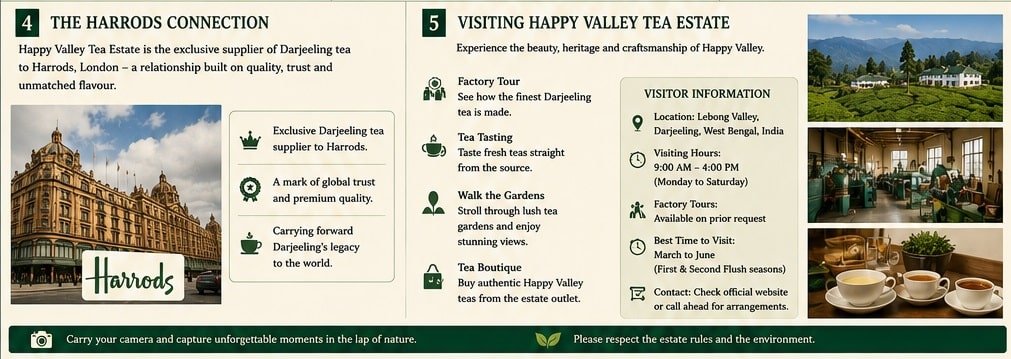
Happy Valley Tea Estate is the most accessible, most organised, and most visited tea estate in Darjeeling — making it the natural starting point for any tea-focused visit to the region.
Visiting Hours
| Day | Estate Hours | Guided Tour Hours |
|---|---|---|
| Monday to Sunday | 9:00 AM – 6:00 PM | 9:30 AM – 4:30 PM |
The estate is open daily — including weekends — making it accessible to visitors who are in Darjeeling for any duration.
What to Expect: The Factory Tour
Depending on the amount of tourists, factory tours are given once every hour. An employee walks you around the fragrant factory, describing the withering, rolling, fermenting, and drying procedures and how green, black, and white teas all come from the same leaf.
The factory tour is the centrepiece of the Happy Valley visitor experience and one of the most genuinely educational tea experiences available in India. A knowledgeable estate employee — typically someone who has worked in the factory for years and knows the process from the inside — guides small groups through each stage of tea production.
What the factory tour covers:
- The withering troughs and fan system that removes 65% of leaf moisture overnight
- The rolling machines — including vintage equipment that has been operating for decades
- The oxidation stage and how the tea maker judges when to halt the process
- The firing/drying machine and how it locks in the final character
- The sorting and grading stage that separates SFTGFOP1 from Family Mixture
- A side-by-side comparison of green, black, and white tea at different processing stages
- The museum section featuring original machinery, historical photographs, and the story of the estate
The tour concludes with a tasting session — where visitors sample teas across different types and grades — and access to the factory outlet for purchases.
The Garden Walk
Beyond the factory, visitors can walk through the tea gardens themselves — along the rows of ancient China-variety bushes, looking out over the valley below, with views of the Himalayan range on clear days.
It allows you to wander about the grounds, which offers some great photographs.
The garden walk is particularly rewarding during the plucking seasons (March–June, October–November) when workers are visible in the rows and the fresh energy of active harvesting fills the air.
Nature Walks and Wellness Experiences
The estate offers educational tours focusing on the history of tea in Darjeeling, the art of cultivation, and the intricacies involved in each step of tea processing. Wellness retreats leveraging on the global wellness trend now also incorporate yoga and meditation sessions amidst the serene backdrop of the tea gardens.
The natural environment of Happy Valley — ancient trees, diverse birdlife, the cool air at 2,100 metres — creates a setting ideal for nature walks and outdoor wellness activities. The wellness retreat programming connects the estate’s offering to the broader global interest in mindful, nature-connected travel.
The Museum
Happy Valley features a museum showcasing tea history alongside the working factory. The museum displays include original tea-processing machinery from the estate’s Victorian-era founding, historical photographs of the estate, information about the founding families, and documentation of the estate’s development from Wilson’s 1854 clearing of forested land to the present day.
It also features a museum as well as the world’s highest factory.
The Happy Golden Café
There is a small tea shop right next to the factory, Happy Golden Café, which is run by a local lady. She has samples of the estate tea which she apparently collects from the employee quota.
Happy Golden Café — a small, intimate tea shop adjacent to the factory — offers the most informal and local way to experience Happy Valley tea. Run by a local woman with access to estate teas through employee channels, the café provides a space to sit, drink, and absorb the atmosphere of the garden without the formality of the official tasting session.
Buying Tea at Happy Valley
If you want to buy the Happy Valley tea in India, you can do so at the factory outlet in the estate here in Darjeeling. You can also buy packs of tea bags.
The factory outlet stocks the estate’s full range of teas — from the premium SFTGFOP1 first flush and hand-rolled specialty teas to the more accessible Family Mixture. Buying directly from the estate ensures complete authenticity and, often, access to teas that are not available through retail channels.
Pricing at the factory outlet:
- SFTGFOP1 First Flush: ₹1,500–3,000+ per 100g (premium lots)
- Hand-rolled specialty: ₹500–600 per 100g retail (₹5,000–6,000 per kg wholesale)
- Family Mixture (standard): More affordable; ideal for everyday drinking
- Tea bags: Accessible price point for beginners
Entry and Fees
The entry to the estate is free; however, if visitors want a detailed tour they can hire a tour guide. A guide will help you tour the tea estate and give you complete details about the types of tea and the entire process. These guides are basically the employees of the tea estate who charge a nominal fee and take you on an excursion around the estate.
The garden itself is free to enter. Factory tours with a knowledgeable guide charge a nominal per-person fee — typically in the range of ₹100–200 per person for the guided factory tour, though this should be confirmed at the time of visiting.
Part 8: Best Time to Visit Happy Valley Tea Estate
| Season | Experience | Tea Availability |
|---|---|---|
| March–April (First Flush) | ⭐⭐⭐⭐⭐ Best — spring plucking active, gardens intensely green, first flush processing | Fresh first flush available directly; SFTGFOP1 lots at their freshest |
| May–June (Second Flush) | ⭐⭐⭐⭐½ Excellent — muscatel processing in full swing | Second flush teas at peak freshness |
| July–September (Monsoon) | ⭐⭐⭐ Good — lush, dramatic; garden operational but tourists sometimes limited by rain | Monsoon flush teas; less tourist-facing activity |
| October–November (Autumnal) | ⭐⭐⭐⭐⭐ Best — crystal-clear skies, Kanchenjunga views, cool and comfortable | Autumnal teas; clear mountain views |
| December–February (Dormant) | ⭐⭐⭐ Quieter — no plucking, but peaceful and beautiful | Previous flush teas available; no active processing |
The Happy Valley Tea Estate is worth a visit, especially during March through May, when the plucking and processing are in progress.
The definitive recommendation: March to May for the full immersive experience of a working first and second flush tea estate. October to November for the clearest weather, the best Himalayan views, and a quieter, more contemplative visit.
Part 9: How to Reach Happy Valley Tea Estate
From Darjeeling Town
Happy Valley is just 3 kilometres from central Darjeeling — accessible three ways:
Walking: The most rewarding approach. Follow Lebong Cart Road north from Darjeeling town — a downhill walk of approximately 45–60 minutes through the town’s outskirts, with improving views of the tea gardens as you descend.
Shared jeep: The most practical. Shared jeeps operate from Darjeeling’s Chowk Bazar area toward Lebong; ask for Happy Valley Tea Estate.
Private taxi: Most convenient for groups; negotiate the fare from your hotel directly. A round-trip including waiting time is reasonable.
From New Jalpaiguri (NJP)
NJP is the nearest major railway junction (~80–90 km). Private taxis (3–3.5 hours) and shared jeeps serve the route. The famous Darjeeling Himalayan Railway (Toy Train) offers a scenic connection from NJP to Darjeeling (7–8 hours) that passes through tea garden landscapes.
From Bagdogra Airport
The nearest airport (~95 km). Taxis and prebooked transfers connect Bagdogra to Darjeeling in approximately 3–4 hours depending on traffic.
Part 10: Tea Leaf Grades at Happy Valley
| Grade | Full Name | Happy Valley Application |
|---|---|---|
| SFTGFOP1 | Super Finest Tippy Golden Flowery Orange Pekoe, Grade 1 | The estate’s absolute pinnacle — reserved for the finest first flush and second flush (Supremo) lots |
| FTGFOP1 | Finest Tippy Golden Flowery Orange Pekoe, Grade 1 | Premium standard for seasonal productions |
| TGFOP | Tippy Golden Flowery Orange Pekoe | Good quality, accessible price point |
| BOP | Broken Orange Pekoe | Broken leaf for stronger, faster brew; used in blends |
| Family Mixture | Proprietary blend name | Happy Valley’s everyday grade — the most accessible entry point |
Part 11: Brewing Happy Valley Tea Perfectly
First Flush (SFTGFOP1)
| Parameter | Guidance |
|---|---|
| Water | Fresh, filtered — soft to neutral mineral content |
| Temperature | 85–88°C — never boiling |
| Quantity | 2.5–3 g per 200 ml |
| Steep time | 2–2.5 minutes |
| Vessel | Clear glass — observe the pale gold liquor |
| Milk | Never |
| Sugar | Never — masks the delicate floral character |
| Best time | Morning, fasted state |
| Multiple infusions | 2–3 excellent infusions |
Second Flush / Supremo
| Parameter | Guidance |
|---|---|
| Temperature | 90–95°C |
| Quantity | 2.5–3 g per 200 ml |
| Steep time | 3–4 minutes |
| Milk | Optional — small amount |
| Multiple infusions | 2 excellent infusions |
Green Tea
| Parameter | Guidance |
|---|---|
| Temperature | 75–80°C |
| Steep time | 1.5–2 minutes |
| Milk | Never |
Family Mixture (Standard Grade)
| Parameter | Guidance |
|---|---|
| Temperature | 95–100°C |
| Steep time | 3–5 minutes |
| Milk | Yes — works well |
| Best moment | Everyday morning; good as breakfast tea |
Part 12: Happy Valley Among Darjeeling’s Most Famous Estates
| Feature | Happy Valley | Makaibari | Castleton | Giddapahar |
|---|---|---|---|---|
| Founded | 1854 | 1852 | 1885 | 1881 |
| Historical rank | 2nd oldest in Darjeeling | Among founding three | Mid-period | Mid-period |
| Altitude | 2,100 m (highest factory) | 600–1,500 m | 980–2,300 m | 4,500–5,200 ft |
| Famous for | Heritage + accessibility + Harrods | World’s most famous, biodynamic | Finest muscatel | Non-colonial, Birmingham machine |
| Tourism | Best structured tour in Darjeeling | Community homestay | Limited | Small family estate |
| Signature tea | SFTGFOP1 First Flush + Hand-rolled | Silver Tips Imperial | Second Flush Muscatel | Delight micro-lot |
| International buyer | Harrods + Mariage Frères | Global premium | Kolkata auction | Specialty importers |
| Organic | Yes (first organic in India) | Yes (biodynamic) | No (Goodricke standard) | ISO 9001, ISO 22000 |
Frequently Asked Questions About Happy Valley Tea Estate
Q: What is Happy Valley Tea Estate famous for?
Happy Valley is famous for being Darjeeling’s second oldest tea estate (established 1854), one of the world’s highest tea factories (2,100 metres), producing premium first and second flush teas from 150-year-old China-variety bushes, its hand-rolled teas sold at Harrods in London and Mariage Frères in Paris, and offering the most accessible and well-structured tea estate tour in Darjeeling.
Q: When was Happy Valley Tea Estate established?
Happy Valley Tea Estate was established in 1854 by David Wilson, an English planter, as the Wilson Tea Estate — making it the second oldest tea estate in Darjeeling, after Steinthal (1852). It received its current name in 1929 when Tarapada Banerjee merged it with the adjacent Windsor Tea Estate.
Q: What is the altitude of Happy Valley Tea Estate?
Happy Valley is situated at 2,100 metres (6,900 feet) above sea level — making it one of the highest tea factories in the world and one of the highest-altitude growing estates in Darjeeling.
Q: What is the altitude of Happy Valley Tea Estate? Happy Valley is situated at 2,100 metres (6,900 feet) above sea level — making it one of the highest tea factories in the world and one of the highest-altitude growing estates in Darjeeling.
Q: How old are the tea bushes at Happy Valley? The tea bushes at Happy Valley range from 80 to 150 years old, with minimal replanting. This means some of the bushes currently producing tea were planted in the late 19th century, under either David Wilson or Tarapada Banerjee’s stewardship.
Q: Is Happy Valley Tea Estate organic? Yes. Happy Valley is recognised as India’s first organic tea garden, and maintains certified organic farming practices that eliminate synthetic pesticides and fertilisers. This organic commitment has been central to its ability to command premium prices at Harrods and other international retailers.
Q: Who owns Happy Valley Tea Estate now? Since 2022, Happy Valley Tea Estate has been owned by Lemongrass Organic Tea Estates Pvt. Ltd. under Mr. Sushil Agarwal, following the financial difficulties of the Ambootia Group (which had owned the estate since 2008).
Q: How do I get to Happy Valley Tea Estate? Happy Valley is 3 kilometres north of Darjeeling town — accessible by a 45–60 minute walk along Lebong Cart Road, by shared jeep from Chowk Bazar, or by private taxi from any Darjeeling hotel.
Q: What are Happy Valley Tea Estate visiting hours? The estate is open Monday to Sunday, 9:00 AM to 6:00 PM. Guided factory tours run from 9:30 AM to 4:30 PM. Entry to the garden is free; guided factory tours charge a nominal per-person fee.
Q: Where can I buy Happy Valley Tea outside of Darjeeling? Harrods in London and Mariage Frères in Paris stock Happy Valley’s premium hand-rolled teas. In India, the factory outlet at the estate, the estate’s official website (happyvalleytea.com), and specialist online retailers stock the full range of Happy Valley teas.
Q: What does Happy Valley first flush taste like? Happy Valley first flush is delicate, floral (orchid, jasmine, white blossom), lightly astringent, and very aromatic — brewing to a pale gold liquor. The 2,100-metre altitude gives its first flush a particularly clean, crystalline character and higher L-theanine concentration than lower-altitude first flush teas.
The TeaFlush Perspective: Why Happy Valley Is Where Every Tea Story Should Begin
There is a reason Happy Valley Tea Estate is the most visited tea garden in India. It is not simply proximity to Darjeeling town, though that helps. It is not simply the quality of the tours, though they are excellent. It is something older and harder to articulate.
It is the feeling of standing in a place where the same work has been done, carefully and with skill, for 170 years. Where the board above the factory entrance still says 1854 in the same paint, or a close reproduction of it. Where the tea bushes in the rows behind you were planted before your grandfather was born, and are still producing the same extraordinary leaves that David Wilson saw potential in when this was a densely forested Himalayan slope.
Tea bushes have thrived here for up to 150 years. Each leaf tells a story dating back to 1854, when the first ceremonial plucking marked the beginning of a legacy.
When you hold a cup of Happy Valley first flush — pale gold, floral, brisk — those 150 years are in the cup with you. The English planter who cleared the forest. The Indian aristocrat who gave it its name. The generations of workers who have plucked these rows every spring since Victoria was on the throne. The tea makers who learned their craft from their teachers, who learned from their teachers, in an unbroken chain of knowledge stretching back to the Victorian era.
That is what a cup of Happy Valley tea is. Not just tea. History, in a cup.
Come for the factory tour. Come for the Himalayan views. Come for the hand-rolled SFTGFOP1 first flush that Harrods sells for £70 a kilo. But stay for the feeling of the place — the particular contentment of being where something extraordinary has been made, lovingly and with great skill, for a very long time.
Happy Valley. You will understand the name the moment you arrive.
Explore more Darjeeling tea estate profiles, brewing guides, and tea travel content at TeaFlush.com
Tags: Happy Valley Tea Estate, Happy Valley Darjeeling, Wilson Tea Estate history, Happy Valley first flush, Happy Valley second flush, Happy Valley organic tea, Happy Valley Harrods, Happy Valley Mariage Freres, highest tea factory in the world, oldest tea estate Darjeeling, Tarapada Banerjee, David Wilson tea estate, SFTGFOP1 Darjeeling, hand rolled Darjeeling tea, visit Happy Valley tea estate, Happy Valley tea tour, Happy Valley visiting hours, Ambootia Group, Lemongrass Tea Estates, Darjeeling tea tourism 2025
Disclaimer: Visiting hours, entry fees, and tour details are subject to change. Always confirm directly with the estate before visiting.