Published on TeaFlush.com | Last Updated: June 2026
Estimated Reading Time: 12 minutes
“Sip, swish, inhale sharply, then spit.” — Rajah Banerjee, former director of Makaibari Tea Estate
Table of Contents
What Is Makaibari Tea Estate?
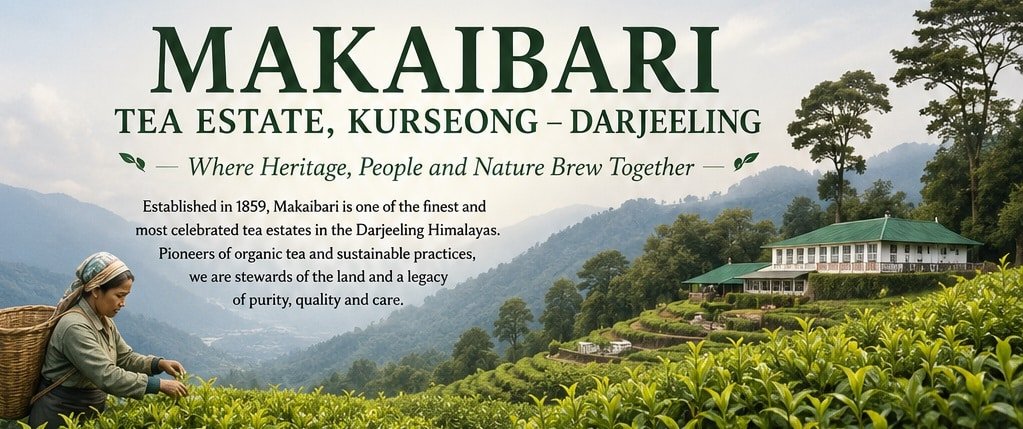
Tucked deep into the misty Himalayan foothills of Kurseong valley, West Bengal, Makaibari Tea Estate is not just a tea garden — it is a living legend. Regarded as one of the oldest and most prestigious tea estates in Darjeeling, Makaibari has for over 165 years produced teas that have shattered auction records, redefined sustainable agriculture, and earned global reverence among tea connoisseurs.
The word “Makaibari” itself comes from the local Nepali language: makai means maize and bari means land — literally, “the land of maize.” Long before tea colonized these hills, this land grew corn. Today, it grows what many consider the finest tea on the planet.
For anyone passionate about Darjeeling tea, Makaibari is the north star. This is where the “Champagne of Teas” earns its crown.
History of Makaibari Tea Estate
The Colonial Origins (1852–1859)
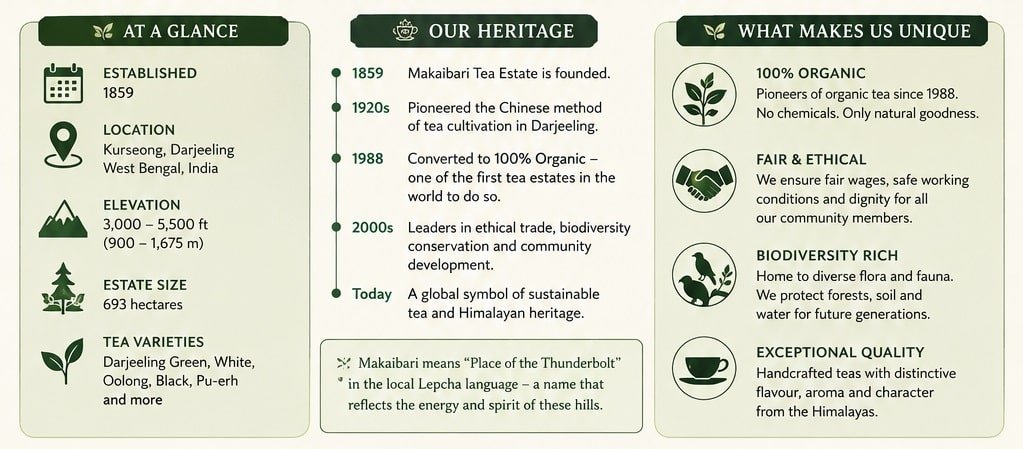
Makaibari was established by Captain Samler of the British Indian Army in 1852. The British Empire, driven by its desire to break China’s monopoly on tea, had begun planting tea across the northeast Indian hills — and Darjeeling’s cool altitudes proved perfect for the endeavour.
Makaibari, founded in 1859, became one of the earliest estates to emerge from this colonial enterprise, yet it took a different path, remaining under Indian ownership and eventually evolving into the world’s first biodynamic tea garden.
Crucially, the factory at Makaibari was established in 1859 and was the first tea factory ever to be started in the world. This makes Makaibari not only historically significant for India, but for the entire global tea industry.
Passing Into Indian Hands
Captain Samler sold the plantation to Girish Chandra Banerjee, who ran a commissary and mail services in Kurseong. It is one of the few tea gardens in Darjeeling owned by an Indian family.
This transition was a turning point. Where many Darjeeling estates remained under British control well into the 20th century, Makaibari was shaped from its early days by an Indian family’s vision — one that would define its philosophical and agricultural identity for generations.
The Banerjee Dynasty: Four Generations of Stewardship
Until 2014, the estate was run by the original founders’ family, the Banerjees, who once hailed from South Bengal. They owned Makaibari Tea Estate through four generations. Few estates anywhere in the world can claim this kind of continuity.
The Luxmi Group Era (2014–Present)
Swaraj (Rajah) Banerjee, after converting the garden to certified organic and biodynamic (the first of its kind) and instituting Fair Trade practices, sold a majority stake in the estate to Luxmi Tea Company Private Limited in 2014. Within three years, he divested completely.
Today, Makaibari Tea Estate continues to operate under the Luxmi Group, preserving the estate’s biodynamic and organic commitments while expanding its reach globally.
Location & Geography
Makaibari Tea Estate is situated in the hilly town of Kurseong in Darjeeling district, West Bengal, India. The estate stands at an elevation of 1,500 metres above sea level and covers approximately 670 hectares, with 270 hectares dedicated to tea.
Its location on the steep Himalayan slopes creates what tea experts call an extraordinary terroir — the unique combination of soil, altitude, rainfall, and climate that gives Makaibari teas their unmatched character.
Makaibari Tea Estate still retains 70 percent of its entire area under forest cover. This is a remarkable statistic for a commercial tea estate and is central to its ecological philosophy.
The estate covers six ridges, and plantation takes place in 120 hectares out of a total of 670 hectares.
Why Makaibari’s Location Is Special
Makaibari Tea Estate is in a temperate climate, while Sandakphu (a few hours uphill at 5,000 metres) is alpine-arctic. This creates a unique biotrope with a diversity of flora and fauna that is unparalleled, making Makaibari a dream for naturalists, botanists and ornithologists.
The estate is also threaded by three rivers, adding moisture and mineral richness to its soils. All of this — the altitude, the rivers, the forest cover, the biodynamic soil — finds its way into every cup of Makaibari tea.
Near by Tea Gardens: Goomtee Tea Estate, Jogmaya Tea Estate, Giddapahar Tea Estate
The Banerjee Family Legacy
No story of Makaibari Tea Estate is complete without understanding the man who transformed it from a colonial relic into a global icon: Swaraj Kumar Banerjee, universally known as Rajah Banerjee.
Rajah Banerjee is an Indian tea planter, environmentalist, and writer best known for his pioneering role in sustainable and organic tea production at the Makaibari Tea Estate in Darjeeling, India, where he served as director for 47 years from 1970 to 2017.
Born around 1948 into a family that owned the Makaibari Tea Estate for four generations, Banerjee returned from university studies in England in 1970 to join his father in managing the estate, quickly becoming a transformative figure in the industry. He spearheaded the adoption of organic cultivation methods in Darjeeling during the 1970s, convincing peers to follow suit and establishing biodynamic farming practices that prioritized uncultivated land to enhance biodiversity and terroir.
Famously, it was worked into the films of legendary Indian filmmaker Satyajit Ray that the discerning and sophisticated protagonist of the most famous detective film series ever made by the film maestro only drank tea from Makaibari Tea Estate. The films of the series began screening in 1974, making the scenes of sipping Makaibari tea, the first instance of product placement in Indian cinema.
Rajah holds the world record for the most expensive tea ever sold in a wholesale auction, at ₹1.11 lakh per kilogram.
His legacy is not just commercial — he built schools, hospitals, and community infrastructure for Makaibari’s workers, making the estate a model for ethical, community-centered business.
World’s First Biodynamic Tea Garden
This is perhaps Makaibari’s most extraordinary distinction: it is the world’s first biodynamic tea garden.
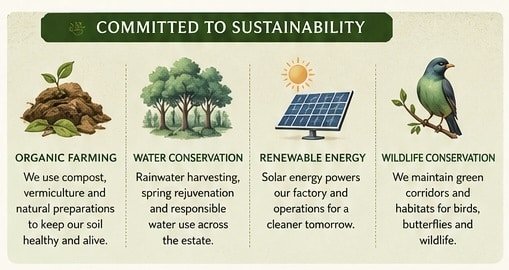
Makaibari tea estate adopts sustainable agriculture and is the first tea garden globally to shift to biodynamic farming, in which no chemical fertilizers are applied, but soil vitality is increased through composting. This makes Makaibari a trailblazer in green farming when industrial farming was on the rise, demonstrating that sustainability and tradition could walk together.
Biodynamic farming, rooted in the philosophy of Rudolf Steiner, treats the farm as a self-sustaining living organism. At Makaibari Tea Estate, this means:
- No synthetic pesticides or fertilizers — ever
- Composting to enrich soil vitality naturally
- Planting, pruning, and harvesting aligned with lunar and cosmic calendars
- Multi-tier agroforestry where tea coexists with native forests
The estate sustains a unique model of 7-tiered mixed agroforestry where tea grows in harmony with the native rainforest.
Rajah Banerjee focused on permaculture, using a multi-tier system of plants and trees to prevent erosion and keep the soil enriched, rather than growing a monoculture of tea bushes, and two-thirds of the land remains forested.
This approach produces tea with a depth of flavour that conventional or even standard organic estates simply cannot replicate. The forest canopy filters sunlight, the diverse root systems enrich the soil microbiome, and the absence of chemicals allows the tea plant’s natural chemistry to express itself fully.
The Famous Teas of Makaibari
Makaibari Tea Estate produces a remarkable range of teas across multiple flushes (harvesting seasons), each with a distinct character.
First Flush (March–April)
The first flush is the most eagerly anticipated harvest of the year. Picked from the youngest, most tender new growth after winter dormancy, Makaibari First Flush is prized for its:
- Light, delicate liquor with a pale golden colour
- Fresh, floral, and slightly grassy aromas
- A lively astringency with a clean, bright finish
- Notes reminiscent of spring blossoms and fresh herbs
First flush teas are sometimes described as “the green tea of black teas” — they retain enough chlorophyll to carry that characteristic vivacity.
On TeaFlush.com, you’ll find in-depth tasting notes for each Makaibari First Flush lot.
Second Flush (June–July)
If the first flush is spring, the second flush is high summer — richer, bolder, and more complex.
Second flush organic tea from India (especially the Darjeeling region) offers a darker liquor and stronger body than teas of the first flush, with far less “green” character. Makaibari’s second flush offers an exquisite aroma and amber colour, with fully-ripened Muscat grape and forest floor notes, and an ample astringency.
The famous muscatel flavour — that intoxicating grape-like character unique to Darjeeling second flush teas — reaches its peak expression at Makaibari Tea Estate. This is largely attributed to the bite of a tiny leafhopper insect (Jacobiasca formosana), whose feeding triggers the tea plant to produce stress compounds that paradoxically enhance flavour complexity.
Monsoon Flush (July–September)
The rains bring a more robust, full-bodied tea — less nuanced than first or second flush, but excellent for everyday brewing, especially with milk.
Autumn Flush (October–November)
Often overlooked, the autumn flush from Makaibari has a warm, mellow, and slightly woody character with a copper-toned liquor. It pairs beautifully with spiced foods.
Springtime Bloom
Springtime Bloom is a first flush black tea with overtones of green tea.
Darjoolong
Darjoolong is a semi-fermented Oolong tea made in small quantities. A rarity from Makaibari, this tea bridges the world of Darjeeling black tea and traditional Taiwanese oolong, offering something genuinely unique.
Silver Tips Imperial: The World’s Most Expensive Darjeeling Tea
Of all of Makaibari’s offerings, none commands more reverence — or more extraordinary prices — than the Silver Tips Imperial.
Silver Tips Imperial is a handmade semi-fermented Oolong tea, which is the top tea made by the estate.
In 2006, it fetched a jaw-dropping $1,800 per kilogram at a Shanghai auction. The green-and-silver streaked leaves are composed solely of the healthy, unbroken tips of Makaibari’s organically grown bushes and are harvested just five times a year, only under the light of a full moon.
What makes Silver Tips Imperial so special?
- Harvested only five times a year, exclusively on full moon nights
- Only the unbroken, unblemished silver tips — the very youngest, most tender leaf bud — are selected
- Hand-processed with extraordinary care by trained workers
- The result is a tea of ethereal delicacy — faint notes of peach, a light amber cup, an aroma of extraordinary subtlety
A special batch of 420 jars of 12 grams each was offered in the UK under the name Moonlight Silver Tips. Its properties were considered so beneficial that a sought-after cosmetics designer in Japan created an anti-aging serum using Makaibari Silver Tips Imperial.
Moonlight Plucking: A Ritual Like No Other
The Moonlight Plucking practice at Makaibari is one of the most extraordinary and scientifically reasoned harvesting rituals in the world of tea.
Just before the summer solstice, on a full moon night in June, from a minute past midnight to 3 AM, specially trained women pluck the two leaves and a bud by the light of hand-held tallow torches at Makaibari. The plucking time of 2 hours, 59 minutes was fixed after intensive study of the biodynamic calendar and precise astronomical charts.
Rajah Banerjee’s explanation for why the full moon matters: during the full moon, water content in all life forms decreases. What you have in the tender tea leaves and bud is the distilled essence of the plant with all its subtle flavours and characters.
This is not mysticism — it aligns with biodynamic principles that recognize lunar cycles as influencing sap flow in plants, much as the moon influences ocean tides. The result is a leaf with an elevated concentration of essential oils, amino acids, and flavour compounds.
For tea lovers, a cup brewed from moonlight-plucked Makaibari leaves is as close to a transcendent experience as tea gets.
Organic & Fairtrade Certifications
Makaibari Tea Estate commitment to ethical, sustainable production is backed by some of the most rigorous certifications in the world:
| Certification | Year Achieved | Significance |
|---|---|---|
| Organic (India’s first tea garden) | 1988 | No synthetic pesticides or fertilizers |
| Biodynamic | 1990s | Lunar-aligned farming, soil-as-living-organism philosophy |
| Fair Trade | First in India | Ethical wages, community benefits, worker welfare |
Under Rajah Banerjee’s guardianship, Makaibari was the first garden amongst Darjeeling’s 87 tea gardens to become completely organic.
Banerjee was the first in India to implement Fairtrade standards in tea gardens, emphasizing ethical labor and community benefits.
These are not marketing labels — they represent a deep, structural commitment to doing tea right: for the land, for the people who work it, and for the people who drink it.

Flora, Fauna & the Forest Cover
Makaibari Tea Estate is not merely a tea estate. It is a thriving, high-altitude ecosystem.
With 70% of its land under forest cover, the estate is home to a remarkable diversity of life:
- Mammals: The Assam macaque (Macaca assamensis), leopards, barking deer, and more inhabit the forested zones
- Birds: The estate is a paradise for birdwatchers, with the Malabar Pied Hornbill among the many species spotted here
- Butterflies: The famous Vernelli Butterfly Trail traverses habitats supporting numerous butterfly species
- Flora: A six-tiered agroforestry system integrates shade trees, fruit trees, bamboo, and forest canopy above the tea bushes
This biodiversity is not incidental — it is a deliberate outcome of Makaibari’s biodynamic farming philosophy. A healthy ecosystem produces healthy soil. Healthy soil produces extraordinary tea.
Visiting Makaibari: Eco-Tourism & Homestays
Makaibari Tea Estate has pioneered eco-tourism in Indian tea gardens, offering visitors a genuine, immersive experience rather than a sanitized tourist spectacle.
Factory Tours
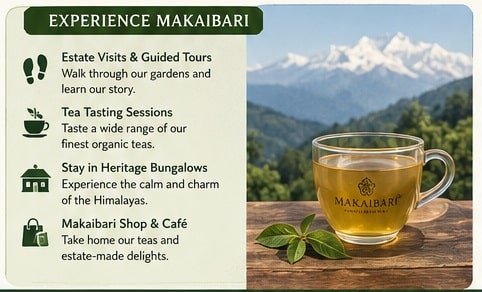
Makaibari is the only tea estate in the area where there are tours of the factory and gardens and tea tasting, after which you can buy the teas that you like.
The factory tour is deeply educational — visitors learn about every stage of tea processing, from withering and rolling to oxidation and drying.
Tea Tasting Sessions
One of the top attractions at Makaibari Tea Estate is the opportunity to participate in a tea tasting session. During these sessions, visitors can sample a variety of Darjeeling teas, including the famous first flush and second flush teas. These tastings are often guided by knowledgeable tea experts, who explain the subtle differences in flavour, aroma, and characteristics of each type of tea.
Homestays
Spend the night at a homestay on the estate with a tea-worker’s family, who will be more than happy to host you, warming your hearts with their hospitality and your bodies with a steaming cup of chai.
The homestay programme is one of Makaibari’s most celebrated offerings. It connects visitors directly with the community — the people who plant, pluck, and process the tea — creating a meaningful human experience around what might otherwise be just a beverage.
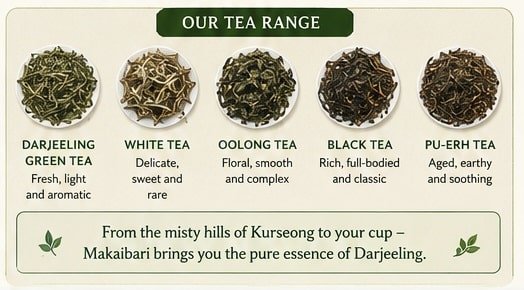
Activities & Experiences
Eco-Tourism at Makaibari is an environmental and cultural programme with outdoor activities and meaningful experiences of community life. Highlights include:
- Verneli Trail and Butterfly Trail — forest trekking through the estate
- Bird watching in the diverse forest zones
- Full Moon Harvesting — witnessing or participating in the legendary moonlight plucking
- A Day in Our Farmer’s Life — animal husbandry, cow milking, biogas production
- Meditation in the estate’s sanctuary
- Sunset at Tiger Hill — a breathtaking Himalayan panorama
The Estate Bungalow
Tucked in the foot of the Himalayas, this iconic bungalow was designed to look partly like a tea estate bungalow and partly as a log cabin. It offers a charming, atmospheric stay for those seeking something beyond the homestay experience.
What to Buy
If you want to pick up some prized tea leaves of Makaibari while visiting the factory, there is a factory retail outlet located just inside the main gate and to the left. There are pouches and small boxes of tea of different varieties kept on the shelves.
How to Reach Makaibari Tea Estate
Makaibari is located in the Kurseong area and about midway between Bagdogra airport and Darjeeling town centre. It takes about 1.5 hours to reach Makaibari from Bagdogra airport or Siliguri and about the same time from Darjeeling town.
Step-by-step directions:
- By Air: Fly into Bagdogra Airport (IXB), the nearest airport (~55 km). From there, take a taxi or shared jeep toward Kurseong.
- By Rail: The New Jalpaiguri (NJP) Railway Station is another major hub (~50 km away). Alternatively, the charming Darjeeling Himalayan Railway (Toy Train) stops at Kurseong — a scenic and memorable option.
- By Road: From Siliguri or NJP, take NH10 toward Kurseong. The estate is approximately 5 km from Kurseong town centre. Taxis are readily available.
- Best Time to Visit: March–May (first flush season) and June–August (second flush, monsoon) are ideal for tea lovers. October–November is perfect for clear Himalayan views.
Where to Buy Makaibari Tea Online
Makaibari teas are available through several channels:
- Makaibari’s official website (makaibari.in) — for direct purchases
- Specialist Darjeeling tea retailers — both domestic and international
- Premium tea boutiques in major Indian cities
- Select e-commerce platforms in the UK, Japan, the USA, and Germany
When buying Makaibari tea, always look for:
- The lot number (e.g., DJ 158/14) — this identifies the specific harvest and batch
- Organic and Biodynamic certification markings
- Flush designation (First Flush, Second Flush, etc.)
- A clearly stated harvest year — freshness matters enormously
At TeaFlush.com, we review and recommend specific Makaibari lots with detailed tasting notes, so you always know what you’re buying.
Makaibari Tea Estate: Key Facts at a Glance
| Detail | Information |
|---|---|
| Established | 1852 (factory: 1859) |
| Location | Kurseong, Darjeeling District, West Bengal, India |
| Altitude | ~1,500 metres (approx. 5,000 feet) above sea level |
| Total Area | ~670 hectares |
| Tea Cultivation Area | ~270 hectares (120 hectares planted) |
| Forest Cover | ~70% of total land |
| Current Owner | Luxmi Tea Company (Luxmi Group) |
| World Record | First biodynamic tea estate in the world |
| Certifications | Organic, Biodynamic, Fair Trade |
| Famous Tea | Silver Tips Imperial (world’s most expensive Darjeeling) |
| Auction Record | $1,800/kg (Shanghai, 2006); ₹1.11 lakh/kg (wholesale) |
| Notable Former Director | Rajah (Swaraj Kumar) Banerjee (1970–2017) |
FAQs About Makaibari Tea Estate
What makes Makaibari tea so special?
Makaibari tea is grown on the world’s oldest biodynamic tea estate, at high altitude, with no synthetic chemicals, using lunar-aligned farming practices. The combination of extraordinary terroir, biodynamic soil health, and meticulous hand-processing creates teas of unparalleled complexity and flavour.
Is Makaibari tea organic?
Yes. Makaibari was the first garden amongst Darjeeling’s 87 tea gardens to become completely organic, achieving certification in 1988. It is also biodynamic and Fair Trade certified.
What is the most expensive tea from Makaibari?
The Silver Tips Imperial, harvested by moonlight only five times a year. In 2006, it fetched $1,800 per kilogram at a Shanghai auction.
Can I visit Makaibari Tea Estate?
Absolutely. The estate welcomes visitors for factory tours, tea tastings, trekking, birdwatching, and immersive homestays with local tea-worker families.
Who owns Makaibari Tea Estate now?
Since 2014, Makaibari has been owned by the Luxmi Tea Company (Luxmi Group), based in Kolkata. Previously, it was owned by the Banerjee family for four generations.
What is the “Moonlight Plucking” at Makaibari?
It is a ritual harvest performed between midnight and 3 AM on a full moon night in June, conducted by specially trained women using tallow torches. The timing is determined using biodynamic calendars and astronomical charts. The resulting tea — Silver Tips Imperial — is among the rarest and most prized in the world.
What is the best Makaibari tea for beginners?
The Second Flush Black Tea is the most accessible entry point — rich, muscatel-inflected, and beautifully balanced. It offers a clear expression of why Darjeeling tea is called the “Champagne of Teas.”
Final Thoughts: Why Makaibari Matters
In a world of commodity teas and industrial agriculture, Makaibari Tea Estate stands as a quietly radical act of resistance. It is proof that a tea garden can be commercially successful while also being ecologically conscious, ethically run, and spiritually rooted.
Darjeeling produces just 0.5% of global tea annually, but due to its spectacular terroir and unique environmental conditions, Darjeeling tea has earned the sobriquet of the best tea in the world — and Makaibari comfortably sits at the helm.
Whether you’re a seasoned tea connoisseur hunting the next extraordinary lot, a traveller dreaming of mist-wrapped Himalayan mornings, or simply someone who reaches for a good cup at the end of a long day — Makaibari Tea Estate has something for you.
At TeaFlush.com, we believe that great tea tells a story. Makaibari’s story is one of the finest ever steeped.
Explore more Darjeeling tea stories, estate profiles, and brewing guides at TeaFlush.com.
Tags: Makaibari Tea Estate, Darjeeling Tea, Biodynamic Tea, Silver Tips Imperial, Organic Tea India, Kurseong Tea Garden, Moonlight Tea, First Flush Darjeeling, Second Flush Darjeeling, Indian Tea Estates, Rajah Banerjee, Luxmi Tea
© TeaFlush.com — All Rights Reserved