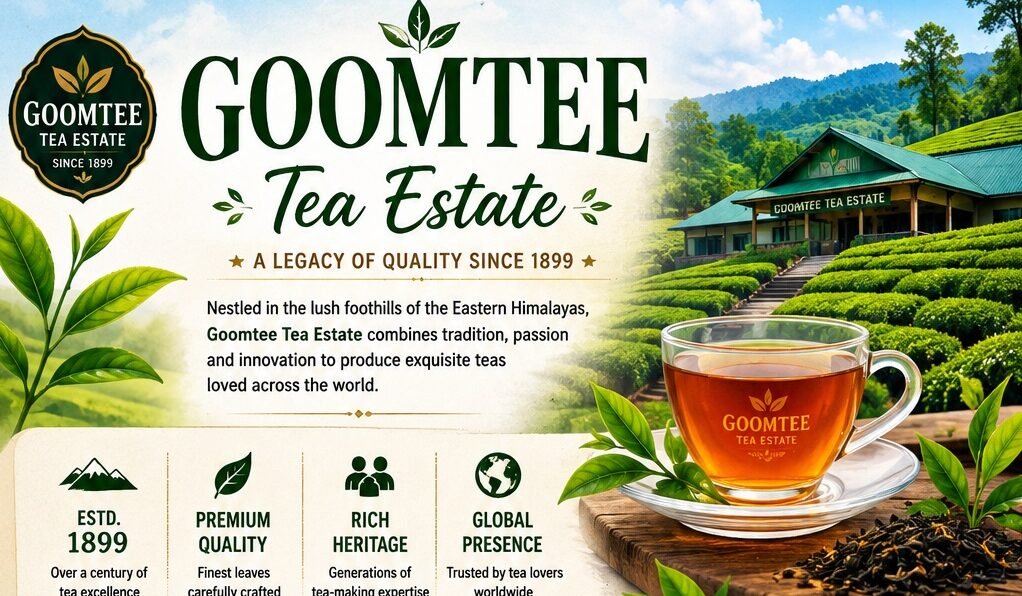
A deep dive into the history, terroir, teas, and timeless legacy of one of Darjeeling’s most celebrated gardens — from the misty slopes of Muscatel Valley to your teacup.
“To drink a cup of Goomtee is to sip the Himalayas themselves.”
Table of Contents
Introduction: Why Goomtee Deserves Your Attention
If you’ve ever explored the world of fine Darjeeling teas, you’ve likely come across names like Castleton, Makaibari, and Jungpana. But tucked between those legendary estates, along the fog-kissed ridges of south Kurseong, lies a garden that serious tea lovers regard with near-reverence: Goomtee Tea Estate.
Goomtee doesn’t shout for attention. It doesn’t need to. Over more than 125 years, this estate has quietly earned its place among Darjeeling’s top five quality gardens — producing muscatel second-flush teas so distinctive, so intensely flavourful, that connoisseurs across Japan, Germany, the UK, and the United States seek them out season after season.
This is everything you need to know about Goomtee — its roots, its land, its teas, and why it matters.
Quick Facts at a Glance
| Detail | Info |
|---|---|
| Location | Kurseong subdivision, Darjeeling district, West Bengal, India |
| Coordinates | 26°53′08″N, 88°19′31″E |
| Established | 1899 |
| Total Area | 225 hectares (approx. 560 acres) |
| Area Under Tea | ~110 hectares (approx. 50%) |
| Elevation | 3,000 to 6,000 feet (900–1,800 m) |
| Certification | ISO 9001, HACCP; Muscatel Valley Division — Organic Certified |
| Annual Production | ~70,000 kg across all flushes |
| Tea Bushes | Over 1 million China clonal bushes |
| Current Management | Ashok Kumar (Managing Partner); Kejriwal family & Mahabir Prasad (owners) |
| Nearest Town | Kurseong (~8 km) |
| Nearest Airport | Bagdogra Airport (~45 km) |
| Nearest Railway | New Jalpaiguri (NJP) Station (~40 km) |
Part 1: The History of Goomtee Tea Estate
Origins Under British Hands (1899)
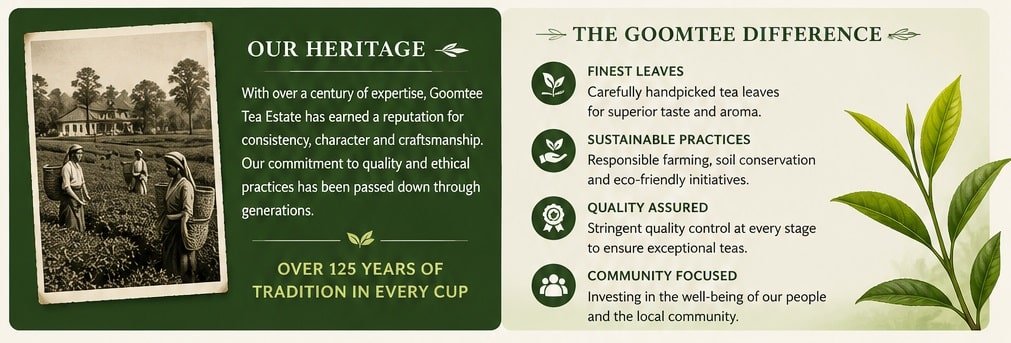
The story of Goomtee begins in the final years of the Victorian era. In 1899, a British tea planter named Henry Montgomery Lennox first planted this garden in the verdant hills of south Kurseong. Lennox wasn’t just a businessman — he was a cultivator of vision, choosing land at a high altitude where the misty Himalayan conditions would coax the finest characteristics out of every tea leaf.
The estate’s heritage bungalow, still standing today, was once Lennox’s family home. It is now over 100 years old and has been lovingly restored to welcome visitors.
The G.W. O’Brien Era and the Post-War Sale
After Lennox, the estate came under the stewardship of G.W. O’Brien, who managed it through the tumultuous decades leading up to World War II. In the aftermath of the war — a period of seismic political and economic change across the Indian subcontinent — O’Brien was compelled to sell the estate. It passed into the hands of Nepal’s ruling Rana family, adding a royal chapter to Goomtee’s already storied history.
The Kejriwal–Prasad Era Begins (Mid-1950s)
By the mid-1950s, the estate changed hands once more. The Kejriwal family and Mahabir Prasad jointly took ownership in approximately 1956, marking the beginning of a new and enduring chapter. Under their stewardship, the estate was modernised, the heritage bungalow was renovated, and a firm commitment to quality was embedded into Goomtee’s identity.
Today, the estate is efficiently managed by Mr. Ashok Kumar, the managing partner, who continues to uphold the legacy built over more than a century.
Part 2: Location and Terroir — The Geography Behind the Magic
Where Exactly Is Goomtee?
Goomtee Tea Estate is located in south Kurseong, in the Kurseong Community Development Block within the Kurseong subdivision of Darjeeling district. It sits almost perfectly midway between Siliguri (40 km) and Darjeeling town (48 km), just 8 km below Kurseong Valley on the Hill Cart Road (National Highway).
Its prestigious neighbours include:
- Jungpana Tea Estate — to the east
- Castleton Tea Estate — to the west
- Sivitar and Giddapahar Tea Estates — to the north
Being nestled between Jungpana and Castleton is no small distinction. These three estates form an unofficial triumvirate of excellence in Darjeeling’s muscatel belt.
Elevation: The Heart of Goomtee’s Character
The estate spans an elevation range of 3,000 to 6,000 feet (900–1,800 metres), with the famed Muscatel Valley Division occupying the highest section between 5,000 and 6,500 feet. At these altitudes, the interaction between cool mountain air, alternating mist and sunshine, and nutrient-rich Himalayan soil creates the slow-growing conditions that are essential for producing leaves of exceptional depth and complexity.
The slower a tea leaf grows, the more concentrated its flavour compounds become. Goomtee’s geography makes this unhurried development not just possible — but inevitable.
Soil and Climate
The terroir at Goomtee is a combination of:
- Fertile, well-drained Himalayan mountain soil rich in minerals
- Alternating mist and sunshine — the classic Darjeeling microclimate
- Cool nights and warm days that stress the tea plant just enough to produce aromatic complexity
- Natural water streams flowing through the estate
This precise combination of factors — what the French would call terroir — is what makes Goomtee teas impossible to replicate anywhere else on earth.
Part 3: Muscatel Valley — Goomtee’s Crown Jewel
What Is the Muscatel Valley Division?
The single most celebrated part of Goomtee is its Muscatel Valley Division — a roughly 250-acre section occupying the highest elevations of the estate (5,000–6,500 ft). The name itself is a declaration: this is where Goomtee’s legendary muscatel-character teas are born.
The Muscatel Valley Division is the fully organic-certified section of the estate, processed separately in the Goomtee Factory in accordance with ISO 9001 and HACCP standards. No chemical fertilisers or pesticides are used here. The philosophy is simple: let the mountain do the work.
What Does “Muscatel” Actually Mean?
“Muscatel” refers to the distinctive flavour note — reminiscent of muscat grapes — that appears in certain Darjeeling second-flush teas. It is one of the most prized and mysterious characteristics in the world of tea, and Goomtee’s Muscatel Valley is among the few places on earth where it appears with reliable consistency and intensity.
The muscatel character in Goomtee’s second flush has been described as:
- Muscat/muscadine grape — the defining note
- Summer roses in full bloom — the bouquet
- Ripe peach — a softer, fruity undertone
- Cocoa and anise — balancing depth and spice
- Light briskness — a lively, refreshing finish
This isn’t just tea. It’s aromatherapy you can drink.
Part 4: The Teas of Goomtee — A Flush-by-Flush Guide
Goomtee produces teas across all four flushes of the Darjeeling calendar. Each offers a completely different sensory experience.
🌸 First Flush (Spring — March to April)
The first flush is the tea world’s equivalent of a new year — fresh, light, and full of anticipation. Goomtee’s first flush is characterised by:
- Appearance: Fine, tippy leaves with a mix of green and light brown hues
- Liquor: Bright, verdant — a clear golden-green cup
- Flavour: Floral and mineral, with creamy notes and a lightly stony, lingering aftertaste
- Mouthfeel: Smooth, delicate, with minimal astringency
Notably, first flush muscatel is rare in the Darjeeling world — yet Goomtee’s Muscatel Valley consistently produces some excellent muscatel notes even in spring, making it a prized collector’s item each season. The 2025 and 2026 first pickings (Invoice DJ-1) from the Muscatel Valley division are processed with a hard wither at 68%, light-pressure rolling, short oxidation, and full firing — a method that ensures full flavour with a longer shelf life.
Tea Grade: FTGFOP1 (Finest Tippy Golden Flowery Orange Pekoe, First Grade)
Brewing Guide:
- Water temperature: 85–90°C
- Steeping time: 2–3 minutes
- Quantity: 2–3 grams per 200 ml
- Best enjoyed: without milk, as a standalone meditative cup
☀️ Second Flush (Summer — May to June)
This is Goomtee’s pièce de résistance. The second flush — harvested between May and June — is where Goomtee transcends mere excellence and enters the realm of the truly extraordinary.
During this peak period, the tea bushes yield leaves bursting with flavour, producing a rich amber liquor with the most pronounced muscatel notes of the year.
- Appearance: Fine, tippy leaves — spicy and woody in character when dry
- Liquor: Deep amber, bright and clear
- Flavour: Classic muscatel grape character, floral bouquet, ripe peach, cocoa, anise
- Mouthfeel: Full-bodied, rich, with a long and satisfying finish
The second flush from Goomtee’s Muscatel Valley is marketed under the name “Muscatel Valley” and sold as a distinct, premium offering alongside standard Goomtee teas. These are produced from pure China clonal leaf bushes and are among the most sought-after Darjeeling teas in the global market.
Tea Grade: FTGFOP1 / SFTGFOP1
Brewing Guide:
- Water temperature: 90–95°C
- Steeping time: 3–4 minutes
- Quantity: 2.5–3 grams per 200 ml
- Best enjoyed: plain, or with the faintest drop of honey
🍂 Autumn Flush (October to November)
Often overlooked in favour of the glamorous first and second flushes, Goomtee’s autumn flush is quietly remarkable.
- Appearance: Thicker leaves, coppery hue — characteristically autumnal
- Liquor: Coppery amber
- Flavour: Sweet, biscuity (malty but not quite), and pronounced — like a warm Himalayan evening
- Mouthfeel: Smooth and comforting, minimal bite
The autumn leaf has almost no tips and is less grassy, more rounded and warm — perfect for cooler evenings and reflective moments.

Part 5: The Orthodox Method — How Goomtee Makes Its Tea
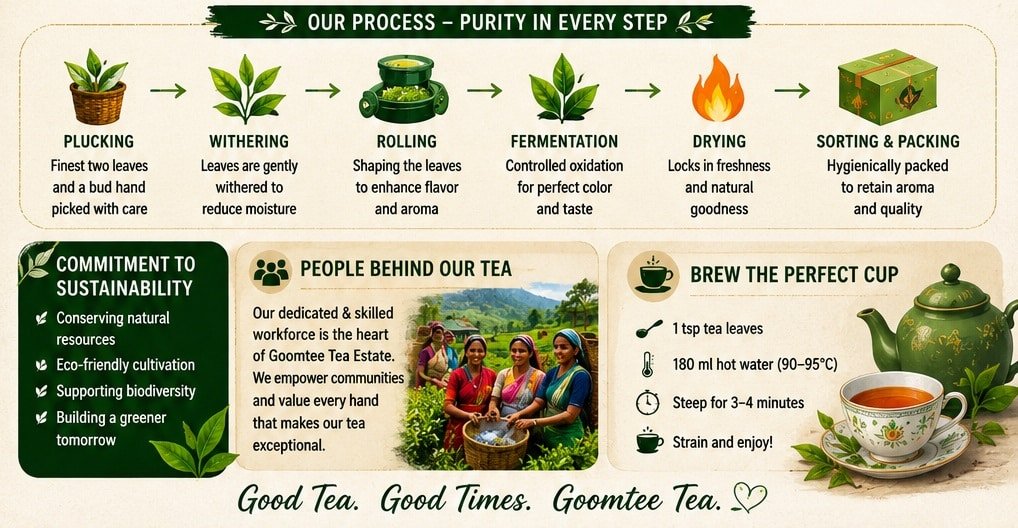
Goomtee produces all its teas using the traditional Orthodox method — the gold standard for Darjeeling teas and the technique that preserves the integrity of the leaf and the terroir it came from.
Here is the step-by-step journey from bush to cup:
Step 1: Plucking
Workers hand-pluck two leaves and a bud — the gold standard in fine Darjeeling production. This selective plucking ensures only the youngest, most flavour-rich growth enters the processing chain.
Step 2: Withering
The freshly plucked green leaf is spread on large trays and exposed to moving air for 12–18 hours. This reduces moisture content and makes the leaf pliable for rolling. The Muscatel Valley division is processed with a hard wither at 68% moisture reduction for its first flush — a technique that locks in fuller flavour.
Step 3: Rolling
The withered leaf is loaded into rolling machines and rolled under pressure, breaking down the cell structure and releasing the natural juices and enzymes that initiate oxidation and pigmentation. This is where the magic begins.
Step 4: Oxidation (Fermentation)
The rolled leaf is spread thinly in a cool, well-ventilated room and left to slowly ferment. The degree and duration of oxidation is carefully controlled — lighter for first flush (to retain floral and green notes), heavier for second flush (to develop muscatel depth and amber colour).
Step 5: Firing (Drying)
The oxidised leaf is passed through a drying machine at high temperature, halting oxidation and reducing moisture to less than 3%. This locks in all the complex flavours developed during rolling and oxidation.
Step 6: Sorting and Grading
The dried tea is sorted by size and grade using vibrating sieves — separating FTGFOP1, SFTGFOP, BOP, and other grades. Goomtee’s finest lots are hand-sorted and reserved for direct export.
Part 6: Sustainability and Organic Farming
Goomtee is a leader in sustainable and organic tea cultivation in the Darjeeling region.
- The Muscatel Valley Division is a fully certified organic section, where chemical fertilisers and pesticides are entirely absent.
- The estate uses composting, natural pest control, and environmentally conscious agricultural methods across the entire property.
- The factory processes organic teas separately from conventional lots, maintaining the integrity of organic certification.
- The estate has been on a path toward full organic certification for the entire 500-acre plantation.
- All teas are processed under ISO 9001 and HACCP standards, ensuring consistent quality and food safety.
- The Majhua Division underwent formal conversion to organic farming under the inspection of IMO/Switzerland.
The estate’s philosophy is beautifully simple: preserve and enrich nature. The mountain will reward you.
Part 7: The Goomtee Tea Bungalow — Where History Sleeps
A 100-Year-Old Heritage Stay
Few tea experiences in the world compare to staying at the Goomtee Tea Bungalow — the very residence where Henry Montgomery Lennox once lived. Perched at an altitude of 4,150 feet, the bungalow offers panoramic views of mountains, valleys, and rolling tea gardens from virtually every window.
Since the Kejriwal and Prasad families renovated it after 1956, the bungalow has been open to tourists, offering a rare opportunity to stay within a working tea estate. The British architectural heritage is intact — high ceilings, wooden floors, the warmth of fireplaces in winter — combined with the comfort of modern amenities.
What to Expect at the Goomtee Resort
- Dining: A charming dining room with wooden floors, serving primarily vegetarian cuisine — North and South Indian, Continental, Chinese, and American dishes. Eggs and dairy are offered. Bottled water is standard.
- Tea: Every morning, guests are served fresh tea harvested the previous day — an experience almost nowhere else on earth can offer.
- Library: A cosy sitting area with cushioned cane chairs — perfect for curling up with a book between garden walks.
- Fireplaces: Lit during winter evenings, filling the bungalow with warmth and the scent of the mountains.
- Garden visits: Guests can witness the full tea-making journey — from plucking in the fields to processing in the factory.
- Included: Vegetarian meals and Darjeeling tea. Additional activities (factory visits, transport, sightseeing) are charged separately.
Contact: P.O. Mahanadi, District Darjeeling 734223, India Mr. Asish — Mobile: +91 87593 81486
Part 8: Getting to Goomtee Tea Estate
Goomtee is conveniently located and well-connected despite its mountain setting.
By Air
Fly into Bagdogra Airport (IXB) — approximately 45 km from the estate. Taxis and shared vehicles are readily available.
By Train
The nearest major railway station is New Jalpaiguri (NJP) — approximately 40 km away. From NJP, hire a taxi or take a shared vehicle toward Kurseong. Get off at Mahanadi Toy Train Station on the Hill Cart Road and take the approach road — the resort is only 100 metres from the highway.
For the adventurous, ride the UNESCO World Heritage Darjeeling Himalayan Railway (Toy Train) from NJP to Kurseong — a journey of extraordinary scenic beauty in itself.
By Road
- From Siliguri: ~40 km via Hill Cart Road (NH-110)
- From Darjeeling: ~48 km
- From Kurseong: ~8 km below the town
Part 9: Things to Do Around Goomtee
Goomtee is more than a tea garden — it’s a gateway to the best of the Darjeeling foothills.
- 🚂 Darjeeling Himalayan Railway (Toy Train) — UNESCO World Heritage Site; board at Mahanadi station
- 🛍️ Kurseong Markets — Explore local crafts, snacks, and mountain life
- 🌿 Dow Hill — A hauntingly beautiful forest known for its biodiversity and legends
- 🦌 Deer Park, Kurseong — A peaceful wildlife spot for families
- 🏔️ Bagora Village — At 7,150 ft, known for birds, oak and pine forests, and rhododendrons
- 🍵 Ambootia Tea Estate — A neighbouring organic estate worth a comparative visit
- 🌄 Sunset viewpoints — The ridges around Kurseong offer sweeping views of the plains and peaks
Part 10: How to Buy Goomtee Tea
Goomtee teas are a limited edition, with approximately 70,000 kg available annually across all flushes and seasons. They sell out fast — particularly the muscatel second-flush lots from the Muscatel Valley division.
You can find authentic Goomtee teas through:
- Specialised Darjeeling tea vendors — Lochan Tea, Darjeeling Tea Boutique, and other estate-direct importers
- International fine tea retailers — In the UK, Germany, Japan, and the US
- Direct from the estate — via their website at goomtee.com
- TeaFlush.com — Your curated source for premium Darjeeling teas including Goomtee’s finest lots
When buying, look for:
- Invoice number (e.g., DJ-1, DJ-05) — confirms authenticity and specific harvest lot
- Flush season clearly labelled (First Flush, Second Flush, Autumn)
- Division — Muscatel Valley lots command a premium and have distinct organic status
- Grade — FTGFOP1 is the finest grade
How to Buy Goomtee Tea
Goomtee teas are a limited edition, with approximately 70,000 kg available annually across all flushes and seasons. They sell out fast — particularly the muscatel second-flush lots from the Muscatel Valley division.
Why Goomtee Stands Apart: A Summary
There are over 80 tea gardens in Darjeeling. Goomtee consistently ranks among the top five. Here’s why:
- Terroir — The Muscatel Valley’s 5,000–6,500 ft elevation produces flavour complexity no lower-altitude garden can match
- History — 125+ years of continuous cultivation by passionate stewards
- Organic integrity — No shortcuts, no chemicals; the leaf is pure
- The Orthodox method — Time-honoured processing that honours the leaf
- Limited production — ~70,000 kg/year means every batch is precious
- The muscatel character — A flavour so distinctive it has its own division named after it
- Sustainability — A genuine, long-term commitment to organic farming and ecological preservation
Final Thoughts: A Cup Worth Seeking
There’s a quiet majesty to Goomtee Tea Estate. It doesn’t manufacture its reputation — it cultivates it, quite literally, leaf by leaf, season by season, at 6,000 feet above sea level.
Whether you’re a seasoned Darjeeling aficionado or someone just beginning to explore the world of single-estate fine teas, Goomtee is a name you’ll return to. The first flush will awaken your senses like a mountain morning. The second flush muscatel will stop you mid-sip and make you set down your cup — not to put it away, but to simply be present in that moment.
That is what the greatest teas do. And Goomtee, in its quiet, mist-wrapped way, does it better than almost anyone.
Explore the world’s finest Darjeeling teas, including Goomtee’s limited seasonal lots, at TeaFlush.com — your guide to the art of exceptional tea.
Tags: Goomtee Tea Estate · Darjeeling Tea · Muscatel Valley · Second Flush Darjeeling · Organic Darjeeling Tea · Kurseong Tea Garden · Orthodox Tea · Single Estate Tea · First Flush Darjeeling · Darjeeling Tea Tourism · Indian Tea Estates · TeaFlush
© TeaFlush.com — Written with a deep love for the leaf.