By TeaFlush | Darjeeling Tea History | Reading Time: ~10 minutes
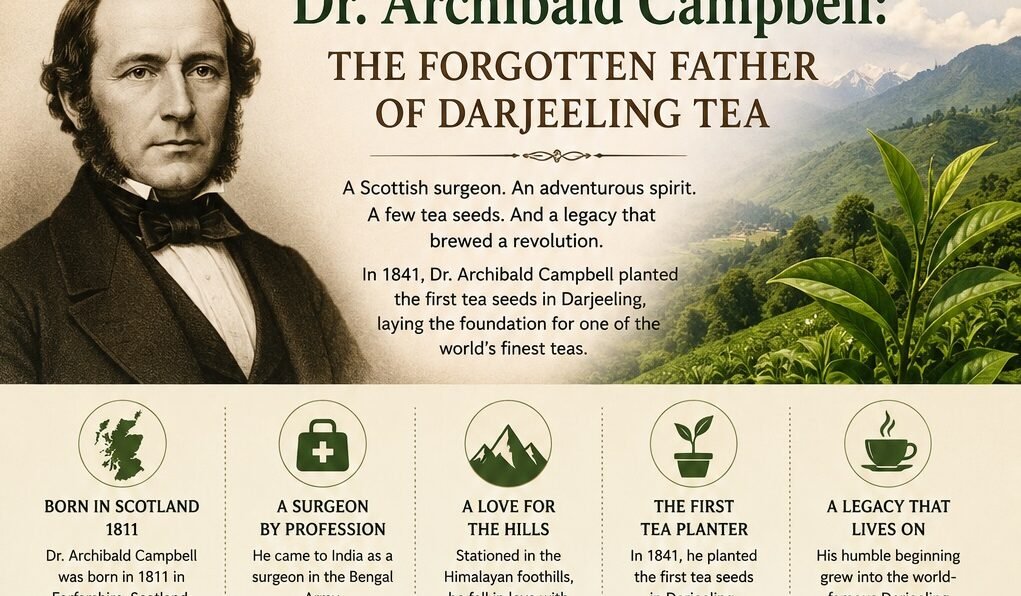
When you cradle a warm cup of Darjeeling tea and breathe in its legendary muscatel aroma, you are inhaling the legacy of one man — Dr. Archibald Campbell. A Scottish physician, botanist, ethnologist, and colonial administrator, Campbell was the visionary whose curious hands first pressed Chinese tea seeds into the misty Himalayan soil of Darjeeling. Without him, there would be no “Champagne of Teas.” Without him, TeaFlush might have a very different story to tell.
Let’s journey deep into the life, work, and lasting legacy of the man who gave the world Darjeeling tea.
Table of Contents
Who Was Dr. Archibald Campbell?
Dr. Archibald Campbell (20 April 1805 – 5 November 1874) was a Scottish-born physician and colonial administrator who served in the Bengal Medical Service of the East India Company. He is best remembered as the first Superintendent of Darjeeling (1840–1862) and, most significantly, as the father of Darjeeling tea — the man who first cultivated Camellia sinensis in the Himalayan foothills and set in motion one of the most celebrated tea cultures on earth.
Beyond tea, Campbell was a polymath. He wrote extensively on ethnology and economic botany, corresponded with the greatest naturalists of his era including Sir Joseph Dalton Hooker and Brian Houghton Hodgson, and played a key role in dramatic political events including the British annexation of the Sikkim Terai region.
His name may not be as instantly recognizable as Robert Fortune or even the East India Company itself — but in the world of tea, there is arguably no more foundational figure.
Early Life and Education
Archibald Campbell was born on 20 April 1805 at Kilciarain, Kildalton, Port Ellen, on the Island of Islay, Scotland. His father was Lieutenant Archibald Campbell of Ardmore, and his mother was Helen Campbell.
Growing up on Islay — an island famous today for its whisky but then known for its rugged landscapes and close-knit communities — young Archibald likely developed his love of the natural world early. He pursued his education at Glasgow, then went on to Edinburgh University, one of the finest medical schools in the world at the time, graduating with an M.D. degree between 1824 and 1827.
Edinburgh in the early 19th century was a hotbed of Enlightenment thinking, scientific inquiry, and natural philosophy. It was an environment perfectly suited to shaping a mind that would later turn a colonial hill station into a botanical laboratory.
From Scotland to the Subcontinent
After graduating, Campbell joined the Bengal Medical Establishment of the East India Company on 8 May 1827. In June 1828, he was posted to the horse artillery at Meerut, also occasionally serving at the European Convalescent Depot at Landour.
In 1832, a pivotal posting changed the direction of his life: he became the surgeon at Kathmandu, Nepal, serving under the legendary Brian Houghton Hodgson — the British Resident and naturalist whose influence on Campbell would prove profound. Hodgson introduced Campbell to the world of natural history, ethnology, and the intellectual circles of colonial India. It was during these Nepal years that Campbell’s passion for botany and the study of local cultures came fully alive.
By the time he was transferred to Darjeeling in 1839–1840, Dr. Archibald Campbell was no ordinary colonial officer. He was a trained physician with a scientist’s curiosity, an administrator’s ambition, and an explorer’s spirit.
Arrival in Darjeeling: The Superintendent Years (1840–1862)
When Campbell arrived in Darjeeling, it was barely a settlement. The British had annexed the small hill region from Sikkim in 1835, initially envisaging it as a sanatorium — a cool, restorative retreat for soldiers and officers exhausted by the Indian plains. At the time of Campbell’s arrival in 1839, the population of Darjeeling was fewer than 100 people.
As the first Superintendent of Darjeeling, Campbell served in that role from 1840 until his retirement on 8 February 1862 — a tenure of over two decades that would transform the region entirely. He was not merely a passive administrator. He was a builder, a visionary, and above all, an experimenter.
Under his stewardship:
- The population of Darjeeling grew from under 100 in 1839 to approximately 10,000 by 1849, swelled by immigrants from Nepal, Sikkim, and Bhutan.
- By 1852, Campbell had overseen the construction of 70 European-style houses, a bazaar, a jail, and a network of roads.
- Forced labour was abolished under his watch — a significant socio-political reform.
- More than Rs. 50,000 in revenue had been raised for the region.
But his most transformative act was far quieter: pressing a few tea seeds into the ground near his home.
The Historic Tea Experiment of 1841
The year 1841 marks one of the most consequential moments in tea history.
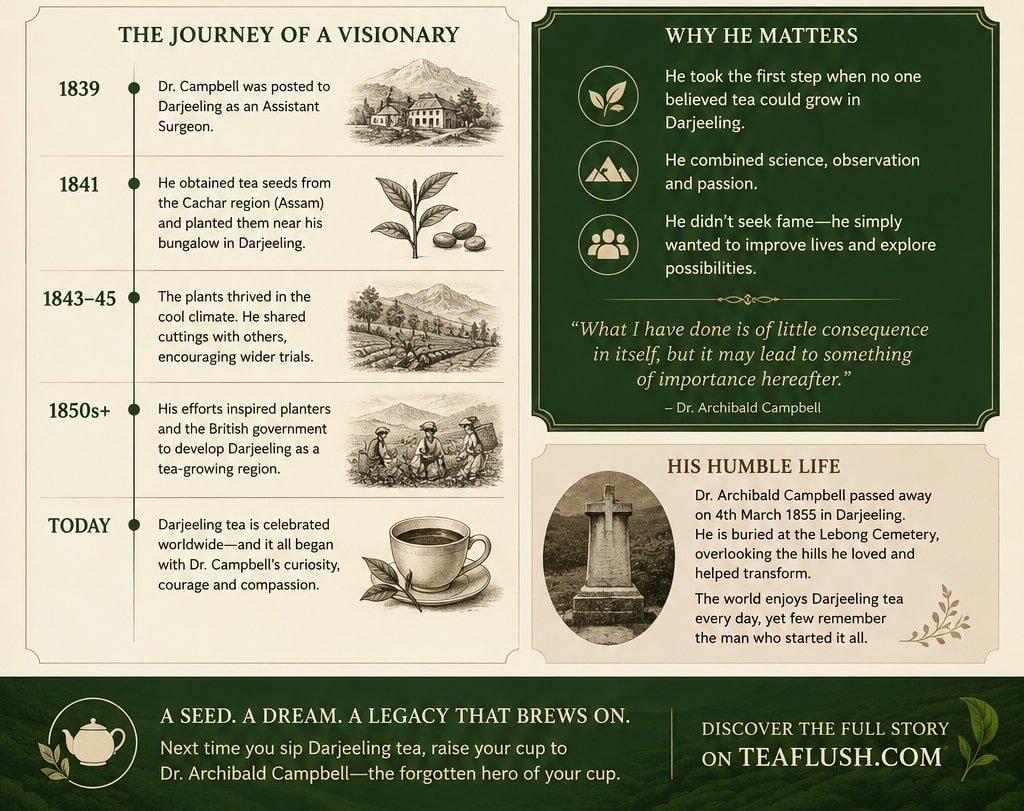
Dr. Campbell, drawing on his knowledge of economic botany and his awareness of ongoing tea experiments in other parts of India, obtained seeds of Camellia sinensis — the Chinese tea plant — and sowed them experimentally near his residence at Beechwood, Darjeeling.
The seeds had been sourced from the Kumaon hills of northern India (some accounts suggest additional seeds also came from the Botanical Gardens of Calcutta). The Kumaon seeds came from Chinese tea stock that had already been cultivated successfully in the northwest Himalayas.
The results were extraordinary. The high-altitude terrain, the cool misty climate, the loamy mineral-rich soils, and the unique interplay of sun and cloud in Darjeeling proved to be a perfect match for the delicate Chinese tea variety. The plants thrived.
As the Annals of Indian Administration recorded in 1862:
“In Darjeeling the first trial of the tea plant was made in 1841 with a few seeds grown in Kumaon from China stock.”
What began as a curious experiment in one man’s garden would, within decades, become one of the most celebrated and economically significant tea industries in the world.
The Beechwood Garden: Where It All Began
The site of Campbell’s original tea experiments was his home — Beechwood, located below the Clock Tower in Darjeeling. It is a location now swallowed by the bustling town that grew around it, but its historical significance is immeasurable.
Beechwood was Campbell’s personal horticultural laboratory. Here, he was not just a government official — he was a naturalist in his own garden, tending plants, observing growth, and carefully documenting outcomes. His experiments at Beechwood were informal but rigorous, and they demonstrated beyond doubt that tea cultivation was viable in Darjeeling.
Shortly after his initial success, Campbell also established a tea nursery at Jalapahar, which was later moved to Lebong in 1845. This was the crucial step from personal garden to commercial potential — the nursery propagated plants that could be distributed to other planters.
The success of Beechwood inspired a cascade. Other settlers began planting. Gardens multiplied. By 1856, tea had become a commercial enterprise in Darjeeling, marking the true birth of the industry.
The Role of Robert Fortune and Chinese Tea Seeds
No account of Darjeeling tea’s origins would be complete without mentioning Robert Fortune — the Scottish botanist commissioned by the Horticultural Society of London who undertook daring missions into China to smuggle out tea seeds and knowledge.
At the time, China closely guarded all aspects of tea cultivation and production as a state secret. Fortune, disguising himself as a Chinese merchant, managed to extract 20,000 high-quality tea plants from the best tea-growing regions of China and bring them to India.
These superior Chinese plants supplemented and improved upon Campbell’s original stock, helping establish the premium quality that Darjeeling tea would become famous for. The combination of Campbell’s pioneer cultivation and Fortune’s botanical intelligence operation gave Darjeeling tea its extraordinary foundation.
It is worth noting, however, that the credit for initiative belongs firmly to Campbell. He was the one who first recognized Darjeeling’s potential, who created the conditions for experimentation, and whose vision set the whole enterprise in motion.
Growing a Hill Station: Campbell’s Administrative Vision
Dr. Campbell’s impact on Darjeeling extended far beyond tea. He was a town-builder in the truest sense. Recognizing Darjeeling’s potential not just as a sanatorium but as a thriving economic and cultural centre, he actively encouraged immigration and infrastructure.
His key administrative achievements included:
Population Growth: Campbell encouraged immigration from Nepal, Sikkim, and Bhutan. The multicultural demographic fabric that defines Darjeeling to this day is, in large measure, a product of his open-door policy.
Infrastructure Development: Roads, houses, a bazaar, and civic buildings — Campbell laid the physical foundations of the hill town that would later captivate writers, travelers, and tea lovers from around the world.
Labour Reform: The abolition of forced labour under his watch demonstrated a progressive streak unusual for colonial administrators of his era.
Economic Diversification: Campbell did not stop at tea. He also experimented with sea-island cotton cultivation in the Terai and explored the potential of Tassar silk culture in the region.
He understood, intuitively, that a resilient economy required diverse foundations — a lesson that remains relevant to sustainable tea-growing communities today.
The Sikkim Expedition and Imprisonment with Joseph Hooker
One of the most dramatic episodes of Campbell’s life unfolded in 1849, when he accompanied the celebrated botanist Sir Joseph Dalton Hooker on an expedition into Sikkim.
Hooker, based in Darjeeling, had been collecting plants throughout the Himalayas. Through their mutual friend Brian Hodgson, Campbell and Hooker had become close, and Campbell played a key role in negotiating British access to Sikkim for Hooker’s botanical work.
During the expedition, the two were taken prisoner by Tsugphud Namgyal, the Chogyal (ruler) of Sikkim, and held captive. The imprisonment of a British government agent and a prominent scientist caused an international incident. The British response was swift and severe — the episode directly led to the British annexation of the Sikkim Terai region, dramatically redrawing the map of northeast India.
Campbell was eventually released, though accounts suggest he was subjected to considerable physical hardship during captivity. The incident did not dampen his scientific enthusiasm. He and Hooker remained close correspondents, and Campbell continued his botanical and ethnological work throughout his superintendency.

Campbell’s Other Botanical Experiments
Tea was just one thread in the rich tapestry of Campbell’s botanical legacy. As superintendent, he used Darjeeling as an open-air laboratory for a range of agricultural experiments:
Cinchona Cultivation: Campbell played an early role in experiments with Cinchona — the bark of which yields quinine, the essential anti-malarial medicine. Darjeeling and the surrounding hills would later become one of the world’s most important cinchona-growing regions, producing quinine that saved countless lives from malaria across the British Empire and beyond.
Sea-Island Cotton: Campbell explored the viability of cultivating premium-quality sea-island cotton in the Terai plains below Darjeeling — an attempt to diversify the region’s economic base.
Tassar Silk: He also experimented with Tassar silk culture, exploring the potential of Darjeeling’s forests and climate for sericulture.
Lloyd Botanical Gardens: Campbell’s era of botanical experimentation set the intellectual climate that would lead to the establishment of the Lloyd Botanical Gardens in Darjeeling — a garden that continues to this day as a centre for plant research and conservation.
Each of these ventures reflects a man who saw the natural world not merely as scenery but as a resource to be understood, cultivated, and shared responsibly.
A Scholar Beyond Tea: Ethnology and Natural History
What makes Campbell truly exceptional — and somewhat under-recognized — is the breadth of his intellectual contributions. He was not merely a man of action. He was a scholar of the first order.
Campbell wrote extensively in the Journal of the Asiatic Society of Bengal, contributing papers on the ethnology, languages, and cultures of the Himalayan peoples. His writings covered the Lepchas, the Limbus, and other communities of the Darjeeling hills, documenting their customs, social structures, and languages at a time when such knowledge was being lost to the upheavals of colonialism.
He corresponded regularly with the greatest naturalists of his age — Charles Darwin (letters from Darwin reference Campbell directly), Sir Joseph Hooker, and Brian Houghton Hodgson — contributing observations and specimens to the great scientific conversations of the Victorian era.
Ironically, this prolific writing under the name “Dr. A. Campbell” has caused some historical confusion — various authors have attributed his first name as Arthur, Andrew, or Archibald, with the Darwin Correspondence Online Database ultimately confirming Archibald as correct.
His intellectual legacy spans botany, medicine, ethnology, and colonial administration — a Renaissance man of the Himalayas.
The Growth of Darjeeling Tea After Campbell
The seed that Campbell planted — both literally and figuratively — grew with extraordinary speed after his retirement in 1862.
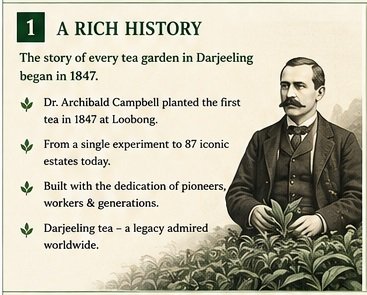
In 1856, the Alubari Tea Garden was established by the Kurseong and Darjeeling Tea Company — the first commercial tea garden in the Darjeeling hills, built squarely on the foundation of Campbell’s experimental work.
By 1866 — just twenty-five years after Campbell’s first planting — Darjeeling already had 39 tea plantations covering 1,000 acres and producing 133,000 lbs of tea per year.
The growth was exponential:
- In the decade after 1866, the number of gardens tripled.
- Acreage increased by 80 percent.
- Production increased tenfold.
The world had recognized what Campbell first knew: that Darjeeling’s combination of altitude, mist, climate, and soil was utterly unique — capable of producing a tea with a delicate, floral, muscatel character found nowhere else on earth.
By the time Darjeeling tea began earning its legendary title — “the Champagne of Teas“ — it was fulfilling the promise of one man’s garden experiment more than two decades earlier.
Campbell’s Legacy in Every Cup
Dr. Archibald Campbell retired on 8 February 1862 and passed away on 5 November 1874, at the age of 69. He did not live to see the full flowering of the industry he planted. But his legacy grew with every new garden, every flush, every cup poured in a drawing room in London or a tea house in Tokyo.
Today, Darjeeling tea is:
- Produced across 87 tea gardens in the Darjeeling district.
- Recognized as a Geographical Indication (GI) product — only tea grown in Darjeeling can legally carry the name.
- One of the most sought-after specialty teas in the world, commanding premium prices in global auctions.
- A cultural symbol of India, West Bengal, and the Himalayan foothills.
None of this would exist without the seeds Campbell planted at Beechwood in 1841.
At TeaFlush.com, every cup of Darjeeling tea we celebrate carries within it the DNA of that original planting. The muscatel notes, the golden liquor, the floral first flush — all trace their lineage to a Scottish doctor who looked at misty Himalayan hillsides and asked: what if tea could grow here?
The answer, as history proved, was magnificent.
FAQs About Dr. Archibald Campbell
Q1. Who is Dr. Archibald Campbell in the context of tea?
Dr. Archibald Campbell (1805–1874) was a Scottish physician and the first Superintendent of Darjeeling who initiated the experimental cultivation of tea (Camellia sinensis) in Darjeeling in 1841. He is widely regarded as the father of Darjeeling tea.
Q2. Where did Dr. Campbell first grow tea in Darjeeling?
Campbell first grew tea at his residence called Beechwood, located near what is now the Clock Tower area in Darjeeling town. He planted seeds sourced from the Kumaon hills of northern India.
Q3. What seeds did Dr. Campbell use for tea cultivation? He used seeds of the Chinese tea plant, Camellia sinensis, initially brought from the Kumaon hills. These were later supplemented by superior Chinese tea plants smuggled into India by Scottish botanist Robert Fortune.
Q4. What else was Dr. Campbell known for besides tea? Campbell was also a noted ethnologist, economic botanist, and colonial administrator. He wrote extensively on Himalayan peoples in the Journal of the Asiatic Society of Bengal, contributed to Cinchona cultivation experiments, and was involved in the 1849 Sikkim expedition with Sir Joseph Hooker.
Q5. What happened during the Sikkim expedition? In 1849, Campbell accompanied botanist Sir Joseph Hooker into Sikkim. Both were taken prisoner by the Sikkimese ruler Tsugphud Namgyal. The incident led to British political intervention and ultimately the annexation of the Sikkim Terai region.
Q6. When did the commercial tea industry in Darjeeling officially begin? While Campbell’s experimental cultivation began in 1841, the commercial tea industry is generally dated to 1856, when the first tea nurseries established from his experiments led to the opening of the Alubari Tea Garden.
Q7. Is Dr. Campbell’s name always correctly recorded? Historically, there has been confusion around his first name — some sources list him as Arthur or Andrew. The Darwin Correspondence Online Database confirms his name as Archibald Campbell, born 20 April 1805.
Conclusion
The story of Darjeeling tea is, at its heart, the story of Dr. Archibald Campbell — a curious Scottish doctor who arrived in a near-empty Himalayan hill station and saw not barren slopes but a garden waiting to happen.
His contributions were many: he built a town from near-nothing, he championed the rights of workers, he corresponded with Darwin and Hooker, he documented endangered cultures, and he survived imprisonment in a Himalayan kingdom. But it is that quiet act in 1841 — sowing a handful of Chinese tea seeds in the Darjeeling soil at Beechwood — that echoes loudest across history.
The next time you brew a cup of Darjeeling — feel the warmth of the mug, inhale the muscatel, take that first sip — remember Dr. Archibald Campbell. His was a small act with an enormous harvest.
Enjoyed this deep dive into tea history? Explore more stories of tea’s origins, culture, and craft at TeaFlush.com — where every cup tells a story.
Darjeeling Tea History, Dr. Archibald Campbell, Father of Darjeeling Tea, Darjeeling Tea Origins, Camellia Sinensis, Bengal Medical Service, Beechwood Darjeeling, Tea History India, Champagne of Teas, TeaFlush
Tea History | Darjeeling Tea
© TeaFlush.com — All Rights Reserved