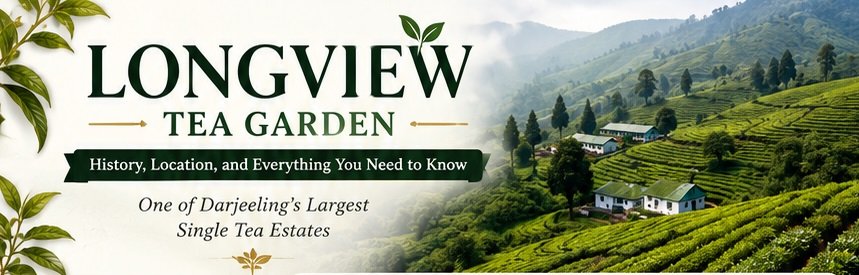
In this guide, we’ll walk through everything worth knowing about Longview Tea Garden: where it sits on the map, how it came to be, who has owned it over the past 150 years, how much tea it produces, and what makes it stand out among the dozens of estates that dot the Darjeeling hills.
Table of Contents
Longview Tea Garden: The Complete Guide to One of Darjeeling’s Largest Tea Estates
If you’ve ever sipped a cup of Darjeeling tea and wondered where the leaves actually came from, there’s a good chance you’ve crossed paths with Longview Tea Garden without even knowing it. Tucked into the sloping hills of Kurseong, this sprawling estate has been part of the Darjeeling tea story since the 1870s — and at one point produced roughly a tenth of all the Darjeeling tea grown anywhere.
Where Is Longview Tea Garden Located?
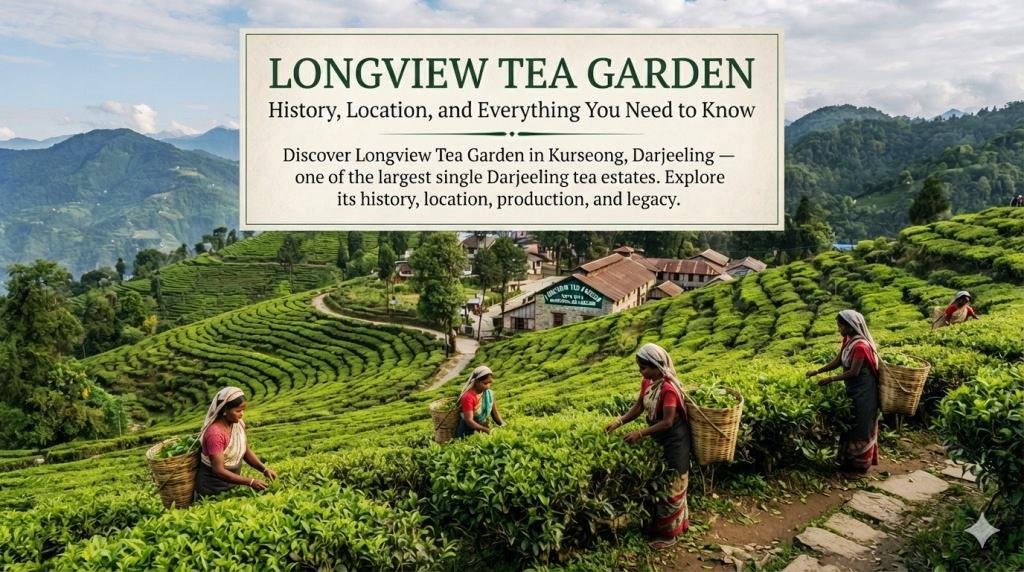
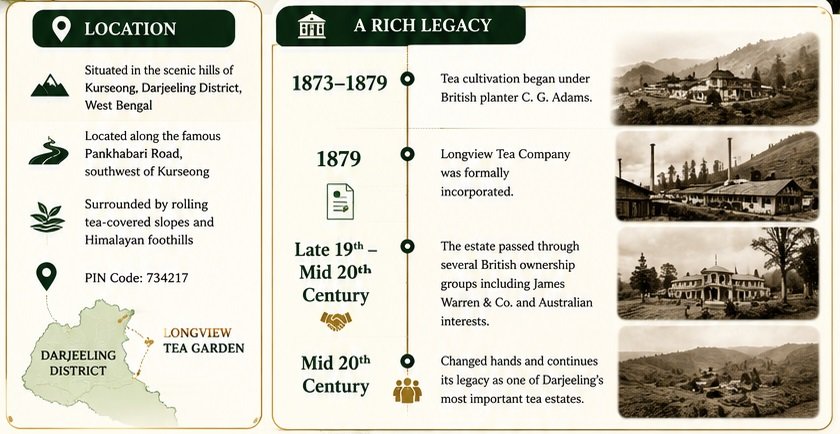
Longview Tea Garden sits in the Kurseong subdivision of Darjeeling district, West Bengal, within the Kurseong Community Development block. Its coordinates place it at roughly 26°48′59″N, 88°15′38″E, on the southwestern side of the Darjeeling hills, in elevation and terrain that runs below the well-known Makaibari tea estate.
One of the most distinctive things about Longview is simply its scale. As you drive toward Pankhabari, the estate’s tea bushes seem to stretch endlessly along both sides of the road, eventually meeting the mountains in the distance — a sight that regularly catches visitors off guard given how compact most Darjeeling gardens feel by comparison.
The estate also gives its name to the surrounding village. Longview Tea Garden village lies about 25.3 km from the Kurseong sub-district headquarters, with Kurseong town itself roughly 15 km away and serving as the area’s main economic hub.
A Brief History of Longview Tea Garden
Longview’s story is older than most people realize, and it’s tangled up with the broader, often turbulent history of British-era tea planting in the Darjeeling hills.
The Early Years (1870s–1950s)
Accounts of exactly who founded Longview vary slightly depending on the source. One history traces the estate back to 16 January 1879, when it was incorporated as a tea company with high hopes for future production. Another widely cited account credits a pioneering British planter named C.G. Adams, who opened the garden in 1873.
What’s clear is that ownership moved through several hands in the decades that followed. The estate was associated early on with James Warren and Company, and later Wyandhams of Australia held the estate until 1953.
The Daga Era and Expansion
In 1954, the Daga family took control, and this marked the beginning of Longview’s most expansive period. The company began with just the one garden, Longview, and went on to acquire five more estates over the following decades: Phuguri Tea Estate in Darjeeling (1954), Bhatpara Tea Estate in the Dooars (1988), Orange Valley Tea Estate in Darjeeling (1990), Sanyasithan Tea Estate in the Terai (1991), and Anandapur Tea Estate, also in the Dooars (1991).
At its peak, this was a genuinely large operation. Toward the close of the 20th century, the company was producing around 30 lakh kg (3 million kg) of tea across all its varieties and gardens, and was a profitable, dividend-paying business for years.
Decline and Restructuring (1999–2000)
Like much of the Darjeeling tea industry, the late 1990s brought hard times. During the 1999–2000 financial year, the company incurred losses and ended up selling off practically all of its tea estates and projects, shifting toward other activities and revenue sources instead.
This restructuring split up what had become a substantial portfolio. Rohini Tea Estate was sold to Sona Tea, Avongrove Tea Estate went to Avon Tea, Phuguri Tea Estate was acquired by the Bagarias, and Longview Tea Garden itself was sold to Ambari Tea. By the year 2000, Orange Valley was the only Darjeeling garden the original Longview Tea Company still held, and the company’s managing director, P.K. Daga, remarked that individual garden owners were outperforming large corporates precisely because they could give full attention to both production and marketing.
Today, the estate operates under Longview Tea & Agro Ltd., headquartered in Kolkata.
How Big Is Longview Tea Garden?
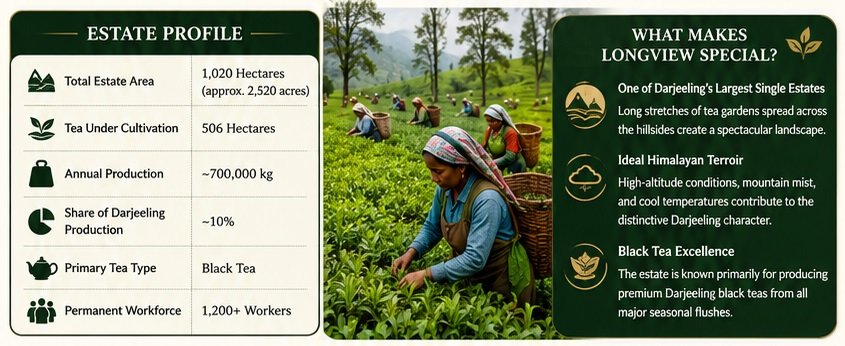
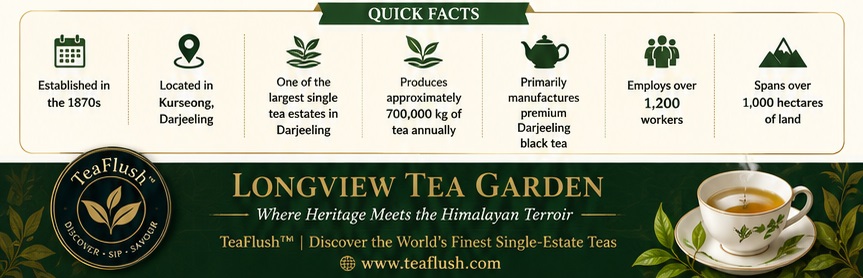
Scale is really where Longview earns its reputation. The estate covers a total area of 1,020 hectares (about 2,500 acres), of which 506 hectares (roughly 1,250 acres) are under active tea cultivation.
That puts it firmly among the largest tea gardens in the entire Darjeeling district. Annual production runs to around 700,000 kg of tea, which represents close to 10% of all Darjeeling tea produced — an extraordinary share for a single estate, given that Darjeeling district is home to dozens of competing gardens.
Most of the leaf harvested at Longview goes into black tea production, though the estate also produces green Darjeeling tea, even if these varieties appear in the market less frequently than the black tea.
The People Behind the Tea
A garden this size doesn’t run itself, and Longview has long been one of the larger employers in the Kurseong area.
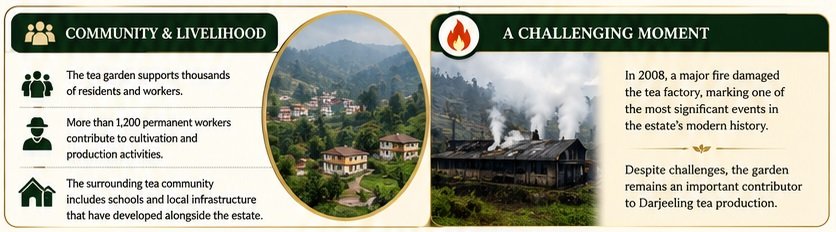
Nearly 2,000 workers are employed across the estate, with around 1,244 of them counted as permanent staff handling everything from plucking and pruning to processing. The surrounding village reflects this labor-driven community: according to the 2011 Census, Longview Tea Garden had a population of 5,301, almost evenly split between 2,651 males and 2,650 females, with a literacy rate of 67.36%.
For families in the area, Pankhabari High School, an English-medium coeducational institution established in 1964, serves students from class V through class XII and houses a library of over 3,600 books.
Challenges Along the Way
No estate with a 150-year history escapes a few setbacks, and Longview has weathered its share.
The 2008 factory fire. In 2008, a devastating fire destroyed the tea factory at Longview, a blow that would have disrupted processing for an estate of this size considerably. The estate has since rebuilt and resumed full operations.
The 2017 Darjeeling hills strike. Longview was also caught up in one of the most significant labor disruptions in the region’s modern history. All 87 Darjeeling tea gardens were shut down starting 17 June 2017, after the Gorkha Janmukti Morcha called an indefinite general strike. By the 64th day of the strike, more than 500 of Longview’s roughly 1,200 workers had returned to voluntary work, reflecting the economic pressure the prolonged shutdown placed on tea-garden families across the district.
Why Longview Matters in the Darjeeling Tea Story
It’s easy to assume that Darjeeling tea is defined entirely by a handful of famous boutique names — the gardens with resident owners, organic certifications, and decades of marketing behind them. Longview tells a different, equally important part of the story: that of a large-scale estate whose sheer output has quietly supported the Darjeeling tea industry’s volume and global supply for generations.
Its history also mirrors the wider arc of Darjeeling tea itself — colonial-era founding, mid-century consolidation under Indian ownership, late-century financial strain, fragmentation into smaller independent estates, and the ongoing labor and climate pressures that continue to shape the hills today. Understanding Longview is, in many ways, a shortcut to understanding how Darjeeling tea as a whole has evolved.
Quick Facts: Longview Tea Garden at a Glance
| Detail | Information |
|---|---|
| Location | Kurseong subdivision, Darjeeling district, West Bengal, India |
| Founded | 1873 (per Darjeeling Tourism) / Incorporated 1879 (per company records) |
| Total estate area | 1,020 hectares (~2,500 acres) |
| Area under tea cultivation | 506 hectares (~1,250 acres) |
| Annual production | ~700,000 kg, around 10% of total Darjeeling tea output |
| Tea types produced | Predominantly black tea, some green tea |
| Workforce | Around 2,000 workers, ~1,244 permanent |
| Current operator | Longview Tea & Agro Ltd., Kolkata |
| Notable events | 2008 factory fire; affected by the 2017 Darjeeling hills strike |
| Village population (2011 Census) | 5,301 |
Final Thoughts
Longview Tea Garden isn’t the estate most often name-dropped on a premium tea tin, but its scale, longevity, and sheer share of Darjeeling’s annual output make it one of the most consequential gardens in the entire district. From its 19th-century founding through ownership changes, expansion, financial restructuring, fire, and labor unrest, Longview has remained a fixture of the Kurseong hillside — and a working example of how much history can sit quietly behind a single cup of tea.
Whether you’re researching Darjeeling tea estates for sourcing purposes, planning a hill visit, or simply curious about where your tea comes from, Longview is well worth knowing.
Looking for more deep dives into the gardens behind your favorite Darjeeling teas? Explore more estate profiles on TeaFlush.com.