Rohini Tea Garden: The Youngest Darjeeling Estate With the Oldest Soul
Tucked into the folded green hillsides of the Kurseong Valley, Rohini Tea Garden tells a story unlike any other estate in Darjeeling. It is, in the same breath, one of the oldest tea-growing tracts in the region and one of its youngest working gardens — a place where century-old China bushes share the slopes with tea plants that are barely three decades into their lives. For tea lovers searching for something beyond the familiar names of Darjeeling, Rohini offers a compelling mix of history, geography, and flavor that’s well worth understanding before your next cup.
Table of Contents
In this guide, we’ll walk through everything that makes Rohini Tea Garden distinctive: its dramatic history, its location and terroir, the divisions that make up the estate, its flush seasons, and the flavor notes that have made its teas a favorite among connoisseurs worldwide.
Where Is Rohini Tea Garden Located?
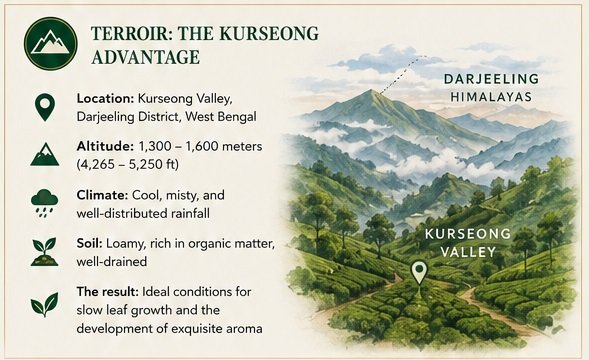
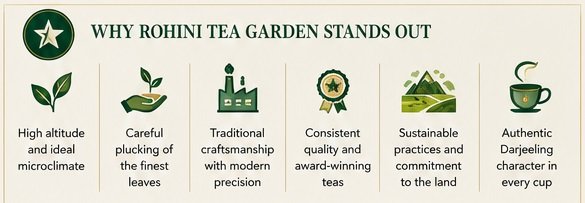
Rohini Tea Garden sits in the Kurseong subdivision of the Darjeeling district in West Bengal, India, within the Kurseong Community Development Block. The garden lies at an elevation ranging roughly from 1,000 feet to about 4,400 feet above sea level, which is considerably lower than many of the famous high-altitude gardens of Darjeeling Sadar. This lower-to-mid elevation band gives Rohini its own distinct microclimate and growing conditions, setting its teas apart from gardens like Margaret’s Hope, Castleton, or Glenburn that sit much higher in the hills.
The estate is part of a dense cluster of historic tea gardens in the northeastern Kurseong subdivision, neighboring well-known names such as Makaibari, Ambootia, Goomtee, and Tindharia. Geographically, it stretches close to Kurseong town itself, with the Balason River and Mahananda Wildlife Sanctuary forming part of the wider landscape of the region.
A Tea Garden With a Remarkable Past
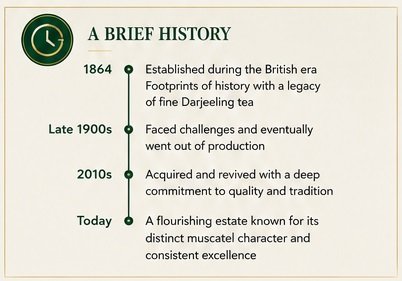
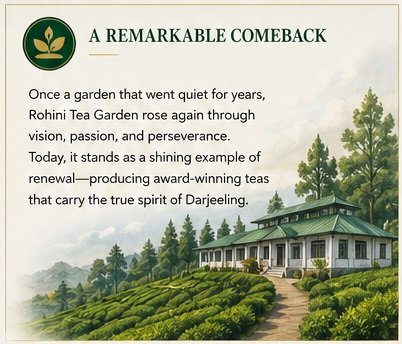
What makes Rohini’s story so unusual is the gap in the middle of it. Unlike most Darjeeling estates that have operated continuously since the British colonial era, Rohini Tea Garden is one of the 8 new gardens in India developed after independence, first planted in 1955.
But the garden’s early promise was cut short. It was closed in 1962 and remained shut for decades, until it was eventually taken over by the Saria family, who began replanting the estate. Sources vary slightly on the exact length of this dormancy, with estimates ranging from roughly 30 to 38 years, but the broad picture is consistent: Rohini essentially went silent for a generation before being brought back to life around the turn of the millennium.
Interestingly, while the garden as a commercial enterprise is relatively young, some of the bushes growing on its slopes are anything but. Rohini is considered one of the oldest tea estates in Darjeeling, with some of its oldest bushes planted by the British as far back as the 1850s. This unusual combination — ancient China-origin bushes growing alongside tea planted only in the last 25-30 years — is part of what gives Rohini its layered, complex character today.
When replanting began, an unexpected discovery added another unique thread to Rohini’s story. A wild tea tree of unknown origin was found growing near the estate, and cuttings from this tree provided the clonal stock for some of the new plantings. Because the original wild plant’s history and exact type remain a mystery, teas made from these clones carry an air of intrigue that few other Darjeeling gardens can claim.
Ownership and Management
Rohini Tea Garden is owned and managed by the Saria family under the Sona Tea Group, a name with deep roots in Darjeeling’s tea industry. The estate is marketed under Sona Tea Limited, established in 1955, which also manages sister gardens including Gopaldhara Tea Estate in the Darjeeling hills, along with New Glencoe and Soongachi Tea Estates in the Dooars region.
The family’s approach to running Rohini is notably hands-on. Rishi Saria, who oversees both the Gopaldhara and Rohini estates, is known for personally walking the gardens, inspecting plants, and managing the processing activities rather than delegating to a traditional estate manager. The two gardens are often described as bookends of the Darjeeling district, with Gopaldhara representing the highest elevations and Rohini the lower ones. This direct involvement, paired with a willingness to experiment with both traditional methods and newer processing equipment, has helped Rohini develop a reputation for innovation within a region that is often deeply traditional.
The Four Divisions of Rohini
One of the most interesting aspects of Rohini Tea Garden is how it is structured. The estate is divided into four named divisions, arranged in ascending order of elevation, each contributing a different character to the final tea.
Jaberhat is the lowest division, sitting at around 1,500 feet and covering approximately 20 to 38 hectares depending on the source. This section represents the entry point to the estate’s terroir.
Kotidhara and Pailodhara form the mid-elevation divisions, together covering somewhere between 70 and 80 hectares. These two divisions are planted predominantly with AV2 and T-78 China clones, which are responsible for producing some of the highest quality teas to come out of the estate. Pailodhara is notable for being the one part of the garden not accessible by road, adding a touch of remoteness to its harvest.
Tukuriya is the highest division, sitting at an average elevation of around 4,400 feet and stretching up toward Kurseong town itself. This division represents much of the original old tea area, with bushes that are now more than a century old.
Out of the original sprawling estate, only a fraction of the historic plantation area remains in active production today, with figures from different sources placing the currently cultivated area somewhere between 74 and 146 hectares. The bulk of this is young tea, planted from the mid-1990s onward, meaning much of what you taste from Rohini today comes from bushes that are still maturing — a fact that makes the estate’s already-impressive teas all the more promising for the future.
Climate, Soil, and Terroir
Rohini’s lower elevation compared to gardens in Darjeeling Sadar gives it a warmer, slightly more humid growing environment. This terroir tends to produce teas with rounder, fruitier, and more full-bodied characteristics compared to the more delicately floral, high-altitude teas from gardens situated above 5,000 feet.
The Kurseong Valley itself is known for its mix of steep slopes and river-fed soil, contributing minerals that show up subtly in the cup. Combined with the China-origin bush stock found throughout the estate, this terroir produces the kind of muscatel sweetness that Darjeeling is famous for, but with a distinct regional accent that separates Rohini from its higher-altitude neighbors.
Flush Seasons: First Flush, Second Flush, and Beyond
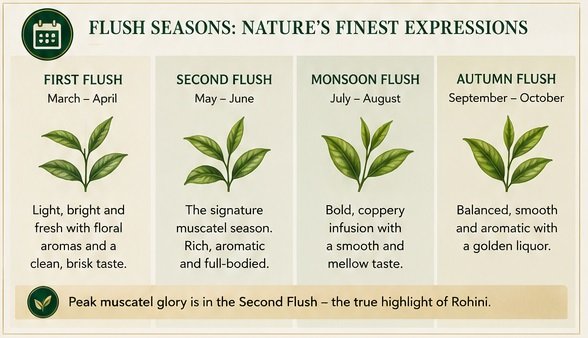
Like all Darjeeling gardens, Rohini’s production calendar is built around the concept of “flushes” — the flavor-distinct harvests that occur at different points in the growing year.
First Flush (Spring Harvest)
Rohini’s first flush, typically plucked in the early weeks of spring, produces teas known for floral, blossomy notes with a gentle, clean finish. First flush teas from the estate, grown from early-producing cultivars at around 2,500 feet, are noted for developing wonderful floral character in a blossomy cup with a gentle finish, with hints of classic muscatel emerging as the tea cools. This is the harvest most prized by tea purists looking for the lighter, brighter side of Darjeeling character.
Second Flush (Summer Harvest)
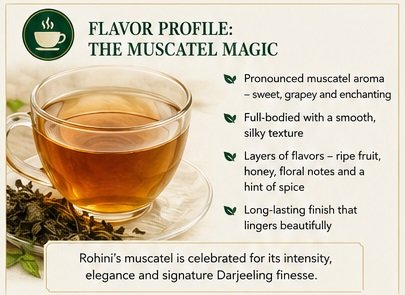
The second flush, harvested through May and June, is where Rohini truly shines and has built much of its modern reputation. This is the period associated with the famous “muscatel” character that Darjeeling tea is celebrated for worldwide. This rare muscatel period is generated by jassid- and thrip-induced terpene production, a phenomenon characteristic of Darjeeling’s high-elevation terroir, and it is during this window that Rohini’s most meticulously crafted teas emerge.
Flavor descriptions of Rohini’s second flush teas frequently mention notes of ripe mango, honey, peach, berries, and even an unusual jamun (Indian blackberry) character in some rare batches, alongside the signature muscatel sweetness. Some second flush oolongs from the estate are also noted for their smooth, fruity profile, with tasting notes describing flavors reminiscent of red wine in their richness and roundedness.
Oolongs and Specialty Teas
Beyond the traditional black tea flushes, Rohini has built a name for itself with semi-oxidized oolongs and rare specialty teas, including white teas made from the estate’s mysterious wild tea clones. The narrow window for producing these oolongs typically falls in May, when low to mid-elevation growth slows down, the weather turns dry, and the rare combination of conditions becomes ideal for crafting these complex, semi-oxidized teas. This focus on small-batch, hand-processed teas has positioned Rohini as a garden willing to experiment well beyond the conventional black tea mold.
What Does Rohini Tea Taste Like?
The black teas, particularly from second flush, tend to be full-bodied with a coppery to bright orange liquor, carrying sweet muscatel character balanced by fruit-forward notes of honey, mango, peach, or berries, finishing with a long, pleasant aftertaste. The oolongs are typically lighter and more delicate, with golden or silver-tipped leaves brewing into amber or yellow liquors, offering a smooth, fruity cup with minimal astringency. The first flush teas lean floral and gentle, ideal for those who enjoy a more restrained, springtime character in their cup. The rare white and specialty teas, made from the estate’s wild clone cuttings, can surprise drinkers with unconventional notes such as spice, capsicum, or hay, making them a favorite among adventurous tea explorers.
Why Rohini Tea Garden Matters in the Darjeeling Story
Rohini occupies a unique place in Darjeeling’s tea landscape. It is neither a heritage garden that has run uninterrupted since colonial times, nor a brand-new plantation without history. Instead, it represents something rarer: a garden that was essentially reborn, combining century-old bush stock with a modern, hands-on approach to cultivation and processing.
This blend of old and new has allowed Rohini to avoid being weighed down by rigid tradition while still benefiting from genuinely old-growth China tea plants that many newer plantations simply don’t have access to. The result is a garden that continues to experiment — with clones, with oxidation levels, with small-batch specialty teas — while still producing the classic muscatel black teas that define what people expect from a great Darjeeling cup.
For tea drinkers, this makes Rohini worth seeking out specifically. Many estates in Darjeeling can claim altitude or heritage, but few can claim a comeback story quite like this one, paired with the kind of flavor complexity that comes from genuinely diverse bush stock and an estate willing to take risks with its processing.
Final Thoughts
Rohini Tea Garden is a reminder that the story behind a tea matters just as much as what’s in the cup. From its post-independence origins and decades-long closure to its revival under the Saria family and its current reputation for muscatel black teas and experimental oolongs, Rohini represents one of the more compelling chapters in modern Darjeeling tea Garden history.
Whether you’re drawn to the floral lightness of a first flush, the rich muscatel depth of a second flush, or the curiosity of a wild-clone white tea, Rohini’s range offers something for nearly every kind of tea drinker. The next time you’re exploring Darjeeling teas beyond the most famous estate names, give Rohini a try — it’s a garden whose teas, much like its history, reward a closer look.
Looking for more deep dives into the gardens behind your favorite cups? Explore the TeaFlush.com blog for more guides to Darjeeling’s most fascinating tea estates. Explore more at TeaFlush.com