By TeaFlush.com | Last Updated: June 2026 | Reading Time: 12 minutes
“There is a great deal of poetry and fine sentiment in a chest of tea.” — Ralph Waldo Emerson
Table of Contents
What Is the “Champagne of Tea”?
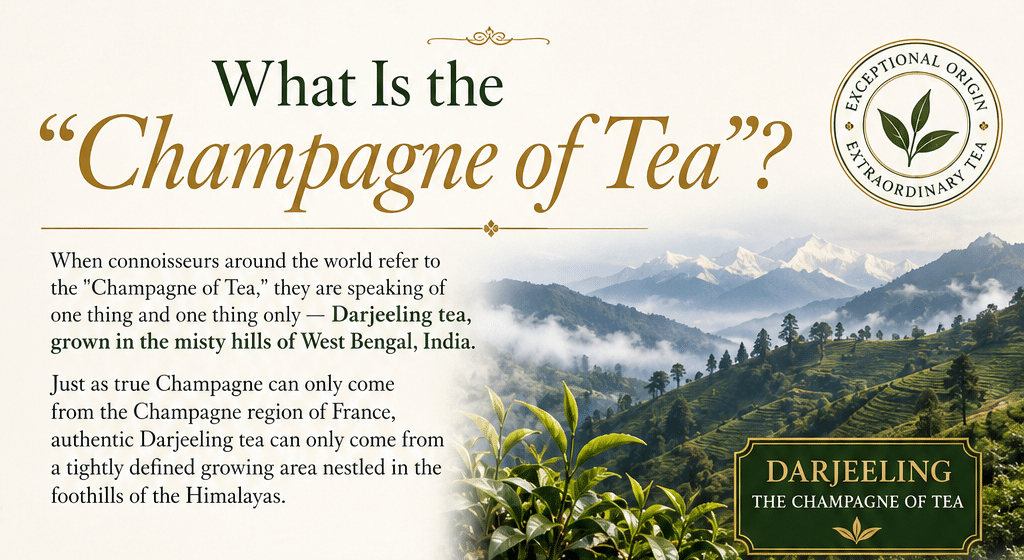
When connoisseurs around the world refer to the “Champagne of Tea,” they are speaking of one thing and one thing only — Darjeeling tea, grown in the misty hills of West Bengal, India. Just as true Champagne can only come from the Champagne region of France, authentic Darjeeling tea can only come from a tightly defined growing area nestled in the foothills of the Himalayas.
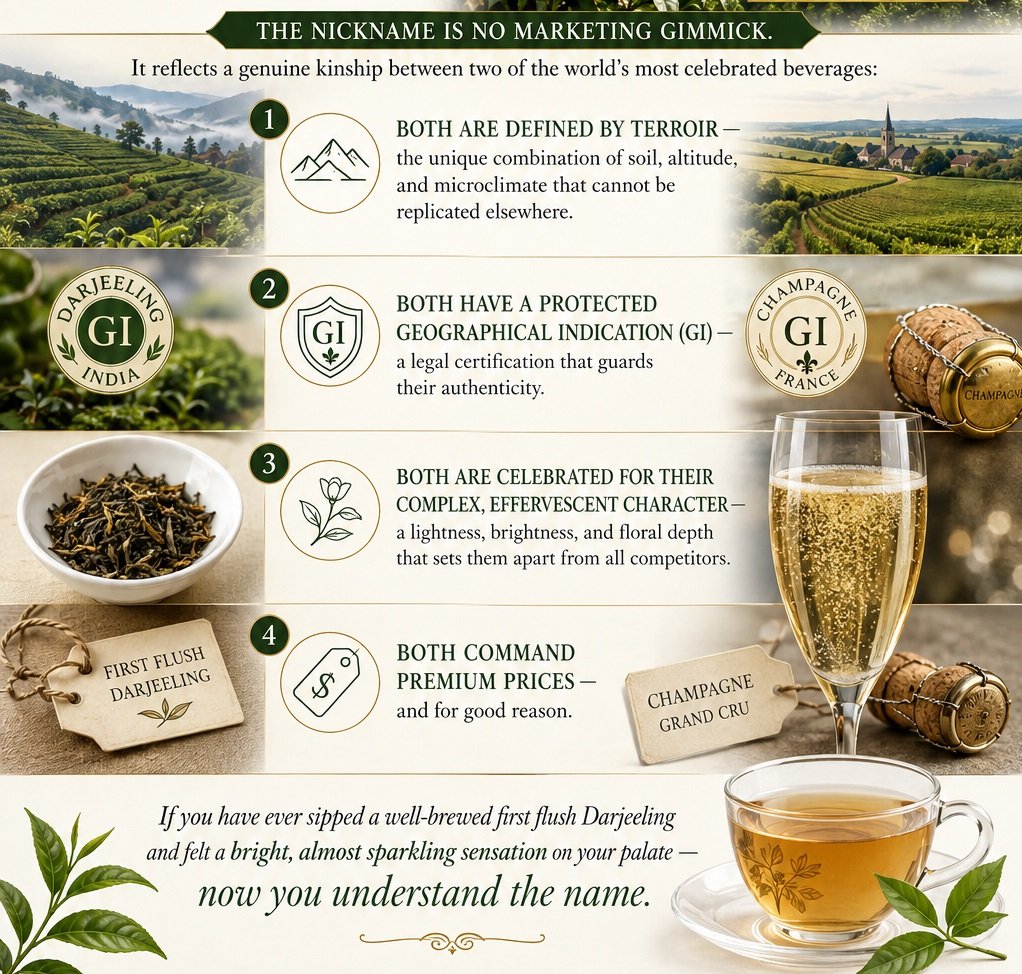
The nickname is no marketing gimmick. It reflects a genuine kinship between two of the world’s most celebrated beverages:
- Both are defined by terroir — the unique combination of soil, altitude, and microclimate that cannot be replicated elsewhere.
- Both have a protected geographical indication (GI) — a legal certification that guards their authenticity.
- Both are celebrated for their complex, effervescent character — a lightness, brightness, and floral depth that sets them apart from all competitors.
- Both command premium prices — and for good reason.
If you have ever sipped a well-brewed first flush Darjeeling and felt a bright, almost sparkling sensation on your palate — now you understand the name.
The Origin Story: How Darjeeling Earned Its Crown
The story of Darjeeling tea begins in the mid-19th century, when British botanist and explorer Dr. Arthur Campbell first planted Chinese tea seeds (Camellia sinensis var. sinensis) near the town of Darjeeling in 1841. The British East India Company, eager to break China’s monopoly on tea, was experimenting with cultivation across its Indian territories.
What Campbell discovered — and what tea planters refined over the next several decades — was that the high-altitude slopes of the Darjeeling hills produced something extraordinary. The combination of thin, cool mountain air, well-drained loamy soil, frequent mist and cloud cover, and a dramatic elevation of 600 to 2,100 metres above sea level created a growing environment unlike anywhere else on earth.
By the late 1800s, Darjeeling tea was being exported to Britain and Europe, where it was immediately recognised as something special. Its delicate, fragrant profile stood in sharp contrast to the bold, malty Assam teas that dominated the market. Tea traders began calling it the “Champagne of teas,” and the name stuck.
Today, the Darjeeling GI tag (granted in 2004) legally protects the name. Only tea grown across 87 registered tea estates in the Darjeeling district can carry the official Darjeeling certification logo.
The First Flush: Why Timing Is Everything
Of all the harvests in the Darjeeling calendar, none is more anticipated — or more celebrated — than the First Flush.
What Is the First Flush?
The First Flush refers to the very first plucking of new leaves in spring, typically occurring between mid-March and mid-April, right after the winter dormancy period ends. These are the youngest, most tender leaves of the entire year — delicate, vibrant, and brimming with the energy of renewal.
Why Is First Flush So Special?
During the winter dormancy, the tea plant rests and concentrates its nutrients. When spring arrives and the first buds break, they carry an extraordinary concentration of:
- Amino acids (especially L-theanine), contributing to sweetness and umami
- Polyphenols and antioxidants, giving brightness and astringency
- Volatile aromatic compounds, responsible for that unforgettable floral fragrance
The result is a tea that is light in body, pale golden in the cup, and extraordinarily fragrant — with notes of fresh flowers, green herbs, muscatel grapes, and a clean, crisp finish that genuinely resembles the effervescence of fine Champagne.
The Four Flushes of Darjeeling
| Flush | Season | Character |
|---|---|---|
| First Flush | March – April | Light, floral, grassy, muscatel, most prized |
| Second Flush | May – June | Amber, full-bodied, pronounced muscatel, bold |
| Monsoon Flush (Rains) | July – September | Darker, robust, used mainly for blending |
| Autumnal Flush | October – November | Mellow, smooth, copper-hued, nutty |
What Makes It Taste Like Champagne?
The “Champagne” comparison goes well beyond poetic licence. Here is what actually happens on your palate:
1. Effervescence and Brightness
A properly brewed first flush Darjeeling creates a lively, tingling sensation on the tongue. This is not actual carbonation, but rather the effect of high concentrations of gallic acid, catechins, and tannins interacting with saliva. The sensation is strikingly similar to the fine bubbles of a good sparkling wine.
2. The Pale Golden Liquor
Pour a first flush Darjeeling into a white porcelain cup and you will find a luminous, pale gold or greenish-yellow liquor — delicate and translucent, like a glass of vintage blanc de blancs Champagne.
3. Complex Aromatics
The aroma profile is multi-layered: fresh-cut flowers (jasmine, orchid, violet), ripe muscatel grapes, green apricot, spring grass, and a mineral undertone. These are not added flavours — they arise naturally from the chemical composition of the leaf and the specific conditions of processing.
4. A Dry, Lingering Finish
Like a fine Champagne, the best Darjeeling teas have a clean, dry, slightly astringent finish that leaves the palate refreshed and craving another sip. This is the hallmark of quality — what tea experts call a “long finish.”
5. Lightness of Body
First flush Darjeeling is never heavy or thick. Its gossamer lightness — achieved through minimal oxidation and careful processing — gives it an almost ethereal quality on the palate. It is the antithesis of a heavy, milk-forward breakfast tea.
The Terroir of Darjeeling: Geography and Climate
The word terroir (from the French, meaning “of the earth”) describes the complete natural environment in which a crop is grown. For Darjeeling tea, terroir is everything.
Altitude
Darjeeling’s tea gardens range from 600 to 2,100 metres above sea level. At higher elevations, the air is thin and cool, slowing the growth of the tea plant. This slow growth concentrates flavour compounds in each leaf, producing greater complexity.
Temperature and Climate
The Darjeeling hills experience a subtropical highland climate, with cool winters, warm springs, heavy monsoons, and mild autumns. The ideal growing temperature for fine Darjeeling is between 13°C and 25°C. Frost is not uncommon at the highest elevations, and this cold stress further intensifies flavour.
Mist and Cloud Cover
Darjeeling’s famous morning mists act as a natural sun shield, reducing the intensity of direct sunlight on the tea leaves. Diffused light promotes slower growth and the development of protective chemical compounds — including the aromatic molecules responsible for Darjeeling’s signature fragrance.
Soil
The hills are covered in well-drained loamy soil, rich in organic matter and slightly acidic (pH 4.5–5.5). Excellent drainage prevents waterlogging at the roots while retaining just enough moisture. The presence of iron, magnesium, and trace minerals in the soil contributes to the tea’s complex, layered mineral notes.
The Himalayan Wind
Cool, dry winds descending from the Himalayas regulate temperature and humidity across the tea gardens, preventing fungal disease and contributing to the natural withering of the fresh leaf before processing.
How the Champagne of Tea Is Made
The production of first flush Darjeeling is a process of remarkable precision and restraint. Every step is designed to preserve the delicate character of the fresh leaf.
Step 1: Plucking (The Golden Standard — “Two Leaves and a Bud”)
Only the terminal bud and the two youngest leaves are hand-plucked. This is the globally recognised standard for premium quality. Skilled pluckers harvest fresh leaves early in the morning, when moisture content in the leaf is at its peak.
Step 2: Withering
Fresh leaves are spread on wire mesh troughs (called withering troughs) and exposed to warm, circulating air for 12 to 18 hours. This reduces the moisture content from approximately 75% to 55–60%, softening the leaf tissue and beginning the release of aromatic compounds.
Step 3: Rolling
The withered leaves are passed through rolling machines that twist and bruise the leaf cells. This ruptures the cell walls, initiating oxidation and mixing enzymes with polyphenols. For first flush Darjeeling, rolling is lighter than for a full black tea, to preserve its delicate, semi-oxidised character.
Step 4: Oxidation (Controlled and Brief)
This is the most critical and artful step. First flush Darjeeling undergoes partial oxidation — typically between 30% and 60%. The rolled leaves are spread in a cool, humid room and monitored closely. The tea master decides when to halt oxidation based on colour, aroma, and experience. Too little, and the tea is raw and grassy. Too much, and the floral delicacy is lost.
Step 5: Drying (Firing)
The partially oxidised leaves are passed through a dryer at approximately 85–95°C for 20–30 minutes. This halts oxidation completely, reduces moisture to around 3%, and locks in the flavour compounds developed during the previous steps.
Step 6: Sorting and Grading
Dried tea is passed through a series of meshes and sieves to separate leaves by size and grade. Common Darjeeling grades include:
- SFTGFOP1 — Super Fine Tippy Golden Flowery Orange Pekoe, Grade 1 (the finest)
- FTGFOP — Fine Tippy Golden Flowery Orange Pekoe
- TGFOP — Tippy Golden Flowery Orange Pekoe
- BOP — Broken Orange Pekoe (smaller leaf, stronger brew)
Step 7: Tasting and Quality Assessment
Before any lot leaves the estate, an experienced tea taster brews and evaluates samples, assessing liquor colour, aroma, flavour, and finish. Only lots that meet the estate’s standards are approved for sale.
The Muscatel Character: The Jewel in the Crown
No discussion of the Champagne of Tea is complete without exploring its most celebrated attribute — the muscatel character.
Muscatel is a complex flavour descriptor that evokes ripe muscatel grapes, dried apricot, honey, and a distinctive floral sweetness. It is the quality that makes second flush (and often first flush) Darjeeling utterly unique among the world’s teas.
Where Does Muscatel Come From?
For decades, the muscatel character was something of a mystery. Modern scientific analysis has revealed that it arises from a fascinating — and entirely natural — process involving a tiny insect called the green leafhopper (Empoasca flavescens).
When leafhoppers feed on young tea leaves, they trigger a defence response in the tea plant. The plant produces specific volatile compounds — most notably geraniol, linalool, β-ionone, and hotrienol — which the plant deploys to repel the insect. These are the very molecules that create the distinctive muscatel aroma.
Remarkably, a similar process occurs in Taiwan’s famous Oriental Beauty (Bai Hao) oolong, which also owes its characteristic honey-floral fragrance to leafhopper activity. Nature’s stress, it turns out, produces some of the world’s most beautiful flavours.
This is why muscatel Darjeeling cannot be replicated in a laboratory or a tea factory elsewhere in the world. It requires the precise combination of Darjeeling’s altitude, microclimate, the right leafhopper population, and the skill of the estate’s processing team.
Top Darjeeling Gardens to Know
Not all Darjeeling estates are equal. These are among the most celebrated:
Makaibari Tea Estate
Founded in 1859, Makaibari is the oldest tea estate in Darjeeling and arguably the most famous. Renowned for its biodynamic and organic farming practices, Makaibari produces some of the world’s most sought-after first flush lots, with auction prices that regularly break records. Its muscatel second flush is considered a benchmark.
Castleton Tea Estate
Castleton, situated at around 1,700 metres in the Kurseong valley, produces what many experts consider the finest muscatel second flush in all of Darjeeling. Its teas are consistently awarded top marks at Kolkata auctions and are the holy grail for muscatel lovers.
Jungpana Tea Estate
High in the hills of Kurseong, Jungpana is celebrated for its exceptional second flush muscatel character. Its teas have a rich, winey depth balanced with floral elegance — a style that commands a devoted global following.
Thurbo Tea Estate
Situated at the border of Darjeeling and Sikkim, Thurbo produces first flush teas of remarkable brightness and complexity, with a pronounced floral character and a clean, mineral finish.
Margaret’s Hope Tea Estate
Named in memory of a young British girl who loved the estate, Margaret’s Hope is one of Darjeeling’s most storied gardens. It produces classically styled Darjeeling teas with excellent balance and consistency across all four flushes.
Goomtee Tea Estate
A smaller, boutique estate in the Kurseong hills, Goomtee is beloved by connoisseurs for its nuanced, artisan-style first flush teas — often featuring pronounced green, orchid, and snow pea notes.
How to Brew the Perfect Cup
The Champagne of Tea deserves to be brewed with care. Here is the complete guide.
What You Will Need
- Premium first or second flush Darjeeling tea (loose leaf, not tea bags)
- Filtered or spring water (never tap water with chlorine)
- A porcelain, ceramic, or glass teapot (avoid metal)
- A fine-mesh infuser or strainer
- A white porcelain cup (to appreciate the liquor colour)
The Brewing Parameters
| Parameter | First Flush | Second Flush |
|---|---|---|
| Water Temperature | 85–90°C (185–194°F) | 90–95°C (194–203°F) |
| Tea Quantity | 2.5g per 200ml | 2.5–3g per 200ml |
| Steeping Time | 2.5–3 minutes | 3–4 minutes |
| Re-steeps | 2–3 times | 1–2 times |
⚠️ Critical note: Never use boiling water for first flush Darjeeling. Boiling water (100°C) scorches the delicate leaves, releasing harsh tannins and destroying the floral aromatics. This is the single most common mistake.
Step-by-Step Brewing
Step 1 — Pre-warm your teapot. Rinse the teapot with hot water and discard. A warm vessel prevents the brewing temperature from dropping suddenly.
Step 2 — Measure your tea. Use 2.5 grams (approximately one rounded teaspoon) per 200ml of water.
Step 3 — Heat your water. Bring filtered water to the correct temperature. If you don’t have a temperature-controlled kettle, bring water to a full boil and let it rest for 3–4 minutes before pouring.
Step 4 — Steep. Pour the water over the leaves. Cover the teapot to retain heat and steep for 2.5 to 3 minutes for first flush.
Step 5 — Pour immediately. Do not leave the leaves in contact with water beyond the steeping time, or the tea will become overly astringent.
Step 6 — Drink without milk. First flush Darjeeling is always consumed without milk. Milk proteins bind to the polyphenols and completely mask the delicate floral and muscatel notes that make this tea special. A slice of lemon is acceptable, though purists prefer the tea entirely unadulterated.
Champagne of Tea vs. Other Premium Teas
How does Darjeeling’s Champagne of Tea compare to the world’s other elite teas?
| Tea | Origin | Character | Best Season |
|---|---|---|---|
| Darjeeling First Flush | India | Floral, light, muscatel, effervescent | Spring |
| Da Hong Pao (Big Red Robe) | Wuyi, China | Roasted, mineral, complex | Year-round |
| Gyokuro | Uji, Japan | Deep umami, grassy, sweet | Spring |
| Silver Needle (Bai Hao Yinzhen) | Fujian, China | Delicate, sweet, honeydew | Spring |
| Oriental Beauty | Taiwan | Honey, floral, muscatel | Summer |
| Tie Guan Yin | Fujian, China | Orchid, creamy, slightly roasted | Autumn |
Darjeeling stands apart from all of these in one unique way: it is the only tea in the world with a Geographical Indication (GI) certification that is internationally recognised in a way directly analogous to Champagne’s AOC protection. It is not just a style — it is a place, a heritage, and a legal identity.
How to Buy Authentic Darjeeling Tea {#how-to-buy-authentic-darjeeling-tea}
The popularity of Darjeeling tea has unfortunately given rise to widespread counterfeiting. Statistics suggest that global sales of “Darjeeling” tea significantly exceed actual Darjeeling production — meaning large quantities of mislabelled tea enter the market every year.
Look for the Official Darjeeling Logo
The Tea Board of India issues an official Darjeeling certification mark — a distinctive logo featuring a tea leaf with the word “Darjeeling” and “Tea” below it. Reputable sellers will display this on their packaging.
Buy from Single Estates
Purchase single-estate, single-flush teas rather than generic blends. A genuine product will state the estate name, flush (harvest), and year. Example: “Makaibari Estate, First Flush, Spring 2026.”
Understand the Price Point
Authentic, high-quality Darjeeling first flush tea is not cheap. Expect to pay ₹800–₹5,000+ per 100 grams for estate-direct or premium-grade teas. If a price seems suspiciously low, it almost certainly is not genuine Darjeeling.
Source from Reputable Specialists
Buy from tea specialists who can trace their supply chain directly to the estate — not from generic supermarket shelves. Online platforms that sell direct from estate offer the best guarantee of authenticity and freshness.
Health Benefits of Darjeeling Tea
Beyond its extraordinary flavour, the Champagne of Tea offers a compelling array of scientifically supported health benefits.
Rich in Antioxidants
Darjeeling tea — especially first flush — is exceptionally rich in polyphenols, including catechins, theaflavins, and thearubigins. These are powerful antioxidants that neutralise free radicals, protecting cells from oxidative stress and reducing the risk of chronic disease.
Supports Heart Health
Regular consumption of black and semi-oxidised teas has been associated with reduced LDL cholesterol levels, improved arterial function, and a lower risk of cardiovascular disease. The flavonoids in Darjeeling tea are particularly beneficial for vascular health.
Boosts Mental Alertness Without the Jitters
Darjeeling contains moderate caffeine (approximately 40–60mg per cup) alongside high levels of L-theanine, an amino acid that promotes calm focus. This combination produces a state of alert relaxation — heightened mental clarity without the anxiety or crash associated with coffee.
Supports Digestive Health
The polyphenols in Darjeeling tea act as prebiotics, promoting the growth of beneficial gut bacteria. Darjeeling tea has also been traditionally consumed to ease digestive discomfort and reduce bloating.
Anti-inflammatory Properties
The catechins and polyphenols in Darjeeling tea have demonstrated anti-inflammatory effects in clinical research, potentially offering protection against inflammatory conditions including arthritis and metabolic syndrome.
Supports Immune Function
Darjeeling tea contains vitamin C, zinc, and various polyphenols that support immune system function and may reduce the duration and severity of common infections.
Note: While the health benefits of Darjeeling tea are well-supported by research, tea should complement — not replace — medical treatment for any health condition. Consult a healthcare professional for personalised medical advice.
Pairing the Champagne of Tea with Food
Like Champagne itself, Darjeeling first flush is a versatile companion at the table — as long as you pair it thoughtfully.
Perfect Pairings
Pastries and Light Baked Goods Butter croissants, plain madeleines, shortbread biscuits, and almond financiers complement the floral sweetness of first flush Darjeeling without overpowering it.
Soft, Mild Cheeses Young chèvre, ricotta, mascarpone, and fresh mozzarella echo the tea’s delicacy. Avoid aged or strong-flavoured cheeses.
Fresh Fruit Sliced peaches, white grapes, lychee, and apricot resonate beautifully with the muscatel and floral notes in the tea.
Light Sandwiches Cucumber sandwiches, smoked salmon on blinis, or egg and cress on soft white bread — the classic British afternoon tea repertoire exists for a reason.
Japanese and East Asian Cuisine Sushi, lightly seasoned sashimi, delicate steamed dumplings, and green salads pair elegantly with first flush Darjeeling’s clean, mineral profile.
Avoid
- Spicy, pungent, or heavily seasoned foods — these overpower the tea’s delicacy entirely.
- Rich, fatty meats — the fat coats the palate and muffles the aromatics.
- Strongly flavoured cheeses — blue cheese, aged cheddar, and washed-rind varieties compete aggressively with the tea.
Frequently Asked Questions
Why is Darjeeling called the Champagne of Tea?
Darjeeling is called the Champagne of Tea because, like fine Champagne, its exceptional quality is inseparable from its specific place of origin. Its GI-protected status, its unique combination of altitude, microclimate, and terroir, and its distinctive effervescent, floral character — qualities that cannot be replicated anywhere else in the world — earned it this prestigious comparison.
Is Darjeeling tea black, green, or oolong?
Darjeeling first flush is often classified as a partially oxidised tea — technically closer to an oolong than a full black tea. Its oxidation level typically ranges from 30% to 60%, giving it a character that sits between green and black tea. Second flush and autumnal Darjeeling are more fully oxidised and closer in style to a traditional black tea.
What does first flush Darjeeling taste like?
First flush Darjeeling tastes light, bright, and floral, with pronounced notes of fresh flowers (jasmine, orchid), muscatel grapes, spring grass, and green apricot. It has a clean, slightly astringent finish and a long, aromatic aftertaste. It is pale golden in the cup and very low in body compared to Assam or Ceylon teas.
Should I add milk to Darjeeling tea?
No. Adding milk to a high-quality first or second flush Darjeeling is considered by connoisseurs to be a mistake, as milk proteins bind to the polyphenols and completely mask the delicate floral and muscatel aromas that define the tea’s character. Drink it plain, in a white cup, to fully appreciate the liquor colour and fragrance.
How should I store Darjeeling tea?
Store Darjeeling tea in an airtight, opaque container, away from heat, light, moisture, and strong odours. A sealed tin canister is ideal. Darjeeling first flush is at its best when consumed within 12–18 months of the harvest date. Unlike some aged teas, fresh Darjeeling is best enjoyed fresh.
What is the best water to use for brewing Darjeeling tea?
Use filtered or natural spring water with a neutral pH and low mineral content. Hard tap water with high chlorine or calcium levels will dull the tea’s brightness and introduce off-flavours. The water temperature is equally critical — always brew first flush at 85–90°C, never at a full boil.
What is the SFTGFOP1 grade?
SFTGFOP1 stands for Super Fine Tippy Golden Flowery Orange Pekoe, Grade 1. It is the highest grade designation used for Darjeeling tea, indicating a large, well-formed leaf with a high proportion of golden tips (the finest, most flavourful part of the leaf). Grade 1 denotes exceptional quality within that leaf grade.
Can I brew Darjeeling tea multiple times?
Yes. High-quality loose-leaf Darjeeling, especially first flush, can be re-steeped 2–3 times. Each subsequent infusion reveals different layers of flavour — often becoming sweeter and more mellow with each steep. Increase the steeping time slightly for each re-steep.
Final Thoughts
The Champagne of Tea is more than a beverage — it is a seasonal event, a cultural heritage, and a sensory experience that rewards patience and attention. Like the finest Champagne, a great Darjeeling first flush asks you to slow down, raise your cup, and pay attention to something fleeting and irreplaceable.
From the mist-wrapped hills above Darjeeling town to the porcelain cup in your hands, every step of the journey — the patient winter dormancy of the tea bush, the skilled hands of the plucker at first light, the tea master’s intuitive judgement over the withering trough, the careful brew at exactly the right temperature — contributes to that luminous, floral, effervescent cup that has captivated tea lovers for nearly two centuries.
At TeaFlush.com, we believe that the best teas in the world deserve to be understood as deeply as they are enjoyed. The Champagne of Tea is a perfect place to begin — or to deepen — that journey.
Explore our curated selection of single-estate, single-flush Darjeeling teas at TeaFlush.com. Each lot is sourced directly from the garden, with full traceability and estate certification.
Tags
darjeeling tea | champagne of tea | first flush darjeeling | darjeeling first flush | best darjeeling tea | muscatel tea | darjeeling tea benefits | how to brew darjeeling tea | darjeeling tea garden | tea connoisseur | premium loose leaf tea | indian tea | TeaFlush
© 2026 TeaFlush.com — All Rights Reserved