Ambiok (Hillton) Tea Estate: A Complete Guide to One of Darjeeling’s Hidden Gems
Published on TeaFlush.com | Category: Darjeeling Tea Estates | Reading Time: ~10 minutes
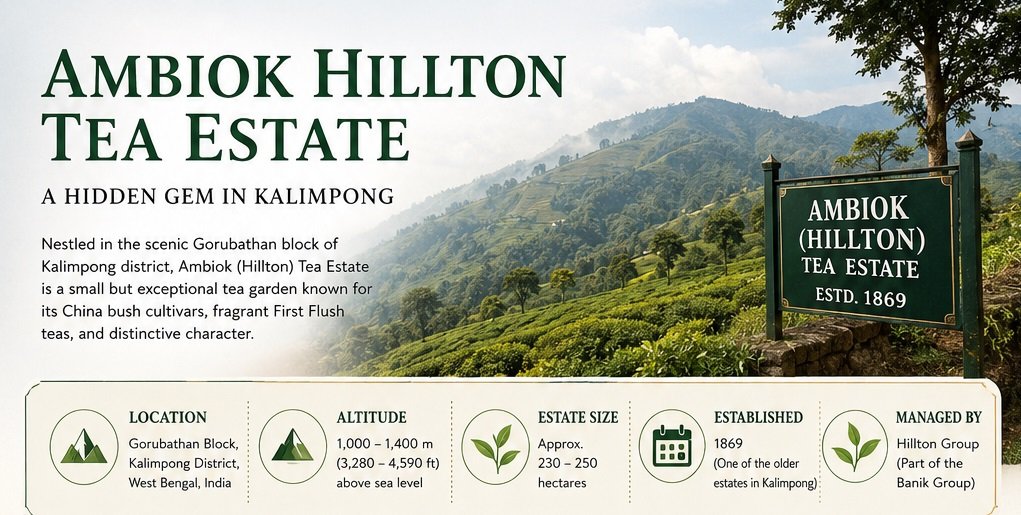
Nestled in the misty foothills of the Eastern Himalayas, Ambiok Tea Estate — officially known as Hillton Tea Estate — is a quiet legend in the world of Darjeeling tea. Located in the Gorubathan block of Kalimpong, it produces orthodox teas of remarkable character from some of the oldest China bushes in the region. If you are a serious tea lover, this garden deserves your full attention.
Table of Contents
1. What Is Ambiok (Hillton) Tea Estate?
Ambiok Tea Estate, also widely known by its trade name Hillton Tea Estate (sometimes spelled Hilton), is one of the six tea gardens in the Gorubathan Development Block of Kalimpong District, West Bengal, India. It falls under the prestigious Darjeeling tea-producing zone, officially recognized and protected by the Tea Board of India under a Geographical Indication (GI) tag.
The name “Ambiok” comes from the local geographical name of the area — Ambeok — while “Hillton” is the commercial brand name under which its teas are marketed and exported internationally. Both names are used interchangeably in the tea trade, so do not be confused when you see either on a packet label.
Despite being lesser-known compared to iconic Darjeeling gardens like Makaibari or Castleton, Ambiok (Hillton) has earned a strong cult following among serious tea connoisseurs in Europe, Japan, and North America, particularly for its First Flush orthodox teas.
2. Location and Geography
Key Facts at a Glance:
| Detail | Information |
|---|---|
| Estate Name | Ambiok Tea Estate / Hillton Tea Estate |
| District | Kalimpong, West Bengal, India |
| Sub-Division | Gorubathan Block, Kalimpong Sub-Division |
| Pincode | 735231 |
| Address | Damdim Lava Road, Gorubathan, Kalimpong District |
| Nearest Town | Mal Bazar (~10 km) |
| Planted Area | ~375 Acres |
| Annual Production | ~1,70,000 kg of tea |
Ambiok Tea Estate sits in the northern part of Darjeeling District, within the Kalimpong sub-division — a region that is geographically distinct from the central Darjeeling hills where most tea estates are clustered. This outlying position, while less commercially prominent, gives the garden a uniquely different microclimate compared to higher-altitude Darjeeling estates.
The estate is accessible from:
- Siliguri – approximately 60 km away
- Darjeeling town – approximately 90 km away
- Mal Bazar – the nearest town, about 10 km away
The address — Damdim Lava Road, Gorubathan — places it along one of the scenic hill routes that wind through the forests of Kalimpong, making it not just a tea estate but a visual delight for visitors.
3. Altitude and Its Role in Flavour
One of the most important factors in any Darjeeling tea’s character is altitude, and Ambiok is particularly interesting in this regard.
The estate occupies an altitude range of 600 metres to 1,770 metres (approximately 1,970 ft to 5,800 ft) above sea level. However, most of the core producing sections of the estate are concentrated between 700 metres and 900 metres — somewhat lower than the classic high-altitude Darjeeling gardens which often sit between 1,200 and 2,000 metres.
What does this mean for the tea?
- Lower astringency compared to high-altitude Darjeeling
- More body and smoothness in the liquor
- Richer floral and fruity notes rather than sharp mineral and muscatel tones
- A profile that is closer in character to a fine oolong than a typical First Flush Darjeeling
This lower-but-varied altitude, combined with the unique slope orientation and the influence of the Teesta Valley’s microclimate, more than compensates for what the garden lacks in sheer elevation.
4. The Terroir: Neora Valley and the Teesta Valley Influence
If one factor separates Ambiok from every other Darjeeling estate, it is its exceptional terroir.
The estate is located just south of the Neora Valley National Park, one of the most biodiverse ecosystems in the Eastern Himalayas. The national park is a rich temperate and sub-tropical forest zone that shelters red pandas, leopards, and hundreds of bird species. The proximity to such an untouched forest ecosystem means:
- Clean, unpolluted air and water flow through the estate
- The biodiversity of insects and flora supports natural pest management
- The estate benefits from consistent moisture brought in by the forests
Additionally, Ambiok is part of the Teesta Valley collection of Darjeeling tea gardens. The Teesta River, which flows through the valleys below, moderates the local climate by bringing in humid air and regulating temperatures across seasons. This river influence contributes to a unique microclimate that sets these Kalimpong-block estates apart from the main Darjeeling producing regions.
The combination of forest proximity, river valley moisture, and varied slope orientation across 600–1,770 metres creates a growing environment where each micro-plot on the estate can produce tea with slightly different characteristics — making every harvest from Ambiok a discovery.
5. Tea Varieties Produced
Ambiok Tea Estate produces primarily orthodox Darjeeling teas, in keeping with the traditional standards of the region. Unlike many neighbouring Kalimpong estates that produce CTC (Crush, Tear, Curl) grade teas, Ambiok’s output is whole-leaf or large-broken orthodox style.
The main products include:
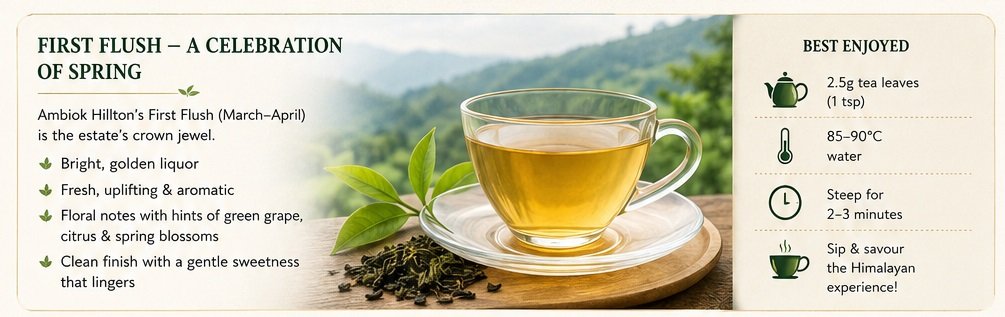
- First Flush Orthodox Black Tea — The estate’s most celebrated offering, harvested in March–April
- Second Flush Orthodox Black Tea — A fuller, more rounded tea harvested in May–June
- Autumnal Flush Tea — Harvested in October–November with earthy, mellow characteristics
The estate’s teas are marketed internationally under the Hillton brand name and have been featured in premium tea subscription boxes in the UK and Europe.
6. The China Bush Cultivar Advantage
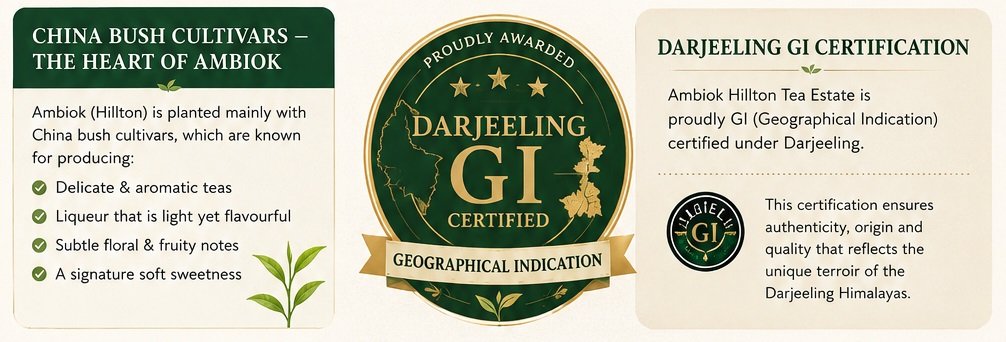
Perhaps the most important aspect of Ambiok’s tea identity is its use of old China bush cultivars (Camellia sinensis var. sinensis).
These original Chinese-variety tea plants were introduced to Darjeeling by the British during the 19th century. Over generations, many estates have replaced old China bushes with more productive hybrid clonal varieties. Ambiok, however, maintains a significant proportion of these heritage China bushes, which:
- Produce smaller, more concentrated leaves with higher polyphenol complexity
- Generate delicate, nuanced flavours with floral, fruity, and mineral depth
- Are naturally more resistant to harsh weather due to centuries of adaptation
- Yield tea with lower astringency and a long-lasting, elegant aftertaste
The use of mixed but predominantly China bush cultivars is a key reason why Ambiok’s First Flush is described by experts as resembling a finely crafted medium-oxidised oolong as much as a classic Darjeeling black tea — a character that many connoisseurs find truly special.
7. First Flush: The Prized Harvest
In the Darjeeling tea world, First Flush is the most eagerly awaited event of the year. Harvested in March to April, First Flush teas capture the very first new growth after winter dormancy — fresh, bright, and bursting with delicate compounds accumulated over months of rest.
At Ambiok (Hillton) Tea Estate, the First Flush is particularly special:
- Leaves are carefully hand-plucked using the traditional two-leaves-and-a-bud standard
- Processing is done with careful partial oxidation, giving the tea characteristics between a green tea and a full black tea
- The resulting liquor is bronze-golden in colour with a luminous brightness
The Hillton First Flush has appeared in curated tea subscription boxes in the UK and received acclaim for its balance, smoothness, and floral complexity — qualities that make it appealing even to those who typically prefer lighter teas like oolongs or greens.
8. Tasting Notes and Flavour Profile
Here is what to expect when you brew a cup of Ambiok (Hillton) First Flush:
Dry Leaf:
- Large, neat mixed-colour leaves
- Slight greenish tinge indicating light oxidation
- Fresh, herbaceous aroma with floral hints
Liquor:
- Colour: Bronze to golden amber
- Aroma: Light, verdant, with floral perfume
Taste:
- Smooth and delicate with pronounced perfumed floral notes
- Distinctly less astringent than typical First Flush Darjeeling
- Lightly mineral, fruity, and creamy undertones
- Reminiscent of flower petals — dry floral, verdant, lightly bittersweet
- Character akin to a medium-oxidised oolong
Aftertaste:
- Lightly drying but long-lasting
- Build-up of subtle metallic notes and tangy brightness
Overall: Very delicate and balanced. Not extremely typical of classic Darjeeling First Flush, but uniquely beautiful and deeply satisfying in its own right — especially for afternoon brewing.
9. How to Brew Ambiok (Hillton) Tea
Getting the most out of an Ambiok (Hillton) tea requires paying attention to water temperature and steeping time. Here are the recommended guidelines:
For First Flush (orthodox black / semi-oxidised style):
| Parameter | Recommendation |
|---|---|
| Water Temperature | 85°C – 90°C (avoid boiling water) |
| Leaf Quantity | 2.5g per 250ml of water |
| Steeping Time | 3 minutes |
| Re-steepings | 2 or more infusions possible |
| Milk / Sugar | Best enjoyed without — drink plain to appreciate the nuance |
Tips:
- Use filtered or spring water if possible — chlorinated tap water can mask delicate flavours
- Pre-warm your cup or teapot before brewing
- For the second infusion, reduce steeping time to 2 minutes for a lighter cup
- Avoid over-steeping, which can bring out unwanted bitterness in these delicate leaves
10. Ambiok in the Context of Darjeeling GI Recognition
One of the most significant distinctions that Ambiok Tea Estate holds is its official inclusion in the Darjeeling GI (Geographical Indication) zone as defined by the Tea Board of India.
The Tea Board specifies that “Darjeeling Tea” may only come from designated gardens in the Darjeeling hills. Crucially, the Kalimpong sub-division estates are specifically named in the GI definition — and Ambiok Tea Estate is one of only four Kalimpong estates that qualify:
- Samabeong Tea Estate
- Ambiok Tea Estate ✅
- Mission Hill Tea Estate
- Kumai Tea Estate
This is no small honour. GI recognition means that tea produced here is legally protected under Indian law and international trade agreements, guaranteeing its authenticity and geographic origin. When you buy a tea labelled “Darjeeling,” it must come from one of these officially designated estates — and Ambiok is one of the very few in Kalimpong with this right.
11. Neighbouring Estates
Ambiok sits within a close cluster of six tea estates in the Gorubathan Development Block of Kalimpong district:
- Samabeong Tea Estate — Known for orthodox organic Darjeeling teas with high-altitude floral character; located near Lava at 5,000–6,700 ft
- Upper Fagu Tea Estate — Closest neighbour to Ambiok; produces orthodox black and green teas from China cultivar at ~1,300 ft altitude
- Lower Fagu Tea Estate — Also in the Gorubathan block
- Kumai Tea Estate — Part of the GI-certified Darjeeling zone
- Mission Hill Tea Estate — GI-certified Kalimpong estate
- Ambiok (Hillton) Tea Estate — The focus of this article
Together, these estates form the Teesta Valley collection — a cluster of outlying Darjeeling gardens whose teas carry a distinct character shaped by the Teesta River valley and the surrounding forests of Neora Valley National Park.
12. The Local Community Around the Estate
The Ambeok Tea Garden is not merely a commercial enterprise — it is a living community. According to Census 2011 data, the Ambeok Tea Garden village is home to approximately 1,297 residents (657 males and 640 females) across 281 households.
Key community statistics:
- Sex ratio: 974 females per 1,000 males
- Literacy: 985 literate residents out of 1,297
- Scheduled Tribe population: 395 residents
- Geographical coverage: 379.6 hectares total area
Like most Darjeeling tea estate communities, the population is largely made up of the Gorkha and tribal communities whose families have worked the garden across generations. Their expertise — in plucking, processing, and managing the estate — is as much a part of the tea’s character as the soil and the rain.
13. Why Ambiok Tea Is Unique — and Underrated
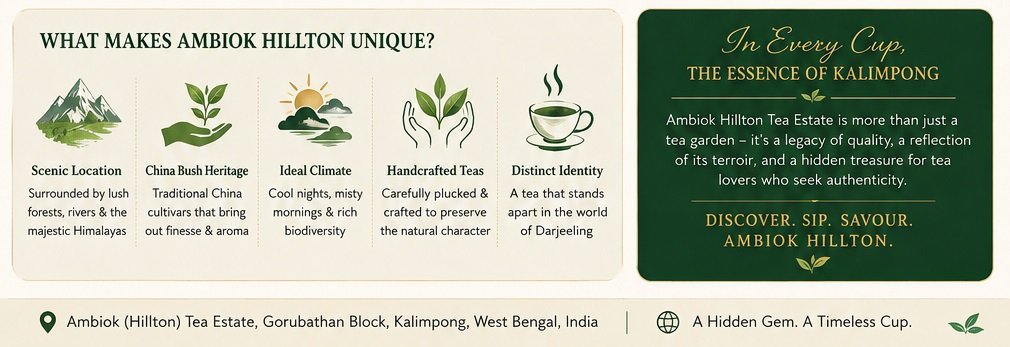
In a region full of celebrated names — Makaibari, Castleton, Jungpana — Ambiok (Hillton) remains relatively under-the-radar. Yet those who have discovered it consistently return to it, and here is why:
It produces a different kind of Darjeeling. Most classic Darjeeling First Flushes are known for their sharp astringency, strong mineral character, and bracing freshness. Ambiok’s First Flush, by contrast, is smooth, floral, and almost oolong-like in its gentleness. For drinkers who find classic Darjeeling too sharp or astringent, Ambiok is revelatory.
The China bushes are still there. Many estates have uprooted their heritage China bushes in favour of higher-yielding hybrids. Ambiok’s commitment to old-growth China bushes preserves a flavour complexity that is increasingly rare.
The environment is pristine. Bordering Neora Valley National Park, the estate benefits from one of the cleanest ecosystems in the region. No industrial pollution, no urban encroachment — just forests, rivers, mist, and tea.
It holds the Darjeeling GI tag. Despite being in Kalimpong (not the Darjeeling Sadar sub-division), its teas are officially Darjeeling teas — a mark of authenticity and quality.
14. Where to Buy Ambiok (Hillton) Tea
Ambiok (Hillton) teas are available through a limited number of specialist retailers, primarily in international markets. Here is where to look:
- Specialist Darjeeling wholesalers in the UK and Europe
- Premium tea subscription boxes (the Hillton First Flush has appeared in curated UK boxes)
- Online Indian tea retailers specialising in single-estate Darjeeling teas
- Auction platforms — Darjeeling teas are sold through Kolkata tea auctions where traders can source directly
When purchasing, look for:
- The name Hillton or Ambiok on the label
- A mention of Kalimpong sub-division or Gorubathan block
- Flush designation (First Flush, Second Flush) and harvest year
- The Darjeeling GI logo (a small teacup design) — a legal guarantee of authenticity
15. FAQs
Q: Is Ambiok and Hillton the same tea estate?
Yes. Hillton (also spelled Hilton) is the commercial trade name for Ambiok Tea Estate. Both names refer to the same garden in the Gorubathan block of Kalimpong.
Q: Is Ambiok tea organic?
Ambiok is not widely certified organic, unlike its neighbour Samabeong which produces certified organic teas. However, its proximity to Neora Valley National Park and its traditional cultivation practices mean chemical inputs are minimal.
Q: What makes Ambiok First Flush different from other Darjeeling First Flushes?
Ambiok First Flush is less astringent and more floral than most classic Darjeeling First Flush teas. It is often described as resembling a medium-oxidised oolong more than a typical brisk Darjeeling, making it smoother and more approachable.
Q: Can I visit Ambiok Tea Estate?
The estate is located in Gorubathan, accessible from Mal Bazar (~10 km), Siliguri (~60 km), or Darjeeling (~90 km). While it is not a major tourist estate with formal visitor programs, the region itself — with Neora Valley National Park nearby — is a wonderful destination for nature and tea lovers.
Q: How much tea does Ambiok produce annually? Ambiok Tea Estate has a planted area of approximately 375 acres and produces around 1,70,000 kg of tea annually.
Q: What is the cultivar used at Ambiok? The estate uses a mixed cultivar base, but the majority of plants are old China bushes (Camellia sinensis var. sinensis), which are prized for producing delicate, complex flavours.
16. Final Thoughts
Ambiok (Hillton) Tea Estate is one of those rare places in the tea world where geography, heritage, and craft come together to produce something genuinely special — and yet it remains beautifully unassuming.
Sitting at the edge of a national park in the Kalimpong hills, drawing moisture from the Teesta Valley, and growing tea on century-old China bushes, Ambiok produces First Flush teas that quietly astonish those who encounter them. They do not shout for attention the way some famous Darjeeling gardens do. Instead, they reward the curious — offering a cup that is smooth, floral, complex, and unlike almost anything else in the world of tea.
If you love Darjeeling tea and have not yet tried a Hillton (Ambiok) First Flush, consider this your invitation.
Enjoyed this deep-dive? Explore more estate profiles, brewing guides, and Darjeeling tea stories on TeaFlush.com.
Tags: Ambiok Tea Estate, Hillton Tea Estate, Darjeeling Tea, Kalimpong Tea Garden, First Flush Darjeeling, Gorubathan Tea, Neora Valley Tea, Teesta Valley Tea, India Tea Estates, Orthodox Darjeeling Tea, China Bush Tea, GI Darjeeling Tea
Meta Description: Discover Ambiok (Hillton) Tea Estate — a hidden gem in Kalimpong’s Gorubathan block. Learn about its altitude, China bush cultivars, GI certification, First Flush flavour profile, and what makes it one of Darjeeling’s most unique tea gardens.
Focus Keyword: Ambiok Hillton Tea Estate