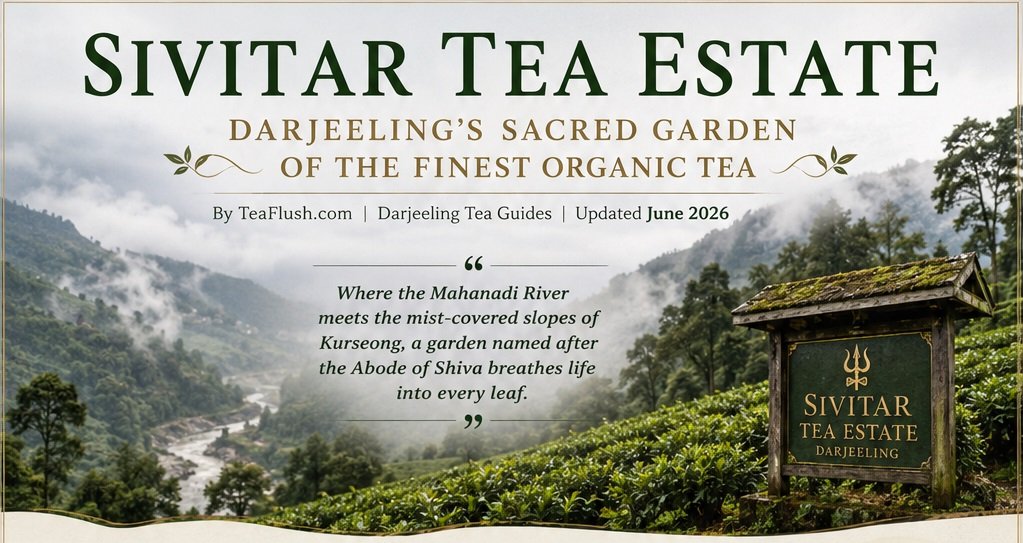
Sivitar Tea Estate: Darjeeling’s Sacred Garden of the Finest Organic Tea
By TeaFlush.com | Darjeeling Tea Guides | Updated June 2026
“Where the Mahanadi River meets the mist-covered slopes of Kurseong, a garden named after the Abode of Shiva breathes life into every leaf.”
Table of Contents
What Is Sivitar Tea Estate?
Nestled in the lush valleys of the Kurseong sub-division of Darjeeling, Sivitar Tea Estate is one of the most celebrated organic tea gardens in the entire Darjeeling district. Known for producing exquisite, hand-plucked teas that carry the unmistakable terroir of the eastern Himalayas, Sivitar stands out not only for the exceptional quality of its leaves but also for its deep-rooted commitment to biodynamic, pesticide-free cultivation.
For tea lovers, connoisseurs, and anyone curious about the “Champagne of Teas“, Sivitar represents everything that makes Darjeeling tea one of the most coveted beverages on earth — delicate floral aromas, crisp spring character, rich muscatel notes, and a story that stretches across generations of careful stewardship.
The Meaning Behind the Name
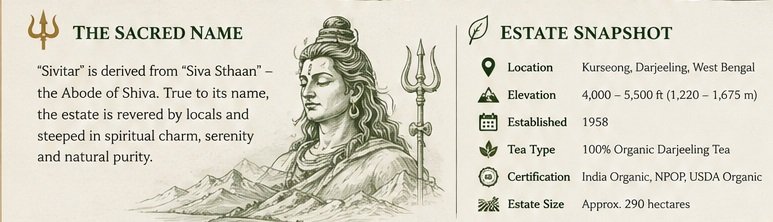
The very name Sivitar carries spiritual weight. In Sanskrit, “Sivitar” translates to “the Abode of Shiva” — a nod to the Hindu deity Lord Shiva, one of the principal figures of the Hindu pantheon. The estate is also locally known as Lizzipur, a name that echoes its colonial-era past.
According to local lore and landscape, one of the hills within the estate has a river flowing along its base in a formation reminiscent of the sacred Shiva Lingam — a revered symbol in Hindu tradition. It is this geographical and spiritual coincidence that gave the garden its evocative name. Even the area around Sivitar, near the Mahanadi River, is steeped in a sense of natural sanctity, as if the land itself knows it nurtures something sacred.
For those who believe that a tea’s essence is shaped not just by soil and sun but by the spirit of its place, sipping a cup of Sivitar tea is nothing short of a meditative experience.
Location & Geography
| Detail | Information |
|---|---|
| District | Darjeeling, West Bengal, India |
| Sub-Division | Kurseong |
| Nearby Landmark | Mahanadi River |
| Also Known As | Lizzipur |
| Terrain | Steep Himalayan slopes, mixed forests, grasslands |
| Cover | Tea plantations, dense forests, open grasslands |
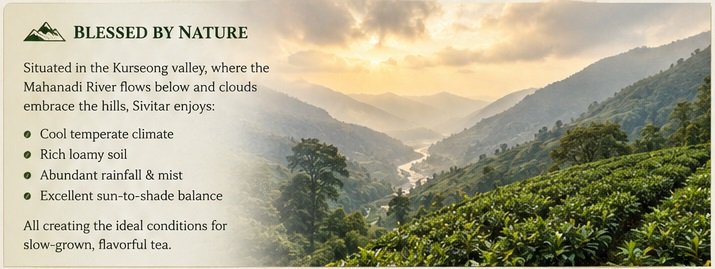
Sivitar Tea Estate is situated in the Kurseong sub-division of Darjeeling district, one of the most productive and botanically rich tea-growing belts in all of India. The garden is watered by the crystal-clear Mahanadi River, whose pure mountain flow nourishes the fertile mountain soil and plays a critical role in the flavour profile of the teas grown here.
The estate is surrounded by a tapestry of natural elements: tea plantations, ancient forests, and open grasslands that create a microclimate ideal for the slow, deliberate growth of tea bushes. The slopes are steep, the mist is constant, and the air carries the mineral coolness of the high Himalayas — all conditions that tea masters consider essential for producing leaves of extraordinary character.
The Kurseong valley is known among tea experts as a cradle of some of Darjeeling’s finest estates. Neighbours include legendary gardens like Jungpana, Goomtee, Castleton, Makaibari, and Margaret’s Hope — a lineage that places Sivitar firmly in elite company.

History of Sivitar Tea Estate
The history of Sivitar Tea Estate is intertwined with the broader colonial and post-colonial story of Darjeeling’s tea industry, which began in earnest in the 1850s when British planters first recognised the extraordinary potential of these Himalayan slopes.
Like many of Darjeeling’s now-iconic gardens, Sivitar went through phases of decline — a common fate for smaller estates that faced financial hardship, mismanagement, or labour disputes across the late 20th century. At its lowest point, the garden was considered a “sick estate”, struggling to produce at its full capacity.
Its modern revival came through one of Darjeeling’s most remarkable stories of conservation and enterprise — the story of the Ambootia Group.
Ownership: The Ambootia Group
Today, Sivitar Tea Estate is managed under the umbrella of the Ambootia Group (also identified with Darjeeling Organic Tea Estate Private Limited and LemonGrass Organic Tea Estates Pvt. Ltd.), one of Darjeeling’s most respected and visionary tea conglomerates.
The group, originally founded around the legendary Ambootia Tea Estate (established in 1861), embarked on an ambitious mission to acquire and revive sick and closed tea estates across the Darjeeling district. This vision — guided by the philosophy of sustainable agriculture and community welfare — transformed not just Sivitar but a family of gardens that now includes:
- Ambootia Tea Estate
- Chongtong Tea Estate
- Happy Valley Tea Estate
- Montevoit Tea Estate
- Moondakotee Tea Estate
- Mullootar Tea Estate
- Nagri Tea Estate
- Nurbong Tea Estate
- Sepoydhoorah (Chamling) Tea Estate
- Sivitar Tea Estate
- Rungmook Tea Estate
- Rangaroon Tea Estate
- Pandam Tea Estate
- Aloobari Tea Estate
Under this stewardship, Sivitar was brought back to life, its century-old tea bushes nurtured back to productivity using biodynamic farming methods that have become the hallmark of the Ambootia Group’s approach.
Farming Philosophy: Organic & Biodynamic Agriculture
What truly sets Sivitar apart from the majority of tea estates — even within Darjeeling — is its unwavering commitment to organic and biodynamic agriculture.
What Is Biodynamic Tea Farming?
Biodynamic farming goes beyond organic. While organic farming prohibits the use of synthetic pesticides and fertilisers, biodynamic agriculture treats the entire farm as a living organism — a self-sustaining ecosystem where soil health, plant vitality, animal life, and cosmic rhythms are all interconnected.
At Sivitar and its sister estates under the Ambootia Group, this means:
- No synthetic fertilisers or pesticides — ever
- Natural composting to enrich the soil with micronutrients
- Biodiversity cultivation — maintaining diverse plant and tree species alongside tea bushes
- Holistic land management — nurturing soil, water, and air quality as a unified system
- Seasonal planting rhythms aligned with natural lunar and solar cycles
The wild orange trees that line the fertile Kurseong valley naturally co-exist with the tea bushes at Sivitar, adding to the aromatic complexity of the surrounding air — a factor that some experts believe subtly influences the character of the tea.
The plantation is also rich with centenary tea plants — bushes that are over a hundred years old — whose deep root systems draw minerals and nutrients from layers of ancient Himalayan soil that younger plantations simply cannot access.
Why Does Biodynamic Farming Matter for Tea?
The answer is simple: it tastes better. The eco-friendly practices of biodynamic estates like Sivitar produce leaves that are pure, vibrant, and alive with flavour. The absence of chemical interference means that every nuance of the terroir — the soil, the altitude, the mist, the river water — expresses itself fully and honestly in the cup.
The Teas of Sivitar: Flush by Flush
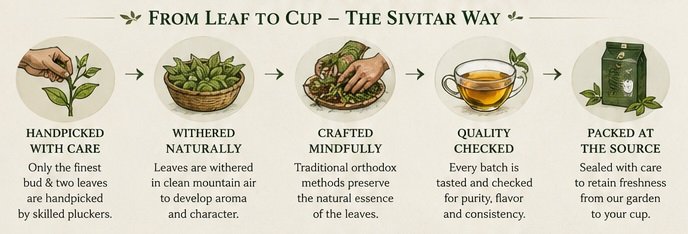
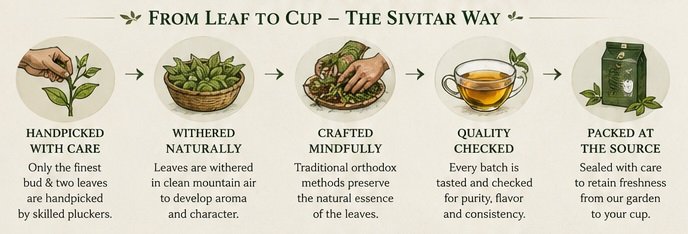
Like all great Darjeeling gardens, Sivitar produces tea across three major seasonal harvests, each with its own personality. The leaves are hand-plucked at each harvest, ensuring only the finest two leaves and a bud make it to the factory.
🌱 First Flush (Spring — February to April)
The First Flush is the most celebrated and eagerly awaited harvest of the Darjeeling year. At Sivitar, the first flush tea embodies the very essence of spring: handpicked from the season’s earliest and most tender leaves, it offers a unique floral scent that invigorates the senses.
The leaves are among the youngest of the year — delicate, silver-budded, and touched with the freshness of new growth. The Sivitar first flush is graded primarily as FTGFOP1 (Finest Tippy Golden Flowery Orange Pekoe — Grade 1), signifying an abundance of golden tips and superior leaf quality.
In the cup, Sivitar’s First Flush reveals:
- A pale golden to light amber liquor
- A refreshingly clean, vibrant floral character reminiscent of spring blossoms
- Delicate herbaceous notes that unfold as the cup cools
- A gentle, pleasant astringency in the finish that provides lift and freshness
This tea has been described by master tasters as possessing notes of green papaya with a flowery resonance — a combination unique to the Kurseong valley‘s microclimate.
☀️ Second Flush (Summer — May to July)
The Second Flush is where Darjeeling tea’s legendary muscatel character fully emerges. Warmer temperatures and longer daylight hours transform the biochemistry of the leaf, creating a richer, more full-bodied cup.
At Sivitar, the second flush produces teas with:
- A bright, warm amber to gold liquor
- The iconic muscatel grape note that defines great Darjeeling
- Hints of honey, rose, and biscuit
- A well-rounded, full-bodied character with lingering sweetness
The second flush is a favourite among traditional Darjeeling tea drinkers and commands significant international demand, particularly in Germany, Japan, and the United Kingdom.
🍂 Autumn Flush (Autumn — October to November)
Often underappreciated but increasingly celebrated, the Autumn Flush from Sivitar is a complex and satisfying tea. After the monsoon rains wash the slopes clean, the tea bushes produce leaves that carry:
- A coppery, amber-toned liquor
- Mellow, round sweetness without the sharp astringency of the first flush
- A mature, well-rounded flavour that is fuller and more mellow than the summer harvest
- Subtle musky undertones that distinguish it from earlier flushes
The autumn flush is an ideal everyday drinking tea — approachable, comforting, and deeply satisfying.
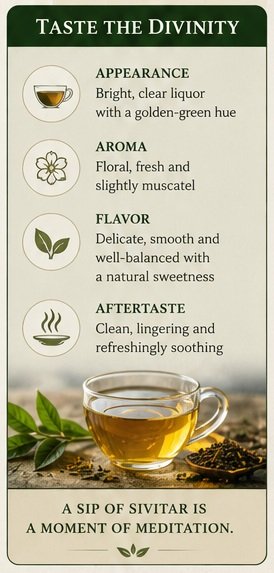
Flavour Profile & Tasting Notes
Across all its flushes, Sivitar Tea Estate produces teas characterised by a distinct freshness and florality rooted in its Kurseong terroir. Internationally renowned tea houses have noted the following:
| Flush | Dry Leaf | Liquor Colour | Primary Notes | Finish |
|---|---|---|---|---|
| First Flush | Silver buds, green-tipped leaves | Pale golden | Floral, green papaya, spring blossoms | Light, refreshing astringency |
| Second Flush | Darker, mixed leaves with tips | Warm amber | Muscatel, honey, rose | Lingering sweetness |
| Autumn Flush | Dark brown, mature leaves | Coppery amber | Mellow, round, slightly earthy | Sweet, warm, rounded |
The Mariage Frères, one of Paris’s most prestigious tea houses, has featured Sivitar’s first flush in their collection, describing the liquor as “Twilight gold” with notes of poppy beaded with morning dew answering the call of frangipani flowers — a poetic testament to the estate’s extraordinary output.
Tea Grades Produced at Sivitar
Darjeeling teas are classified using the Orange Pekoe grading system, which assesses leaf quality, tip content, and overall appearance. Sivitar produces teas across several grades, with the finest being:
FTGFOP1 — Finest Tippy Golden Flowery Orange Pekoe, Grade 1
This is the highest grade achievable in Darjeeling. The “Tippy” designation refers to the presence of golden tips (young, unopened leaf buds), which are the most flavourful and aromatic part of the plant. Grade 1 indicates the pick of the harvest — the absolute finest leaves from the most carefully tended bushes.
Other grades produced include:
- FTGFOP — Finest Tippy Golden Flowery Orange Pekoe
- TGFOP — Tippy Golden Flowery Orange Pekoe
- GFOP — Golden Flowery Orange Pekoe
Each grade offers a slightly different experience in the cup, making Sivitar’s range suitable for both novice tea drinkers and seasoned connoisseurs.
Certifications & Sustainability
Sivitar Tea Estate, under the Ambootia Group’s management, holds a rigorous array of certifications that confirm both the purity of its product and the integrity of its operations:
- ✅ Certified Organic — No synthetic chemicals at any stage of production
- ✅ Biodynamic Certified (Demeter) — Meeting the highest standards of holistic, ecological farming
- ✅ IMO Certified — Institute for Marketecology organic certification
- ✅ USDA Organic — Approved for the American organic market
- ✅ JAS Certified — Japanese Agricultural Standards organic approval
- ✅ Fairtrade Certified — Ensuring fair wages, safe working conditions, and community development for all estate workers
- ✅ HACCP Certified — Meeting international food safety management standards
This remarkable certification portfolio places Sivitar among the most rigorously verified tea estates not just in Darjeeling, but in the world.
Community & Social Responsibility
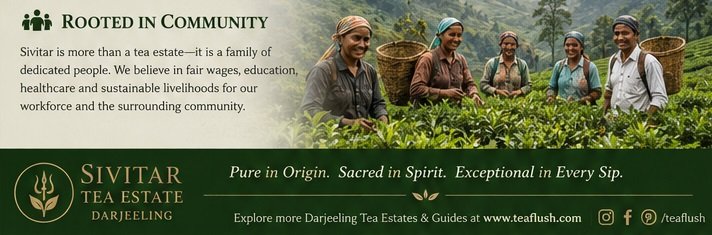
Beyond environmental stewardship, the Ambootia Group’s management of Sivitar places significant emphasis on the welfare of the estate’s workers and surrounding community. Fairtrade certification ensures that workers receive fair wages and have access to healthcare, education, and improved living conditions — a standard that not all tea estates in India maintain.
Sivitar Tea on the Global Stage
Despite being relatively lesser-known than some of Darjeeling’s most marketed gardens, Sivitar’s teas have found their way into premium tea houses across Europe, North America, and East Asia.
The estate’s organic and biodynamic credentials have made it particularly appealing to markets with strong ethical consumption cultures. Notable international presences include:
- Mariage Frères (France) — Featured as a premier spring harvest Darjeeling
- Nannuoshan (Germany) — Sells Sivitar FTGFOP1 First Flush as a premium single-estate tea
- Kent Tea & Coffee Co. (UK) — Promotes Sivitar as part of Ambootia’s sustainable estate network
- Various Japanese specialty importers — Given Japan’s exacting standards for Darjeeling tea quality
The estate’s first flush, in particular, has earned consistent praise for its vibrant floral character, clean mountain flavour, and exceptional purity — qualities that command premium prices at international auctions.
How to Brew Sivitar Tea Perfectly
Getting the best out of a single-estate tea like Sivitar requires just a little attention. Here are the recommended parameters for each flush:
First Flush Brewing Guide
- Water Temperature: 75–80°C (167–176°F) — lower than boiling to protect delicate aromatics
- Leaf Quantity: 3 grams per 250 ml (10 oz) of water
- Steep Time: 2–3 minutes
- Vessel: White porcelain or glass — to appreciate the pale golden colour
- Milk: Not recommended — enjoy it pure
- Tip: Use soft, filtered water for the purest expression of flavour
Second Flush Brewing Guide
- Water Temperature: 90–95°C (195–205°F)
- Leaf Quantity: 3 grams per 250 ml (10 oz) of water
- Steep Time: 3 minutes
- Vessel: Ceramic or porcelain
- Milk: A small dash is acceptable if preferred, but try it plain first
- Tip: The muscatel note intensifies as the cup cools slightly
Autumn Flush Brewing Guide
- Water Temperature: 90–95°C (195–205°F)
- Leaf Quantity: 3 grams per 250 ml (10 oz) of water
- Steep Time: 3–4 minutes
- Vessel: Any classic teacup or mug
- Milk: Works beautifully with a small amount of milk
- Tip: Ideal for an afternoon pot — robust enough to hold its flavour
💡 Pro Tip from TeaFlush: Always pre-warm your teapot or cup with hot water before brewing. This stabilises the temperature and allows the leaves to open evenly, releasing the full complexity of Sivitar’s mountain terroir.
Where to Buy Sivitar Tea
Sivitar Tea Estate teas are available through a number of reputable online and offline channels:
- Specialist Darjeeling tea retailers — Look for single-estate listings specifying “Sivitar” on trusted platforms
- Direct from estate networks — LemonGrass Organic Tea Estates Pvt. Ltd. and Darjeeling Organic Tea Estate Pvt. Ltd. manage direct sales channels
- International premium tea houses — Mariage Frères, Nannuoshan, and selected UK/US importers carry Sivitar teas seasonally
- TeaFlush.com — Your trusted source for curated Darjeeling teas, including seasonal Sivitar offerings
When purchasing, always look for:
- The Darjeeling GI (Geographical Indication) logo on the packaging — your guarantee of authenticity
- The flush designation (First, Second, or Autumn)
- The harvest year — freshness matters enormously in premium Darjeeling tea
- Organic / Demeter / Fairtrade certification marks
Visiting Sivitar & the Kurseong Valley
While Sivitar Tea Estate is not as publicly promoted as a tourist destination as some other gardens, the Kurseong valley in which it sits is increasingly recognised as one of the most beautiful and accessible tea tourism corridors in Darjeeling.
Getting to Kurseong
- By Rail: The legendary Darjeeling Himalayan Railway (Toy Train), a UNESCO World Heritage Site, stops at Kurseong on its route between New Jalpaiguri (NJP) and Darjeeling
- By Road: Kurseong is approximately 30 km from Siliguri and 32 km from Darjeeling town, well-connected by NH-55 (Hill Cart Road)
- Nearest Airport: Bagdogra Airport (IXB), approximately 40 km from Kurseong
Things to Do in and Around Sivitar’s Kurseong Region
- Tea estate walks through the Kurseong valley, where tea gardens carpet the hillsides
- Tea factory tours at nearby estates to understand the journey from leaf to cup
- Mahanadi River excursions — the river that nourishes Sivitar’s soil
- Forest trails and birdwatching — the Kurseong forests are home to an extraordinary variety of Himalayan birds
- Heritage bungalow stays at restored colonial planters’ residences
For the serious tea lover, visiting during the First Flush season (March–April) offers the rare chance to witness the plucking and processing of one of the world’s most prized teas in real time.
Frequently Asked Questions
What makes Sivitar Tea Estate unique?
Sivitar is unique for its combination of biodynamic farming, centenary tea bushes, and Kurseong valley terroir. It is nourished by the Mahanadi River, managed under organic principles, and produces teas that carry a genuinely distinctive floral and fresh character.
Is Sivitar tea truly organic?
Yes. Sivitar Tea Estate is certified organic by multiple agencies including IMO, USDA, and JAS, and is additionally Demeter-certified biodynamic — a higher standard than regular organic certification.
What does Sivitar First Flush taste like?
Sivitar First Flush is known for its vibrant floral aromatics, clean spring character, notes of green papaya and blossom, and a refreshing, gentle astringency. It is light in body with a bright golden liquor.
Who owns Sivitar Tea Estate?
Sivitar is currently managed under the Ambootia Group (also referred to as Darjeeling Organic Tea Estate Pvt. Ltd. / LemonGrass Organic Tea Estates Pvt. Ltd.), which acquired it as part of a mission to revive struggling Darjeeling estates.
What tea grade does Sivitar produce?
Sivitar is known for producing FTGFOP1 (Finest Tippy Golden Flowery Orange Pekoe, Grade 1) — the highest quality designation in Darjeeling tea grading.
Can I visit Sivitar Tea Estate?
The Kurseong sub-division where Sivitar is located is accessible to visitors. While direct estate tourism at Sivitar is limited, the surrounding region offers ample opportunities for tea walks, factory tours, and valley experiences. Contact local tour operators in Kurseong for current access information.
What is the best season to buy Sivitar tea?
First Flush (March–April) is the most prized season, favoured by connoisseurs for its spring freshness. Second Flush (May–July) offers the classic muscatel Darjeeling experience. Each season has its devotees — the best approach is to try all three.
Final Sip: Why Sivitar Tea Deserves a Place in Your Cup
In a landscape as storied and competitive as Darjeeling’s tea country, Sivitar Tea Estate carves out a place of quiet distinction. It is not the loudest name in the valley, but among those who know Darjeeling tea deeply, it commands genuine respect.
Its teas carry the purity of mountain water, the memory of century-old roots reaching deep into Himalayan soil, and the philosophy of a farming community that refuses to shortcut quality for convenience. When you lift a cup of Sivitar First Flush to your lips and smell the spring blossoms of the Kurseong hills, you are tasting not just a beverage but a commitment — to the land, to the craft, and to the idea that the finest things in life are grown with patience and care.
At TeaFlush.com, we believe that understanding where your tea comes from makes every sip more meaningful. Sivitar Tea Estate is exactly the kind of story we exist to tell.
Explore more Darjeeling tea estate guides, brewing tips, and curated single-estate teas at TeaFlush.com.
Tags
Sivitar Tea Estate | Darjeeling Tea | Organic Darjeeling Tea | Kurseong Tea Garden | Biodynamic Tea | First Flush Darjeeling | Ambootia Group | Single Estate Tea | Darjeeling Tea Estates | FTGFOP1 | Champagne of Teas | Indian Tea | TeaFlush
© 2026 TeaFlush.com — All rights reserved. Written with passion for the leaf.