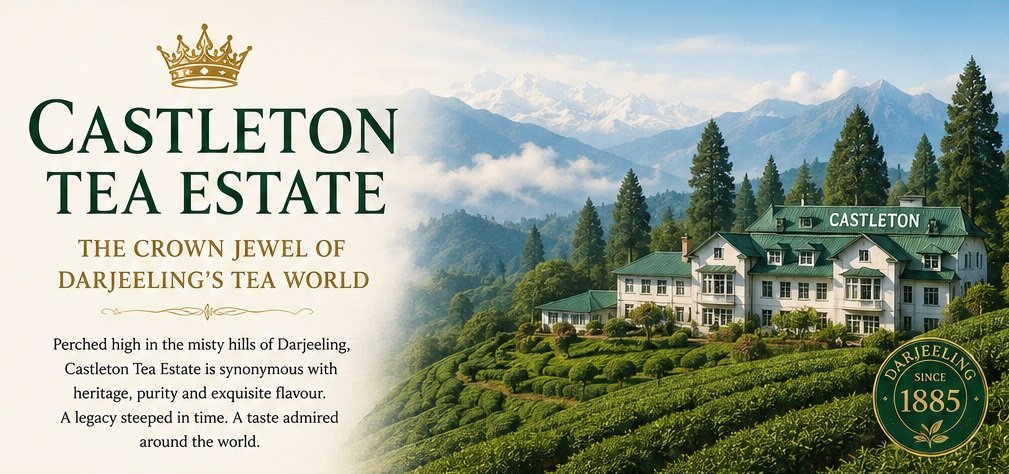
Castleton Tea Estate: The Crown Jewel of Darjeeling’s Tea World
Published on TeaFlush.com | Category: Tea Estates | Reading Time: ~12 minutes
“Castleton is truly the abode of the Gods. Here, mountain, earth, sun, mist, and dew shed their gentle blessings to produce the world’s finest teas.” — Goodricke Group
Table of Contents
1. Introduction: Why Castleton Tea Estate Is Legendary
If Darjeeling tea is the Champagne of teas, then Castleton Tea Estate is unquestionably the Grand Cru of Darjeeling. Perched dramatically in the misty Kurseong hills of West Bengal, India, Castleton is not just a tea garden — it is an institution. It is a name that causes tea connoisseurs worldwide to pause mid-sip, a name whispered reverently at auction halls, and a name that has repeatedly shattered global price records.
For over 140 years, Castleton has been producing teas of breathtaking complexity — teas that smell of roses and ripe grapes, that taste like sweet summer wines, and that linger on the palate long after the last sip. Its Muscatel teas are considered the benchmark against which all other Muscatels in the world are measured.
Whether you are a lifelong tea enthusiast, a curious newcomer, or a professional in the trade, understanding Castleton Tea Estate is an essential chapter in the story of fine tea. In this comprehensive guide, TeaFlush.com takes you deep into the world of Castleton — its history, geography, teas, records, and much more.
2. Location & Geography
Where is Castleton Tea Estate located?
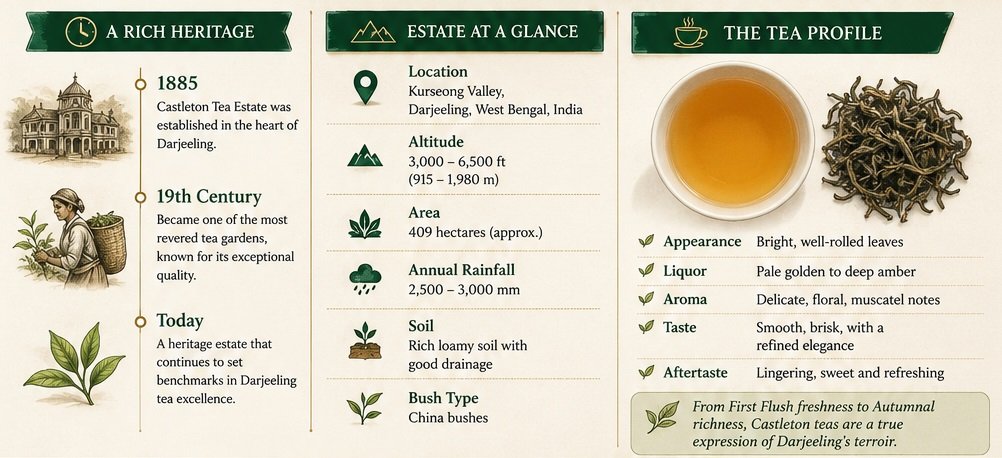
Castleton Tea Estate is located in the Kurseong subdivision of the Darjeeling district in the Indian state of West Bengal. More precisely, it sits in the Kurseong South Valley, one of the most prized tea-growing microclimates in the entire Darjeeling region.
Key Location Facts
| Detail | Information |
|---|---|
| State | West Bengal, India |
| District | Darjeeling |
| Subdivision | Kurseong South Valley |
| Coordinates | 26°52′10″N 88°16′40″E |
| Altitude Range | 980 m to 2,300 m (3,220 ft to 7,550 ft) |
| Approximate Elevation | ~5,000 feet above sea level |
The estate spans the hilly slopes of Kurseong and Pankhabari, climbing from the foothills up to the clouds. This dramatic elevation gradient — from roughly 980 meters to 2,300 meters — is one of the primary reasons why Castleton’s teas possess such extraordinary complexity. At any given moment, different sections of the garden experience different temperatures, moisture levels, and sun exposure, collectively contributing to a flavor profile that simply cannot be replicated elsewhere.
3. A Rich History: From Kumseri to Castleton
The Founding: 1885
The story of Castleton Tea Estate begins in 1885, when the estate was planted by Dr. Charles Graham, a pioneering figure in the Darjeeling tea world. In those early days, the estate was known by its original name: Kumseri.
The Darjeeling tea industry was still relatively young at the time — British planters were actively expanding tea cultivation across the hills of the region, and Dr. Graham’s vision helped establish what would eventually become one of the most celebrated gardens on earth.
A related division of the estate, Springside, was also planted by Dr. Graham around the same era (some sources indicate 1865). The Springside factory was named for its location beside a spring near the forest-covered ridge of Kurseong. Locally, this area is still referred to as ‘Watting Kaman’, named after a certain Mr. Watting, an early figure associated with the property.
The Name “Castleton”
Why was the garden renamed from Kumseri to Castleton? The name has an endearingly quirky origin. Near the estate stands a building called “Bank Ghar” (literally “bank house”), which local lore describes as having once served as a moneylender’s premises. The structure’s appearance — somewhat castle-like in its architecture — led to the estate taking on the name Castleton. While no one knows its precise history for certain, the castle-esque building remains a charming part of the estate’s identity.
4. Ownership Through the Ages
Castleton’s ownership history reads like a compelling chapter from India’s colonial and post-independence story.
- 1885 — Planted and established by Dr. Charles Graham
- Early years — The estate passed through the hands of Mr. Cochrane and Mr. Mill, each leaving their mark on the property
- 1945 — Purchased by the Roy family of Calcutta, who renamed the estate ‘Gourishankar’ — a combination of their daughter’s name (Gouri) and son’s name (Shankar). This renaming, however, did not endure in popular memory
- 1965 — Ownership transferred to The Coventry Tea and Engineering Co. (P) Limited
- 1984 onwards — The estate became part of the Goodricke Group Ltd., under its subsidiary Amgoorie India Ltd. Goodricke itself is part of the globally renowned Camellia Plc.
Since joining the Goodricke Group, Castleton has flourished, setting world price records and winning prestigious international awards. Goodricke is often described as the “guardian of this treasure”, continuing Castleton’s fine tradition of excellence.
5. The Terroir: Nature’s Perfect Recipe
The concept of terroir — the unique combination of soil, climate, and geography that gives agricultural products their distinctive character — is nowhere more relevant than at Castleton.
What Makes Castleton’s Terroir Unique?
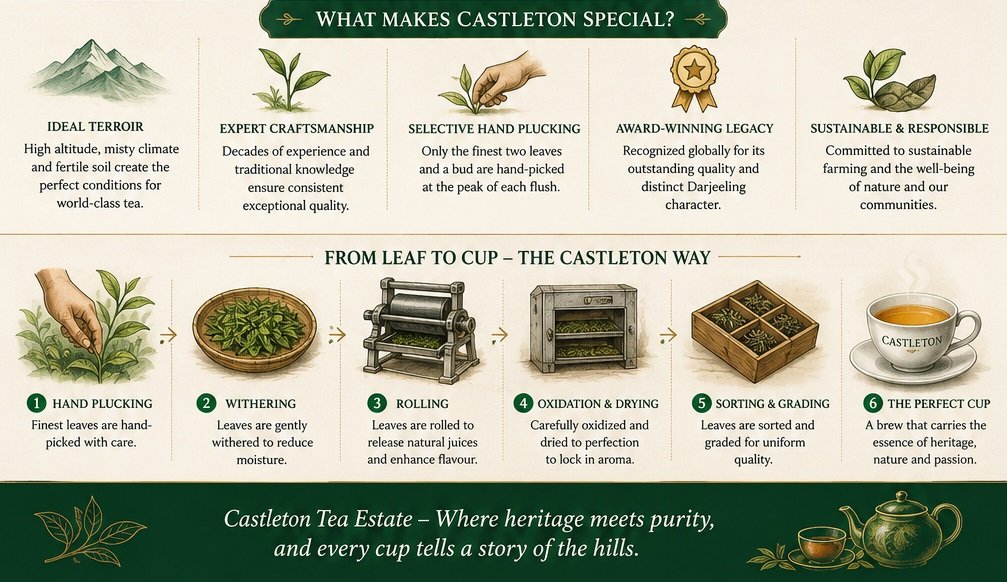
Altitude: The dramatic elevation range (980 m to 2,300 m) means cool nights, temperature differentials between day and night, and slower leaf growth. Slower growth translates to more concentrated flavors — essential for the Muscatel character.
Mist and Cloud Cover: Castleton is frequently draped in mist from the surrounding Himalayan foothills. This natural humidity moderates the temperature and protects the tea bushes from harsh direct sunlight, resulting in more delicate leaves with nuanced aromas.
Soil Profile: The garden’s unique combination of topography and soil composition is considered irreplaceable. As one estate manager has noted, “Quality of Castleton teas cannot be replicated by other gardens” — a direct reflection of its singular soil profile.
Biodiversity: The estate is surrounded by biodiverse forest cover, which contributes to the health of the soil ecosystem and supports the growth of microorganisms that enrich the land naturally.
China Bushes: Perhaps the most defining terroir element is the estate’s planting material. Castleton is cultivated predominantly with heritage China bushes (Camellia sinensis var. sinensis) — many of which are over 100 years old. These ancient plants have deep root systems drawing minerals from layers of soil that younger plants cannot reach. Their leaves produce teas of exceptional finesse, with a delicacy and aromatic complexity that Assam-derived hybrid cultivars simply cannot match.
6. Tea Sections of Castleton: Named, Not Numbered
One of the most charming and distinctive features of Castleton Tea Estate is its tradition of giving names rather than numbers to the various sections of the garden — a practice that sets it apart from virtually every other estate in Darjeeling.
The Named Sections
| Section Name | Meaning |
|---|---|
| Bhalu Khop | Bear Cave |
| Dhobitar | Washerman’s Clothesline |
| Baseri | Resting Place |
| Jim Basha | The erstwhile manager’s domain |
These names reflect the human stories and natural landmarks embedded in the estate’s long history. For tea lovers and historians alike, they offer a window into the cultural fabric of the region. The Muscatel Valley — the most celebrated microzone within the estate — is specifically the origin of Castleton’s prized Muscatel teas, its most sought-after produce.
7. The Teas of Castleton Estate
Castleton Tea Estate produces a remarkable range of teas, each representing a different facet of its exceptional terroir and heritage.
Types of Tea Produced
1. FTGFOP1 China Specials The highest grade of Darjeeling orthodox tea — Fine Tippy Golden Flowery Orange Pekoe First Grade. These represent the very best of Castleton’s hand-picked output, featuring golden tips and exceptional liquor.
2. Muscatel (Second Flush) The crown jewel of the estate. Produced in limited quantities, this is the tea that put Castleton on the world map. More on this below.
3. First Flush Light, floral, and ethereally delicate. Castleton’s First Flush teas are eagerly awaited each spring and are known for being slightly more malty than some of its neighboring estates, while still retaining that signature Darjeeling lightness.
4. Moonlight Tea (White Tea) A rare and exquisite white tea made predominantly from the finest silvery tips. Produced only during the second and third flush period (June and September), Castleton’s Moonlight tea is considered one of the most exclusive teas in the world.
5. China Teas Teas produced from the estate’s heritage China bushes, known for their gentle, floral character.
6. Tippy Clonals Teas produced from select clonal varieties that produce abundant golden tips.
7. Green Tea A more recently expanded category, Castleton’s green teas offer a fresher, lighter expression of its famous China bush terroir.
Tea Grades Produced
- FTGFOP1 (Fine Tippy Golden Flowery Orange Pekoe, First Grade)
- TGFOP (Tippy Golden Flowery Orange Pekoe)
- Various special and limited batches
8. The Muscatel Magic: Darjeeling’s Most Celebrated Flavor
No discussion of Castleton is complete without a deep dive into Muscatel — the flavor that changed Darjeeling tea forever.
What Is Muscatel?
Muscatel refers to a specific flavor profile — a complex, intoxicating combination of grape-like sweetness, musky fragrance, and wine-like richness found in Darjeeling’s finest second flush teas. It is often compared to the taste of the Muscat grape, widely used in premium winemaking.
The Discovery of Muscatel at Castleton
The Muscatel flavor was first identified at Castleton Tea Estate in 1986 (some sources cite 1985 as the year of the first batch) by Mr. Arun Kumar Gomden, who was then the estate manager. During one particular second flush season, the teas produced had a uniquely grape-like, musky quality that had never been documented before in Darjeeling tea production.
As Mr. Gomden himself recalled:
“Because of its grape-like taste that year, we named this tea after the Muscat grape, widely used in winemaking.”
The tea debuted at the Calcutta Auction Sale, where it fetched record prices and immediately captured the attention of the global tea trade. The rest, as they say, is history.
Why Can’t Other Gardens Match It?
Muscatel character in Darjeeling tea is influenced by a combination of:
- Green leafhopper insect activity — Similar to Taiwan’s Oriental Beauty, a specific insect bite on the leaves triggers a chemical response in the plant that produces the distinctive musky aroma
- Heritage China bushes — The genetic material of the plant plays a crucial role
- Specific microclimatic conditions — The unique elevation, mist, and temperature patterns of Castleton’s Muscatel Valley
- Processing expertise — Castleton’s closely guarded processing techniques, much of which is mechanized for consistency while retaining the artisanal spirit of orthodox production
While many Darjeeling estates now produce what they call Muscatel teas, the consensus among connoisseurs is clear: Castleton’s Muscatel remains the original and the benchmark. As one tea expert famously noted, some estates have gone as far as to call Castleton’s the “true muscatel” — the standard against which every other Muscatel is measured.
9. Certifications & Quality Standards
Castleton Tea Estate was the first tea garden in Darjeeling to receive ISO 9002 certification, a landmark achievement that reflected the estate’s commitment to quality management from an early stage.
Current Certifications
| Certification | Significance |
|---|---|
| ISO 9000 | International quality management standard |
| HACCP | Hazard Analysis and Critical Control Points — food safety |
| ISO 22000 | Food safety management systems |
| FSSC 22000 | Food Safety System Certification — global food chain standard |
| Rainforest Alliance Certified | Environmental sustainability and worker welfare |
| ETP Certified | Ethical Tea Partnership — ethical sourcing and labor standards |
These certifications collectively affirm that Castleton’s teas are not only exceptional in taste but also produced with rigorous attention to food safety, environmental responsibility, and ethical labor practices.
10. World Record Prices & Awards
The 1992 World Record
In 1992, Castleton Tea Estate made international headlines when a batch of DJ-42 FTGFOP1 Muscatel tea sold for an astounding Rs. 13,001 per kilogram at the Calcutta tea auction — a world record at the time that sent shockwaves through the global tea industry.
To put this in context: at a period when most Darjeeling teas were selling for a small fraction of this price, Castleton’s Muscatel commanded a figure more associated with fine wine or rare spirits than with tea.
Consistent Record-Setting
Since becoming part of the Goodricke Group in 1984, Castleton has set multiple price records at tea auctions. Its Muscatel teas have fetched the highest prices at global auctions at least seven times — a testament to the consistent, extraordinary quality of what this garden produces.
Awards & Recognitions
- Gold Medal — North American Tea Conference, 2014
- Global Tea Awards — Winner for its unique Muscatel flavor
- Consistently recognized by international tea journals, brokers, and connoisseurs as among the finest teas in the world
Castleton’s teas are described as being sought after by royalty, collectors, and connoisseurs across the globe — a distinction few estates anywhere in the world can claim.
11. The Flushes of Castleton: Season by Season
Like all Darjeeling estates, Castleton’s teas change dramatically with the seasons. Each flush brings a different character, a different story.
First Flush (March – April)
The first harvest after the winter dormancy. Castleton’s First Flush teas are light, fresh, and aromatic, with a slightly more malty character than some neighboring estates. The liquor is pale gold, and the aroma is green and floral with hints of fresh grass and spring flowers. These teas are eagerly snapped up by buyers in Germany and Japan, who have a deep appreciation for first flush Darjeeling Tea.
Brewing suggestion: Use water at 88°C–90°C and steep for 2–3 minutes for a delicate, luminous cup.
Second Flush (May – June)
The most celebrated flush at Castleton. This is when the legendary Muscatel character emerges in full force. The leaves are fuller, darker, and more complex. The liquor is a deep amber-gold, and the flavor profile is a symphony of grape, musk, honey, and sweet wine.
This flush is produced in extremely limited quantities and commands the highest prices. The Muscatel Valley within the estate is the heart of this production.
Brewing suggestion: Use water at 90°C–95°C and steep for 3–4 minutes for the full Muscatel experience.
Monsoon Flush / Third Flush (July – September)
Produced during the rainy season, the monsoon flush teas are bolder and more robust. While they lack the delicacy of the first or second flush, Castleton’s monsoon teas — particularly the Moonlight White Teas produced during this period — are prized for their richness.
Autumnal Flush (October – November)
The final harvest before winter. Autumnal Darjeeling teas are known for their copper-colored leaves, full-bodied liquor, and earthy, woodsy notes. Castleton’s autumnal offerings are smooth, mellow, and deeply satisfying.
12. How to Brew Castleton Tea Perfectly
Getting the most from your Castleton tea is both an art and a science. Here’s everything you need to know.
General Brewing Guidelines
| Parameter | First Flush | Second Flush (Muscatel) | White / Moonlight |
|---|---|---|---|
| Water Temperature | 88°C – 90°C | 90°C – 95°C | 75°C – 80°C |
| Steeping Time | 2 – 3 minutes | 3 – 4 minutes | 3 – 5 minutes |
| Tea Quantity | 2.5 g per 200 ml | 2.5 – 3 g per 200 ml | 2 g per 200 ml |
| Milk? | Not recommended | Not recommended | Not recommended |
Step-by-Step Brewing Guide
Step 1 — Pre-warm your teaware
Pour hot water into your teapot or cup and discard it. This ensures the water doesn’t lose temperature when it hits cold ceramic.
Step 2 — Measure your tea
Use approximately 2.5 grams of Castleton tea per 200 ml of water. For loose leaf, a rounded teaspoon is a good approximation.
Step 3 — Heat water to the correct temperature
Never boil Darjeeling tea — especially first flush. Use a thermometer or let boiling water cool for a few minutes. Water that is too hot will destroy the delicate aromatic compounds.
Step 4 — Steep
Pour water over the leaves and steep for the recommended time. Do not stir.
Step 5 — Strain and serve
Remove the leaves promptly at the end of steeping. Castleton tea is best enjoyed without milk or sugar, especially the Muscatel — additives mask its extraordinary complexity.
Step 6 — Appreciate
Inhale the aroma before sipping. Let the liquor sit on your tongue for a moment. Notice the layers of flavor — the initial brightness, the Muscatel sweetness, the lingering finish.
Water Quality Tip
Always use fresh, filtered water. Castleton’s teas are subtle enough that chlorinated or mineral-heavy water can interfere with their delicate flavor profile.
13. Where to Buy Authentic Castleton Tea
Given Castleton’s global reputation, counterfeit and mislabeled teas claiming to be from the estate do exist. Here’s how to ensure you’re getting the real thing.
Trusted Sources
- Goodricke Tea (official) — goodricketea.in and goodricketea.com are the estate’s parent company’s direct channels
- TeaFlush — A reputable Indian tea e-commerce platform with direct estate sourcing
- Reputable specialty tea retailers in Germany, Japan, the UK, and the USA
What to Look For
- Clear mention of “Castleton Estate” with the flush (First Flush / Second Flush / Muscatel)
- The batch number (e.g., DJ-42) for premium grades
- Goodricke Group as the estate owner/exporter
- FTGFOP1 grade designation for the highest quality tiers
Price Range
Authentic Castleton teas are never cheap. Expect to pay:
- Entry-level Castleton blends: INR 700–1,500 per 100g
- First Flush orthodox: INR 2,000–5,000 per 100g
- Muscatel Second Flush: INR 3,000–10,000+ per 100g
- Limited / auction-grade batches: Prices can reach INR 50,000+ per kg
If you find Castleton Muscatel being sold at suspiciously low prices, exercise caution about its authenticity.
14. Visiting Castleton Tea Estate
Castleton Tea Estate also welcomes visitors who wish to experience its beauty firsthand — and few experiences in the tea world compare to walking through these mist-drenched hillside gardens.
What to Expect
- The gardens themselves — Rolling hillside plantations stretching across dramatic elevation changes, often shrouded in mountain mist
- The factory — A working orthodox tea processing facility. Guided tours may be arranged (fees apply and prior contact is recommended)
- The “castle” building — The charming “Bank Ghar” structure that gave the estate its name
- Tea tasting sessions — Taste Castleton teas directly at the estate; a revelatory experience
- The estate shop — Purchase fresh, authentic Castleton teas directly from the source — varieties not always available elsewhere
Practical Information
- Location: Kurseong, Darjeeling district, West Bengal
- Entry to plantations: Generally free for walking through the gardens
- Factory tours & tastings: May involve a fee; contact the estate directly for current arrangements
- Best time to visit: April–June (First and Second Flush season) when the gardens are at their most lush and production is in full swing
- Nearest town: Kurseong (well-connected by road and the famous Darjeeling Himalayan Railway)
15. Frequently Asked Questions
Who owns Castleton Tea Estate?
Castleton Tea Estate is owned by Amgoorie India Ltd., a subsidiary of the Goodricke Group Ltd., which in turn is part of Camellia Plc., a global agricultural company. Goodricke has owned and managed Castleton since 1984.
What is Castleton tea famous for?
Castleton is most famous for its Muscatel second flush teas — the original Muscatel tea, first identified at the estate in 1986. It is also celebrated for its Moonlight white tea and consistently high-quality first flush teas.
Why is Castleton tea so expensive?
Several factors contribute to Castleton’s premium pricing: its century-old China bushes, its unique terroir that cannot be replicated, the extremely limited production of its finest grades, its consistent auction-record history, and the exceptional skill and care that goes into every stage of production.
What does Castleton Muscatel taste like?
Castleton Muscatel is described as tasting like sweet summer wines, with intense top notes of musk, a grape-like sweetness, and a long, complex finish. The aroma is intoxicatingly floral and fruity, reminiscent of Muscat grapes. The liquor is a deep, luminous amber-gold.
What is the best grade of Castleton tea?
FTGFOP1 (Fine Tippy Golden Flowery Orange Pekoe, First Grade) is the highest grade produced at Castleton. The Muscatel FTGFOP1 is what set the 1992 world record price and remains the most sought-after expression of the estate.
Is Castleton tea available outside India?
Yes. Most Castleton teas are sold at the Kolkata tea auction, with the primary export markets being Japan, Germany, and the United Kingdom. It is also available through online specialty tea retailers worldwide.
What is the total area of Castleton Tea Estate?
The estate covers approximately 471 hectares (1,164 acres) in total, of which around 318 hectares (788 acres) are under active tea cultivation. During its peak season, the garden employs up to 665 workers, including temporary staff.
16. Final Thoughts
Castleton Tea Estate is more than a tea garden. It is a living legend — a place where history, geography, tradition, and nature have converged over 140 years to create something genuinely irreplaceable.
In an age of mass production and commoditized agriculture, Castleton stands as a reminder of what is possible when a piece of land is tended with patience, skill, and deep respect. Its teas are not just beverages; they are expressions of a specific place and time, captured in leaf and liquor.
For those who have sipped a perfectly brewed Castleton Muscatel — with its heady grape aromas, its wine-like sweetness, and its impossibly long finish — no further explanation is needed. For those who haven’t yet had the pleasure, consider this your invitation.
TeaFlush.com celebrates estates like Castleton because they represent the very pinnacle of what tea can be. We encourage every tea lover to seek out this extraordinary estate’s offerings and taste for yourself why, for over a century, the world has considered Castleton to be in a class of its own.
About TeaFlush.com
At TeaFlush.com, we are passionate about connecting tea lovers with the world’s finest estates, most fascinating stories, and most delicious cups. From the rolling hills of Darjeeling to the mist-covered mountains of Yunnan, we explore every corner of the tea world — one flush at a time.
Explore more on TeaFlush.com:
- The Best Darjeeling Tea Estates Ranked
- What Is Muscatel Tea? A Complete Guide
- First Flush vs. Second Flush: What’s the Difference?
- How to Taste Tea Like a Professional
- Goodricke Group: The Guardians of Darjeeling Tea Heritage
Tags: Castleton Tea Estate, Darjeeling Tea, Muscatel Tea, Goodricke Tea, Kurseong Tea Garden, Best Darjeeling Tea, Second Flush Darjeeling, Castleton Muscatel, India Tea Estate, Premium Black Tea, Darjeeling First Flush, Moonlight Tea, FTGFOP1, Tea Tourism India, TeaFlush
© TeaFlush.com — All rights reserved. Please do not reproduce without permission.