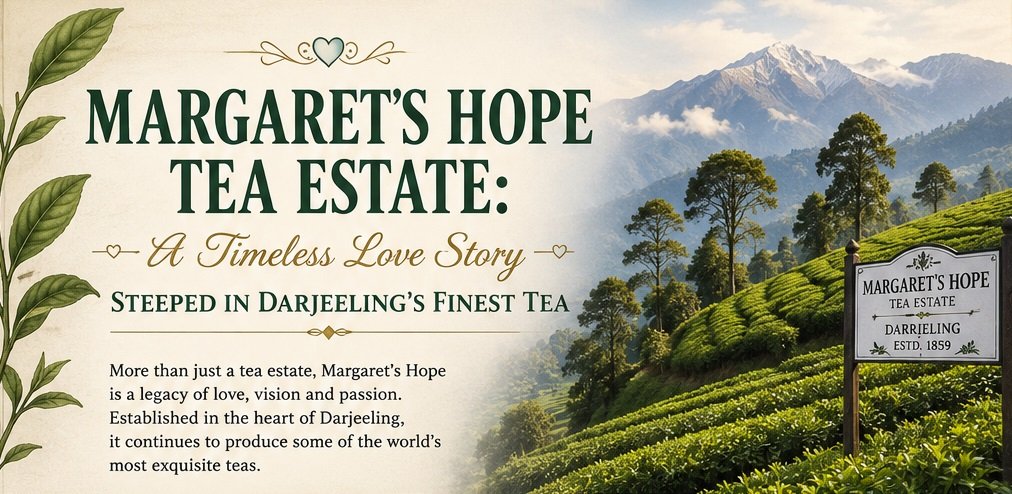
Margaret’s Hope Tea Estate: A Timeless Love Story Steeped in Darjeeling’s Finest Tea
Published on TeaFlush.com | Category: Tea Estates | Reading Time: ~13 minutes
“With emerald hills sloping away in gentle curves, their contours softened by rolling mist that floats through the air like a quiet breath, Margaret’s Hope Tea Estate has become synonymous with Darjeeling over the 160 years since its founding in 1864.” — World Tea News
Table of Contents
1. Introduction: The Estate That Bears a Daughter’s Memory
In the rolling, mist-draped hills of Darjeeling, where some of the world’s most celebrated teas are grown, few estates carry as much emotional weight as Margaret’s Hope Tea Estate. It is a place where every cup of tea tells two stories simultaneously — one of extraordinary natural beauty and unmatched tea craftsmanship, and one of a father’s grief and a daughter’s unfulfilled dream.
Established in 1864 as one of the oldest tea gardens in Darjeeling, Margaret’s Hope spans magnificent emerald hillsides in the Kurseong valley of West Bengal, India. Its teas — particularly its First Flush and Second Flush Muscatel varieties — are counted among the finest Darjeeling teas in the world. The estate has a loyal following among connoisseurs across the globe and is regarded, alongside neighbours like Castleton and Badamtam, as one of the crown jewels of the Goodricke Group’s Darjeeling portfolio.
But what makes Margaret’s Hope truly unique is its soul. This is a garden that carries a name born of love and loss, a name that invites every visitor and every tea drinker to pause and reflect. On TeaFlush.com, we believe tea is as much about story as it is about flavour — and Margaret’s Hope has one of the most beautiful stories in the world of tea.
2. Location & Geography
Where is Margaret’s Hope Tea Estate?
Margaret’s Hope Tea Estate is situated in the Kurseong subdivision of the Darjeeling district, in the Indian state of West Bengal. More specifically, it lies in the Northern Valley of Kurseong — locally known as “the land of the white orchid” — very close to Longview Highlands.
Key Location Facts
| Detail | Information |
|---|---|
| State | West Bengal, India |
| District | Darjeeling |
| Subdivision | Kurseong North Valley |
| Coordinates | 26°55′25″N 88°16′22″E |
| Postal Address | P. O. Tung 734224, Dist – Darjeeling, West Bengal |
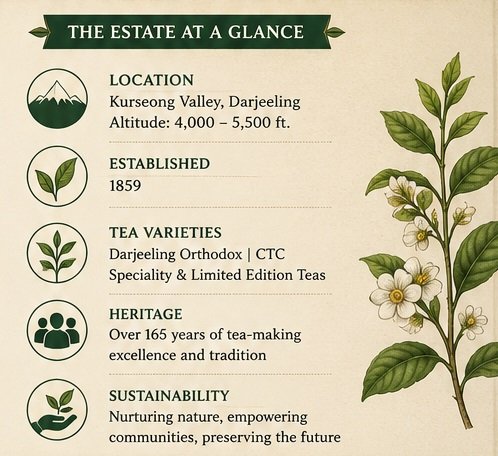
| Total Area | ~585 hectares (1,450 acres) |
| Cultivated Area | ~361 hectares under tea |
| Elevation Range | 950 m – 1,830 m (3,120 ft – 6,000 ft) |
Two rivers flow through the plantation area, adding natural irrigation and contributing to the lush, moist microclimate that the estate’s tea bushes thrive in. The estate’s distinctive green-roofed factory building, with lettering so large it is visible from satellite view on Google Maps, has become an iconic landmark of the Darjeeling tea belt.
A Garden Above the Clouds
Because of its high elevation and the resulting cooler temperatures, Margaret’s Hope teas are produced later than many lower-altitude gardens in Darjeeling — a factor that contributes to their distinctive complexity. Slower growth in cooler air allows the tea leaves to accumulate greater concentrations of the essential oils, polyphenols, and aromatic compounds that define world-class Darjeeling tea.
On most days, mist covers the emerald blanket of the garden. The air feels cool and damp, carrying the scent of tea leaves and rich earth. Views of the surrounding Himalayan foothills extend in every direction, and the garden is abundantly endowed with lichens, orchids, and diverse wildlife — all testament to the exceptional ecological health of this place.
3. The Poignant History Behind the Name
Of all the stories in the world of tea, few are as moving as the one that gave Margaret’s Hope its name.
The Original Name: Bara Ringtong
The estate was first set up in the 1830s and began commercial tea production in 1864. In those early days, it was known as Bara Ringtong (also variously recorded as Bara Rington, Ringstrong, or Ringtong in historical sources). It was most likely first under the influence of the British East India Company, during the era when Dr. Archibald Campbell — the superintendent of the British sanitorium in Darjeeling — was actively encouraging and supervising tea cultivation across the Darjeeling hills.
The Story of Margaret
The name that would transform the estate forever came in 1927, through a story of love, hope, and heartbreak.
J.G.D. Cruickshank (also referred to in some sources as Mr. Bagdon) was the estate manager from 1896 to 1927. On a visit to the garden, he brought along his youngest daughter, Margaret. The young Englishwoman was immediately and completely enchanted by the estate’s breathtaking landscape — the misty hillsides carpeted in emerald green, the rivers winding through the valleys, the snow-capped Himalayan peaks visible on clear days, and the vibrant wildlife that made this corner of India unlike anywhere else in the world.
Margaret fell deeply in love with this place. She told her father of her dream: to return to Darjeeling and make the estate her home.
But fate had other plans. On her voyage back to England, Margaret fell gravely ill. She never recovered, passing away before she could return to the garden that had so captured her heart.
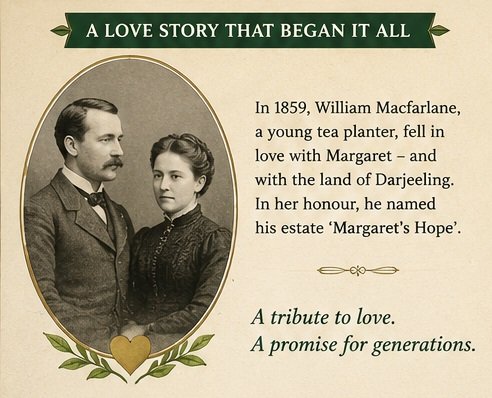
In a heartfelt tribute to his beloved daughter — and to the hope she had carried with her — her father renamed the estate from Bara Ringtong to Margaret’s Hope. The name has endured ever since, ensuring that her spirit would forever be woven into the soil and the leaves of the garden she adored.
Why This Story Matters
This is more than a historical footnote. Every time someone lifts a cup of Margaret’s Hope tea, they are in some sense keeping Margaret’s dream alive — the dream of a young woman who glimpsed paradise in these hills and hoped to return. It is a story that makes each cup richer, more resonant, more human.
4. Ownership Through the Ages
The estate’s ownership history reflects the broader arc of colonial India’s tea industry and its transition to independence and modernity.
- 1830s — Estate first established, most likely under British East India Company influence
- 1864 — Commercial tea production begins, known as Bara Ringtong
- 1896–1927 — Managed by J.G.D. Cruickshank (also cited as Mr. Bagdon in some sources)
- 1927 — Estate renamed Margaret’s Hope in memory of the manager’s daughter
- Mid-20th century — The estate reportedly passed through several ownership changes, including a period during which the Maharani of Cooch Behar is said to have acquired a lease on the property
- Present day — Owned by the Goodricke Group Limited, under its subsidiary Amgoorie India Ltd., which in turn is part of Camellia PLC — one of the world’s largest private-sector tea producers, listed on the London Stock Exchange
The Goodricke Group owns five prestigious tea estates in Darjeeling: Thurbo, Badamtam, Barnesbeg, Castleton, and Margaret’s Hope — widely regarded as some of the finest gardens in the entire region.
5. The Terroir: Why Margaret’s Hope Teas Are Extraordinary {#terroir}
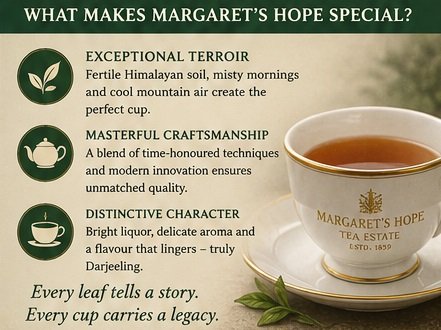
Terroir — the French term describing how geography, climate, and soil uniquely shape the flavour of agricultural produce — is perhaps nowhere more powerfully expressed than in a fine Darjeeling tea. At Margaret’s Hope, the terroir is nothing short of exceptional.
The Tea Bushes
The estate is planted predominantly with heritage China bushes (Camellia sinensis var. sinensis), concentrated at elevations between 2,800 ft and 5,500 ft (850 m to 1,680 m). These ancient plants — many of them original to the garden’s early plantings — have deep root systems that draw minerals and nutrients from layers of mountain soil inaccessible to younger plants.
However, what distinguishes Margaret’s Hope from many of its neighbours is its higher proportion of Assamica (Camellia sinensis var. assamica) bushes — a detail noted by professional tea buyers as a key reason why the estate’s teas tend to have a particularly bold and fruity character compared to other Darjeeling tea gardens. This blend of China Jat and Assamica cultivars gives Margaret’s Hope teas a unique complexity: the delicacy and floral nuance of China bushes combined with the fuller body and brisk brightness of Assamica.
Elevation & Climate
The dramatic elevation range — from 950 m to 1,830 m — creates a microclimate of remarkable diversity within the single estate. Higher sections experience:
- Cooler average temperatures, which slow leaf growth and concentrate flavour compounds
- Frequent mist and cloud cover, which moderates sunlight and protects the leaves from harsh UV radiation
- High rainfall from both pre-monsoon and monsoon precipitation, balanced by good drainage on the hillside slopes
Soil & Water
Two rivers flowing through the estate ensure natural moisture retention in the soil without waterlogging. The surrounding forest cover — dense and biodiverse — contributes organic matter to the soil and maintains a healthy ecosystem of microorganisms. The combination of these factors creates a living, dynamic terroir that is genuinely irreplaceable.
6. The Teas of Margaret’s Hope
Margaret’s Hope produces a wide and distinguished range of teas, each reflecting a different expression of the estate’s exceptional terroir and the season in which it is harvested.
Primary Tea Types
1. First Flush Black Tea (Spring) The estate’s most celebrated and widely sought-after tea. Margaret’s Hope First Flush is light, brisk, and intensely aromatic — with floral top notes, hints of fresh green grass, nutty undertones, and a lively, refreshing finish. The liquor is pale gold, almost luminous. This is the tea that has earned the estate its international reputation and its “Champagne of Teas” designation.
2. Second Flush Black Tea (Summer — Muscatel) Rich, complex, and deeply satisfying. The Second Flush from Margaret’s Hope develops a distinctive Muscatel character — that signature grape-like muskiness unique to Darjeeling’s finest summer teas. The liquor deepens to a beautiful amber, and the flavour profile adds notes of dried fruit, honey, and sweet wine to the spring-like freshness of earlier harvests.
3. Autumnal Flush Black Tea Harvested after the monsoon, autumnal teas from Margaret’s Hope offer copper-coloured leaves and a full-bodied, mellow liquor with earthy, woody notes and a satisfying depth. Less delicate than the earlier flushes but wonderfully smooth and warming.
4. Experimental & Specialty Teas In recent years, the Goodricke Group has begun exploring new processing techniques and specialty teas at Margaret’s Hope — reflecting the estate’s willingness to innovate without compromising its heritage. These experimental offerings occasionally appear in limited batches for specialist buyers and tea enthusiasts.
Tea Grades Produced
- FTGFOP1 — Fine Tippy Golden Flowery Orange Pekoe, First Grade (the pinnacle)
- TGFOP — Tippy Golden Flowery Orange Pekoe
- FOP — Flowery Orange Pekoe
- OP — Orange Pekoe (for more robust, second flush styles)
The estate produces orthodox, hand-picked teas, ensuring the integrity of the leaf and the fullest expression of Margaret’s Hope terroir in every grade.
7. The Flushes: Season by Season
Like all great Darjeeling estates, Margaret’s Hope tells a different story with each season. Understanding the flushes is essential to appreciating the full range of what this estate can offer.
First Flush (March – April): The Spring Awakening
After months of winter dormancy, the tea bushes burst back to life in early spring. Margaret’s Hope First Flush teas are eagerly anticipated by buyers in Germany, Japan, the United Kingdom, and the USA each year.
Owing to the estate’s higher elevation, its First Flush production begins slightly later than lower-altitude gardens — but this delayed start is a gift: the leaves have had more time to develop, resulting in a more nuanced, complex flavour profile.
Flavour Profile: Brisk, green-fruity, floral, lightly astringent with a long, clean finish
Liquor Colour: Pale gold to light amber
Best For: Afternoon tea, mindful sipping, pairing with light pastries or fruit
Brewing Tip: Water at 88°C–90°C, steep for 2–3 minutes. Never add milk — it masks the delicate floral notes entirely.
Second Flush (May – June): The Muscatel Season
The most prestigious and most coveted flush. As temperatures warm and the famous green leafhoppers begin their activity on the leaves, the estate’s teas develop the irreplaceable Muscatel character — that heady, grape-like muskiness that defines the finest Darjeeling summer teas.
Margaret’s Hope’s Second Flush teas have a bolder, fruitier character than many of their Darjeeling peers, owing to the estate’s higher Assamica bush proportion. The liquor is a deep, luminous amber, and the flavour lingers long and memorably on the palate.
Flavour Profile: Muscatel, grape, dried fruit, honey, sweet wine
Liquor Colour: Deep amber-gold
Best For: Evening tea ritual, pairing with mild cheeses, dark chocolate, or dried fruits
Brewing Tip: Water at 90°C–95°C, steep for 3–4 minutes. The Muscatel character blooms best without milk.
Monsoon / Third Flush (July – September): The Robust Harvest
The monsoon brings rapid growth and heavier, more robust teas. While the Third Flush teas lack the delicacy of the spring and summer harvests, they are valued for their full body and bold character, often used in blends. In recent years, Goodricke has experimentally trialled mechanical plucking during the monsoon flush at Margaret’s Hope — a carefully managed innovation that generated significant attention in the global tea industry.
Autumnal Flush (October – November): The Mellow Close
The final harvest of the year, as the bushes prepare for winter rest. Autumnal Margaret’s Hope teas offer copper-tipped leaves, a warm amber liquor, and flavour profiles that are earthier and more body-forward. They are smooth, mellow, and deeply comforting — ideal for cooler autumn evenings.
Flavour Profile: Earthy, woody, mellow, slightly sweet
Liquor Colour: Copper-amber
Best For: Cooler months, pairing with spiced foods, evening relaxation
8. The Tea Factory & Processing
The Margaret’s Hope Tea Factory is one of the most iconic structures in the Darjeeling tea landscape. Its distinctive green roof with large white lettering is so visible from above that it appears clearly on satellite imagery — an unmistakable landmark that speaks to the estate’s size and stature.
Orthodox Processing
Margaret’s Hope teas are produced using the orthodox method — the traditional, labour-intensive technique that preserves the integrity of the whole leaf and allows the full development of the tea’s complex flavour compounds.
The orthodox process at Margaret’s Hope includes:
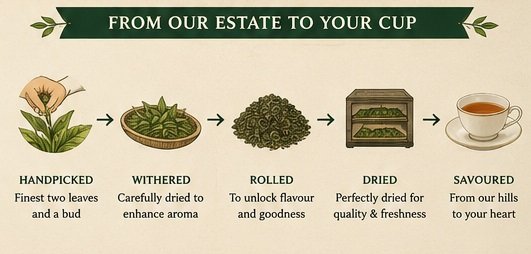
Step 1 — Plucking
Predominantly hand-plucking, with trained workers selecting the fine two leaves and a bud from each shoot. This selective harvesting ensures only the finest, youngest growth makes it into the tea. During the first and second flush, all plucking is done by hand to protect the delicate aromatic profiles of these premium harvests.
Step 2 — Withering
Freshly plucked leaves are spread on withering troughs and allowed to lose moisture over 12–16 hours. This reduces cell turgor and prepares the leaves for rolling.
Step 3 — Rolling
The withered leaves are rolled — either by hand or using orthodox rolling machines — which breaks down the cell walls and initiates the enzymatic oxidation process that gives black tea its character.
Step 4 — Oxidation (Fermentation)
The rolled leaves are spread in a cool, humid environment and allowed to oxidise. The degree of oxidation determines the tea’s colour, flavour depth, and body. This stage is closely monitored by the estate’s skilled tea makers.
Step 5 — Firing (Drying)
The oxidised leaves are passed through driers at controlled temperatures to halt oxidation and reduce moisture content to below 3%. This locks in the flavour and ensures the tea’s shelf stability.
Step 6 — Sorting & Grading
The dried tea is sifted and sorted by leaf size into the various orthodox grades (FTGFOP1, TGFOP, FOP, OP, etc.). Each grade is tasted, evaluated, and approved before packaging or dispatch to auction.
9. Biodiversity & Natural Heritage
Margaret’s Hope Tea Estate is far more than a commercial tea garden. It is a living ecosystem of remarkable richness, and its management has invested significantly in protecting and enhancing the natural heritage of the property.
A Biodiversity Hotspot
Margaret’s Hope is a biodiversity hotspot. It is home to the endangered Himalayan Salamander and boasts a dense and fertile forest cover. Rows and rows of red poinsettias line the pathways, along with wild sunflowers and lavenders.
The small lake on the garden is abundant with salamanders and regularly attracts scientists and researchers from around the region. The presence of this rare amphibian species — a creature highly sensitive to environmental quality — is a powerful indicator of the ecological health of the estate.
Flora
The estate’s landscape is a botanical treasure:
- White orchids — reflecting Kurseong’s traditional identity as the “land of the white orchid”
- Lichens in remarkable variety across the forest areas
- Red poinsettias lining garden pathways
- Wild sunflowers and lavenders growing naturally through the estate
- Dense Himalayan forest cover across the upper reaches of the garden
Romantic Views
The garden has romantic views of the Himalayas and is abundantly endowed with a variety of lichens and orchids. Two rivers flow through the garden and on most days, mist covers the emerald blanket that is the garden. On clear days, the snow-capped peaks of the Himalayas are visible on the horizon — a view that must have been among the first things that captured Margaret’s heart when she arrived here nearly a century ago.
10. Certifications & Quality Standards
Margaret’s Hope Tea Estate holds a suite of internationally recognized certifications that reflect its commitment to both quality and responsible production.
| Certification | What It Means |
|---|---|
| Rainforest Alliance Certified | Meets rigorous standards for environmental sustainability, wildlife protection, and worker welfare |
| Ethical Trade Partnership (ETP) Certified | Confirms ethical sourcing, fair labour practices, and supply chain transparency |
| ISO Quality Standards | International quality management certifications consistent with Goodricke Group standards |
In order to retain their Rainforest Alliance and Ethical Trade Partnership certifications, the management has had to invest proactively in forest audits to ensure a sustainable value chain across the gardens. These are not passive certifications — they represent an active, ongoing commitment to sustainability that shapes every decision made on the estate.
11. Community, Labour Heritage & Social Impact {#community}
Margaret’s Hope Tea Estate holds a unique and important place in the social and political history of India’s tea industry — one that goes beyond the quality of its teas.
The 1955 Labour Movement
Margaret’s Hope is considered to be the birthplace of the organised labour movement in West Bengal’s tea industry. In 1955, a strike, called by the Communist Party of India and the Akhil Bharatiya Gorkha League, was underway. On 25 June, hundreds of workers had gathered at Margaret’s Hope Tea Estate to register their protest against low wages and denial of facilities by tea garden managements. Six protesters, including two women, were killed in police firing. The furore spilled over and the next day 20,000 workers and common people laid siege of the district headquarters. By 27 June, the management met all the demands of the workers. For the first time, tea garden workers were paid bonus — a provision that until then no tea garden had implemented despite it being available under the Bonus Act. Wages were also raised.
This is a chapter of history that every tea drinker should know. The dignity and rights of the workers who grow and process these remarkable teas were hard-won — and Margaret’s Hope is where the turning point came.
Modern Community Investment
Today, the estate’s social legacy continues in a very different form:
Margaret’s Hope has the only primary healthcare center that caters to the people living in the estate as well as those living between Kurseong and Darjeeling town. A school caters to the children of over 1,200 employees here, and a Women’s Self-Help center — the only one of its kind within a 10km radius — trains women in basic home economic skills.
During peak season, the estate employs a significant workforce — making it not just a tea garden but a self-sustaining community with housing, healthcare, education, and social support infrastructure.
12. Margaret’s Hope & Tea Tourism
In recent years, Margaret’s Hope has embraced tea tourism as both a revenue stream and a way to deepen the public’s connection to the world of Darjeeling tea.
Margaret’s Deck Tea Lounge
One of the most beloved additions to the estate is Margaret’s Deck Tea Lounge — a restaurant and tearoom near the entrance to the garden on Hill Cart Road in Kurseong. Here, visitors can:
- Sample teas from all of Goodricke’s gardens — not just Margaret’s Hope — brewed and served by knowledgeable staff
- Enjoy panoramic views of the Kurseong valley from the tea deck, with the endless roll of emerald tea bushes stretching into the mist below
- Pair fine teas with refreshments and light meals
- Purchase fresh, authentic estate teas directly
The Tea Deck has been extremely well-received, becoming a popular stop for tea tourists travelling the Darjeeling route.
The Maharanee Bungalow
A recent addition to the estate’s tourism offering is the Maharanee Bungalow — a heritage property set within the tea garden itself, on the grounds where the Maharani of Cooch Behar (who is said to have once held a lease on Margaret’s Hope) once developed a residence. The bungalow features suite-type rooms with panoramic views of the tea garden, nestled inside the tea garden itself. This offers visitors the rare and extraordinary experience of sleeping within a working Darjeeling tea garden — waking up to mist, mountains, and the sound of pluckers moving through the rows of bushes.
What to Experience at Margaret’s Hope
- Walk the tea garden pathways lined with red poinsettias and wild orchids
- Visit the iconic green-roofed factory and observe orthodox tea processing firsthand
- Spot Himalayan Salamanders at the estate’s small lake
- Enjoy panoramic Himalayan views on clear mornings before the mist rolls in
- Taste the estate’s teas at Margaret’s Deck Tea Lounge
- Stay at the Maharanee Bungalow for a true immersive experience
Practical Visitor Information
| Detail | Information |
|---|---|
| Location | Hill Cart Road, Kurseong, Darjeeling, West Bengal |
| Best Time to Visit | March–June (First and Second Flush season) |
| Tea Lounge | Margaret’s Deck — open to visitors; no appointment needed |
| Factory Tour | Recommended to contact the estate in advance |
| Accommodation | Maharanee Bungalow (heritage stay within the garden) |
| Nearest Town | Kurseong (accessible by road and the Darjeeling Himalayan Railway) |
13. How to Brew Margaret’s Hope Tea Perfectly
Brewing Margaret’s Hope tea well is a matter of respect — for the estate, for the workers who produced it, and for the extraordinary flavour locked inside each leaf. Follow these guidelines to get the most from every cup.
Brewing Parameters by Flush
| Parameter | First Flush | Second Flush (Muscatel) | Autumnal Flush |
|---|---|---|---|
| Water Temperature | 88°C – 90°C | 90°C – 95°C | 90°C – 95°C |
| Steeping Time | 2 – 3 minutes | 3 – 4 minutes | 3 – 5 minutes |
| Tea Quantity | 2 – 2.5 g per 200 ml | 2.5 – 3 g per 200 ml | 2.5 – 3 g per 200 ml |
| Milk? | Never | Never | Optional |
| Sugar? | Not recommended | Not recommended | Optional |
Step-by-Step Guide
Step 1 — Use the right water
Always use fresh, filtered water. Margaret’s Hope teas are subtle enough that mineral-heavy or chlorinated water can genuinely interfere with the flavour profile. Soft to medium hardness is ideal.
Step 2 — Pre-warm your vessel
Fill your teapot or cup with hot water, swirl, and discard. This prevents the brewing water from losing temperature on contact with cold ceramic.
Step 3 — Measure carefully
Use approximately 2–2.5 grams of loose leaf tea per 200 ml of water. A kitchen scale gives more consistent results than a teaspoon, especially for fine orthodox grades.
Step 4 — Heat water to the right temperature
Do not use boiling water for Margaret’s Hope teas — especially the First Flush. Boiling water (100°C) will scorch the delicate leaves and produce a harsh, bitter cup. Let boiling water cool for 2–3 minutes, or use a temperature-controlled kettle.
Step 5 — Steep and observe
Pour water over the leaves in a circular motion. Watch as the liquor develops colour. For First Flush, the cup will be a beautiful pale gold; for Second Flush, a rich amber. Do not stir.
Step 6 — Strain promptly
Remove the leaves immediately at the end of steeping. Leaving them in longer will introduce astringency and bitterness that mask the complexity you are trying to enjoy.
Step 7 — Appreciate before sipping
Lift the cup and inhale deeply before drinking. The aroma of a fine Margaret’s Hope tea — particularly a First Flush — is a sensory experience in itself. Note the floral, green, and fruity notes before they reach your palate.
Can You Re-steep Margaret’s Hope Tea?
Yes — fine orthodox Darjeeling teas from high-quality estates like Margaret’s Hope can be steeped 2–3 times. Each infusion reveals different nuances. The first steep is typically the most aromatic; subsequent steeps develop more depth and body. Add 30–60 seconds to your steeping time with each subsequent infusion.
14. Where to Buy Authentic Margaret’s Hope Tea
Given the estate’s fame, authentic Margaret’s Hope teas are available through a range of trusted channels — but it pays to know what to look for.
Trusted Sources
- Goodricke Tea (goodricketea.in / goodricketea.com) — The official channel of the estate’s parent company; the most reliable source for authentic Goodricke-branded Margaret’s Hope teas
- Teabox — A reputable Indian single-estate tea platform with direct estate sourcing and seasonal new-crop releases
- Specialty tea retailers in Germany, Japan, and the UK — These markets have long traditions of sourcing from Margaret’s Hope; look for independent specialty tea shops with estate-specific offerings
- Tea auction platforms — For the most adventurous buyers; Margaret’s Hope teas are sold at the Kolkata tea auction and occasionally at international specialty auctions
What to Look For on the Label
- “Margaret’s Hope Estate” clearly stated — not just “Darjeeling tea”
- The flush (First Flush, Second Flush, Autumnal)
- The harvest year — freshness matters enormously, especially for First Flush
- The grade (FTGFOP1 being the premium tier)
- Goodricke Group as the estate owner/processor
Price Guide
| Tea Type | Approximate Price Range |
|---|---|
| Entry-level Margaret’s Hope blends | INR 500–1,200 per 100g |
| First Flush orthodox (FTGFOP1) | INR 1,500–4,000 per 100g |
| Second Flush Muscatel (FTGFOP1) | INR 2,000–6,000 per 100g |
| Rare / limited harvest batches | Significantly higher at specialist auction |
Be cautious of extremely cheap “Margaret’s Hope” teas — the estate’s premium production commands premium prices for a reason.
15. Frequently Asked Questions
Who owns Margaret’s Hope Tea Estate?
Margaret’s Hope Tea Estate is owned by the international group Camellia Plc, which is listed in the London Stock Exchange and is governed in India under the Goodricke Group and Amgoorie Group Limited. Goodricke is the second most prolific tea producer across the Darjeeling, Dooars/Terai, and Assam regions of India.
Why is it called Margaret’s Hope?
In 1927, the estate’s owner, Mr. Cruikshank, renamed it in memory of his beloved daughter, Margaret. She had fallen in love with the estate’s enchanting landscape during a visit and dreamed of returning to make it her home. Tragically, on her voyage back to England, she contracted a tropical illness and passed away shortly after. In a heartfelt tribute, her father renamed the estate Margaret’s Hope — ensuring her spirit would forever be part of the garden she so adored.
What is the best tea from Margaret’s Hope?
The estate’s First Flush FTGFOP1 is most consistently celebrated by connoisseurs for its extraordinary floral delicacy and clean, brisk character. Its Second Flush Muscatel is also highly prized for its bold, fruity complexity and distinctive Muscatel grape notes.
How does Margaret’s Hope tea taste different from other Darjeeling teas?
The teas from this estate tend to have a particularly bold and fruity character. This is widely attributed to the estate’s higher proportion of Assamica bushes compared to other Darjeeling estates, which lends greater body and brightness to an already complex flavour profile.
Is Margaret’s Hope tea good for health?
Like all high-quality orthodox Darjeeling teas, Margaret’s Hope teas are rich in antioxidants (catechins and polyphenols), L-theanine (which promotes calm focus), and flavonoids linked to cardiovascular health. The minimal processing of fine orthodox black tea preserves more of these beneficial compounds than heavily processed teas. Always consult a healthcare professional for specific health advice.
Can I visit Margaret’s Hope Tea Estate?
Yes. The estate welcomes visitors, and Margaret’s Deck Tea Lounge on Hill Cart Road in Kurseong is open to the public. Factory tours may be arranged with advance notice. The Maharanee Bungalow offers immersive overnight accommodation within the garden itself.
When is the best time to visit Margaret’s Hope?
March to June is the peak season, when the First and Second Flush harvests are underway. This is when the gardens are at their most lush and active, and when the freshest teas of the year are being produced. Avoid the monsoon months (July–September) if you want clear views and optimal garden conditions.
What is the total size of Margaret’s Hope Tea Estate?
Margaret’s Hope Tea Estate has an area of 1,450 acres with elevations ranging from 3,120 to 6,000 ft. Of this total area, approximately 361 hectares are under active tea cultivation. During peak season, the estate employs over 1,200 workers.
16. Final Thoughts
There are tea estates in Darjeeling that are famous for record-breaking prices. There are estates celebrated for the rarity of their harvests. And then there is Margaret’s Hope — an estate that is famous for all of these things and for something more: a story that touches the heart.
Every cup of Margaret’s Hope tea is a small act of remembrance. It carries in its liquor the dream of a young woman who stood on these misty hillsides nearly a century ago and fell in love with a landscape so beautiful it felt like home. That she never returned to claim it only makes the estate’s legacy richer and more poignant.
But beyond its romantic history, Margaret’s Hope stands on the merit of its teas — extraordinary, complex, and deeply satisfying expressions of one of the world’s most celebrated tea-growing regions. It stands on its social legacy as the birthplace of organised labour rights in West Bengal’s tea industry. It stands on its ecological stewardship, protecting one of Darjeeling’s most biodiverse natural habitats. And it stands on its community commitment, providing healthcare, education, and economic opportunity to over a thousand families.
At TeaFlush.com, we believe that the best teas tell the deepest stories. Margaret’s Hope tells one of the best stories of all.
Seek it out. Brew it carefully. Sip it slowly. And when you do, raise your cup — to Margaret, to the workers of this magnificent garden, and to one of the most extraordinary places on earth.
About TeaFlush.com
At TeaFlush.com, we are passionate about connecting tea lovers with the world’s finest estates, most fascinating histories, and most memorable cups. From the rolling hills of Darjeeling to the ancient forests of Yunnan, we explore every corner of the tea world — one flush at a time.
Explore more on TeaFlush.com:
Explore more on TeaFlush.com:
- Castleton Tea Estate: The Crown Jewel of Darjeeling
- Darjeeling First Flush vs. Second Flush: The Complete Guide
- What Is Muscatel Tea? A Deep Dive into Darjeeling’s Finest Flavour
- The Goodricke Group: Guardians of Darjeeling’s Greatest Estates
- How to Taste Tea Like a Professional
- The Best Darjeeling Tea Estates Ranked by Experts
Tags: Margaret’s Hope Tea Estate, Darjeeling Tea, First Flush Darjeeling, Muscatel Tea, Goodricke Tea, Kurseong Tea Garden, Premium Black Tea, India Tea Estate, Single Estate Tea, Darjeeling Second Flush, FTGFOP1, Tea Tourism Darjeeling, Champagne of Teas, Camellia PLC, TeaFlush
© TeaFlush.com — All rights reserved. Please do not reproduce without permission.