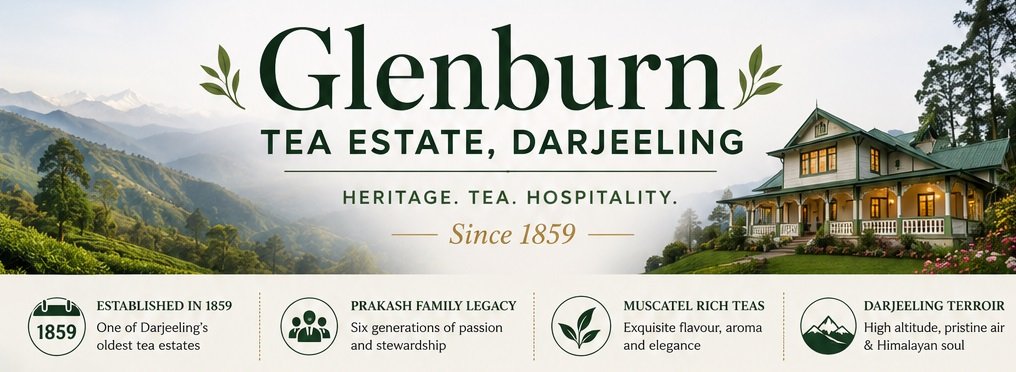
Tucked into a steep river valley below Darjeeling town, with Mount Kanchenjunga rising in the distance and two snow-fed rivers running through its grounds, Glenburn Tea Estate is one of the most storied tea gardens in the world. For tea drinkers, it’s a name synonymous with rich, muscatel-laden Darjeeling tea. For travelers, it’s one of India’s most romantic heritage retreats.
Table of Contents
This guide covers everything you need to know about Glenburn — its history, its tea, its bungalow stays, and how to plan a visit.
What Is Glenburn Tea Estate?
Glenburn Tea Estate is a 750-hectare (roughly 1,900-acre) tea garden located in the Rangli Rangliot block of the Darjeeling Sadar subdivision in West Bengal, India. The estate sits at an elevation ranging from 1,000 to 3,000 feet, spread across a dramatic river valley where the Rangeet and Rungdung rivers flow alongside the tea bushes. Surrounded by the 350-hectare Simbong Reserve Forest, Glenburn is as much a wildlife and nature sanctuary as it is a working tea garden.
The name “Glenburn” is itself a clue to the landscape — it loosely translates to “river valley,” a fitting description for an estate defined by its plunging slopes and rushing water.
The History of Glenburn Tea Estate
Founded by a Scottish Tea Company in 1859
Glenburn’s story begins in 1859, when it was established by a Scottish tea company during the height of British colonial tea expansion in the Darjeeling hills. Like many of the original All Darjeeling gardens, it was planted on hillsides cleared from dense Himalayan forest, taking advantage of the region’s unique soil, altitude, and climate that would later make Darjeeling tea world-famous.
The Prakash Family Era
Glenburn is now run by a Kolkata-based business family across four generations — the Prakash family. The Prakashes are often referred to locally as the “Chaiwala family,” a term that essentially translates to “tea planters” or “tea people.” Under their stewardship, Glenburn evolved from a purely commercial tea garden into a globally recognized name in both fine tea and luxury hospitality.
The Legend of “Kimble”
One of the most charming pieces of Glenburn folklore involves its very first manager. According to local legend, the ghost of Kimble Murray, Glenburn’s first estate manager, is said to still roam the grounds in eternal search of the perfect cup of tea — which is precisely why locals affectionately nickname the estate “Kimble.” The Prakash family has embraced this story as part of their philosophy, often noting that it isn’t just the sun and rain that shape their tea, but a kind of soul and spirit embedded in the estate itself.
Where Is Glenburn Tea Estate Located?
Glenburn sits within the Rangli Rangliot community development block, part of the Darjeeling Sadar subdivision in the Darjeeling district of West Bengal, India, at coordinates approximately 27.08°N, 88.34°E. It lies north of Darjeeling town and is bordered by Sikkim to the north, with the Badamtam Tea Estate as its nearest neighboring garden to the east.
This positioning gives Glenburn some of the most dramatic views in the entire Darjeeling tea belt — sweeping panoramas of the Singalila mountain range, the Rangeet river valley below, and on clear days, the snow-capped peak of Kanchenjunga, the third-highest mountain on Earth.
The Geography and Landscape of the Estate
Several features make Glenburn’s terroir distinct even among Darjeeling’s famous gardens:
- Total estate size: Approximately 750 hectares (1,900 acres), though only a fraction is under active tea cultivation, with the remainder protected as forest and natural habitat.
- Elevation range: From 1,000 feet up to 3,000 feet above sea level, creating multiple microclimates across a single estate.
- Rivers: The Rangeet River and the Rungdung stream flow through or near the tea estate, contributing to both the irrigation and the scenic character of the property.
- Forest cover: A 350-hectare reserve forest known as Simbong Forest sits within the estate’s total area, sheltering native Himalayan flora and fauna alongside the cultivated tea bushes.
- Workforce and community: Around 700 worker families live and work on the estate, making Glenburn a largely self-sustained tea-garden community in the Darjeeling hills.
This combination of altitude variance, river-cooled air, dense surrounding forest, and rich mountain soil is what tea experts call terroir — and it’s central to why Glenburn’s tea tastes the way it does.
Glenburn’s Tea: Flavor Profile and Specialties
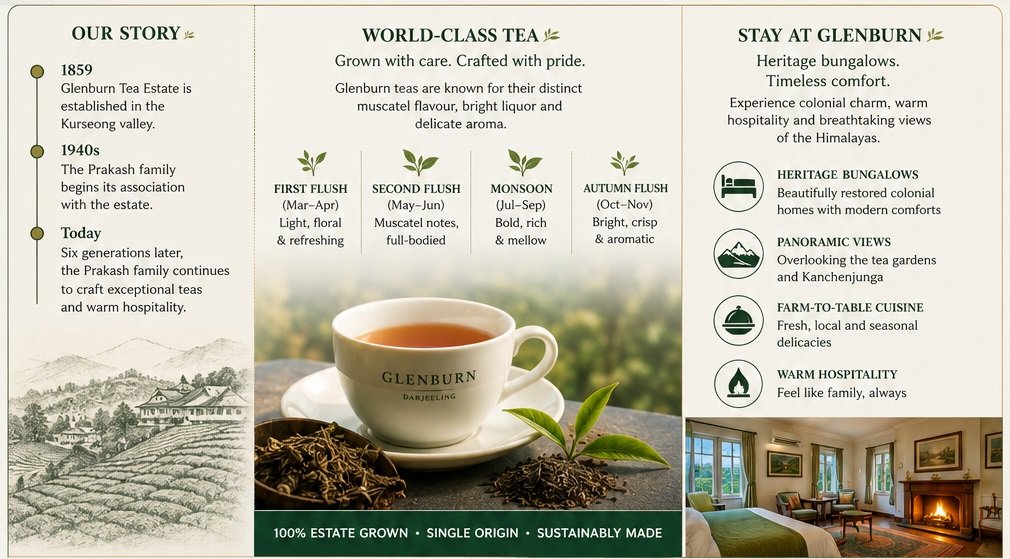
Glenburn specializes primarily in black tea, though it also produces other tea varieties, and it is widely regarded as one of the finest tea estates in the Darjeeling region. The estate is particularly celebrated for its distinctive muscatel character — a complex, wine-like sweetness that is the holy grail of Darjeeling tea connoisseurs.
First Flush (Spring Harvest)
Plucked in the early spring months, Glenburn’s first flush teas are prized for their delicate, light-bodied character with floral and sometimes fruity notes, in keeping with the classic profile of Darjeeling first flush teas across the region.
Second Flush (Summer Harvest)
Glenburn’s second flush, plucked during the early summer months of May and June, draws its succulence from late spring rain showers and is rolled into a stylish, twisted leaf. The resulting cup runs clear amber and delivers a full-bodied, mature flavor compared to the preceding first flush. Glenburn’s distinctive growing conditions give its select clonal plants a special character in the liquor — a complex layering of maltiness alongside musk and nutty undertones.
Tasting notes commonly associated with Glenburn second flush include:
- Classic muscatel grape sweetness
- Notes of dried fruit, honey, and cocoa
- A smooth, rounded, highly drinkable body
- A dry leaf appearance that is dark blackish-brown with characteristic coppery leaves and pale yellowish tips, with a wet-leaf aroma of sweet honey and muscatel
- A deep amber infusion that some tasters describe as carrying rich notes of cocoa and malt, crafted from the prized AV2 varietal known for its natural sweetness
Autumnal Flush
Later in the season, Glenburn also produces an autumnal harvest — picked after the monsoons, once new growth on the bushes has matured. These autumn teas tend to be darker, bolder, and fuller-bodied than the spring and summer flushes, though typically with fewer of the bright, spicy top notes that define first flush Darjeeling.
Why Does Glenburn Tea Taste the Way It Does?
The signature muscatel flavor found in second-flush Darjeeling teas develops partly through the action of small sap-sucking insects called jassids and thrips, which nibble on the young tea leaves. In response, the tea plant produces terpenes as a natural defense mechanism, and it’s this higher terpene concentration that creates the distinctive muscatel character so many tea drinkers seek out. Combined with Glenburn’s altitude, river-valley humidity, and forest-fringed soil, this natural process is a major reason the estate’s tea has such a devoted global following.
Visiting Glenburn: A Heritage Tea Estate and Luxury Retreat
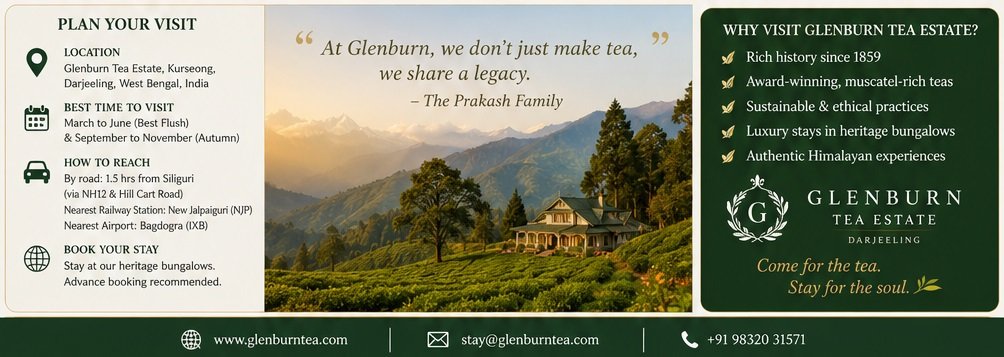
Beyond its reputation as a tea producer, Glenburn has become equally famous as one of India’s premier heritage hospitality destinations. Alongside the tea it grows and produces, Glenburn has established itself as a culturally rich leisure destination, anchored by the renovation of its two guest bungalows — the Burra Bungalow and the Water Lily Bungalow.
Burra Bungalow
The Burra Bungalow is the original planters’ residence — the building where Glenburn’s actual estate managers once lived and worked. Restoration work began by carefully stripping away layers of paint and plywood to reveal the beautiful, burnished original wood underneath, followed by refurbishing the classic colonial-era furniture to a fresh polish. The reinvented bungalow opened as a bespoke boutique hotel in 2002.
Water Lily Bungalow
The second property, added roughly eight years after the Burra Bungalow’s debut, offers a similarly intimate, colonial-inspired stay experience, set within the same sprawling garden grounds.
What Staying at Glenburn Is Like
All suites at Glenburn feature hand-embroidered bed linens, fresh flowers from the estate’s own gardens, baskets of fresh fruit, bathrooms with running hot and cold water and complimentary Darjeeling green tea toiletries, ceiling fans, and hair dryers, with beds fitted with electrical warmers for the cool hill nights. True to the estate’s emphasis on tranquility, there are no televisions in the rooms, and internet access across the property is deliberately limited.
The estate’s hotel comprises eight suites distributed across two wings, including standout rooms like the Rung Dung Suite, which overlooks the Rung Dung River and Darjeeling town, and the Singalila Suite, known for its sunrise views over the Singalila mountain range.
On the riverside, guests can also opt for the Campsite Lodge, which offers two double rooms with attached bathrooms and a large veranda looking out toward Sikkim on the opposite bank of the valley.
Dining at Glenburn
Glenburn’s dining hall serves guests a menu spanning European, Indian, and South-East Asian cuisines, with ingredients sourced largely from the hotel’s own organic garden. Signature dishes drawn from the Prakash family’s own recipes include Burmese Khow Suey, chocolate brownies, and tea-leaf pakoras — a menu that reflects both the estate’s colonial heritage and its deep connection to the surrounding Himalayan region.
Things to Do at Glenburn
A stay at Glenburn typically combines tea-garden immersion with outdoor adventure, including:
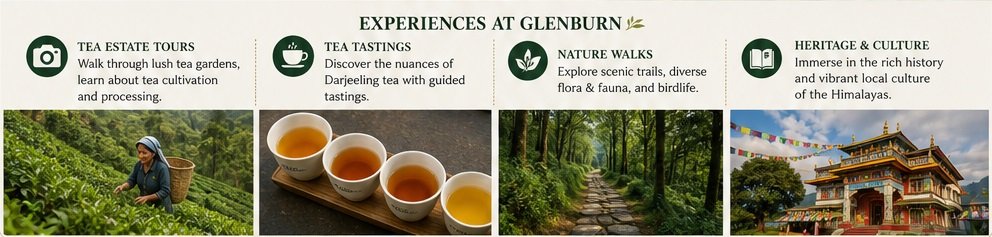
- Guided walks through the tea gardens with estate staff explaining plucking and processing
- Visits to the tea factory to see first-hand how leaf is withered, rolled, oxidized, and dried
- Birdwatching and nature walks through the Simbong Reserve Forest
- River-side picnics and fishing along the Rangeet and Rungdung
- Trekking and pony rides through the surrounding hills
- Sundowners with sweeping views of Kanchenjunga and the Sikkim hills
Glenburn’s Community and Sustainability Work
Glenburn’s reputation extends well beyond tea and tourism into community development. The Glenburn Welfare Trust was established in 2005 to promote education, culture, and good health within the Glenburn community. As part of its health initiatives, the trust has worked with medical professionals to run regular workplace-safety workshops and First Aid training for local staff and their families. On the education side, the estate partners with local government primary schools to strengthen their facilities — introducing nursery and kindergarten classes, funding additional teachers to improve student-to-teacher ratios, and carrying out infrastructure repairs.
This commitment reflects a broader trend among Darjeeling’s top estates: recognizing that the quality of the tea is inseparable from the wellbeing of the workers and families who cultivate it.
Glenburn Tea Estate: Quick Facts
| Detail | Information |
|---|---|
| Location | Rangli Rangliot, Darjeeling Sadar subdivision, West Bengal, India |
| Established | 1859, by a Scottish tea company |
| Current owners | Prakash family (four generations) |
| Estate size | Approx. 750 hectares (1,900 acres) |
| Elevation | 1,000 to 3,000 feet |
| Nearby rivers | Rangeet River and Rungdung stream |
| Reserve forest | Simbong Forest (350 hectares) |
| Specialty | Black tea, especially muscatel-rich second flush |
| Worker families | Around 700 |
| Accommodation | Burra Bungalow, Water Lily Bungalow, Campsite Lodge |
| Nickname | “Kimble,” after the estate’s first manager |
How to Buy Authentic Glenburn Darjeeling Tea
Because Glenburn is one of the most respected and sought-after names in Darjeeling tea, it’s worth knowing what to look for when buying:
- Check the flush. First flush teas are lighter and more floral; second flush teas carry the prized muscatel character; autumnal teas are darker and bolder.
- Look for grading. Terms like FTGFOP1 or SFTGFOP1 indicate high-quality, whole-leaf orthodox grading commonly used for Glenburn’s premium lots.
- Buy from reputable sources. Authentic single-estate Glenburn tea is sold both directly through the estate’s own tea label and through specialty tea retailers worldwide.
- Store it properly. Like all fine Darjeeling teas, Glenburn tea should be kept in an airtight container away from light, heat, and moisture to preserve its delicate aromatics.
Final Thoughts: Why Glenburn Stands Out
Glenburn Tea Estate occupies a rare position in the world of tea — it’s simultaneously a 165-year-old working tea garden, a globally respected producer of muscatel Darjeeling, a luxury heritage hotel, and a genuine community built around four generations of family stewardship. Whether you’re a tea enthusiast chasing down the perfect cup of second-flush muscatel, or a traveler seeking a quiet, story-rich escape into the Himalayan foothills, Glenburn delivers an experience that few other tea estates in the world can match.
For tea lovers who can’t make the journey to Darjeeling, sourcing a single-estate Glenburn second flush is the next best thing — a cup that captures the river valley, the misty forest, and 165 years of tea-making history in every sip.
Looking to explore more single-estate Darjeeling teas like Glenburn? Browse our Darjeeling tea collection at TeaFlush.com for hand-selected first flush, second flush, and autumnal harvests from the region’s most celebrated gardens.