Published on TeaFlush.com | Your Complete Tea Resource
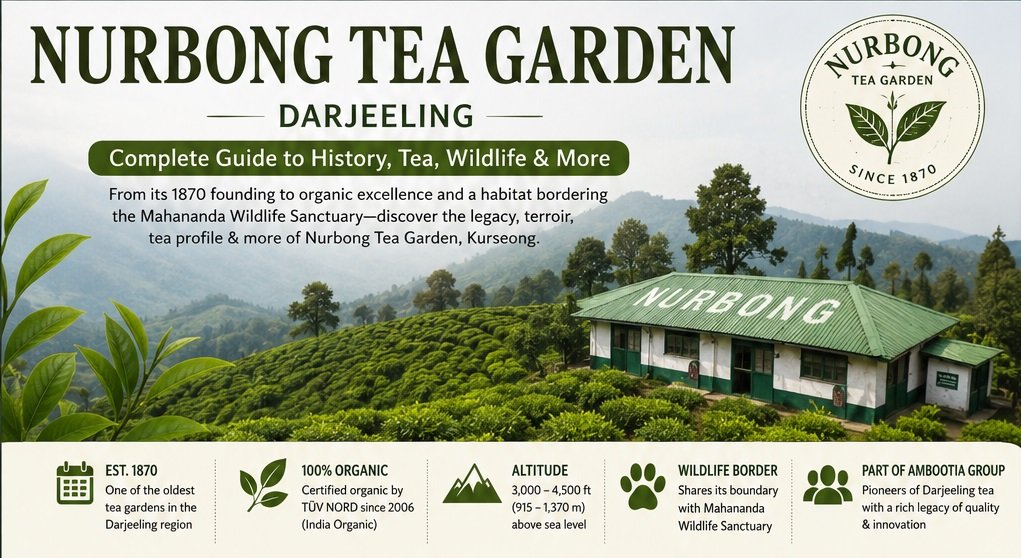
On the southern slopes of the Darjeeling Himalayas, where the cultivated tea terraces give way to dense subtropical forest, lies one of Darjeeling’s most ecologically distinctive tea gardens. Nurbong Tea Garden sits directly bordered by the Mahananda Wildlife Sanctuary — a protected forest where wild elephants still roam freely through the landscape below the tea rows. It is a place where the cultivated and the wild meet at the edge of every plucking row, where the scent of fresh tea leaf mixes with the deep green smell of untouched Himalayan forest, and where the tea itself carries something of that proximity to wilderness in its character.
Table of Contents
Founded in 1870 — one of the earlier tea gardens established during Darjeeling’s Victorian expansion — Nurbong has spent over 150 years on these southern Kurseong slopes, evolving from a colonial-era plantation into a fully certified organic estate producing teas of genuine distinction: honey-sweet, rounded second flush black teas reminiscent of Ceylon or dark oolong, and bright, peppery, wildflower-scented first flush spring teas that have recently begun attracting serious attention from specialty importers around the world.
This is the complete guide to Nurbong Tea Garden — its history, its ownership journey through one of Darjeeling’s most significant corporate transitions, its remarkable wildlife-bordered terroir, its tea, and everything you need to know to understand and enjoy what this quietly excellent estate produces.
What Does “Nurbong” Mean?
The name Nurbong — sometimes rendered as Norbung or Norbuung in older records and postal addresses — derives from the Lepcha and Nepali linguistic heritage common to many place names in the Darjeeling hills. Like many Himalayan toponyms in the region, the name likely reflects a description of the local landscape or a feature of the original settlement that predates the tea garden’s commercial establishment.
The estate’s full postal designation appears in historical records as “Norbuung T.E., P.O. Tindharay” — situating it firmly within the Tindharia postal and administrative zone of the Kurseong subdivision, one of the most densely tea-cultivated corridors in all of Darjeeling district.
Quick Reference: Nurbong Tea Garden at a Glance
| Detail | Information |
|---|---|
| Full Name | Nurbong Tea Garden (also: Nurbong Tea Estate; historically Norbuung) |
| Established | 1870 |
| Location | Kurseong subdivision, Darjeeling district, West Bengal, India |
| Postal Address | Norbuung T.E., P.O. Tindharay, West Bengal — 734223 |
| Bordering Feature | Mahananda Wildlife Sanctuary (southern slopes) |
| Altitude | Approximately 1,200 metres (medium altitude) |
| Total Area | 496 hectares (per industry sources) |
| Cultivation Status | 100% organic certified |
| Tea Bush Character | Heavily oxidised processing style; wiry, tippy leaf |
| Tea Types | Black tea (first flush, second flush) |
| Historical Ownership | British colonial era (1870s) → Ambootia Group (Sanjay Bansal) |
| Current Ownership | Lemongrass Organic Tea Estates Pvt. Ltd. (LOTEPL) — since late 2022 |
| Owner (LOTEPL) | Sushil Kumar Agarwal, joint venture between MLA Group and KK Group |
| Sister Estates (LOTEPL) | Ambootia, Happy Valley, Chongtong, Monteviot, Moondakotee, Mullootar, Nagri (Mangarjung), Sepoydhoorah (Chamling), Sivitar |
| Nearby Stations | Rongtong Railway Station (~2.2 km), Darjeeling Himalayan Railway Reverse No.1 (~3.2 km) |
| Nearby Estates | Sivitar Tea Estate, Sepoydhoorah Tea Estate, Tindharia Tea Estate |
| GI Certification | Darjeeling GI Certified (Tea Board of India) |
| International Distribution | Sweden, USA, and other specialty markets |
Part 1: The History of Nurbong Tea Garden
1870: Founding in Darjeeling’s Expansion Era
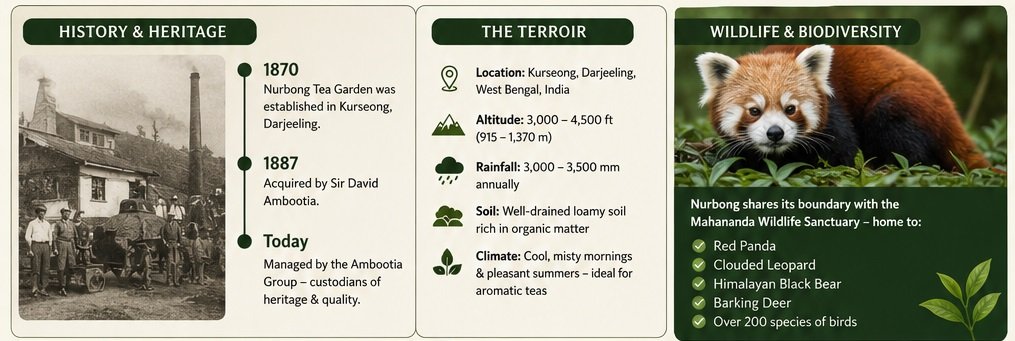
Nurbong was established in 1870 — a year that places it squarely within the second great wave of Darjeeling tea garden development. By this point, the founding three estates of 1852 (Tukvar, Steinthal, Aloobari) had proven the commercial viability of Himalayan tea cultivation, and the British colonial administration, alongside private planters and tea companies, was rapidly expanding cultivation across the district. By 1870, the number of gardens increased to 56 to produce about 71,000 kgs of tea harvested from 4,400 hectares. By 1874, tea in Darjeeling was found to be a profitable venture and there were 113 gardens with approximately 6,000 hectares.
Nurbong’s establishment in this period places it among the second generation of Darjeeling estates — not among the absolute founding gardens, but firmly part of the era when the industry’s commercial template had been proven and ambitious new plantations were being developed across the district’s most promising slopes, including the southern Kurseong zone where Nurbong sits.
The Tindharia Connection
Nurbong’s postal designation through Tindharia situates it within one of the most historically significant transportation corridors in Darjeeling. Tindharia is home to one of the major workshops of the Darjeeling Himalayan Railway — the UNESCO World Heritage-listed narrow-gauge “Toy Train” that has connected the hills to the plains since 1881. The proximity to this rail corridor would have been commercially significant for Nurbong in its early decades, providing a transportation link for moving processed tea down to the plains and onward to Calcutta for export.
The Twentieth Century and the Path to Organic Certification
Like many Darjeeling estates, Nurbong’s twentieth-century history followed the broader pattern of the district’s tea industry: continued production through the colonial period, transition through India’s independence in 1947, and — in more recent decades — a significant shift toward organic and sustainable farming practices that has come to define the estate’s modern identity.
Today, Nurbong is recognised specifically as a fully organic estate. Industry sources confirm that only organic tea is grown at Nurbong — no synthetic fertilisers, pesticides, or chemical inputs are used in its cultivation, a standard that places it within Darjeeling’s broader and increasingly significant organic tea movement.
The Ambootia Group Era
For a significant period, Nurbong operated under the umbrella of the Ambootia Group — formally known as Darjeeling Organic Tea Estates Pvt. Ltd. (DOTEPL) — led by Sanjay Bansal, the visionary who transformed Ambootia Tea Estate itself from a financially troubled “sick unit” into the world’s largest Demeter-certified biodynamic tea producer.
At its peak, the Ambootia Group managed 15 tea estates within its portfolio, of which 12 were in Darjeeling and two each in Assam and the Dooars. Nurbong was one of these twelve Darjeeling gardens — benefiting from the group’s comprehensive commitment to organic and sustainable farming, its international certification infrastructure, and its broader vision of estate revival and worker welfare.
2022: The Transition to Lemongrass Organic Tea Estates
In late 2022, due to a long-going financial distress at Darjeeling Organic Tea Estates Pvt. Ltd., Ambootia along with five other gardens were handed over to Mr. Sushil Kumar Agarwal of Lemongrass Organic Tea Estates Pvt. Ltd. (LOTEPL), a joint venture between MLA Group and KK Group.
This was a significant moment in Darjeeling’s modern tea history — a wave of estate transitions driven by the broader financial pressures facing the district’s tea industry, including declining European demand, rising production costs, and the structural challenges of an industry built on a colonial-era labour and land system that has struggled to adapt to contemporary economic realities. In 2022, the DOTEPL abandoned ten tea estates, a restructuring that affected thousands of workers across the affected gardens.
Nurbong was one of the estates that transitioned into the Lemongrass Organic Tea Estates portfolio during this period. The gardens of the Lemongrass Organic Tea Estates Private Ltd. include: Ambootia, Chongtong, Happy Valley, Monteviot, Moondakotee, Mullootar, Nagri (Mangarjung), Sepoydhoorah (Chamling), Sivitar — and Nurbong.
With this acquisition, the Sushil Kumar Agarwal-led LOTEPL manages nine tea estates in the Darjeeling region and has positioned itself as one of the most sought-after companies globally for Darjeeling tea — continuing the organic farming commitment and quality standards that defined the Ambootia Group era, while navigating the broader structural challenges facing the entire Darjeeling tea industry in the 2020s.
Part 2: Geography and Terroir — Life on the Edge of the Wild
Location: The Southern Slopes
Nurbong is located in the Kurseong region along the southern slopes of the Darjeeling Himalayas, bordered by the lush forests of the Mahananda Wildlife Sanctuary, where elephants still roam freely through the landscape below.
This is one of the most ecologically distinctive features of any Darjeeling tea garden. While many estates border forest reserve land — a legacy of the original 1847 colonial policy requiring 60% of allotted land to remain forested — few have the specific designation of bordering a formally protected wildlife sanctuary with resident elephant populations.
The Mahananda Wildlife Sanctuary is a protected forest area in the foothills of the Darjeeling Himalayas, home to elephants, leopards, and a rich diversity of Himalayan flora and fauna. Tea gardens that border this sanctuary — including Nurbong and several of its Kurseong-zone neighbours — exist in a genuine ecological transition zone between cultivated agricultural land and wild Himalayan forest.
What the Wildlife Border Means for the Tea
This proximity to genuinely wild, undisturbed forest has practical implications for the character of Nurbong’s tea:
Natural pest regulation: The biodiversity of the bordering forest — including birds, insects, and other wildlife — provides a degree of natural pest control that reduces the pressure for chemical intervention, supporting Nurbong’s organic certification status.
Soil and air quality: Proximity to undisturbed forest means cleaner air, richer surrounding soil microbiology, and a more complete ecosystem than estates surrounded entirely by monoculture cultivation.
The aromatic environment: Tea bushes are known to absorb and reflect the aromatic character of their surrounding environment to some degree. The combination of wild forest understory, diverse flowering plants, and the specific microclimate created by proximity to dense forest cover contributes to the “wildflower” and “peppery” notes that specialty buyers have identified in Nurbong’s first flush teas.
Altitude and Climate
Nurbong sits at a medium altitude of approximately 1,200 metres above sea level — placing it in the moderate elevation range of Darjeeling’s growing zones, below the extreme high-altitude gardens of the Mirik Valley (Gopaldhara, Thurbo) but well above the lowest valley-floor plantations.
At this elevation, Nurbong experiences:
- Moderate temperatures — warmer than the highest-altitude gardens, allowing for somewhat faster growth and higher yield
- Good rainfall — benefiting from the southern slope’s exposure to monsoon weather patterns
- Morning mist — though typically less dense and persistent than at the highest-altitude estates
- A longer effective growing season — the moderate altitude means less extreme winter dormancy than gardens above 1,800 metres
This medium-altitude profile contributes to Nurbong’s distinctive processing approach: rather than competing directly with the delicate, ultra-high-altitude first flush teas of Gopaldhara or Thurbo, Nurbong has developed a character that leans toward fuller body and more pronounced oxidation — a tea style suited to its specific growing conditions.
Scale: A Large Plantation
Nurbong is a large plantation of 496 hectares, established in 1870, where only organic tea is grown.
At 496 hectares, Nurbong ranks among the larger tea gardens in the Darjeeling district — significantly larger than boutique estates like Jungpana (78 acres) or Giddapahar (115 hectares), and comparable in scale to substantial estates like Ambootia (790+ hectares total) or Happy Valley (177 hectares). This scale allows Nurbong to maintain consistent commercial production while still adhering to organic standards across its full cultivation area.
Part 3: The Teas of Nurbong Tea Garden — A Complete Sensory Guide
Nurbong produces teas across the primary Darjeeling flush seasons, with particular character distinctions that reflect both its medium altitude and its specific processing philosophy.
☀️ Second Flush — The Estate’s Signature Character
Season: May to mid-June
Oxidation: Heavier than typical Darjeeling second flush
Character: Ceylon-like, dark oolong reminiscent, honey-sweet
Second harvest Darjeeling from Nurbong Tea Estate. Well, it has its own character. The leaves are more heavily oxidised than many other Darjeeling teas — i.e., Castleton — giving it a character reminiscent of Ceylon teas or dark oolong. Not particularly bitter, but with a soft and rounded taste, slightly sweet with hints of honey.
This is one of the most distinctive descriptions of any Darjeeling second flush tea, and it points to something genuinely unusual about Nurbong’s processing philosophy. Where the most celebrated Darjeeling second flush teas (Castleton, Jungpana, Margaret’s Hope) are prized specifically for their muscatel character — that warm, grape-like, wine-like aromatic signature — Nurbong’s second flush takes a different path: heavier oxidation, producing a darker, rounder, more honey-forward cup that draws comparisons to Ceylon black teas and dark oolong rather than the classic Darjeeling muscatel profile.
Liquor Colour: Rich, dark amber to deep copper — notably darker than the typical Darjeeling second flush due to the heavier oxidation.
Aroma: Honey-forward with a rounded, mellow depth rather than the sharp muscatel brightness of lighter-oxidised Darjeeling second flush teas.
Flavour: Soft and rounded taste, slightly sweet with hints of honey. Not particularly bitter — the heavier oxidation, rather than producing harshness, instead delivers smoothness and depth. The character draws genuine comparison to Ceylon teas (with their characteristic brightness combined with body) and dark oolong (with its rounded, honeyed complexity).
Mouthfeel: Full and smooth — the heavier oxidation contributes body and roundness rather than astringency.
Why this matters: For tea drinkers who find classic Darjeeling muscatel too delicate or who prefer the fuller, darker character of Ceylon or Assam teas but want the terroir and quality standards of certified Darjeeling, Nurbong’s second flush offers a genuinely distinctive middle path — Darjeeling provenance with a more robust, honey-sweet character.
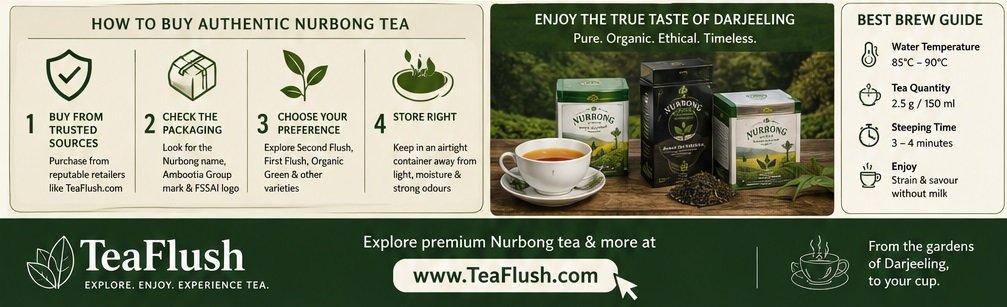
Best enjoyed: Plain, or with a small amount of milk — the fuller body and honey sweetness make it more milk-compatible than delicate first flush teas. At 90–95°C for 3–4 minutes.
🌱 First Flush — The Spring Expression
Season: Mid-March to April (2026 harvest documented)
Character: Fresh, green, peppery, with wildflower and stone-fruit notes
Format: Available as rare micro-lots from specialty importers
This 2026 first flush beautifully reflects the vibrant mountain environment from which it comes. The wiry, tippy leaves offer a striking aromatic profile — fresh, green, and gently peppery — recalling the brisk vitality of early Himalayan spring.
Nurbong’s first flush has begun attracting attention from specialty tea importers internationally — a relatively recent development that reflects the estate’s growing recognition as a producer of genuinely distinctive, terroir-expressive teas beyond its established second flush character.
Dry Leaf Appearance: Wiry, tippy leaves — fine, twisted, with visible golden and silver tips indicating a high-quality plucking standard and careful processing.
Liquor Colour: In the cup, the liquor glows a light golden hue — bright, clear, and luminous, characteristic of a well-made, lightly oxidised first flush.
Aroma: Fresh, green, and gently peppery — a distinctive aromatic signature that sets it apart from the purely floral character of many other Darjeeling first flush teas. The “peppery” quality is an unusual and memorable descriptor, suggesting a spice-forward complexity layered over the expected spring freshness.
Flavour: The flavor is smooth and lightly creamy, offering a fresh natural sweetness layered with delicate wildflower nuances, subtle stone-fruit notes, and a clean, lingering finish.
This combination — smooth, lightly creamy texture; natural sweetness; wildflower nuances; subtle stone fruit — describes a first flush of genuine sophistication. The “wildflower” character is particularly notable and is plausibly connected to Nurbong’s proximity to the Mahananda Wildlife Sanctuary’s diverse forest understory, where wild flowering plants growing near the tea gardens may contribute aromatic complexity through proximity and cross-pollination effects that experienced tea tasters can sometimes detect.
Mouthfeel: Lightly creamy — an unusual and pleasant textural quality for a first flush, suggesting good leaf maturity and skilled processing.
Finish: Clean and lingering — the mark of a well-made spring harvest.
Rarity: Some Nurbong first flush releases have been offered as genuine micro-lots — specialty retailers have offered batches as small as 5 kilograms, reflecting both the estate’s selective approach to its finest spring pluckings and the developing international specialty market interest in this previously lesser-known garden.
Best enjoyed: Plain, without milk. At 85–88°C for 2–2.5 minutes — standard first flush brewing parameters that will showcase the wildflower and stone-fruit complexity without overwhelming bitterness.
Part 4: Why Nurbong’s Flavour Profile Is Distinctive
Understanding why Nurbong tastes different from many of its Darjeeling neighbours requires looking at the combination of factors specific to this estate:
| Factor | Nurbong’s Specific Character | Effect on the Cup |
|---|---|---|
| Medium altitude (~1,200m) | Lower than Mirik Valley or highest Kurseong gardens | Fuller body, faster growth, less extreme delicacy |
| Heavier oxidation philosophy | Distinctly more oxidised second flush than Castleton-style teas | Ceylon/dark oolong character rather than classic muscatel |
| Wildlife sanctuary border | Direct proximity to Mahananda forest ecosystem | Wildflower notes, natural pest regulation, ecosystem diversity |
| Full organic certification | No synthetic inputs across 496 hectares | Cleaner flavour profile, soil health reflected in cup |
| Large estate scale | 496 hectares — among the larger Darjeeling gardens | Consistent commercial production alongside quality lots |
| Tindharia railway corridor | Historical transportation advantage | Efficient processing-to-market logistics |
Part 5: How Nurbong Compares to Its Kurseong Neighbours
| Estate | Altitude | Signature Character | Distinguishing Feature |
|---|---|---|---|
| Nurbong | ~1,200m | Honey-sweet, Ceylon-like second flush; peppery wildflower first flush | Borders Mahananda Wildlife Sanctuary |
| Castleton | 980–2,300m | Classic intense muscatel second flush | Benchmark for traditional Darjeeling muscatel |
| Giddapahar | 1,370–1,585m | Bold, creamy, “dry” character first flush | Century-old Birmingham rolling machine |
| Jogmaya | 1,370–1,585m | Mellow, slightly astringent first flush; silky white tea | Century-old Chinary bushes, Shaw family |
| Sivitar | Similar zone | Organic, neighbouring estate | Part of same LOTEPL ownership group |
| Tindharia | Similar zone | Organic certified | Railway workshop town namesake |
What distinguishes Nurbong within this prestigious neighbourhood is precisely its departure from the classic muscatel template — offering instead a darker, honey-forward second flush and a peppery, wildflower-inflected first flush that gives specialty drinkers genuine variety within the Kurseong growing zone.
Part 6: Organic Certification and Sustainable Farming at Nurbong
Nurbong is explicitly identified across multiple industry sources as a fully organic tea estate — where only organic tea is grown, with no synthetic fertilisers, pesticides, or chemical inputs used anywhere across its 496-hectare area.
What Organic Certification Means at Nurbong
As part of the broader Ambootia Group and subsequently Lemongrass Organic Tea Estates portfolio, Nurbong has benefited from:
Comprehensive organic protocols: Natural composting methods, biological pest management, and soil health practices consistent with the broader organic philosophy that defined the Ambootia Group’s approach across its twelve Darjeeling estates.
International certification infrastructure: As part of a group that achieved IMO Organic and Demeter Biodynamic certifications at its flagship Ambootia estate, Nurbong has had access to the auditing, documentation, and quality assurance systems necessary to maintain credible organic status for international export markets.
Worker welfare considerations: The broader Ambootia Group philosophy — articulated by Sanjay Bansal as treating workers and their families “as part of a family” — extended across the group’s portfolio of estates, including Nurbong, with implications for housing, healthcare, and community welfare standards.
The Transition Period
It is worth noting honestly that the 2022 financial distress and ownership transition affecting the broader DOTEPL portfolio represented a genuinely difficult period for workers across the affected estates, including Nurbong. The challenges facing Darjeeling’s tea industry more broadly in this period — declining European demand, falling production, rising costs — created real hardship that the transition to Lemongrass Organic Tea Estates has worked to address in the years since.
Part 7: How to Buy Authentic Nurbong Tea Garden Tea
What to Look For
Authentic Nurbong tea will clearly state:
- ✅ Estate name: “Nurbong Tea Garden” or “Nurbong Tea Estate,” Kurseong, Darjeeling
- ✅ The Darjeeling GI certification mark — the Tea Board of India logo
- ✅ Organic certification — IMO or equivalent organic logo
- ✅ Flush and year — First Flush / Second Flush + harvest year
- ✅ Leaf grade — SFTGFOP1, FTGFOP1, etc.
Where to Buy
Nurbong tea has been sourced internationally by specialty retailers including:
- Happy Earth Tea (USA) — sourced Nurbong’s 2026 first flush as a new addition to their portfolio, with direct estate-connected sourcing
- Tecentralen (Sweden) — has carried Nurbong second flush SFTGFOP1, describing its distinctive Ceylon-like, honey-sweet character
- Indian specialty tea retailers sourcing directly from Kurseong-zone estates within the Lemongrass Organic Tea Estates portfolio
Pricing Guide
| Tea Type | Indicative Price Range |
|---|---|
| First Flush (micro-lot) | Premium pricing reflecting limited availability |
| Second Flush SFTGFOP1 | Mid-to-premium Darjeeling second flush pricing |
Part 8: Brewing Nurbong Tea Perfectly
Brewing Nurbong First Flush
| Parameter | Guidance |
|---|---|
| Water | Fresh, filtered — soft to neutral mineral content |
| Temperature | 85–88°C — never boiling |
| Quantity | 2.5–3 g per 200 ml |
| Steep time | 2–2.5 minutes |
| Vessel | Clear glass — observe the light golden liquor |
| Milk | Never — preserve the wildflower and stone-fruit complexity |
| Multiple infusions | 2–3 infusions recommended given the tippy, high-quality leaf |
Brewing Nurbong Second Flush
| Parameter | Guidance |
|---|---|
| Temperature | 90–95°C |
| Quantity | 2.5–3 g per 200 ml |
| Steep time | 3–4 minutes |
| Milk | Optional — the fuller, honey-sweet body accommodates milk well |
| Best pairing | Given its Ceylon-like character, pairs well with foods typically suited to Ceylon tea: light pastries, scones, mild cheeses |
Frequently Asked Questions About Nurbong Tea Garden
Q: When was Nurbong Tea Garden established?
Nurbong Tea Garden was established in 1870, during Darjeeling’s major Victorian-era expansion period, when the number of tea gardens in the district was rapidly increasing from the original founding three estates of 1852.
Q: Where is Nurbong Tea Garden located? Nurbong is located in the Kurseong subdivision of Darjeeling district, West Bengal, along the southern slopes of the Darjeeling Himalayas, with the postal designation Tindharia. It is directly bordered by the Mahananda Wildlife Sanctuary.
Q: Is Nurbong Tea Garden organic? Yes. Nurbong is a fully certified organic tea estate — only organic tea is grown across its entire 496-hectare area, with no synthetic fertilisers or pesticides used in cultivation.
Q: Who owns Nurbong Tea Garden? Nurbong was historically part of the Ambootia Group (Darjeeling Organic Tea Estates Pvt. Ltd.) under Sanjay Bansal. In late 2022, due to financial distress at the parent company, Nurbong transitioned to Lemongrass Organic Tea Estates Pvt. Ltd. (LOTEPL), owned by Sushil Kumar Agarwal, a joint venture between MLA Group and KK Group.
Q: What makes Nurbong’s tea distinctive? Nurbong’s second flush is notably more heavily oxidised than classic Darjeeling muscatel teas like Castleton — producing a character reminiscent of Ceylon tea or dark oolong, with a soft, rounded, honey-sweet taste rather than the typical grape-like muscatel profile. Its first flush offers a distinctive peppery, wildflower, and stone-fruit character, plausibly influenced by its direct proximity to the Mahananda Wildlife Sanctuary’s diverse forest ecosystem.
Q: What altitude is Nurbong Tea Garden? Nurbong sits at a medium altitude of approximately 1,200 metres above sea level — moderate compared to the highest-altitude Darjeeling gardens in the Mirik Valley, contributing to its fuller-bodied tea character.
Q: Does Nurbong Tea Garden really border wild elephants? Yes. Nurbong is located along the southern slopes of the Darjeeling Himalayas, bordered by the lush forests of the Mahananda Wildlife Sanctuary, where elephants still roam freely through the landscape below the tea garden.
Q: How big is Nurbong Tea Garden? Nurbong is a large plantation of 496 hectares — among the larger tea gardens in the Darjeeling district, comparable in scale to substantial estates like Ambootia.
Q: What does Nurbong second flush taste like? Nurbong second flush has a soft and rounded taste, slightly sweet with hints of honey, and a character reminiscent of Ceylon teas or dark oolong rather than the classic Darjeeling muscatel profile — not particularly bitter, with notable smoothness and depth from its heavier oxidation.
Q: Where can I buy Nurbong tea? Specialty international retailers including Happy Earth Tea (USA) and Tecentralen (Sweden) have sourced Nurbong tea directly. Always look for the Darjeeling GI certification mark and organic certification logos to verify authenticity.
The TeaFlush Perspective: Tea at the Edge of the Wild
There is something quietly profound about a tea garden that exists at the literal edge of wilderness — where the last row of cultivated tea bushes gives way directly to forest that elephants still walk through, undisturbed by the human industry happening just metres away.
Nurbong Tea Garden occupies that edge. For over 150 years, since 1870, it has cultivated tea on these southern Kurseong slopes, evolving through the colonial era, through India’s independence, through the rise and financial difficulties of one of Darjeeling’s most ambitious organic tea conglomerates, and into its current chapter under Lemongrass Organic Tea Estates.
Through all of that change, the Mahananda Wildlife Sanctuary has remained exactly where it always was — a reminder that the cultivated landscape of Darjeeling’s tea gardens, however carefully tended and however valuable its export, is still only a narrow human intervention into a vastly older, vastly wilder Himalayan ecosystem.
When you brew a cup of Nurbong second flush — its honey-sweet, rounded, Ceylon-like character so distinct from the classic muscatel of its more famous neighbours — or its peppery, wildflower-scented first flush, you are tasting something shaped by that proximity. Tea grown at the genuine edge of the wild carries something of that wildness with it: a character that does not quite follow the expected Darjeeling template, that surprises tasters who come to it expecting the familiar muscatel and find instead something rounder, darker, and more honeyed.
That is Nurbong’s quiet gift: a Darjeeling tea that reminds you the hills were wild before they were cultivated, and that the wildness has never entirely left.
Explore more Darjeeling tea estate profiles, brewing guides, and tea culture at TeaFlush.com
Tags: Nurbong Tea Garden, Nurbong Tea Estate Darjeeling, Nurbong Kurseong, Nurbong organic tea, Nurbong second flush, Nurbong first flush, Mahananda Wildlife Sanctuary tea, Ambootia Group history, Lemongrass Organic Tea Estates, Tindharia tea garden, Darjeeling Ceylon-style tea, honey sweet Darjeeling second flush, SFTGFOP1 Nurbong, organic Darjeeling tea estate, Kurseong tea garden 1870, wildlife bordered tea estate
Disclaimer: Ownership, certification, and operational details are based on multiple industry and news sources and may have changed since publication. For the most current information, contact the estate or its parent company directly.