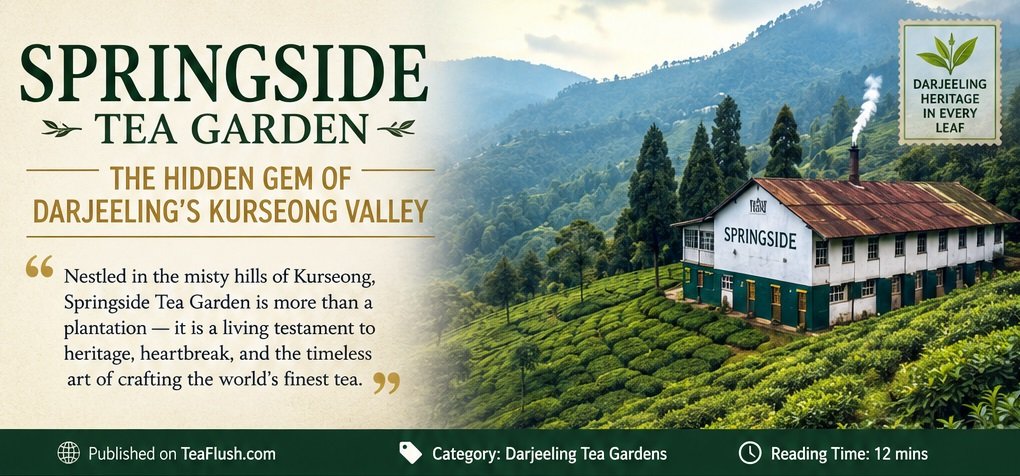
Springside Tea Garden: The Hidden Gem of Darjeeling’s Kurseong Valley
Published on TeaFlush.com | Category: Darjeeling Tea Gardens | Reading Time: 12 mins
“Nestled in the misty hills of Kurseong, Springside Tea Garden is more than a plantation — it is a living testament to heritage, heartbreak, and the timeless art of crafting the world’s finest tea.”
Table of Contents
1. Introduction: Why Springside Stands Apart
When tea lovers speak of Darjeeling, names like Castleton, Margaret’s Hope, and Makaibari often steal the spotlight. Yet tucked within the lush valleys of Kurseong’s northern subdivision lies a garden that carries a soul unlike any other — Springside Tea Garden.
Known locally as Wathan Kaman or Wathan’s Tea Garden, Springside is one of the 87 registered tea estates in Darjeeling authorized to label their produce with the coveted “Darjeeling” GI (Geographical Indication) tag. This is no small distinction. In a world overrun with counterfeit blends marketed as “Darjeeling,” an authentic Springside cup is a rare luxury — rich in flavour, steeped in history, and brimming with character.
Whether you are a seasoned Darjeeling tea connoisseur or just beginning your journey into single-estate teas, Springside Tea Garden is a name you need to know.
2. Location & Geography
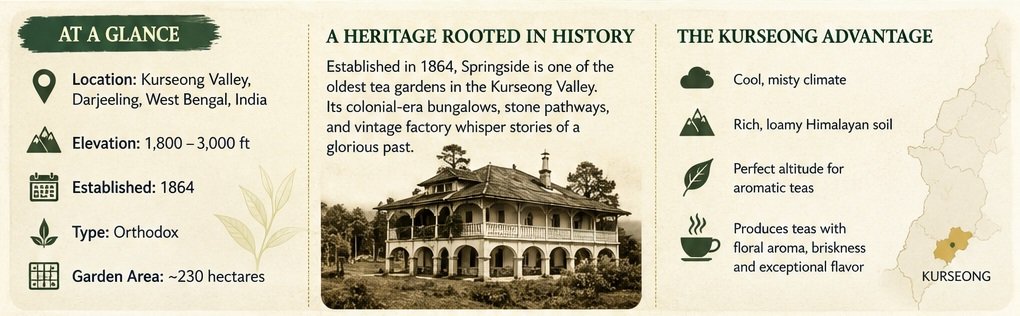
Springside Tea Garden is situated in the Kurseong (North) subdivision of the Darjeeling district in West Bengal, India. Kurseong — often called the “Land of White Orchids” — is one of the most celebrated tea-producing pockets in the entire Himalayan belt.
Key Geographic Details:
| Detail | Information |
|---|---|
| State | West Bengal, India |
| District | Darjeeling |
| Subdivision | Kurseong (North) |
| Region | Darjeeling Hills |
| Elevation Range | 915 metres to 1,830 metres (approx. 3,002 ft to 6,004 ft) |
| Climate | Sub-alpine, cool, misty, high rainfall |
| Managed by | Goodricke Group (Amgoorie India Limited) |
The garden is flanked by several other prestigious estates in the Kurseong North corridor, including Margaret’s Hope, Eden Vale (Maharani), Ringtong, Oaks, Moondakotee, and Ambootia Tea Gardens — making this belt one of the richest tea-growing micro-climates on Earth.
3. The Touching History of Springside Tea Garden
Every great tea garden has a story. Springside’s is one of the most poignant in all of Darjeeling.
The Origins: Alfred Wathan and a Heartbroken Memorial
The history of Springside Tea Garden traces back to 1900, a time when British colonial planters were at the height of their influence across the Darjeeling hills.
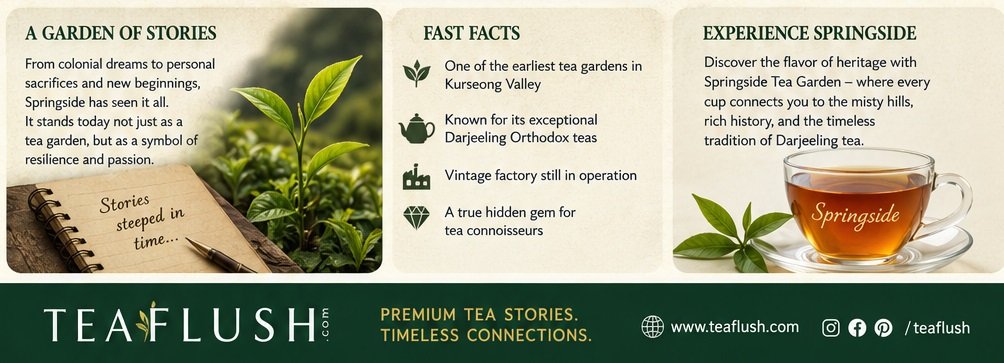
Alfred Wathan, the then-Manager of the garden, and his wife Mary experienced an unimaginable tragedy — the loss of their infant daughter. Devastated by grief, the couple created a flower garden around their baby’s grave, where they would go to rest and find peace after long days on the estate. The spring nearby — bubbling cool and clear through the hills — became a place of solace for the grieving parents. It was this very spring that gave the garden its enduring name: Springside.
To this day, the garden is affectionately known among locals as Wathan Kaman — a tribute to the man who turned his deepest sorrow into something beautiful. The spring itself, the flower memorial, and the emotional history live on in the estate’s identity, making Springside not just a tea garden but a place of quiet reverence.
Colonial Legacy to Modern Management
Like many Darjeeling estates, Springside passed through various hands after Indian independence in 1947. It eventually came under the umbrella of the Goodricke Group, one of India’s most respected tea conglomerates, managed specifically through its subsidiary Amgoorie India Limited.
Today, Springside stands alongside other Goodricke-managed Darjeeling jewels such as Margaret’s Hope, Castleton, Edenvale (Maharani), and Dilaram Tea Estates, all of which are synonymous with quality and consistency.
4. Elevation & Terroir: Nature’s Role in the Cup
The extraordinary taste of Darjeeling tea is inseparable from its terroir — the combination of soil, altitude, climate, and geography that makes the region’s teas unlike anything grown anywhere else on the planet.
Springside Tea Garden spans an impressive elevation range of 915 metres to 1,830 metres above sea level. This is the sweet spot that Darjeeling teas need. Here’s why elevation matters so profoundly:
Why High Altitude Makes Better Tea
- Slower Growth = More Flavour: At higher elevations, cooler temperatures slow the growth of the Camellia sinensis tea plant. This slower cell development concentrates flavour compounds, antioxidants, and the aromatic oils that define premium Darjeeling teas.
- Mountain Mist as a Natural Filter: The cloud cover and mist that Kurseong is famous for act as a natural UV filter, reducing stress on the plant and encouraging the production of delicate flavour precursors.
- Well-Drained Acidic Soil: The steep Himalayan slopes ensure no waterlogging, while the naturally acidic soil enhances the characteristic brightness and astringency of Darjeeling black teas.
- Cool Winters, Misty Summers: The dramatic seasonal variation between Kurseong’s dry winters and wet monsoon summers is what drives the distinct character of each flush.
The combination of all these factors gives Springside its tea a profile that is strong in flavour, bright in the cup, and deeply aromatic — qualities that have earned it recognition among global tea buyers.
5. The Tea Flushes of Springside
Darjeeling teas are harvested in seasonal cycles known as flushes, and each flush produces a tea with a dramatically different personality. Springside Tea Garden produces teas across these seasons:
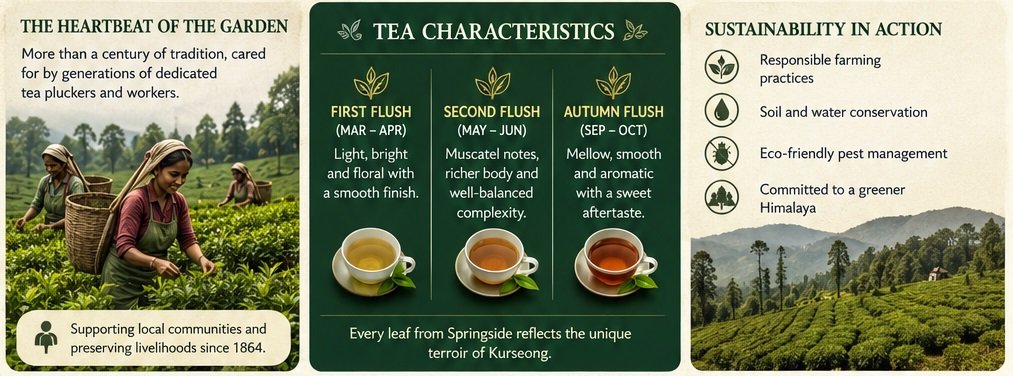
🌱 First Flush (March – April): The Spring Awakening
The First Flush is the most eagerly awaited harvest of the year. After the cold, dry winter, the first rains of March coax the dormant tea bushes back to life. At Springside’s higher elevations, First Flush plucking often begins slightly later than lower-lying gardens — this slower start, paradoxically, yields more complex and nuanced teas.
Springside First Flush Characteristics:
- Colour: Pale gold to yellow-green in the cup
- Aroma: Fresh, floral, grassy, with hints of spring blossoms
- Flavour: Light-bodied, delicately astringent, with a clean, green character
- Best for: Afternoon sipping; pairs beautifully with light pastries or simply enjoyed alone
First Flush Darjeeling from Springside is a highly sought-after product in international markets, particularly in Japan, Germany, and the United Kingdom.
☀️ Second Flush (May – June): The Muscatel Crown
The Second Flush is where Springside truly announces itself on the world stage. Harvested in the warm, humid weeks of late May to June, the Second Flush brings with it the legendary muscatel character — a grape-like, honeyed complexity that is the hallmark of premium Darjeeling teas.
Springside’s SFTGFOP1 Second Flush is among the most respected in the Kurseong North belt.
Springside Second Flush Characteristics:
- Colour: Deep amber to copper; rich and luminous
- Aroma: Musky muscatel, ripe stone fruit, wildflowers, honey
- Flavour: Full-bodied, with a wine-like depth and long, warming finish
- Grade: Often classified as SFTGFOP1 (Super Fine Tippy Golden Flowery Orange Pekoe, Grade 1)
- Best for: Breakfast or mid-morning; pairs with dark chocolate, cheese, or dried fruits
The Second Flush teas from Springside command premium prices at international auction houses and are prized by connoisseurs who understand the rarity of authentic muscatel Darjeeling.
🍂 Monsoon / Rainy Flush (July – September): The Everyday Hero
The Monsoon Flush, also known as the Rains Flush, is harvested during the heavy monsoon months. The abundant rainfall accelerates leaf growth, producing larger, more robust leaves. While less nuanced than First or Second Flush, the Monsoon Flush from Springside delivers a bold, full-bodied brew ideal for everyday drinking.
Springside Monsoon Flush Characteristics:
- Colour: Dark, rich, opaque amber
- Flavour: Strong, malty, straightforward
- Body: Heavy; good with milk and sugar
- Best for: Morning cup; ideal as a builder’s tea or breakfast blend
🍁 Autumn Flush (October – November): The Copper Harvest
The Autumn Flush — also called the Autumnal — is a lesser-known but deeply satisfying harvest. Harvested after the monsoon rains recede, the Autumn Flush produces teas with a distinctive coppery liquor and a mellow, earthy depth.
Springside Autumn Flush Characteristics:
- Colour: Bright copper-amber
- Aroma: Earthy, woody, subtly spicy
- Flavour: Smooth, round, with a pleasing mellow finish
- Best for: Evening relaxation; pairs with biscuits, light Indian snacks
6. Flavor Profile: What Does Springside Tea Taste Like?
In the world of Darjeeling teas, Springside holds a special reputation for being strong in flavour, vibrant in aroma, and rich in colour — qualities that distinguish it even among the elite gardens of Kurseong.
Experts who have tasted Springside teas — including former Goodricke planters Mr. Jivan Pradhan and Mr. N.K. Puri, who have conducted tea tasting sessions across all Goodricke gardens — consistently describe the tea in these terms:
- ✅ Bold and assertive — not a shrinking violet; this tea makes its presence known
- ✅ Floral and musky (particularly in Second Flush)
- ✅ Bright and clean liquor with excellent clarity
- ✅ Long, warming finish that lingers pleasantly on the palate
- ✅ True Darjeeling character — the kind of tea that perfectly exemplifies what makes the region’s produce world-famous
Springside tea is described as “a perfect example of the best quality Darjeeling tea” — a reputation hard-won over more than a century of cultivation.
7. Tea Grades Produced at Springside
Springside produces tea in the traditional orthodox method, where whole leaves are carefully hand-plucked and processed to preserve their integrity. The garden’s teas are graded according to the international leaf grading system:
| Grade | Full Form | Description |
|---|---|---|
| SFTGFOP1 | Super Fine Tippy Golden Flowery Orange Pekoe Grade 1 | The pinnacle — premium estate’s finest tea |
| FTGFOP | Fine Tippy Golden Flowery Orange Pekoe | High-quality whole leaf with golden tips |
| TGFOP | Tippy Golden Flowery Orange Pekoe | Classic Darjeeling grade, excellent quality |
| GFOP | Golden Flowery Orange Pekoe | Good whole-leaf, reliable flavour |
The SFTGFOP1 Second Flush from Springside is the estate’s crown jewel and the grade most prized by collectors and connoisseurs worldwide.
8. Springside Under the Goodricke Group
Springside Tea Garden is managed under Amgoorie India Limited, a subsidiary of the Goodricke Group — one of India’s largest and most respected tea companies.
Goodricke, in turn, is part of the globally influential Camellia PLC, a holding company that owns and operates 67 tea estates worldwide. This means Springside benefits from:
- World-class tea planting and processing expertise
- Rigorous quality control at every stage of production
- Sustainable farming practices aligned with global standards
- International distribution networks ensuring Springside teas reach markets in Europe, Japan, North America, and beyond
Other Goodricke/Amgoorie-managed Darjeeling estates include:
- Castleton Tea Estate (Kurseong South) — the “crown jewel” of the Goodricke portfolio
- Margaret’s Hope Tea Estate — historic estate established in 1864
- Edenvale (Maharani) Tea Estate — known for exceptional Second Flush
- Dilaram Tea Estate — located along the Rinchengtong river valley
Being in this elite company elevates Springside’s standing and ensures its teas meet the highest international benchmarks.
9. Landmark Spots Within the Garden
Springside Tea Garden is not merely a tea factory — it is a living landscape filled with history, natural beauty, and places that have become iconic among visitors and tea enthusiasts:
🦅 Eagle’s Craig
Perhaps the most spectacular vantage point within the garden, Eagle’s Craig offers a sweeping panoramic view of the Darjeeling hills. On clear days, the panoramic vista of mountains, valleys, and the rippling countryside is nothing short of breathtaking. This is one of the must-visit spots for anyone exploring the garden.
🌸 The Baby’s Flower Garden
The origin of the garden’s name and its emotional heart — the flower garden created by Alfred and Mary Wathan around their infant daughter’s grave still carries a quiet, poignant beauty. It is a reminder of the deeply human stories woven into the soil of every great tea garden.
💧 The Springside Spring
The original spring that gave the garden its name, once a source of comfort for the grieving Wathan family. Its cool waters still flow through the estate, symbolic of the natural vitality that fuels the garden’s extraordinary teas.
🏡 Ayana Kothi
A charming heritage bungalow within the estate, the Ayana Kothi is one of the most visited spots in Springside. These old colonial-era planter bungalows are characteristic of Darjeeling estates and offer a window into the lifestyle of early 20th-century tea planters.
🍊 Orange Grove Rakti Jhora
The Orange Grove at Rakti Jhora is another beloved landmark within the garden — a verdant grove that adds to the estate’s natural diversity and visual charm.
10. Brewing the Perfect Cup of Springside Tea
To truly honour the craftsmanship that goes into every leaf of Springside Darjeeling, you must brew it with care. Here is the TeaFlush.com recommended brewing guide:
For First Flush (Delicate & Floral)
| Parameter | Recommendation |
|---|---|
| Water Temperature | 85°C – 90°C (do NOT use boiling water) |
| Tea Amount | 2 – 2.5g per 200ml (roughly 1 teaspoon) |
| Steeping Time | 2 – 3 minutes |
| Milk/Sugar | Absolutely none — drink it pure |
| Vessel | Glass or white porcelain to appreciate the pale gold liquor |
For Second Flush (Rich & Muscatel)
| Parameter | Recommendation |
|---|---|
| Water Temperature | 95°C – 100°C |
| Tea Amount | 2.5g per 200ml |
| Steeping Time | 3 – 4 minutes |
| Milk/Sugar | Optional — though purists insist on black |
| Vessel | Porcelain teapot; pre-warm before brewing |
For Autumn Flush (Smooth & Mellow)
| Parameter | Recommendation |
|---|---|
| Water Temperature | 95°C – 100°C |
| Tea Amount | 2.5 – 3g per 200ml |
| Steeping Time | 3 – 4 minutes |
| Milk/Sugar | A splash of milk is perfectly acceptable |
Pro Tip from TeaFlush.com: Loose-leaf Springside teas can typically be steeped 2–3 times. Each successive steeping reveals a different dimension of the tea’s character. Never extend steep time to compensate for fewer leaves — this extracts bitterness, not flavour.
11. How to Buy Authentic Springside Darjeeling Tea
Given the global problem of counterfeit Darjeeling tea — where blenders sometimes label their tea “Darjeeling” even when only a fraction comes from the region — purchasing authentic Springside tea requires knowing where to look.
What to Check Before You Buy:
- The Darjeeling Logo & Certificate Number: Authentic Darjeeling tea carries the official Darjeeling GI (Geographical Indication) logo — a lady plucking tea — on its packaging. Springside, as one of only 87 registered Darjeeling estates, is entitled to use this mark.
- Estate Name on Packaging: The words “Springside Estate” or “Springside Tea Garden” should appear clearly, along with the flush (First, Second, or Autumnal) and the year of harvest.
- Flush & Year: Premium single-estate teas are vintage products. The year and flush season matter enormously for quality.
- Grade: Look for SFTGFOP1 for the finest quality Second Flush teas.
- Reputable Retailers: Buy from established tea boutiques, importers, or directly from Goodricke-authorized sellers who can verify provenance.
At TeaFlush.com, we are passionate about helping you access only the most authentic, traceable, single-estate Darjeeling teas. Explore our curated collection to find genuine Springside teas from verified harvests.
12. Springside Tea Garden vs. Other Kurseong Estates
To put Springside in context, here’s how it compares with some of its Kurseong neighbours:
| Estate | Known For | Elevation | Owned By |
|---|---|---|---|
| Springside | Bold flavour, strong colour, poignant history | 915m – 1,830m | Goodricke (Amgoorie) |
| Margaret’s Hope | Fruity, bold character; historic legend | 952m – 1,829m | Goodricke |
| Castleton | Muscatel crown jewel; competition winner | 982m – 2,300m | Goodricke |
| Edenvale (Maharani) | Exceptional Second Flush; 100% China bushes | 1,066m – 1,358m | Goodricke |
| Ambootia | Certified organic; biodynamic cultivation | 1,200m – 1,800m | Ambootia Group |
| Makaibari | World’s first tea factory (1859); biodynamic | 1,500m+ | Luxmi Tea |
Springside’s defining characteristic — the combination of wide elevation range, Wathan heritage, and Goodricke’s quality stewardship — gives it a flavour profile and story that is uniquely its own.
13. FAQs About Springside Tea Garden
Q: Where exactly is Springside Tea Garden located?
A: Springside Tea Garden is in the Kurseong North subdivision of the Darjeeling district, West Bengal, India. It is one of the 87 GI-registered Darjeeling tea estates.
Q: Who owns Springside Tea Garden?
A: It is managed by Amgoorie India Limited, a subsidiary of the Goodricke Group, which is part of the global Camellia PLC conglomerate.
Q: Why is Springside called “Wathan Kaman”? A: The garden is named after Alfred Wathan, its early 20th-century manager, who along with his wife Mary created a flower garden in memory of their infant daughter near a natural spring on the estate — giving rise to both the name “Springside” and the local epithet “Wathan Kaman.”
Q: What is the best flush to buy from Springside? A: The Second Flush (May–June) SFTGFOP1 is considered the garden’s finest product, celebrated for its muscatel character and rich, full-bodied flavour. However, the First Flush is highly prized by green tea fans and floral tea lovers.
Q: Is Springside tea certified Darjeeling? A: Yes. Springside is one of only 87 registered estates authorized to label their tea as “Darjeeling” under the GI protection scheme, making it a guaranteed authentic product.
Q: What altitude does Springside Tea Garden grow tea at? A: The garden cultivates tea across an elevation range of 915 metres to 1,830 metres (approximately 3,000 ft to 6,000 ft) above sea level.
Q: Can you visit Springside Tea Garden? A: Like most Darjeeling estates, access for visitors is typically arranged through the managing company or through organised tea tourism packages. The Goodricke Group does host tea tourism activities at its Darjeeling estates.
14. Final Sip: Why Springside Deserves a Place in Your Teacup
Springside Tea Garden is one of those rare places where nature, history, and human emotion converge to create something extraordinary. From the tragic love story of Alfred and Mary Wathan and the spring that bears witness to their grief, to the sweeping vistas from Eagle’s Craig and the rich, vibrant teas that have delighted connoisseurs for over a century — Springside is Darjeeling at its most soulful.
Its teas are more than a beverage. They are a connection to the Himalayan mist, to the hands that plucked each leaf, and to the story of a garden born from heartbreak and nurtured into excellence.
Whether you choose the ethereal lightness of its First Flush or the muscatel grandeur of its Second Flush, a cup of Springside Darjeeling is an experience that transcends the ordinary.
At TeaFlush.com, we believe every great cup of tea tells a story. Springside’s story is one of the most compelling in all of Darjeeling — and it is waiting to be tasted.
🍵 Ready to Experience Springside?
Explore our curated collection of authentic, single-estate Darjeeling teas from Springside and other legendary Kurseong gardens — sourced directly, verified for provenance, and delivered to your door.
👉 Shop Authentic Darjeeling Teas at TeaFlush.com
Tags: Springside Tea Garden, Darjeeling Tea, Kurseong Tea Gardens, Goodricke Tea, First Flush Darjeeling, Second Flush Darjeeling, SFTGFOP1, Wathan Kaman, Darjeeling GI Tag, Best Darjeeling Tea Estates, TeaFlush, Single Estate Tea, Amgoorie India Limited
© TeaFlush.com — Your Destination for Authentic Indian Single-Estate Teas