Ambootia Tea Garden: The Complete Guide to Darjeeling’s Legendary Organic Estate
Published on TeaFlush.com | Your Ultimate Tea Discovery Resource
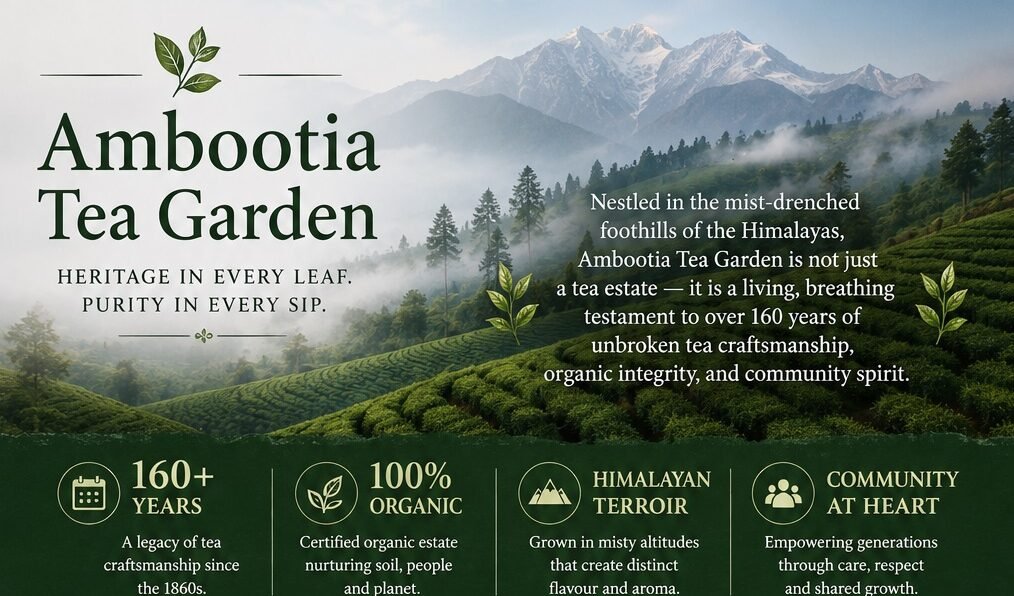
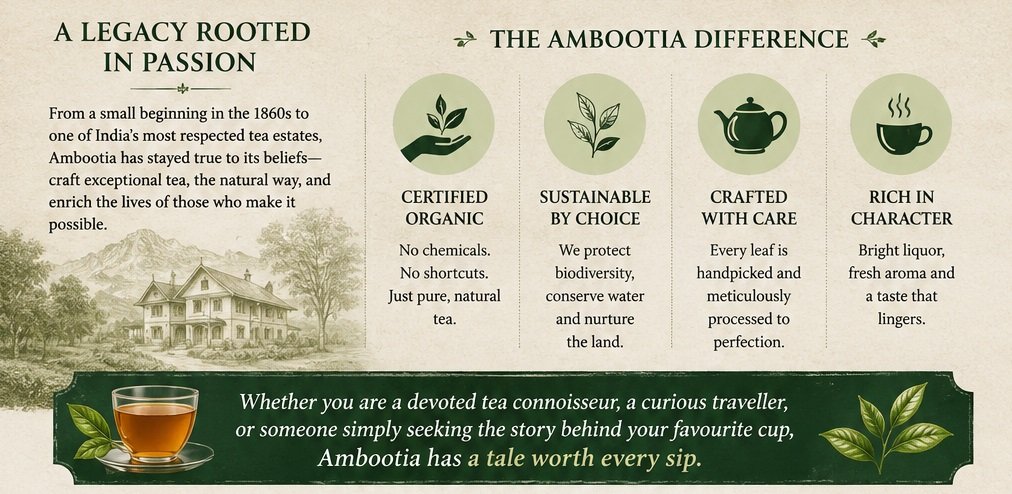
Nestled in the mist-drenched foothills of the Himalayas, Ambootia Tea Garden is not just a tea estate — it is a living, breathing testament to over 160 years of unbroken tea craftsmanship, organic integrity, and community spirit. Whether you are a devoted tea connoisseur, a curious traveller, or someone simply seeking the story behind your favourite cup, Ambootia has a tale worth every sip.
Table of Contents
What is Ambootia Tea Garden?
Ambootia Tea Garden — also spelled Ambootay — is one of the oldest, most celebrated, and most historically significant tea estates in Darjeeling, India. It stands among the first 30 tea gardens ever established in the Darjeeling hills and today ranks as the second-largest producer of Darjeeling Tea in India.
The garden is globally revered for its commitment to 100% certified organic and biodynamic tea production, a distinction it has held since 1992. It has been recognised by the United Nations FAO Project as a model farm for Darjeeling Organic Tea — a distinction that underscores not just the quality of its teas, but the philosophy that guides every leaf plucked from its slopes.
For tea lovers around the world, Ambootia is more than a name on a packet. It is a guarantee of purity, provenance, and passion.
Where is Ambootia Tea Garden Located?
Location: Kurseong subdivision, Darjeeling district, West Bengal, India
Ambootia Tea Garden is situated in the Kurseong subdivision of Darjeeling, perched in the foothills of the mighty Himalayan Mountains. The estate lies on the western side of Kurseong town, in a valley cloaked in mist and draped in terraced green.
Key Geographic Facts:
- Region: Kurseong, Darjeeling, West Bengal
- Country: India
- Altitude: Approximately 3,000 to 6,000 feet above sea level (with some sources placing the main garden around 4,000 feet)
- Climate: Cool, misty, with well-drained Himalayan slopes
- Nearest Town: Kurseong (within walking distance from Cochrane Place)
The terrain here — steep hillsides, mineral-rich soils, persistent morning mists, and unpredictable mountain weather — creates the legendary terroir that gives Darjeeling teas their uniquely floral, muscatel character. Ambootia sits at the heart of this magic.
A Rich History: From British Planters to Organic Pioneers
The story of Ambootia Tea Garden is as layered and complex as the teas it produces.
The Colonial Origins (1859–1864)
Ambootia Tea Garden was established during the earliest days of the Darjeeling tea plantation era, sometime between 1859 and 1864, by the British Government. It was privileged to be among the first 30 tea gardens ever established in Darjeeling. The Darjeeling Tea Company of England formally set up the garden in 1861, making it one of the foundational estates in the entire history of Indian tea.
During the colonial period, the British brought their horticultural expertise and commercial ambition to these Himalayan slopes, transforming the forested hillsides into the iconic green terraces that define Darjeeling today. Ambootia was part of that pioneering wave.
Post-Independence Transition (1947–1986)
After India achieved independence in 1947, the estate, like many British-owned plantations, transitioned to Indian ownership. Indian entrepreneurs took over the management of Ambootia in 1954. However, by the 1980s, the garden had fallen into financial difficulty and was declared a sick unit — a term used in Indian industry to describe enterprises in economic distress.
The Bansal Turnaround (1987 Onwards)
In 1987, the Bansal Tea Group acquired Ambootia Tea Garden. What happened next is one of Indian tea’s great revival stories. Rather than taking conventional routes to profitability, the Bansal Group made a radical, visionary decision: they would convert Ambootia into a fully organic and biodynamic operation.
By 1992, Ambootia had completed its transition to 100% certified organic and biodynamic tea production — a remarkable achievement that set it apart from almost every other tea estate in the country. In 1994, it achieved Fairtrade certification. A struggling, loss-making garden had been transformed into an internationally acclaimed model of sustainable agriculture.
Ownership Through the Ages
| Period | Owner/Manager |
|---|---|
| 1859–1954 | British Government / Darjeeling Tea Company of England |
| 1954–1987 | Indian entrepreneurs (post-independence transition) |
| 1987–2022 | Bansal Tea Group / Ambootia Group (Mr Sanjay Bansal) |
| 2022–Present | Lemongrass Organic Tea Estates Pvt. Ltd. (Mr Sushil Kumar Agarwal, LOTEPL) |
In late 2022, due to prolonged financial distress at Darjeeling Organic Tea Estates Pvt. Ltd., Ambootia and five other gardens were transferred to Mr Sushil Kumar Agarwal of Lemongrass Organic Tea Estates Pvt. Ltd. (LOTEPL) — a joint venture between the MLA Group and KK Group. Under this new stewardship, LOTEPL now manages 9 tea estates in the Darjeeling region and is growing into one of the most respected Darjeeling tea companies globally.
Size, Elevation & Geography of the Estate
Ambootia Tea Garden is a substantial estate by any measure:
- Total Area: 790.64 hectares (approximately 1,953.7 acres)
- Area Under Tea Cultivation: 350.48 hectares (approximately 866.1 acres)
- Elevation Range: 3,000 to 6,000 feet above sea level
- Workforce: Approximately 800 workers (permanent and casual) plus 84 staff members
- Factory: Fully operational, well-maintained tea processing factory on-site
The estate’s vast expanse of manicured tea bushes clings to steep Himalayan slopes, interspersed with tall shade trees and dotted with colonial-era estate bungalows. The result is a landscape of breathtaking beauty — a lush green carpet draped across the misty hillsides, unlike almost anything else in the world.
Ambootia’s Organic & Biodynamic Revolution
Of all Ambootia’s achievements, its transition to biodynamic and organic farming stands as the most defining.
What is Biodynamic Farming?
Biodynamic farming goes beyond organic agriculture. It treats the farm as a self-sustaining, living ecosystem, guided by Rudolf Steiner’s holistic principles. Practitioners follow a planting calendar linked to lunar and cosmic cycles, use specific herbal and mineral preparations to enrich the soil, and aim for complete harmony between plants, animals, soil, and the wider environment — without any synthetic inputs whatsoever.
Ambootia’s Approach
Since 1992, Ambootia has:
- Eliminated all synthetic fertilizers and pesticides from its farming practices
- Relied on natural composting methods and biodynamic preparations to enrich the soil
- Worked to maintain and enhance biodiversity across the estate
- Adopted a holistic approach to farm management that nurtures plants, soil, water, and wildlife in concert
The results are evident in every cup. The teas produced at Ambootia are notably pure, with a complexity of flavour that orthodox, chemically farmed estates simply cannot replicate. The living soil of Ambootia, nurtured by decades of biodynamic care, imparts a depth of character to its teas that is genuinely extraordinary.
Certifications That Set Ambootia Apart
Ambootia Tea Garden holds an impressive portfolio of internationally recognised certifications:
| Certification | Certifying Body |
|---|---|
| Organic | IMO (Institute for Marketecology) |
| Biodynamic | Demeter International |
| Fairtrade | Fairtrade Labelling Organisations International (FLO) |
| UN FAO Model Farm | United Nations FAO (Food and Agriculture Organisation) |
These certifications are not mere marketing labels — they require rigorous audits, transparent supply chains, ethical labour practices, and consistent adherence to strict environmental standards. Ambootia has maintained these standards for decades, which is why it commands premium prices on the global tea market and the trust of discerning buyers worldwide.

The Teas of Ambootia: Flushes, Flavours & Grades
Ambootia produces a full spectrum of Darjeeling teas across multiple flush seasons, each with its own distinct character.
First Flush
Harvest Period: March to April (early spring)
The First Flush is Ambootia’s crown jewel and the tea most eagerly awaited by connoisseurs each year. These are the very first tender leaves and buds to emerge after winter dormancy — the “two leaves and a bud” hand-plucked by skilled workers as the hills slowly warm.
Tasting Notes:
- Delicate, light, and bright in the cup
- Pronounced floral and vegetal notes — think fresh-cut grass, spring blossoms, and green herbs
- Brisk and refreshing, with a clean, astringent finish
- Light golden to pale amber liquor
Grade: Often graded as SFTGFOP1 (Super Finest Tippy Golden Flowery Orange Pekoe — Grade 1), reflecting the exceptional quality of the leaf and the golden tips present in the best batches.
Ambootia’s First Flush is particularly prized on the European and Japanese markets, where buyers queue months in advance for allocations from the estate.
Second Flush
Harvest Period: May to June (early summer)
The Second Flush is where Darjeeling tea’s most iconic characteristic — the legendary muscatel flavour — fully expresses itself. The slightly warmer temperatures and the action of the leafhopper insect on the leaves trigger a natural oxidation that produces the distinctive musky, fruity character beloved by Darjeeling devotees.
Tasting Notes:
- Fuller-bodied and more robust than the First Flush
- Rich muscatel notes — think ripe stone fruit, amber, and dried apricot
- Warm amber to copper liquor
- Long, complex finish with underlying floral tones
Ambootia’s Second Flush teas are consistently among the most sought-after in the Darjeeling region.
Autumnal Flush
Harvest Period: October to November (autumn)
The Autumnal Flush — sometimes called the “in-between” tea — is harvested after the monsoon rains have subsided and the hills dry out under clear autumn skies. These teas are typically fuller in body and lower in astringency, with a rounder, mellower character.
Tasting Notes:
- Full-bodied, smooth, and mellow
- Earthy, woody notes with a hint of nuttiness
- Ideal for blending, or for those who prefer a less astringent cup
- Deep amber to reddish-brown liquor
Ambootia’s Premium Darjeeling blend — a mix of Second Flush and Autumnal teas — is particularly notable: it delivers a full-bodied, bright cup with a delicate, slightly sweet, champagne-like aftertaste.
Green, White & Oolong Teas
Beyond its celebrated black teas, Ambootia produces a range of minimally processed teas that showcase the estate’s extraordinary raw material:
- Green Tea: Lightly processed to preserve the fresh, grassy character of the leaf; crisp and clean with a delicate sweetness
- White Tea: Made from the youngest buds, barely processed; subtle, silky, and extraordinarily refined
- Oolong Tea: Partially oxidised, sitting between green and black; complex, fragrant, and layered
All of these teas are certified organic and biodynamic, produced without any synthetic inputs.
What Makes Ambootia Tea Taste So Special?
Several interconnected factors combine to make Ambootia tea truly exceptional:
1. Altitude Tea cultivated at high altitudes (3,000–6,000 feet) grows more slowly, developing a greater concentration of flavour compounds. The cool nights slow oxidation within the leaf, allowing complex aromatic molecules to accumulate.
2. Climate & Mist The persistent morning mists of Kurseong diffuse sunlight, reducing stress on the tea plant and encouraging the slow development of delicate flavour precursors. The cool, misty environment is the single most important natural factor behind Darjeeling tea’s signature floral character.
3. Soil Decades of biodynamic farming have built Ambootia’s soil into a rich, living ecosystem. The diverse microbial life in the soil transfers mineral complexity directly to the leaf, creating what tea professionals call terroir — the unmistakable taste of place.
4. Organic Farming The complete absence of synthetic chemicals means the tea plant’s natural defence mechanisms remain active, producing higher levels of catechins, polyphenols, and aromatic compounds — all of which contribute to flavour, aroma, and health benefits.
5. Hand-Plucking Skilled workers — predominantly women — hand-pluck only the finest “two leaves and a bud,” ensuring that only the youngest, most flavourful growth enters the processing stream.
6. Artisanal Processing Ambootia’s on-site factory employs time-honoured processing methods — withering, rolling, oxidation (fermentation), and drying — executed with the precision and care that only a dedicated, experienced workforce can provide.
The Ambootia Tea Group & Sister Gardens
Under successive stewardship, Ambootia grew from a single estate into a significant group of tea gardens. The current portfolio, now managed by Lemongrass Organic Tea Estates Pvt. Ltd., includes 9 Darjeeling tea estates:
- Ambootia (the flagship)
- Chongtong Tea Estate
- Happy Valley Tea Estate (one of Darjeeling’s oldest, est. 1854)
- Monteviot Tea Estate
- Moondakotee Tea Estate
- Mullootar Tea Estate
- Nagri (Mangarjung) Tea Estate
- Sepoydhoorah (Chamling) Tea Estate
- Sivitar Tea Estate
The guiding philosophy across all these estates is consistent: organic agriculture, biodynamic practices, fair labour standards, and a commitment to quality above all else. The previous Ambootia Group under the Bansals had also acquired sick gardens across Darjeeling and Assam, nursing them back to health with biodynamic methods — an extraordinary act of stewardship in the Indian tea industry.
Workers, Community & Social Responsibility
Ambootia Tea Garden is not simply a tea-producing enterprise. It is a community — a world unto itself where hundreds of families live, work, and build their lives within the estate boundaries.
Employment & Welfare
- The estate employs approximately 800 workers (both permanent and casual), plus 84 staff members
- Many workers are descendants of families who have lived and worked in these hills for generations
- Wheat, rice, and kerosene are provided to labourers at subsidised rates, supporting household food security
- Workers have access to housing within the estate
Social Initiatives
The estate invests meaningfully in the wellbeing of its community:
- Education: Schools and educational facilities for workers’ children
- Healthcare: Medical services and healthcare programmes for estate residents
- Cultural activities: Community events and cultural support for the predominantly Nepali-speaking population
- Fairtrade premiums: Additional funds generated through Fairtrade certification are reinvested in community development projects
International Recognition for Community Work
Ambootia Tea Estate won 2nd prize in a global voting process for the Workers’ Homestead Project from Nature & More, Netherlands — an independent foundation that evaluates quality aspects of organic food. This recognition acknowledges not just the quality of Ambootia’s tea, but the quality of life it fosters for its workers.
Awards & International Recognition
Ambootia’s excellence has been formally recognised on the global stage:
- United Nations FAO Project: Selected as a Model Farm for Darjeeling Organic Tea under the UN FAO (Food and Agriculture Organisation) project
- 2nd Prize, Workers’ Homestead Project: From Nature & More, Netherlands
- Fairtrade Certified since 1994: One of the earliest Indian tea estates to achieve this standard
- Organic & Biodynamic since 1992: Consistently certified by IMO and Demeter for over three decades
- Listed by Lonely Planet as a recommended attraction in Kurseong
These accolades, spanning social welfare, environmental stewardship, and agricultural innovation, paint a picture of an estate that excels in every dimension.
Visiting Ambootia Tea Garden: A Tourist’s Guide
Ambootia Tea Garden welcomes visitors and offers one of the most enriching tea tourism experiences in the entire Darjeeling region. If you are planning a trip to Kurseong or Darjeeling, a visit to Ambootia should be at the very top of your itinerary.
Guided Garden Tours
The estate offers guided walks through its vast, undulating tea fields. As you stroll through the geometric patterns of tea bushes clinging to misty hillsides, knowledgeable guides will explain:
- The significance of altitude, climate, and soil in shaping Darjeeling’s flavour
- The organic and biodynamic farming practices that distinguish Ambootia from conventional estates
- The tea-plucking process — watch skilled workers (predominantly women) select only the finest “two leaves and a bud” by hand
- The role of shade trees and biodiversity in maintaining the health of the ecosystem
These tours are both educational and deeply immersive — an experience that connects you to your cup of tea in a way that words alone cannot.
Tea Tasting Sessions
One of the highlights of any visit to Ambootia is a professional tea tasting (or “cupping”) session led by an on-site tea expert. During these sessions, you will:
- Sample different flush varieties — First Flush, Second Flush, and Autumnal — side by side, experiencing the dramatic seasonal variation
- Sample different tea types — black, green, and white teas, all from the same estate
- Learn to identify subtle aromas — floral, muscatel, vegetal, earthy — that define each tea
- Understand how to brew Darjeeling tea correctly to extract the best from each variety
- Appreciate why Darjeeling tea is called the “Champagne of Teas” — and why Ambootia’s teas are among its finest expressions
Factory Tours
A guided tour of Ambootia’s tea factory reveals the meticulous, multi-stage process by which raw tea leaves are transformed into the finished product:
- Withering: Freshly plucked leaves are spread on large troughs and allowed to lose moisture over 12–18 hours, making them pliable
- Rolling: Withered leaves are rolled to break cell walls and initiate oxidation — the physical process that begins flavour development
- Oxidation (Fermentation): Rolled leaves are spread in a cool, humid room and allowed to oxidise, changing from green to copper-brown as complex flavour compounds develop
- Drying: Oxidised leaves are passed through hot-air driers to halt oxidation and lock in flavour
- Sorting & Grading: Dried tea is sorted by leaf size and quality into various grades
- Packaging: The finished tea is weighed, packed, and prepared for dispatch to buyers around the world
Watching this transformation — from the fresh, grassy scent of withering leaf to the rich, complex aroma of finished Darjeeling — is a genuinely memorable experience.
Nature Walks & Photography
Beyond the tea itself, Ambootia is surrounded by natural splendour:
- Panoramic views of the Kurseong Valley and the majestic Kanchenjunga Range on clear days
- Rich birdlife — the estate is home to many Indian bird species, making it a delight for birdwatchers
- Forest walks through areas of natural vegetation bordering the estate
- Misty hillscapes that create extraordinary photographic opportunities at dawn and dusk
The estate’s organic and biodynamic management means wildlife thrives here. Birdsong in the early morning is a particularly magical feature of a stay near Ambootia.
Shopping for Ambootia Tea
Before you leave, the estate outlet offers a range of freshly packaged, certified organic teas for purchase directly from the source. Buying directly from Ambootia guarantees:
- Complete authenticity — you know exactly what you are getting
- Maximum freshness — shorter time from production to purchase
- Support for ethical, sustainable farming — your money goes directly to the people who grew your tea
Available products typically include First Flush, Second Flush, Autumnal, Green, White, and specialty teas.
Where to Stay Near Ambootia
Cochrane Place is the most renowned accommodation option in close proximity to Ambootia Tea Estate. This colonial-era heritage property is set amidst acres of tea bushes and offers guests an immersive experience of the Kurseong tea belt. Waking up to views of mist-covered tea gardens from a heritage bungalow is, quite simply, one of the finest ways to experience Darjeeling.
Best Time to Visit Ambootia Tea Garden
| Season | Months | What to Expect |
|---|---|---|
| First Flush Season ⭐ | March – May | Best time; watch First Flush harvest, pleasant weather, vibrant garden activity |
| Second Flush Season | May – June | Muscatel teas being produced; warm and lush |
| Monsoon | June – September | Heavy rainfall; travel can be difficult; not recommended |
| Autumn ⭐ | October – November | Clear skies, golden light, Autumnal Flush harvest; stunning scenery |
| Winter | December – February | Cold and quiet; garden is largely dormant |
Best months overall: March to May (First Flush season) and October to November (Autumn flush and clearest weather).
How to Reach Ambootia Tea Garden
Ambootia Tea Garden is located near Kurseong town in the Darjeeling hills and is accessible via multiple routes:
By Air
- Nearest Airport: Bagdogra Airport (IXB), Siliguri
- Distance from Airport to Kurseong: Approximately 40–50 km
- Travel Time: 1.5 to 2 hours by road
By Rail
- Nearest Major Railway Station: New Jalpaiguri (NJP), Siliguri
- Travel: From NJP, hire a taxi or take the iconic Darjeeling Himalayan Railway (Toy Train) — a UNESCO World Heritage experience — up to Kurseong
- Distance from NJP to Kurseong: Approximately 50 km (about 2 hours by road)
By Road
- Regular shared jeeps and private cabs run from Siliguri to Kurseong
- From Kurseong town, Ambootia Tea Estate is accessible on foot (a scenic walk) or by a short drive
Within Kurseong
- The estate lies in the valley on the western side of Kurseong town
- It is a good walking destination from Cochrane Place — Lonely Planet recommends this route specifically
- A local guide or your accommodation can provide specific directions
How to Brew Ambootia Tea at Home
To fully appreciate Ambootia’s teas, brewing technique matters. Here’s how to get the best from each type:
Ambootia First Flush (Black Tea)
- Water Temperature: 85–90°C (not boiling — boiling water will scald delicate First Flush leaves)
- Quantity: 2–2.5 grams per 200ml water
- Steeping Time: 2–3 minutes
- How to Serve: Best drunk without milk to appreciate the delicate floral notes; a touch of honey is optional
Ambootia Second Flush (Black Tea)
- Water Temperature: 90–95°C
- Quantity: 2.5 grams per 200ml water
- Steeping Time: 3–4 minutes
- How to Serve: Can be enjoyed black or with a small splash of milk; pairs beautifully with light pastries or fresh fruit
Ambootia Premium Blend (Second Flush + Autumnal)
- Water Temperature: Freshly boiled (95–100°C)
- Quantity: 2.5 grams per 200ml water
- Steeping Time: 3–4 minutes
- Flavour Profile: Full-bodied, bright, with a delicate champagne-like sweetness
Ambootia Green Tea
- Water Temperature: 75–80°C
- Quantity: 2 grams per 200ml water
- Steeping Time: 1.5–2 minutes (do not oversteep — bitterness develops quickly)
- How to Serve: Always without milk; serve in a glass to appreciate the pale green liquor
General Tips
- Always use freshly drawn, filtered water — tap water chlorine kills delicate tea aromas
- Warm your teapot or cup before brewing by rinsing with hot water
- Never squeeze the tea bag if using bagged tea — it releases bitter tannins
- Experiment with steeping times — a few seconds can make a dramatic difference
Where to Buy Authentic Ambootia Tea
Ambootia teas are available through several trusted channels:
- Directly at the estate when visiting Kurseong
- Specialist Darjeeling tea retailers — look for verified, certified organic Darjeeling teas with estate-specific labelling
- Online tea specialists — reputable online retailers in Europe, North America, and Japan stock Ambootia teas, particularly First Flush and Second Flush varieties
- TeaFlush.com — your trusted source for curated, estate-direct Darjeeling teas including select Ambootia offerings
When purchasing Ambootia tea, always look for:
- The Darjeeling GI (Geographical Indication) logo on the packaging — this certifies authenticity
- IMO organic certification and Demeter biodynamic certification markings
- Estate name and flush season clearly indicated — Ambootia teas should specify which flush (First, Second, or Autumnal)
Frequently Asked Questions (FAQs)
Is Ambootia Tea Garden open to visitors?
Yes, Ambootia Tea Estate welcomes visitors for guided garden tours, factory tours, and tea tasting sessions. It is recommended to check current visiting arrangements in advance.
Q: What type of tea is Ambootia most famous for? A: Ambootia is most celebrated for its First Flush Darjeeling black teas, particularly those graded SFTGFOP1. Its Second Flush muscatel teas are also highly prized globally.
Q: Is Ambootia Tea certified organic? A: Yes. Ambootia has been 100% certified organic since 1992 and biodynamic (certified by Demeter) since the same period. It is also Fairtrade certified since 1994.
Q: What does “biodynamic” mean for Ambootia tea? A: Biodynamic farming treats the estate as a closed, self-sustaining ecosystem. No synthetic chemicals are used; instead, natural composts, herbal preparations, and lunar planting calendars guide farming decisions. The result is tea that is cleaner, more complex, and more reflective of its natural environment.
Q: Who currently owns Ambootia Tea Garden? A: As of late 2022, Ambootia is managed by Lemongrass Organic Tea Estates Pvt. Ltd. (LOTEPL) under Mr Sushil Kumar Agarwal, following a transition from the Ambootia Group under Mr Sanjay Bansal.
Q: How many workers does Ambootia Tea Garden employ? A: The estate employs approximately 800 workers (permanent and casual) and 84 staff members, supporting a significant local community.
Q: Is Ambootia the same as Ambootay? A: Yes — Ambootia and Ambootay are alternate spellings of the same estate.
Q: What is the best Ambootia tea for a first-time Darjeeling drinker? A: Start with an Ambootia Second Flush — its muscatel character is the quintessential Darjeeling experience, full-bodied enough to be approachable but complex enough to reveal what makes this tea so beloved.
Q: Can I buy Ambootia tea online? A: Yes. Ambootia teas are available through specialist tea retailers globally. Always verify certifications and estate labelling to ensure authenticity.
Q: What is the SFTGFOP1 grade on Ambootia tea? A: SFTGFOP1 stands for Super (or Special) Finest Tippy Golden Flowery Orange Pekoe — Grade 1. It denotes the highest quality grade of whole-leaf Darjeeling tea, characterised by abundant golden tips, fine leaf quality, and exceptional flavour.
Final Thoughts: Why Ambootia Tea Garden Is in a League of Its Own
In the world of tea, where marketing claims are abundant and authenticity is increasingly rare, Ambootia Tea Garden stands as an unimpeachable standard-bearer. Everything about this estate — its history, its farming philosophy, its social responsibility, its international certifications, and above all, its tea — reflects a level of integrity that is genuinely exceptional.
From its origins among the first 30 tea gardens ever planted in the Darjeeling hills, through its bold transformation into a biodynamic pioneer in the early 1990s, to its current role as a globally celebrated model of sustainable tea agriculture, Ambootia has never compromised on what matters most: the purity and quality of every leaf.
When you drink a cup of Ambootia Darjeeling tea, you are not simply enjoying a beverage. You are experiencing over 160 years of history, the labour of hundreds of skilled hands, the living soil of the Himalayan foothills, and a philosophy that believes the best tea comes from the most carefully tended land.
At TeaFlush.com, we believe that knowing where your tea comes from — and how it was grown — transforms every cup into something more meaningful. Ambootia is, in that spirit, the perfect place to begin your journey into the world of great Darjeeling tea.
Explore more Darjeeling tea estate guides, brewing tips, and curated organic teas at TeaFlush.com — your home for the finest teas from India’s most celebrated gardens.
Tags: Ambootia Tea Garden, Darjeeling Tea Estate, Organic Darjeeling Tea, Biodynamic Tea India, Kurseong Tea Garden, First Flush Darjeeling, Second Flush Tea, Darjeeling Tea Tourism, Best Darjeeling Tea Estates, Fair Trade Tea India, TeaFlush, Indian Tea Gardens
Meta Description: Discover everything about Ambootia Tea Garden — Darjeeling’s legendary organic estate. Explore its 160-year history, biodynamic farming, flush teas, certifications, visitor guide, and more on TeaFlush.com.
Focus Keyword: Ambootia Tea Garden
Secondary Keywords: Ambootia Darjeeling tea, organic Darjeeling tea, Kurseong tea estate, biodynamic tea India, first flush Ambootia, Ambootia tea estate history