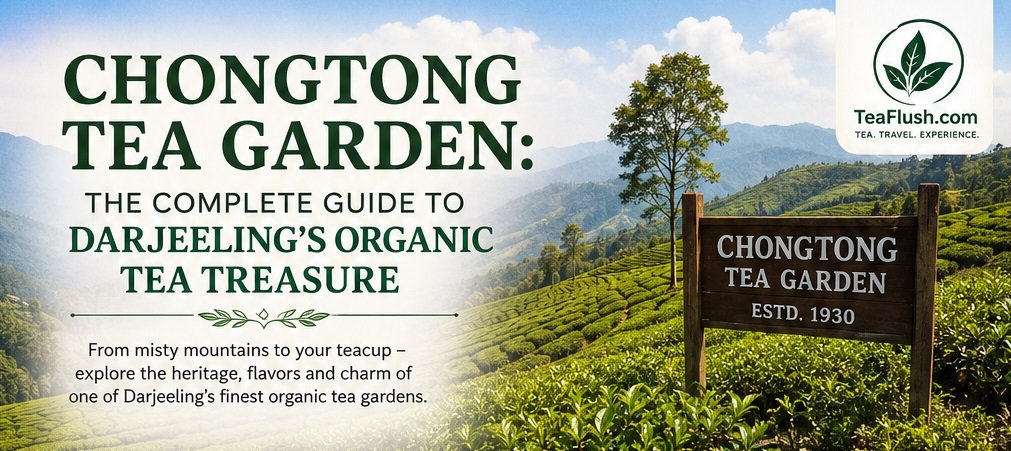
Chongtong Tea Garden: The Complete Guide to Darjeeling’s Organic Tea Treasure
Tucked into a steep, sun-warmed slope above the Rangeet River, Chongtong Tea Garden is one of Darjeeling’s most distinctive tea estates — equal parts working plantation, living village, and quiet Himalayan retreat. If you’ve ever sipped a cup of Darjeeling tea with a soft muscatel finish and wondered where that character comes from, gardens like Chongtong are exactly where the story begins.
In this guide, we’re covering everything there is to know about Chongtong Tea Garden: its 19th-century origins, how it became a fully organic estate, the cultivars that define its flavor, and what it’s actually like to visit. Whether you’re a tea enthusiast researching your next purchase or planning a trip to the Darjeeling hills, this is your complete reference.
Table of Contents
Where Is Chongtong Tea Garden?
Chongtong Tea Garden sits in the Darjeeling Pulbazar block of the Darjeeling Sadar subdivision, in the Indian state of West Bengal. It lies near Bijanbari and Pulbazar, about 13 km from Darjeeling town, and roughly 78 km from Siliguri, making it accessible as both a day excursion from Darjeeling and a stop on a longer hill circuit.
Geographically, the estate occupies dramatic terrain. Elevations in the area range from around 1,000 to 1,800 meters above sea level, with the tea garden itself reaching up to approximately 1,768 meters, a height that gives the slopes natural drainage for the region’s heavy monsoon rainfall. The Rangeet River flows nearby, adding to the picturesque setting, while neighboring estates like Badamtam and Ging frame the wider tea-growing belt. On clear days, the elevated slopes offer panoramic views of the Kangchenjunga range, the world’s third-highest peak.
Administratively, Chongtong is also recognized as a populated place in its own right. It is registered as a census town in the Darjeeling Pulbazar CD block of the Darjeeling Sadar subdivision, and according to the 2011 District Census Handbook, it covers an area of 6.81 square kilometers.
A Garden Named by the Lepchas
Long before it became a tea estate, this land had a different name and a different purpose. The garden was originally inhabited by the local Lepcha community and was known as “Chun Thang,” a name in the Lepcha dialect. Over time, that name evolved into “Chongtong,” the name the estate carries today — a small but meaningful link to the region’s indigenous heritage that predates the British tea boom in Darjeeling.
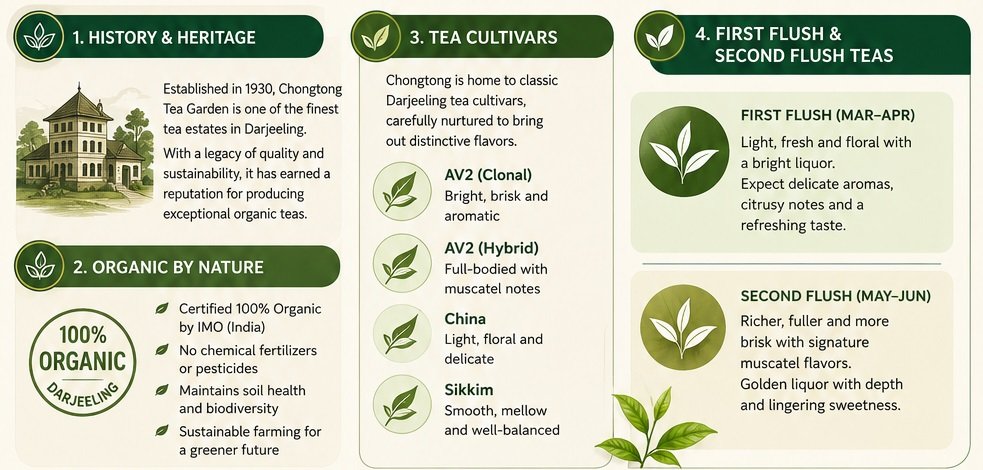
The History of Chongtong Tea Estate
Chongtong’s story as a commercial tea garden stretches back over 140 years, and its ownership history reads almost like a chronicle of Darjeeling’s tea industry itself.
The estate was established between 1882 and 1883 by James T., and it remained under British management for decades. In 1954, it changed hands for the first time when it was purchased by Pradeep Kumar Daga, who managed the garden until 1979. The years that followed saw a flurry of short-term ownership changes:
- A brief period of management under Chiryamar, lasting about two years
- A single year of management by Jhunjhunwala
- In 1983, the garden was acquired by Ajit Kumar Agarwal, who managed it for over two decades, until 2006
- In 2007, the estate was finally sold to Sunil Kumar Bansal and Amit Bansal
Since that 2007 sale, Chongtong has been part of a larger, well-known group. It is now managed under Darjeeling Organic Tea Private Limited, alongside the group’s other Darjeeling tea gardens, which include Ambootia, Happy Valley, Monteviot, Moondakotee, Mullootar, Nagri, Noorbong, Sepoydhurah (Chamling), Sivitar, Rangmook Cedar, Rangaroon, Pandam, and Aloobari. This group is one of the pioneers of organic and biodynamic tea cultivation in the region, and Chongtong’s conversion to organic methods fits squarely into that broader mission.
The Three Divisions of Chongtong
One of the more interesting structural features of Chongtong Tea Garden is that it isn’t a single uniform plantation — it’s split into three distinct divisions, each occupying a different elevation band on the slope:
- Salabari — the upper division
- Chiyasi — the middle division
- Sirisi Tar — the lower division
These three divisions follow the picturesque slope where the Rangeet River runs through the garden, and each has its own microclimate and cultivar mix, which contributes to subtle variations in the leaf even within the same estate.
Organic Cultivation and Tea Cultivars
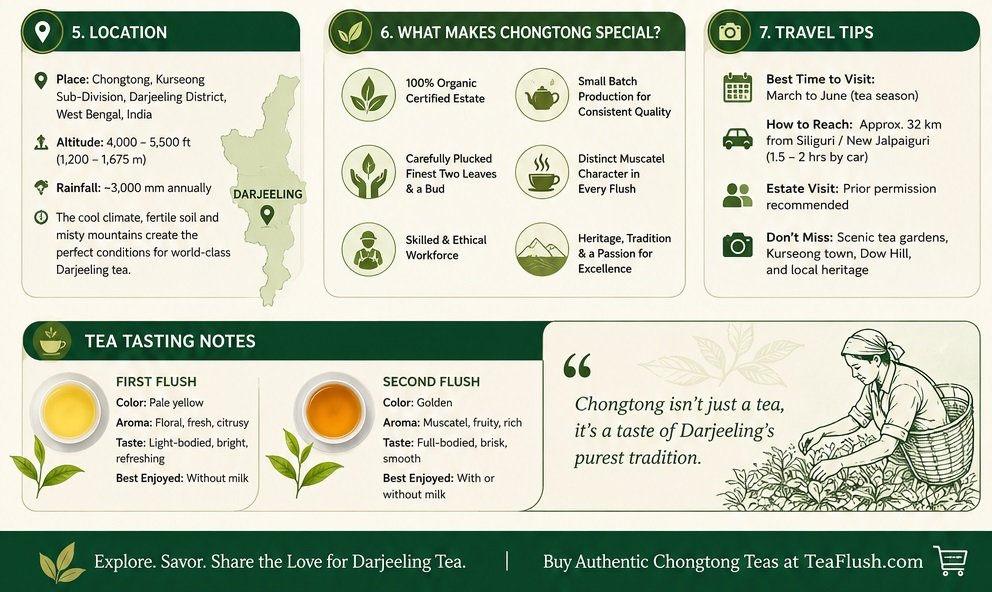
Chongtong is fully committed to organic farming. The teas from this garden are 100% bio-organic, grown without synthetic pesticides or chemical fertilizers — a practice that, according to ecological surveys of the area, plays a key role in preserving soil microbial diversity and fostering a balanced ecosystem across the 960-acre garden.
In terms of plant material, the estate grows a mix of cultivars:
- China clone bushes — the most popular cultivar at Chongtong, dominating the Sirisi Tar division, with some bushes reportedly over 100 years old
- P312 clonal bush — grown on about 4 acres of the estate
- Nanda Devi clone — also grown on roughly 4 acres
- Assam clone — present in smaller quantities alongside the China and clonal varieties
Of the estate’s 960 acres of cultivable land, the vast majority is given over to the old-growth China variety, with the clonal varieties occupying a much smaller, specialized footprint. On average, Chongtong produces about 1.75 lakh kilograms of tea annually — a figure echoed consistently across census and industry records.
What Makes Chongtong Tea Special
Darjeeling tea is often called the “Champagne of Teas,” and gardens like Chongtong are a big part of why that reputation holds up. The region’s high altitude, temperate climate, fertile soil, and the skill of local growers combine to produce the distinct muscatel flavour and refreshing aroma Darjeeling tea is known for worldwide.
At Chongtong specifically, the most sought-after teas are the first flush and second flush harvests:
- First Flush Tea (spring harvest): Light, floral, and delicate — picked from the season’s first tender new growth, typically in March and April.
- Second Flush (summer harvest): Fuller-bodied with the deeper muscatel character Darjeeling is famous for, usually harvested in late May and June.
Production follows the traditional orthodox method rather than the faster CTC (crush-tear-curl) process used for mass-market teas. This means hand-plucked leaves go through careful withering, rolling, oxidation, and firing — a slower, more labor-intensive process, but one that preserves the nuanced character that makes orthodox Darjeeling tea so prized by connoisseurs.
Visiting Chongtong Tea Garden
For travelers, Chongtong offers something a little different from the more commercialized tea estates closer to Darjeeling town: an authentic, working tea garden experience without the crowds.
What to Expect
Visitors who’ve made the trip describe strolling through the open gardens to get a real sense of how tea is cultivated and processed, with the best views of the lush green plantation often found by walking down below the main roadside. Several visitors also mention a fun, hands-on detail: you can pluck a tender tea leaf straight off the bush and chew it raw to experience the flavor firsthand.
One practical perk worth knowing before you pack: Chongtong tends to be noticeably warmer than other parts of Darjeeling, so heavy winter clothing usually isn’t necessary, even when the rest of the hill station is chilly.
A Word of Caution
Honesty matters here. Several visitor reviews flag the road conditions leading to and within the estate as quite poor, so it’s worth budgeting extra travel time and choosing a sturdy vehicle if you’re driving yourself or hiring a local taxi.
Where to Stay
For travelers who want more than a day trip, tea tourism retreats have sprung up around the estate. Packages typically include pickup from NJP Railway Station or Bagdogra Airport, a stay at a property overlooking the Chongtong tea gardens, guided walks through the plantation, and side trips to nearby Darjeeling attractions such as the Peace Pagoda, Tenzing Rock, the Dali Monastery, and the Padmaja Naidu Himalayan Zoological Park.
Chongtong Tea Garden: Quick Facts
| Detail | Information |
|---|---|
| Location | Pulbazar Block, Darjeeling Sadar Subdivision, West Bengal, India |
| Established | 1882–1883 |
| Founder | James T. |
| Current Owner/Manager | Darjeeling Organic Tea Pvt. Ltd. (since 2007) |
| Total Area | 960 acres (390 hectares) |
| Annual Production | ~1.75 lakh kg |
| Farming Method | 100% bio-organic |
| Main Cultivars | China clone, P312, Nanda Devi, Assam clone |
| Divisions | Salabari (upper), Chiyasi (middle), Sirisi Tar (lower) |
| Elevation | Up to ~1,768 meters |
| Distance from Darjeeling | ~13 km |
| Distance from Siliguri | ~78 km |
| Signature Teas | First flush, second flush (orthodox) |
Why Tea Lovers Should Know This Garden
For anyone building out a genuine appreciation of Darjeeling tea — not just the famous big-name estates, but the broader landscape that gives the region its character — Chongtong deserves a place on the list. It combines a long, layered ownership history, a genuine organic farming commitment, old-growth China clone bushes that have survived more than a century of changing hands, and a setting dramatic enough to rival any postcard of the Himalayas.
Whether you’re sourcing it for your tea collection or planning to walk its slopes in person, Chongtong is a reminder that great Darjeeling tea is never just about the cup — it’s about the hillside, the history, and the hands that shape every flush.
Looking for more deep dives into Darjeeling’s finest tea estates? Explore the rest of the TeaFlush.com tea garden guides to plan your next cup — or your next trip into the hills.
What type of tea is grown at Chongtong Tea Garden?
Chongtong is recognized for producing high-quality organic Darjeeling tea, including specialty varieties like traditional black tea, green tea, and white tea.