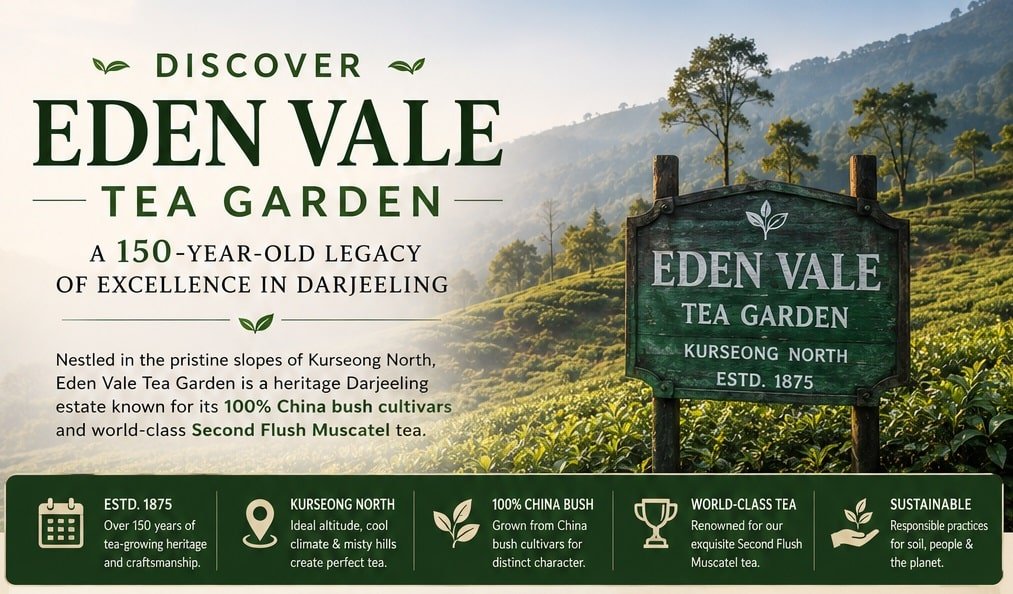
Eden Vale Tea Garden: The Hidden Gem of Kurseong’s Tea Country
Published on TeaFlush.com | Category: Darjeeling Tea Estates | Reading Time: ~10 minutes
“Nestled in the misty slopes of Kurseong, Eden Vale Tea Garden is more than a tea estate — it is a living legacy, where 100% China bush cultivars produce some of the most exquisite second flush Darjeeling tea money can buy.”
Table of Contents
1. Introduction to Eden Vale Tea Garden
Among the 87 registered tea estates that dot the lush hills of Darjeeling, Eden Vale Tea Garden stands out as a quiet titan — modest in profile, extraordinary in cup. While names like Makaibari, Castleton, and Margaret’s Hope dominate conversations among global tea connoisseurs, Eden Vale occupies a special, almost mythic, niche in the Darjeeling tea world.
Located in the Kurseong North sub-division of Darjeeling district, West Bengal, India, this estate is celebrated above all for its 100% China bush cultivars — the most prized genetic heritage in the world of Camellia sinensis cultivation. The result? A second flush Darjeeling tea so refined, so complex, and so deeply flavoured that even experienced tea planters have described it in near-reverential terms.
If you are a true tea lover — someone who reads labels, savours flushes, and understands why terroir matters — then Eden Vale Tea Garden deserves a permanent spot on your radar, and ideally, in your teacup.
2. Location and Geography
Eden Vale Tea Garden is situated in the Kurseong North region, one of the most important tea-growing sub-divisions within the broader Darjeeling hills. Kurseong itself is a hill station town in the Darjeeling district of West Bengal, positioned approximately 30 kilometres south of Darjeeling town, at an elevation of around 1,500 metres (4,900 ft) above sea level.
Kurseong: The Land of the White Orchid
Kurseong is often called the “Land of the White Orchid” — a name that evokes the pristine, forested landscapes that cradle many of Darjeeling’s finest estates. The town sits in the Eastern Himalayan foothills, and its distinctive microclimate — cool mountain mist, ample monsoon rainfall, afternoon cloud cover, and well-drained acidic loamy soils — creates near-perfect conditions for growing premium Darjeeling tea.
The Kurseong North belt is home to several distinguished estates, including:
- Ambootia Tea Garden (renowned for biodynamic certification)
- Balasun Tea Garden
- Dilaram Tea Garden
- Margaret’s Hope Tea Garden (a world-famous muscatel benchmark)
- Moondakotee Tea Garden
- Oaks Tea Garden
- Ringtong Tea Garden
- Springside Tea Garden
- And of course, Eden Vale Tea Garden
This cluster of gardens benefits from shared altitude, shared cloud cover, and a shared tradition of orthodox tea craftsmanship. Yet each estate, thanks to subtle variations in slope, soil composition, and bush genetics, produces a tea distinctly its own.
3. History and Origins
Founded in 1870 by Mr. Kerr
Eden Vale Tea Garden traces its establishment to 1870, when a planter known as Mr. Kerr developed the estate in the Kurseong hills. This places Eden Vale squarely within the golden age of Darjeeling tea expansion — a period when entrepreneurs, colonial officers, and botanists were transforming the Himalayan foothills into one of the most celebrated tea-producing regions on Earth.
The broader history of Darjeeling tea itself began a few decades earlier. Dr. Archibald Campbell, working with the East India Company, is credited with planting Camellia sinensis seeds in Darjeeling as early as 1841. By 1852, the first commercial tea gardens — Tukvar, Steinthal, and Aloobari — had been established. By 1866, there were 39 functioning tea gardens; by 1874, that number had risen to over 100, with the total cultivated area approaching 6,000 hectares.
Eden Vale emerged during this expansionary wave, and its foundation was guided by a simple, prescient choice: to plant only China-variety bushes. This decision, now over 150 years old, defines the garden’s exceptional character to this day.
From Kerr to Goodricke
Like many Darjeeling estates, Eden Vale passed through various phases of ownership over the decades following Indian Independence in 1947. It is now managed under the umbrella of the Goodricke Group, one of India’s most respected tea conglomerates, which also manages iconic estates like Castleton, Margaret’s Hope, and Thurbo.
4. Elevation and Terroir
Eden Vale Tea Garden is planted at an elevation ranging from approximately 1,066 metres to 1,358 metres (3,500 to 4,455 feet) above sea level. This mid-to-high altitude range is a critical factor in the tea’s quality.
Why Elevation Matters in Darjeeling Tea
In the world of Darjeeling tea, altitude is everything. The higher and cooler the growing conditions, the slower the tea bush grows — and slower growth means:
- Greater concentration of aromatic compounds
- More complex flavour development
- A naturally finer, more nuanced leaf structure
- Enhanced muscatel character in the second flush
Darjeeling tea gardens as a whole range between 600 and 2,000 metres in elevation, and Eden Vale’s 1,066–1,358 metre range places it in an ideal sweet spot — high enough for premium character, yet accessible enough for consistent year-round cultivation and processing.
Soil, Mist, and Microclimate
The soils at Eden Vale, as across Kurseong’s North belt, are slightly acidic and rich in organic material — a natural byproduct of the subtropical and wet temperate forests that historically covered these slopes. The Eastern Himalayan geography creates a rhythm of dry winters (November–February) followed by heavy monsoon rains (July–September), with the most valuable growing periods falling in the spring and early summer flushes.
The afternoon cloud cover — a near-daily feature at these elevations — acts as a natural diffuser of sunlight, slowing oxidation in the leaf and encouraging the development of the delicate aromatic compounds that define great Darjeeling tea.
5. The China Bush Legacy
If there is one feature that sets Eden Vale apart from the majority of Darjeeling tea gardens, it is this: 100% China bush cultivars.
What Are China Bushes?
The tea plant, Camellia sinensis, exists in two primary botanical varieties:
- Camellia sinensis var. sinensis — the China variety, smaller-leaved, cold-hardy, and naturally adapted to high-altitude, temperate growing conditions.
- Camellia sinensis var. assamica — the Assam variety, larger-leaved, suited to warmer, lower-altitude conditions, used widely for robust, full-bodied CTC teas.
In Darjeeling, the China variety (often called “Chinary” by local planters) was the original cultivar introduced by the British and is prized above all others for the quality, delicacy, and aromatic complexity it produces. However, over the decades, many gardens have introduced hybrid clones and assamica varieties to boost yield. A garden that retains 100% China bushes is, therefore, extraordinarily rare.
Eden Vale is one of those rare gardens.
The China bushes at Eden Vale are not just any variety — they are heritage-age plants, descendants of the original genetic stock planted in the 1870s. Old-growth China bushes yield lower quantities than younger or hybrid plants, but the cup they produce is in a different league altogether: refined, complex, and endlessly layered.
6. Tea Flushes at Eden Vale
Like all Darjeeling estates, Eden Vale produces tea across four distinct seasonal harvests, each with its own character and market appeal.
🌱 First Flush (March – May)
The First Flush — the earliest harvest after the tea plant’s winter dormancy — produces the most delicate leaves of the year. At Eden Vale, the China bush heritage lends the first flush a particularly light, floral, and subtly astringent character. The dry leaf is greenish, sometimes almost silvery, and the infusion is a pale golden hue. Aromas of fresh grass, white flowers, and a gentle citrus note are typical.
The First Flush is best enjoyed without milk, allowing the delicate flavours to express themselves fully.
☀️ Second Flush (May – June)
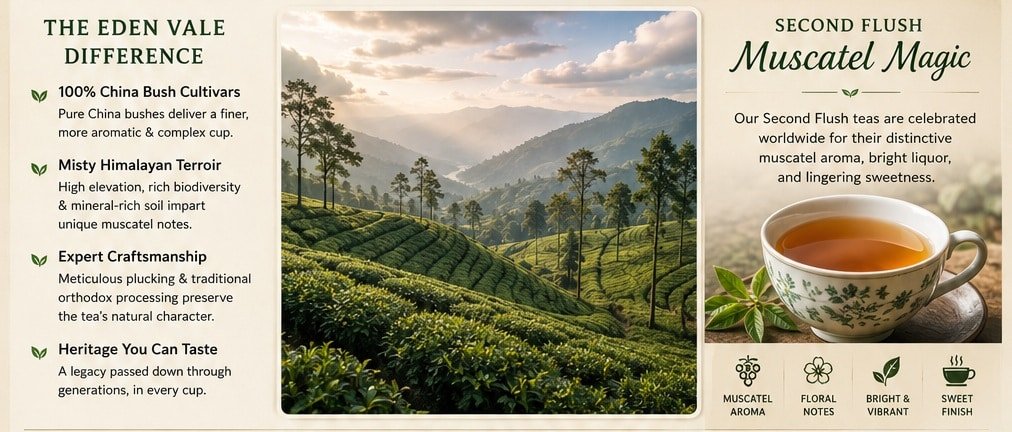
The Second Flush is where Eden Vale truly earns its legendary status. This is the harvest for which the garden is most celebrated, and which draws tea buyers from across Europe, Japan, and North America.
In Darjeeling, the second flush is defined by the famous muscatel character — a distinctive, fruity, wine-like flavour reminiscent of Muscat grapes. This flavour develops as a result of the tea plant being naturally “attacked” by a small leafhopper insect (Empoasca flavescens), which triggers the plant to release defensive compounds, initiating a partial oxidation of the leaf. The result, counterintuitively, is one of the most desirable flavours in the tea world.
At Eden Vale, with its 100% China bushes, the muscatel development is described as exceptional — nuanced, deep, and layered, without the heaviness of lower-altitude or hybrid-plant teas. Former Margaret’s Hope manager “Bingo” is famously quoted:
“The tea made from the 100% China bushes is a treat for tea lovers. Their Second Flush Tea is to die for and is by far the best quality Darjeeling tea that money can buy.”
🌧️ Monsoon Flush (July – September)
The Monsoon Flush produces larger, faster-growing leaves during the heavy rains. The resulting tea is generally fuller-bodied and less aromatic — often used for blending or the domestic market. At Eden Vale, some of this production may be processed as green tea, which requires less withering and no oxidation, and can preserve the freshness of the leaf despite the wet conditions.
🍂 Autumnal Flush (October – November)
The Autumnal Flush — sometimes called the “second autumn” — produces a herbaceous, fuller-bodied tea with a muted muscatel character and deeper amber colour. While less celebrated than the second flush, autumnal Eden Vale teas are prized for their warmth and roundness, offering a satisfying cup as temperatures cool across the Himalayas.
7. Taste Profile and Tasting Notes
Eden Vale Second Flush — Detailed Tasting Notes
| Attribute | Description |
|---|---|
| Dry Leaf Appearance | Wiry, dark brown-green leaves with occasional silver tips; classic orthodox Darjeeling appearance |
| Aroma (Dry) | Floral, slightly spicy, with hints of ripe stone fruit |
| Infusion Colour | Deep amber-gold to copper |
| Aroma (Wet Leaf) | Rich and complex — muscatel grapes, fresh hay, subtle floral undertones |
| Flavour | Full muscatel character with fruity sweetness; stone fruit, dried apricot, and a hint of wild honey; finishes clean and lingering |
| Mouthfeel | Smooth, medium-bodied, with a gentle astringency that coats the palate pleasantly |
| Aftertaste | Long and refined; a signature of high-quality China bush cultivars |
Best Brewing Method for Eden Vale Tea
- Water Temperature: 90–95°C (do not use boiling water — it scalds the delicate leaf)
- Tea Quantity: 2–2.5 grams per 150ml of water
- Steep Time: 2.5 to 3.5 minutes for first steep
- Vessel: White porcelain or glass gaiwan to best observe the liquor colour
- Milk/Sugar: Neither — this tea is best enjoyed pure and unadulterated
8. Eden Vale Under the Goodricke Group
Eden Vale Tea Garden is operated under the management of the Goodricke Group — a name synonymous with quality and consistency in the Indian tea industry. Founded in 1977 and headquartered in Kolkata, Goodricke manages a premium portfolio of Darjeeling and Dooars tea estates.
Under Goodricke’s stewardship, some of the most iconic Darjeeling estates have flourished, including:
- Castleton Tea Estate — widely regarded as the source of the finest muscatel Darjeeling in the world
- Margaret’s Hope Tea Estate — the benchmark for second flush muscatel character
- Thurbo Tea Estate — known for its striking clonal teas
- Badamtam Tea Estate — known for vibrant first flush offerings
Goodricke brings consistent investment in factory infrastructure, quality control, and orthodox processing methods — ensuring that the hand-plucked leaves from Eden Vale’s heritage China bushes are processed with the care and precision they deserve.
9. Maharani: The Out-Division of Margaret’s Hope
A fascinating chapter in Eden Vale’s administrative history: the estate is also known by the name “Edenvale / Maharani”, and is currently managed as an out-division of Margaret’s Hope Tea Estate.
Margaret’s Hope Tea Estate — one of Darjeeling’s most storied gardens — lends its management infrastructure to Eden Vale/Maharani, meaning the expertise of Goodricke’s planters is directly applied to overseeing the cultivation and processing of Eden Vale’s remarkable harvest.
This arrangement speaks to the esteem in which Eden Vale’s bushes are held. Rather than merging production or sacrificing quality, Goodricke has chosen to maintain Eden Vale as a distinct entity, preserving the provenance and character of its 100% China bush teas while benefitting from the managerial excellence of Margaret’s Hope.
10. How Eden Vale Compares to Other Kurseong Estates
| Feature | Eden Vale | Margaret’s Hope | Makaibari | Castleton |
|---|---|---|---|---|
| Sub-Region | Kurseong North | Kurseong North | Kurseong South | Kurseong South |
| Established | 1870 | 1930s (renamed) | 1859 | 1885 |
| Bush Type | 100% China | Primarily China | Organic China | China + Clonal |
| Signature Flush | Second Flush | Second Flush | All Flushes | Second Flush |
| Known For | Muscatel, heritage China bushes | Muscatel benchmark | Biodynamic, organic | Premium muscatel lots |
| Management | Goodricke (via Margaret’s Hope) | Goodricke | Swaraj Tea | Goodricke |
| GI Certified | Yes | Yes | Yes | Yes |
While Margaret’s Hope is the household name and Makaibari captures headlines for biodynamic pioneering, Eden Vale offers something arguably more pure: an undiluted expression of what Darjeeling’s original China bush heritage tastes like, grown in ideal Kurseong North conditions, with minimal commercial fanfare.
11. Where to Buy Eden Vale Tea
Finding genuine, single-estate Eden Vale Darjeeling tea requires going beyond supermarket shelves. Here are the best approaches:
Trusted Sources
- Speciality Darjeeling tea retailers who stock single-estate, flush-labelled teas and can confirm garden provenance (look for “Goodricke” or “Margaret’s Hope division” on labels).
- Tea auction platforms — Kolkata’s Calcutta Tea Auction Centre handles many premium Darjeeling lots.
- Direct from Goodricke Group — their official channels sometimes carry estate-specific selections.
- Premium online tea boutiques in Europe, Japan, and the US that specialize in Darjeeling origin teas often stock Eden Vale second flush lots during the summer harvest window (typically available June–August each year).
What to Look For on the Label
When buying Eden Vale tea, look for:
- ✅ Garden name: Eden Vale (sometimes listed as “Edenvale” or “Eden Vale Maharani”)
- ✅ Flush designation: Second Flush (for the best expression)
- ✅ GI (Geographical Indication) logo — the woman holding two leaves and a bud
- ✅ Harvest year
- ✅ Orthodox processing indication
Avoid teas labelled simply “Darjeeling blend” — these are often blended from multiple gardens and bear no resemblance to single-estate Eden Vale character.
12. Visiting Kurseong: A Tea Lover’s Guide
Kurseong is a spectacular destination for tea tourism and offers a deeply immersive way to experience the world of Darjeeling tea — including estates like Eden Vale.
Getting to Kurseong
- By Rail: The Darjeeling Himalayan Railway (UNESCO World Heritage Site) connects Kurseong to New Jalpaiguri (NJP) and Darjeeling. The “Toy Train” journey through the tea gardens is itself a bucket-list experience.
- By Road: Kurseong is accessible by shared jeep or taxi from Siliguri (approximately 2 hours), NJP, or Darjeeling town.
- Nearest Airport: Bagdogra Airport, approximately 40–45 km from Kurseong.
What to Do in Kurseong
- Tea Garden Walks: The Kurseong North estates are criss-crossed with walking trails. Watching skilled women tea pluckers move through rows of lush China bushes in early morning mist is an unforgettable sight.
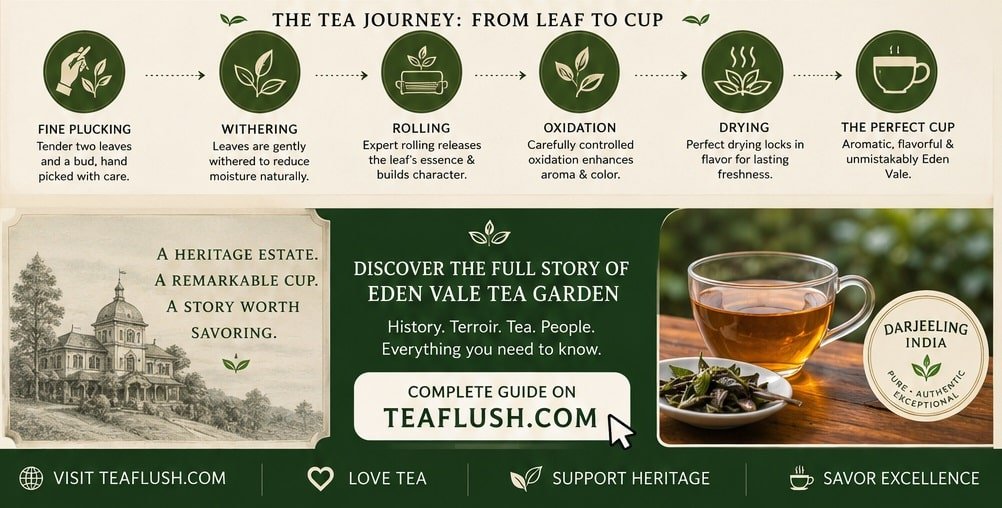
- Factory Visits: Several Kurseong estates open their orthodox processing factories to visitors during flush season (March–October). Witnessing the withering, rolling, oxidation, and drying process firsthand is a tea education in itself.
- Tea Tasting Sessions: Arrange cupping sessions through estate managers or local tea guides. Tasting a fresh Second Flush directly at elevation is an experience that transforms how you understand Darjeeling tea.
- Nature and Birding: Kurseong’s forested slopes are home to over 130 documented bird species, orchid farms, and spectacular views of Kanchenjunga on clear mornings.
Best Time to Visit for Tea
| Season | Flush | What You’ll Experience |
|---|---|---|
| March–April | First Flush | Bud break, plucking of the first tender leaves, the garden at its most vibrant green |
| May–June | Second Flush | Peak muscatel season; the most exciting time for tea lovers |
| July–September | Monsoon Flush | Dramatic monsoon landscape; lower tourist footfall |
| October–November | Autumnal Flush | Crisp Himalayan air, golden light, the final harvest before winter dormancy |
13. FAQs About Eden Vale Tea Garden
Q: Where exactly is Eden Vale Tea Garden located?
Eden Vale Tea Garden is located in the Kurseong North sub-division of Darjeeling district, West Bengal, India. It sits at an elevation of approximately 1,066 to 1,358 metres above sea level.
Q: When was Eden Vale Tea Garden established?
Eden Vale was established in 1870 by a planter named Mr. Kerr, making it a 150+ year-old heritage estate.
Q: What makes Eden Vale tea special?
Eden Vale is one of the few Darjeeling gardens that cultivates 100% China bush (Camellia sinensis var. sinensis) cultivars — the original, heritage-variety tea plants that produce the finest, most aromatic, and most complex Darjeeling teas. Its Second Flush in particular is considered exceptional.
Q: What does Eden Vale tea taste like? Eden Vale Second Flush Darjeeling is known for a deep muscatel character, with notes of ripe stone fruit, dried apricot, wild honey, and a long, refined aftertaste. It is smooth, medium-bodied, and exquisitely fragrant.
Q: Who manages Eden Vale Tea Garden? Eden Vale is managed by the Goodricke Group, one of India’s leading tea companies. It functions as an out-division of Margaret’s Hope Tea Estate within Goodricke’s Darjeeling portfolio.
Q: Is Eden Vale tea GI certified? Yes. Like all authentic Darjeeling teas, Eden Vale teas carry the Geographical Indication (GI) certification — the first GI tag ever issued for an Indian product — which guarantees their provenance and authenticity.
Q: Which flush is best from Eden Vale? The Second Flush (May–June harvest) is Eden Vale’s most celebrated offering, prized for its exceptional muscatel character derived from the garden’s 100% China heritage bushes.
Q: Can I visit Eden Vale Tea Garden? Directly visiting Eden Vale may require arrangements through Goodricke or local tea tour operators based in Kurseong. The broader Kurseong North tea belt is accessible to visitors and several nearby estates offer tours and tastings.
14. Final Sip: Why Eden Vale Deserves a Place in Your Teacup
In a world awash with generic “Darjeeling blends” and supermarket teabags bearing the name of the Himalayan hills with none of their soul, Eden Vale Tea Garden represents something rare and precious: the uncompromised expression of what Darjeeling tea was always meant to be.
From the original 1870 planting by Mr. Kerr to the 100% China bush heritage that remains intact today, from the ideal Kurseong North elevation and microclimate to the skilled hands that pluck the Two Leaves and a Bud with the care of craftspeople — every cup of Eden Vale Darjeeling is a conversation with history.
Its Second Flush is, by the testimony of seasoned tea planters and connoisseurs alike, among the finest expressions of muscatel character available from any estate in the world. It is not the loudest name in the valley. It is, arguably, the purest voice.
At TeaFlush.com, we believe that great tea begins with knowing where your cup comes from. Eden Vale Tea Garden is one of those origin stories worth knowing deeply — and tasting often.
You Might Also Enjoy Reading:
- Margaret’s Hope Tea Estate: The Complete Guide
- Darjeeling Flushes Explained: First, Second, Monsoon & Autumnal
- What Is Muscatel Darjeeling Tea?
- The 87 Darjeeling Tea Estates: A Complete Map and Guide
- China Bush vs. Clonal Tea: What’s the Difference?
© TeaFlush.com | All content is original and crafted with love for the world of tea. Last updated: 2026.
Meta Title: Eden Vale Tea Garden: History, Tea, Flushes & Complete Guide | TeaFlush.com
Meta Description: Discover Eden Vale Tea Garden — a 150-year-old Darjeeling estate in Kurseong North famed for its 100% China bush cultivars and world-class second flush muscatel tea. Complete guide on TeaFlush.com.
Focus Keyword: Eden Vale Tea Garden
Secondary Keywords: Eden Vale Darjeeling tea, Eden Vale Maharani, Kurseong North tea estates, Darjeeling second flush, China bush Darjeeling, Goodricke tea estates, Darjeeling muscatel tea, Eden Vale tea garden history