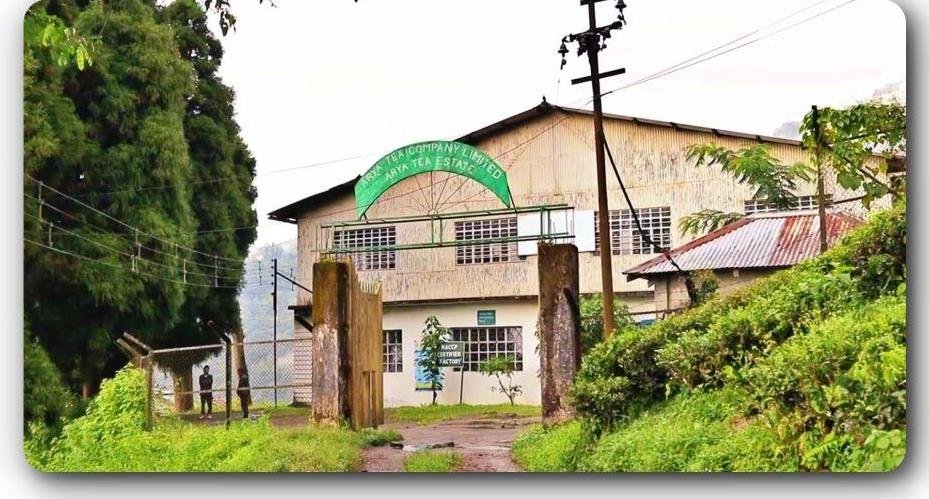
Published on TeaFlush.com | Your Complete Tea Resource
There is a moment every spring, just before dawn, when nine to ten skilled pluckers gather on the highest slopes of a 125-hectare garden on the outskirts of Darjeeling. The air smells of jasmine. The bushes still carry the night’s dew. The Himalayan darkness has not yet lifted. And these workers are doing something that requires more patience and skill than almost any other act of tea production anywhere in the world: harvesting the leaves for Arya Pearl — one of the rarest, most delicate, and most exquisitely crafted white teas on earth.
Nine to ten people working side by side can produce only one kilogram of this tea. A single person could produce a kilogram of the estate’s standard black tea in the same time. That is the scale of difference. That is what rareness actually means.
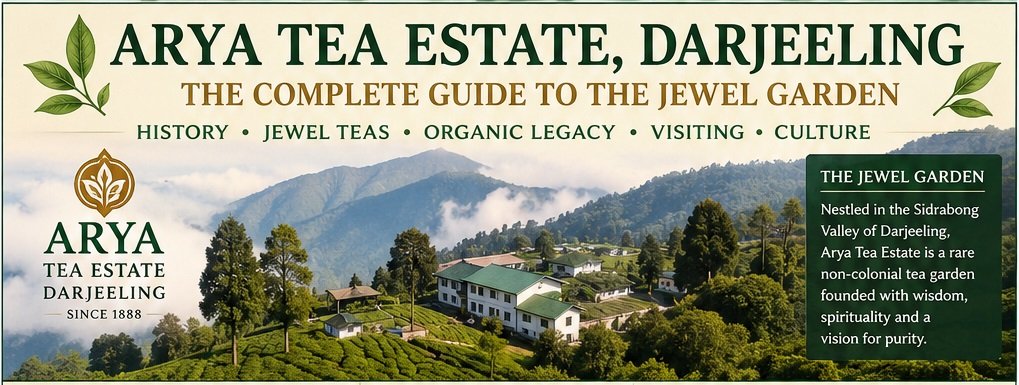
Arya Tea Estate is not a typical Darjeeling garden. It is one of only two non-colonial tea estates among Darjeeling’s 87 certified gardens — rooted in a founding story involving Buddhist monks, Sanskrit nomenclature, and a spiritual encounter with a hillside of extraordinary purity. It produces what may be the most creative and diverse range of specialty teas of any estate in Darjeeling: five jewel-named teas — Ruby, Diamond, Emerald, Pearl, and Topaz — each representing a completely different tea type, each produced with specific clonal cultivars from the highest sections of the garden, each sold in limited quantities to connoisseurs around the world.
Table of Contents
“Tea is Happiness” — so said the Arya Monk, leader of the founding monks of Arya Tea Estate. At TeaFlush, we believe that the story behind the tea is as worth knowing as the tea itself. So here — in complete detail — is everything about Arya Tea Estate, Darjeeling.
What Does “Arya” Mean?
The name Arya carries profound significance across multiple layers of etymology and culture.
Arya is a word from the ancient language Sanskrit which means “respected.” It could be assumed to have derived from and also relating indirectly to the word Aryan, a group of prehistoric people who spoke proto-Indo-European, a Caucasian group of Nordic descent which flourished in the Northern Gangetic plains.
In the Buddhist tradition from which this estate’s founding monks came, the term “Arya” holds specific spiritual meaning — referring to one who has attained a level of spiritual awakening or nobility. An Arya being is one who has seen the truth. It is not a casual word. For monks steeped in Buddhist philosophy and practice, naming their garden and their tea “Arya” was a statement of spiritual aspiration: a tea of the highest, most refined, most truthful quality.
The secondary name, Sidrabong, is the estate’s other identity — an older name rooted in the local landscape, still used interchangeably with Arya by those who know the garden’s full history. The head monk was known by that name, so the group of monks used the name Arya and Sidrabong to refer to the garden, interchangeably.
Quick Reference: Arya Tea Estate at a Glance
| Detail | Information |
|---|---|
| Full Name | Arya Tea Estate (also: Sidrabong Tea Estate) |
| Name Meaning | Sanskrit: “respected,” “noble” — also the name of the founding head monk |
| Established | 1885 (formal commercial establishment) |
| Original Name | Sidrabong |
| Location | Darjeeling Pulbazar CD block, Darjeeling Sadar subdivision, Darjeeling district, West Bengal, India |
| Position | West Darjeeling area, outskirts of Darjeeling town |
| Coordinates | 27°02′37″N 88°14′21″E |
| Altitude Range | 900 to 1,820 metres (2,950 to 5,970 feet) above sea level |
| Average Altitude | ~1,500 metres (4,921 feet) |
| Total Area | 125 hectares (310 acres) under tea |
| Annual Production | ~70 metric tons (70,000 kg) |
| Ownership | Arya Tea Company Ltd. (KPL International / Eurasia Group — taken over 2008) |
| Previous Ownership | Duncans Brothers (Walter and William Duncan) from 1885 |
| Garden Manager | Subashish (Subhasis) Roy |
| Tea Bush Composition | ~60% China bush, plus AV2 clonal on highest sections |
| Organic Certification | USDA Organic (IMO Control), IMO, JAS (Japan) |
| Other Certifications | Darjeeling Tea Association member, Darjeeling GI Certified |
| Tea Types | Black, green, white, oolong (all organic) |
| Famous Teas | The Jewel Collection: Ruby, Diamond, Emerald, Pearl, Topaz |
| Historical Landmark | Original monk’s dwelling house still preserved on the estate |
| Tourism | Arya Tea Resort — 2-storey boutique stay with Kanchenjunga views |
Part 1: The Legend of Arya — The Buddhist Monk Origin Story

The Monk Who Found Paradise
As the legend goes, a monk who was believed to possess extraordinary spiritual powers chanced upon a hill and was left speechless by its purity. He looked all around and felt a sense of elation, for what he saw was a stunning expanse of beautiful hills being nurtured and caressed by the freshness of the wind.
This moment of spiritual encounter — a monk, alone on a hillside, overwhelmed by the purity and beauty of the place — is the founding myth of Arya Tea Estate. Whether it is literal history or the kind of elevated storytelling through which all great things come to be understood, it captures something true about this garden: that the people who first cultivated this land were motivated not by commercial logic but by something closer to reverence.
More importantly, it made him realize that he was about to give shape to what had for long been brewing in his mind — a unique flavor of tea that would have no parallel anywhere else in the world. The monk was already revered for his Chinese seed development skills, and here he was — at gates of Paradise, about to discover a flavor divine.
The monk was skilled in the cultivation of Chinese tea varieties — the small-leafed Camellia sinensis var. sinensis plants that would go on to define Darjeeling tea’s finest character. He was, in other words, both a spiritual practitioner and a skilled agriculturalist. The combination of those two qualities — devotion and technical mastery — is reflected in the estate’s tradition of producing teas of exceptional purity and craft.
The Monks Study the Land
The monks did not rush. They were, after all, practitioners of a tradition that measured wisdom in years of patient practice, not weeks of commercial urgency.
They studied in great detail the nature of soil, topography and the weather pattern for years till the right conditions were identified. The hard work yielded rich results as the flavor surpassed their expectations. Hence was born an exceptional brew — inimitable and unmatched till today.
This multi-year study of soil, slope, and weather before planting a single bush is the kind of commitment to understanding the land that produces genuinely exceptional tea. The monks were not simply finding a place to plant — they were learning a place deeply enough to know exactly what kind of tea it could produce.
The Name “Arya Monk” and the Legacy
The “Sidrabong” gardens were thus established by the monks in the 19th century and the legendary formula was passed over, giving us “Arya Monk” Bio-Organic Certified Darjeeling Tea.
The head monk’s name was Arya — or was known by that name — and the entire tradition of the garden passed through him into the modern estate. Today, the estate’s founding “Arya Monk” Bio-Organic Certified Darjeeling Tea is a direct invocation of that lineage: a tea that carries, in its name and in its cultivation philosophy, the monks’ commitment to purity, quality, and reverence for the land.
The legendary garden still preserves the house in which the monks dwelled back in the 1800s. This original monk’s dwelling — still standing on the estate today — is one of the most historically significant structures in all of Darjeeling’s tea landscape. It is a physical, visible connection to the founding moment of the garden, preserved not as a museum piece but as a living part of the estate’s identity.
Part 2: The Full History of Arya Tea Estate
Pre-1885: The Monk’s Garden (Early 19th Century)
The Buddhist monks who first cultivated this hillside did so in the early 19th century — decades before the formal establishment of the commercial tea estate. Their cultivation was guided by spiritual principles and traditional knowledge of Chinese tea varieties, not by the commercial imperatives that would eventually transform the Darjeeling hills into one of the world’s great tea-producing regions.
During this pre-commercial period, the garden was known as Sidrabong — the monks’ name for the place — and the tea produced there was consumed within the monastic community and shared within the local spiritual network.
1885: The Duncan Brothers and Commercial Establishment
When the Scottish brothers Walter and William Duncan (founders of the agricultural company Duncans) took it over in 1885 as the population of aged monks thinned, they called the tea cultivated there Arya Monk tea. Ultimately, the garden would be called Arya Tea Estate.
Walter and William Duncan — founders of Duncans Industries, one of the significant colonial-era agricultural enterprises in India — formalised and expanded the garden in 1885 as a commercial tea estate. They retained the name Arya from the founding monks, and the tea they produced under their management was marketed as “Arya Monk Tea” — explicitly invoking the Buddhist founding legacy as a quality signal.
This transition from monastic garden to commercial estate under the Duncans marks 1885 as the formal founding year — the date recorded in all official registrations and certifications. The monks did not disappear immediately; their population simply thinned as the aged monks passed and the commercial operation expanded.
The Buddhists are mostly gone now, and Gorkhas, generations removed from the original migrants to British Darjeeling, populate the villages around the tea estate.
The Non-Colonial Distinction
Here is the historical fact that places Arya in exceptional company: Arya Tea Estate is one of only two non-colonial tea gardens out of the 87 operating today in Darjeeling district.
While the Duncan brothers’ commercial takeover in 1885 brought British involvement, the founding origin of the garden — and the tradition, knowledge, and even the name it carried — was entirely pre-colonial, Indian, and Buddhist. The monks who developed the land, studied the terroir, planted the Chinese tea seeds, and created the foundational cultivation approach that defines Arya today were not colonial agents. They were local spiritual practitioners acting from reverence for the land and a desire to create something exceptional.
This non-colonial origin gives Arya a unique cultural and historical standing among Darjeeling’s estates — similar in this respect to Giddapahar, the other non-colonial estate, though with a very different founding story.
2008: KPL International / Eurasia Group
This organic tea estate has been taken over by the KPL International group in 2008. The tea estate operates under the Eurasia Group and is located in west Darjeeling area.
The KPL International / Eurasia Group acquisition in 2008 brought professional corporate management to the estate while maintaining its organic certification and distinctive specialty tea character. The plantation spreads across 125 hectares and starting at an altitude of 1,820 meters spreads down to 900 meters with an average of 1,500 meters. Producing 70 tons annually, Arya tea is a prolific producer and exporter of the finest range of black tea and the delicate varieties of green tea.
The Garden Manager: Subashish Roy
Garden Manager Roy says that at another garden, he might be contemplating retirement, but he credits the intensity of feeling for the garden of his boss, RK Bansal, with his staying on. “I am here because of his passion,” Roy says. Roy is no stranger to the tea industry, having “made his bones” at the Chamong Group, learning at the side of tea baron Ashok Lohia. “It takes a few years to really know a garden — each section has its own distinct character, and it takes time to familiarise oneself with each area.”
This quote from Subashish Roy captures something essential about what makes Arya exceptional at the operational level: the garden is managed by someone who stays not for convenience but for genuine love of the place, working for an owner whose passion is the motivating force. This kind of commitment — from the CEO down to the garden manager — is what produces teas that consistently exceed expectations.
Part 3: Geography and Terroir
Location: The Outskirts of Darjeeling Town
Arya Tea Estate is located in the outskirts of Darjeeling Town. More specifically, it sits within the Darjeeling Pulbazar community development block, in the western area of Darjeeling Sadar subdivision — on the slopes between Darjeeling town and the Rangeet River valley below.
This location of Arya Tea Estate is close to Darjeeling town, accessible but genuinely high-altitude — makes Arya one of the most accessible premium estates for visitors who are already in Darjeeling. Nearby tea estates include Happy Valley and the Lebong and Mineral Spring Tea Estate.
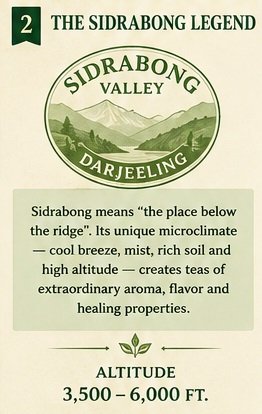
Altitude: 900 to 1,820 Metres
The elevation od Arya Tea Estate, ranges from 900 to 1,820 m (2,950 to 5,970 ft) above sea level. The average altitude is approximately 1,500 metres (4,921 feet) — firmly in the high-altitude zone that defines premium Darjeeling tea character.
This wide altitude range — spanning nearly 1,000 metres from the lowest to highest sections — creates multiple micro-terroirs within a single estate. Each elevation zone experiences subtly different temperature patterns, mist exposure, UV intensity, and growing conditions:
- Lower sections (900–1,200 m): Warmer temperatures, fuller-bodied teas, more robust character — used for the estate’s standard grades and first flush black teas
- Mid sections (1,200–1,600 m): The sweet spot for complex, aromatic Darjeeling — the majority of the estate’s standard production
- Highest sections (1,600–1,820 m): The most prized growing zones — cooler, mistier, more UV-intense — where the AV2 clonal cultivars for the Jewel Collection are exclusively planted
Few gardens can boast the elevation of Arya Tea Estate, which is a key element of raising such aromatic cultivars. Other factors include the mineral-rich terroir and rolling mist that bathes the leaves in moisture.
The Mineral-Rich Himalayan Terroir
The soils at Arya Tea Estate are the classic Darjeeling Himalayan loam — acidic, well-drained, and rich in minerals from the underlying rock formations of the Himalayan foothills. This mineral-rich substrate is a defining element of the Arya terroir: it contributes a clean, crystalline quality to the teas that is distinctly different from lower-altitude or non-Himalayan growing environments.
The mineral-rich terroir and rolling mist that bathes the leaves in moisture create a growing environment that the monks first encountered as a “paradise” — and which continues, 140+ years later, to produce teas that justify that description.
The AV2 Clonal Advantage for Jewel Collection Teas
All five teas in the Jewel Collection — Ruby, Diamond, Emerald, Pearl, and Topaz — are produced from special clonal tea bushes planted on the highest sections of the garden.
All Jewel teas are produced with special clonal tea bushes mainly AV2 varietal planted on the highest point of the garden.
The AV2 (Ambari Vegetative 2) clonal cultivar was developed specifically for high-altitude Darjeeling growing conditions. It is one of the most prestigious clonal varieties in Indian tea production, known for producing:
- Exceptionally large, downy buds with high tip content
- High EGCG and L-theanine concentrations
- Pronounced muscatel and floral aromatic development
- Excellent adaptation to cool, high-altitude conditions
Planting AV2 exclusively on the highest, most demanding sections of Arya’s terrain ensures that the Jewel Collection teas are as concentrated, complex, and aromatic as the garden’s terroir can produce.
Part 4: Organic Certification — A Commitment to Purity
The Organic Transformation
It produces around 70 tons of tea annually, 30 tons less than before the estate became organic.
This statistic tells the full story of what organic certification means at the operational level. Arya’s conversion to fully organic farming reduced annual production by 30 metric tons — a significant commercial sacrifice. The choice to accept lower yields in exchange for organic integrity reflects both the estate’s founding philosophy (the monks’ reverence for the purity of the land) and its positioning as a premium specialty producer.
Quality over quantity. Always.
Certifications Held
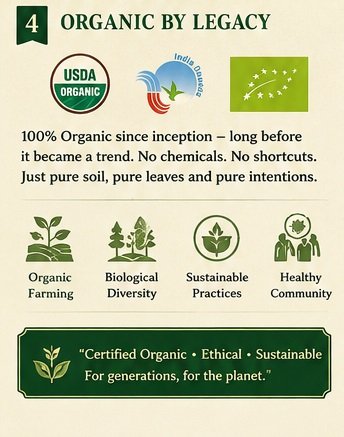
Arya Tea Estate does business as Arya Tea Co. Ltd., Kolkata and its operations are certified USDA Organic by IMO Control. The other Organic certifications are by IMO and JAS.
| Certification | Body | Market Access |
|---|---|---|
| USDA Organic | IMO Control (Swiss) | United States, global |
| IMO Organic | Institute for Marketecology (Switzerland) | EU, Switzerland, global |
| JAS Organic | Japan Agricultural Standard | Japan — one of Darjeeling’s largest premium markets |
| Darjeeling GI | Tea Board of India | Authenticated Darjeeling provenance |
| Darjeeling Tea Association | DTA | Industry certification, quality standards |
The combination of USDA, IMO, and JAS certifications is notably comprehensive — covering three of the world’s most stringent organic markets simultaneously. This tri-certification signals that Arya’s organic practices are not simply compliant with one standard but rigorously verified by multiple independent international bodies.
Part 5: The Jewel Collection — Arya’s Five Signature Teas
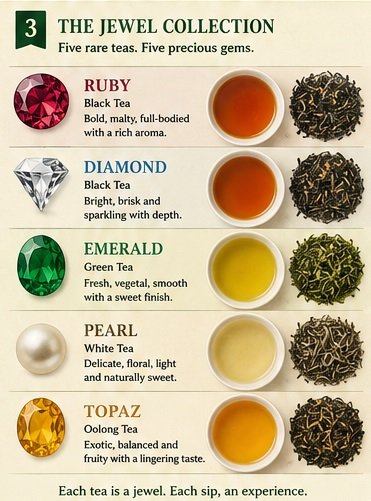
The five teas of Arya’s Jewel Collection are the estate’s most distinctive and celebrated contribution to Darjeeling’s tea landscape. Each tea is named for a precious stone, produced from AV2 clonal cultivars on the highest garden sections, made in limited quantities, and represents a completely different tea type. Together, they showcase the full spectrum of what a single extraordinary terroir can produce.
It also has a range of its own jewels — Ruby (Black Tea), Emerald (Green Tea), Pearl (White Tea), Diamond (Chunky Tips) and Topaz (Oolong).
💎 Arya Diamond — The Estate’s First Flush Crown Jewel
Type: Black tea (first flush) | Grade: SFTGFOP1 | Cultivar: AV2 clonal | Season: Spring
The estate’s premier first flush bears the name “Arya Diamond.” Diamond is the highest-expression first flush tea at Arya — produced from the most select AV2 clonal leaves from the uppermost garden sections, graded at SFTGFOP1 (Super Finest Tippy Golden Flowery Orange Pekoe, Grade 1), and sold in limited quantities that sell out quickly each spring.
2025 Production Notes: During the 2025 harvest, Mr. Roy, the estate manager, graciously shared a variety of classic grades. Among them, Invoice EX-35 stood out during tasting sessions. This 2025 Floral FTGFOP1 First Flush tea captures the true essence of traditional Darjeeling, offering the bright, brisk, floral notes that connoisseurs cherish.
Dry Leaf Appearance: Fairly bold, rolled and green open leaves with silver tips. The leaves are large — reflecting the AV2 cultivar’s characteristically generous bud size — with abundant silver and golden tips that indicate the high proportion of young buds in the blend.
Infusion Color: Pale yellow. In a glass cup, the Diamond liquor glows with a delicate, luminous gold — startlingly pale for those expecting the darker colour of conventional black tea, but perfectly characteristic of a lightly oxidized AV2 first flush.
Aroma: The brew saturates the nose with a symphony of floral notes. White flower, orchid, jasmine, and a clean mountain freshness — an aroma that fills the room immediately upon pouring.
Flavor: A taste with a complex mixture of fruits and flowers. This first flush tea is bright in appearance and full body. Each sip is deliciously fruity which reminds of ripe mangoes, peach and sweet raisins.
The infusion brews a very mellow and soothing cuppa that has floral elements and a very soothing flavour with wafting aroma.
Its body goes down silky smooth. Carrying the sense of a garden in a cup, it is truly a “Champagne” among teas.
Mouthfeel: Silky, smooth, full-bodied for a first flush — the AV2 cultivar and high altitude combine to create a tea of unusual concentration and presence.
Best enjoyed: Plain, without milk. At 85–88°C for 2–2.5 minutes.
💎 Arya Ruby — The Second Flush Jewel
Type: Black tea (second flush) | Cultivar: AV2 clonal | Season: Summer
Ruby is Arya’s second flush signature — the summer harvest expression of the same AV2 high-altitude terroir, with full oxidation bringing out the muscatel and fruity depth that makes Darjeeling’s summer teas legendary.
Experience the depth of Darjeeling summer tea with its delightful sweet and fruity notes.
Character: Fresh taste reminiscent of chamomile. Floral and fruity aroma (grape and peach). Sweet and silky on the palate. A classic, elegant 2nd flush.
The chamomile note is distinctive and specific to Ruby — a warm, honey-chamomile quality that sits alongside the more expected muscatel grape and peach. This combination of familiar and unexpected aromas is what makes Ruby a collector’s second flush rather than simply a good summer Darjeeling.
Dry Leaf: Dark, fully oxidized leaves with abundant golden tips from the AV2 cultivar — classically beautiful second flush appearance.
Liquor: Deep amber to copper-gold — rich and luminous.
Aroma: Grape, peach, chamomile, warm honey, floral depth.
Flavor: Sweet, fruity, silky — full muscatel character with a smooth, lingering finish.
Best enjoyed: Plain or with a very small amount of milk. At 90–95°C for 3–4 minutes. Pairs beautifully with rich desserts, dried fruit, and dark chocolate.
💎 Arya Emerald — The Jewel Collection Green Tea
Type: Green tea | Grade: FTGFOP1 | Cultivar: China bush + AV2 | Season: Spring
The Arya Estate produces a beautifully worked green tea with a fragrant infusion and refined flavour profile. Smooth, aromatic, and naturally uplifting.
Arya’s Emerald green tea is produced by stopping oxidation immediately after rolling — halting the enzymatic transformation that would otherwise produce black or oolong tea. At 1,500 metres average altitude with the Himalayan mist and cool temperatures of the Darjeeling spring, the green tea produced at Arya has a character quite different from Japanese or Chinese green teas.
Dry Leaf Appearance: FTGFOP1-grade leaf from the historic Arya Estate. Long, twisted green leaves with silver tips — elegant and visually distinctive.
Liquor: A light golden-green liquor. Pale, luminous, and clear — the colour of spring water in the Himalayas.
Aroma: A clean, floral aroma and a gently brisk character.
Flavor: This is easily the most complex green tea — with layers and layers of flavor that were an absolute treat. It has the highlights of green tea, high-mountain oolong, and young sheng pu-erh all in one cup. This thing just kept transforming and becoming more nuanced literally with EVERY SIP.
A smooth body with subtle grassy notes, delicate fruitiness, and a lasting, fragrant finish.
Arya Emerald has inspired some of the most effusive praise of any green tea on review platforms — specifically for its extraordinary complexity and transformative quality through multiple infusions.
Best enjoyed: Plain, without milk. At 75–80°C for 1.5–2 minutes. Multiple infusions strongly recommended — each infusion reveals a different dimension.
💎 Arya Pearl — The Rarest Treasure
Type: White tea (entirely handcrafted) | Cultivar: AV2 clonal | Season: Spring (earliest harvest)
Arya Pearl is the estate’s — and arguably one of Darjeeling’s — most extraordinary teas. It is produced in such limited quantities, with such labour-intensive handcraft, and with such extraordinary care for the raw material that it occupies a category almost unto itself.
The Harvest: This White Tea is crafted entirely by hand, with no machinery of any kind used at any step of the production. The rarity and delicacy of this tea begins at the time of harvest. Handpicked just before dawn, when there is still dew on the bushes and the scent of jasmine fills the air, only the most delicate buds and young leaves are plucked.
Harvesting is thorough, requiring nine to ten pickers to produce a kilo of this supreme quality. To understand the degree of skill involved, a single person can produce a similar amount of black tea in the same area.
This ratio — nine to ten pluckers for one kilogram — is one of the most extreme labour-to-yield ratios in any tea production. It reflects how selective and careful the harvest must be: only the youngest, smallest, most downy buds, plucked before the morning sun opens and changes the leaf, one at a time, by hand.
Zero Machinery: Every step of Arya Pearl’s production is done by human hands. No rolling machine. No mechanical dryer. No automated sorting. The monks who founded this estate valued purity — and in Pearl, that founding value is expressed in the most literal possible way: no machine has ever touched this tea.
Dry Leaf Appearance: Typically selected from two of the youngest leaves and a bud, though greenish, they are covered in silvery-white fibers. The silver-white down that covers the young buds gives Pearl its name — and its visual beauty.
Liquor: The liquor is bright and almost clear — an ivory appearance that gives off just the slightest tint of gold.
Aroma: Nestled on the steep slopes of Darjeeling, with a breathtaking view of the majestic Mount Kanchenjunga, where the golden rays of sunrise gently kiss the tea plants. The aroma reflects this setting: pure, honeyed, jasmine-touched, and extraordinarily clean.
Flavor: Arya Pearl is a hand-crafted artisanal tea that is made in very small quantities — offered at their highest price for most ardent connoisseurs. The flavor is delicate, sweet, floral — all the characteristics of the AV2 bud at its most unprocessed, expressing the 1,820-metre terroir in its purest form.
Best enjoyed: At 75–80°C for 3–5 minutes. No milk. No sugar. Multiple infusions (3–4) warmly rewarded.
💎 Arya Topaz — The Oolong Jewel
Type: Oolong (semi-oxidized, 30–60%) | Cultivar: AV2 clonal | Season: Spring/Summer | Made to order
Arya Topaz is an oolong tea made to order for buyers. The leaves used are long, and the semi-oxidation of the leaves leave it with a light flavor and clean character.
Arya Topaz is the most unusual tea in the Jewel Collection — and in some ways the most forward-looking. Oolong is not a traditional Darjeeling tea type; it is the processing approach of Taiwan and southern China. But the specific combination of Arya’s AV2 cultivar at high altitude, with its natural muscatel and floral tendency, creates an oolong of genuine distinction.
The semi-oxidation — stopped at between 30% and 60% depending on the specific lot — captures the tea in a state between Emerald (green) and Ruby (black), combining the floral freshness of the former with the fruity depth of the latter.
Character:
- Liquor: Gold to amber — warmer and deeper than Emerald, lighter and more luminous than Ruby
- Aroma: Floral, honeyed, light muscatel — the characteristic Arya AV2 aromatics expressed in oolong form
- Flavor: Light, clean, complex — the characteristic “light flavor and clean character” that Roy describes
- Finish: Long, floral, slightly fruity
Made to Order: Topaz is not produced speculatively and held in inventory — it is made on specific order from buyers who request it. This production model ensures maximum freshness and allows for customisation of the oxidation level to specific buyer requirements.
Best enjoyed: At 85–90°C for 2–3 minutes. No milk. Multiple infusions (4–5) excellent.
Part 6: Beyond the Jewels — Arya’s Full Tea Range
In addition to the five Jewel Collection teas, Arya produces an extensive range of standard Darjeeling teas that represent the estate’s broader production.
Classic First Flush (SFTGFOP1 / FTGFOP1)
Arya’s standard first-flush black teas — produced from China-variety bushes across the mid-altitude sections of the garden — offer the classic Darjeeling spring character at various grades.
Nestled near Darjeeling town and spread over 125 hectares, Arya Tea Estate is one of the highest elevation tea gardens in the region, comparable to estates like Risheehat. Known for its commitment to organic farming and heritage processing methods, Arya produces both rare artisan teas and consistently exceptional seasonal harvests.
2025 First Flush: The 2025 Arya Classic First Flush delivers exactly what the season promises: A very fine new season 2025 organic spring tea from the renowned Arya estate in Darjeeling. The infusion brews a very mellow and soothing cuppa that has floral elements and a very soothing flavour with wafting aroma.
Arya Jasmine — The Floral Blend
Arya mixes jasmine flower with its green tea to make “Arya Jasmine,” a refreshing tea with a heavy fragrance of the flower.
Arya Jasmine combines the estate’s Emerald-style green tea with dried jasmine petals — a pairing that amplifies the natural floral tendency of the high-altitude Darjeeling leaf with the direct, heady perfume of jasmine. The result is a tea for those who want maximum floral intensity with the health benefits of green tea.
Arya Rose — The Petal Blend
They also mix rose petals with black tea to make “Arya Rose.”
Arya Rose takes the estate’s black tea — the Ruby-style richness of the second flush — and adds dried rose petals. The resulting brew combines the malty-fruity depth of summer Darjeeling black tea with the romantic, sweet fragrance of rose. A particularly appealing option for those new to Darjeeling who want a more accessible, aromatic introduction to the estate’s character.
Seasonal Flush Range
| Flush | Character | Best For |
|---|---|---|
| First Flush (March–April) | Light, floral, pale gold, lightly oxidized | Connoisseurs, spring ritual, morning focus |
| Second Flush (May–June) | Muscatel, fruity, copper-gold, full-bodied | Depth seekers, afternoon tea, wine lovers |
| Monsoon Flush (July–Sept) | Bold, earthy, dark amber — lower in premium | Everyday drinking, chai base |
| Autumnal Flush (Oct–Nov) | Warm, nutty, smooth — quiet complexity | Evening tea, autumn/winter warmth |
Part 7: The Tea Production Process at Arya
Plucking
All teas at Arya are hand-plucked — standard is “two leaves and a bud” for the classic range, with even finer selective plucking for the Jewel Collection teas. Plucking is done by skilled workers — predominantly women — who walk the steep high-altitude slopes early in the morning when leaf moisture and temperature are optimal.
For Pearl: handpicked just before dawn, when there is still dew on the bushes and the scent of jasmine fills the air, only the most delicate buds and young leaves are plucked.
Withering
After plucking, fresh leaves are spread on withering troughs with airflow below and above. For first flush teas, Arya uses a “hard wither” — a longer, more thorough moisture reduction that develops the aromatic precursors of the floral first flush character. For Emerald green tea, withering is brief and immediately followed by heat treatment to stop oxidation.
Rolling and Oxidation
Orthodox rolling machines break the cell walls of the withered leaves, releasing the polyphenol oxidase enzymes that drive oxidation. For the Jewel Collection black teas (Ruby, Diamond), oxidation is carefully monitored — stopped at the precise moment when the desired floral, fruity character has developed.
For Emerald (green) and Pearl (white), oxidation is either minimised (green) or essentially absent (white). For Topaz (oolong), oxidation is stopped at the partial stage — between 30% and 60%.
For Pearl: No machinery of any kind used at any step of the production. The white tea process is entirely manual — hand-withering on cloth or wicker trays, hand-rolling or simply laying flat to dry, no mechanical input at any stage.
Firing and Drying
High heat applied at the desired oxidation level deactivates the enzymes permanently and removes residual moisture. For first flush teas, lighter firing preserves the volatile aromatic compounds. For second flush, fuller firing at higher temperature develops the malty depth.
Sorting and Grading
After drying, teas are sorted by size and quality through vibrating mesh sieves. This produces the leaf grades (SFTGFOP1, FTGFOP1, etc.) that appear on packaging. The finest lots — most abundantly tipped, most consistently sized — are reserved for the Jewel Collection names.
Part 8: Leaf Grades and What They Mean at Arya
| Grade | Full Name | Arya Application |
|---|---|---|
| SFTGFOP1 | Super Finest Tippy Golden Flowery Orange Pekoe, Grade 1 | The absolute pinnacle — reserved for the finest Diamond and Ruby lots |
| FTGFOP1 | Finest Tippy Golden Flowery Orange Pekoe, Grade 1 | Premium standard for first flush and select seasonal lots |
| TGFOP1 | Tippy Golden Flowery Orange Pekoe, Grade 1 | High quality, good tip content — accessible premium range |
| FTGFOP | Finest Tippy Golden Flowery Orange Pekoe | Mid-range excellent quality |
| BOP | Broken Orange Pekoe | Fannings grade — used for blending and export |
Key note on Arya grades: Because the estate produces entirely organic tea, even its standard FTGFOP1 and TGFOP1 grades carry the USDA/IMO/JAS organic certifications — an additional quality marker beyond the leaf grade alone.
Part 9: How to Brew Arya’s Jewel Collection Teas
Each Jewel tea requires a different brewing approach that matches its processing and character.
Brewing Arya Diamond (First Flush Black)
| Parameter | Guidance |
|---|---|
| Water | Fresh, filtered — soft mineral content |
| Temperature | 85–88°C (never boiling) |
| Quantity | 2.5–3 g per 200 ml |
| Steep time | 2–2.5 minutes |
| Vessel | Clear glass — to see the pale gold liquor develop |
| Milk | Never |
| Infusions | 2–3 excellent infusions |
Brewing Arya Ruby (Second Flush Black)
| Parameter | Guidance |
|---|---|
| Temperature | 90–95°C |
| Quantity | 2.5–3 g per 200 ml |
| Steep time | 3–4 minutes |
| Milk | Optional — small amount works |
| Infusions | 2 good infusions |
Brewing Arya Emerald (Green Tea)
| Parameter | Guidance |
|---|---|
| Temperature | 75–80°C |
| Quantity | 2 g per 200 ml |
| Steep time | 1.5–2 minutes |
| Milk | Never |
| Infusions | 3–4 infusions — each reveals new dimensions |
Brewing Arya Pearl (White Tea)
| Parameter | Guidance |
|---|---|
| Temperature | 75–80°C |
| Quantity | 3–4 g per 200 ml (white tea is less dense) |
| Steep time | 3–5 minutes |
| Milk | Never |
| Infusions | 3–5 infusions — extraordinary depth develops |
Brewing Arya Topaz (Oolong)
| Parameter | Guidance |
|---|---|
| Temperature | 85–90°C |
| Quantity | 3 g per 200 ml |
| Steep time | 2–3 minutes |
| Milk | Never |
| Infusions | 4–6 infusions — oolong blooms over multiple steepings |
Part 10: Visiting Arya Tea Estate — The Arya Tea Resort
The tea estate has a 2-storied resort available for stay with glass walls in the lounge providing view of the Kanchenjunga range. The resort also has a lawn for tourists to enjoy tea from the estate along with the view of the 300 acres of the tea estate.
The Arya Tea Resort is one of the most distinctive accommodation options in the Darjeeling hills — a two-storey boutique stay set within the working tea garden, with panoramic views of both the tea terraces and the Kanchenjunga massif on clear days.
The Glass-Walled Lounge
The resort’s most celebrated feature is its lounge with glass walls — offering unobstructed, panoramic views of the Kanchenjunga range and the tea garden sloping below. Nestled on the steep slopes of Darjeeling, with a breathtaking view of the majestic Mount Kanchenjunga, where the golden rays of sunrise gently kiss the tea plants. Watching the Himalayan sunrise from this glass-walled lounge, with a freshly brewed cup of Arya Diamond in hand, is one of the finest tea experiences available anywhere in India.
What to Experience at Arya
Tea Garden Walks Walk through 125 hectares of organic tea gardens at altitudes from 900 to 1,820 metres. Guides can explain the difference between China bush and AV2 clonal cultivars, show the difference between sections that will produce Diamond and sections that produce the standard first flush, and point out the original monk’s dwelling that still stands on the estate.
Factory Tour Visit Arya’s processing factory and watch the entire orthodox tea production sequence — withering, rolling, oxidation, firing, and sorting. The tour is particularly valuable for understanding the difference in processing between the Jewel Collection teas (especially Pearl’s entirely handmade production) and the standard grades.
The Original Monk’s House The legendary garden still preserves the house in which the monks dwelled back in the 1800s. This historic structure — one of the oldest surviving buildings associated with Darjeeling’s tea history — is a must-see for anyone interested in the estate’s extraordinary origin story.
Tasting Session Arya is identified for its farming methods and tea processing methods. The estate offers tasting experiences that allow visitors to compare teas across the flush calendar, across the Jewel Collection, and across different grades — an education in terroir and processing that no amount of reading fully replicates.
The Garden Lawn The resort also has a lawn for tourists to enjoy tea from the estate along with the view of the 300 acres of the tea estate. Sitting on the lawn with a pot of freshly brewed Arya Pearl or Diamond, looking out over the garden where those leaves were picked that morning, is the ideal conclusion to a tea tourism experience.
How to Get There
By Air: The hill station of Darjeeling in West Bengal has Bagdogra as its nearest airport (95 km away). Bagdogra operates regular flights from some of the major Indian cities like New Delhi, Kolkata and Darjeeling. Once at the airport, one can hire taxis or cabs to make it to the hill station.
By Train: The nearest major railway station is New Jalpaiguri (NJP), approximately 80–90 km from Darjeeling. Regular train services connect NJP to Kolkata, Delhi, and other major cities. From NJP, taxis and shared jeeps operate to Darjeeling town (~3–3.5 hours).
The famous Darjeeling Himalayan Railway (Toy Train) — a UNESCO World Heritage Site — connects NJP to Darjeeling in approximately 7–8 hours, a scenic journey worth experiencing in its own right.
From Darjeeling Town: Arya Tea Estate is on the outskirts of Darjeeling town — easily accessible by taxi or on foot from central Darjeeling. The estate is close to Happy Valley Tea Estate, making a combined visit to both gardens in a single day practical.
Best Seasons to Visit:
| Season | Why Visit |
|---|---|
| March–April (First Flush) | Watch Diamond and Pearl production; experience the spring awakening of the garden |
| May–June (Second Flush) | Ruby production; maximum lushness; warmest conditions |
| October–November (Autumnal) | Clear skies; Kanchenjunga views at their best; quieter visitor numbers |
| December–February | Winter dormancy; misty, atmospheric; off-season pricing at the resort |
Part 11: Where to Buy Arya Tea Estate Teas
Trusted Retailers (India)
- Golden Tips Tea — estate-direct sourcing with DJ lot transparency; stocks 2025 Arya first flush teas including Spring Diamond
- Thunderbolt Tea — specialist Darjeeling retailer with direct relationship with garden manager Roy and access to specific invoiced lots
- Teabox — reliable online platform with estate-direct sourcing and freshness tracking
- Vahdam Teas — internationally accessible platform with Arya estate teas including Emerald green tea
International Retailers
- Sans & Sans (Spain) — stocks Arya Diamond second flush with full provenance
- True Tea Company (UK) — stocks Arya Emerald FTGFOP1 organic green tea
- Specialist Darjeeling importers in Germany, Japan, the US, and Switzerland
Authenticity Checklist
When purchasing Arya Tea Estate teas, verify:
- ✅ Estate name: Explicitly states “Arya Tea Estate” or “Arya Tea Garden, Darjeeling”
- ✅ Organic certification logos: USDA Organic, IMO, JAS — at least one should be present
- ✅ Darjeeling GI mark — the Tea Board of India certification
- ✅ Flush and year — First Flush / Second Flush + harvest year
- ✅ DJ Invoice number — for premium and estate-direct purchases (e.g., DJ 12, EX-35)
- ✅ Leaf grade — SFTGFOP1, FTGFOP1 etc. stated clearly
Part 12: Arya Tea Estate’s Place Among Darjeeling’s Greatest Gardens
Arya is a specialty tea estate. They cultivate only high-quality leaf for connoisseurs and tourist boutiques in Darjeeling town.
This deliberate positioning — specialty quality over volume, connoisseurs over mass market — places Arya in a specific and distinguished tier of Darjeeling’s 87 gardens. It is not trying to be Castleton (famous for muscatel volume and prestige), or Makaibari (the organic pioneer on a grand scale), or Giddapahar (the family estate with a century-old Birmingham machine). It is something specifically its own: a Buddhist-founded, monk-named, organically certified garden with a global reputation built on five jewel-named specialty teas and a founding story that connects it to a deeper spiritual relationship with the land than any purely commercial estate can claim.
Its exclusive offerings command a premium every season.
The combination of extraordinary founding myth, rigorously certified organic practice, AV2 high-altitude clonal cultivation, and the creative genius of the Jewel Collection makes Arya Tea Estate one of the most genuinely irreplaceable estates in Darjeeling’s landscape.
Frequently Asked Questions About Arya Tea Estate
Q: Who founded Arya Tea Estate?
Arya Tea Estate was founded by a group of Buddhist monks who cultivated Chinese tea seeds on this hillside beginning in the early 19th century. They called the garden “Sidrabong” — named after the head monk, known as Arya. When the Scottish brothers Walter and William Duncan took over in 1885 as the population of aged monks thinned, they formalised it as the commercial Arya Tea Estate.
Q: What does “Arya” mean?
Arya is a word from ancient Sanskrit meaning “respected” or “noble.” It also refers to the name of the founding head monk of the estate. The monks practised Ayurvedic sciences, and the Sanskrit name reflects their spiritual and philosophical approach to the land and tea cultivation.
Q: What is the Jewel Collection at Arya Tea Estate?
The Jewel Collection comprises five specialty teas: Ruby (Black Tea), Emerald (Green Tea), Pearl (White Tea), Diamond (Chunky Tips/First Flush Black), and Topaz (Oolong). All are produced from AV2 clonal cultivars planted on the highest sections of the garden and sold in limited quantities.
Q: What is Arya Pearl white tea? Arya Pearl is a white tea crafted entirely by hand, with no machinery used at any step of production. It is handpicked just before dawn when there is still dew on the bushes. Nine to ten pickers are required to produce one kilogram — versus one person for the same amount of standard black tea.
Q: What altitude is Arya Tea Estate? The elevation ranges from 900 to 1,820 m above sea level, with an average elevation of approximately 1,500 metres.
Q: Is Arya Tea Estate organic? Yes. Arya Tea Estate’s operations are certified USDA Organic by IMO Control, with additional certifications by IMO and JAS (Japan). The estate produces approximately 30 metric tons less per year since converting to organic farming — a deliberate commercial sacrifice for quality and certification integrity.
Q: Can I visit Arya Tea Estate? Yes. The estate has a 2-storied resort available for stay with glass walls in the lounge providing a view of the Kanchenjunga range, and a lawn for tourists to enjoy tea from the estate. It is located on the outskirts of Darjeeling town, making it easily accessible for day visits or overnight stays.
Q: What is the best Arya Tea to try first? For those new to Arya, the Arya Diamond First Flush (spring) is the ideal introduction — the estate’s most celebrated tea, with the floral complexity and mellow depth that fully represents what makes Arya exceptional. For maximum rarity and uniqueness, Arya Pearl is the once-in-a-lifetime cup.
Q: How many types of tea does Arya Estate produce? Arya produces a full range including Black Tea, Green Tea, White Tea, and Oolong — across four flush seasons, in standard grades (SFTGFOP1, FTGFOP1, TGFOP1, BOP) and the five Jewel Collection specialty teas. Additionally, the estate produces flavoured blends including Arya Jasmine and Arya Rose.
The TeaFlush Perspective: What Arya Teaches Us About Tea
There is a particular quality in Arya Tea Estate that no other garden in Darjeeling quite replicates.
It is the quality of intention.
The monks who first came to this hillside were not looking for a commercial opportunity. They were looking for paradise — and they found it. They spent years studying the soil and the weather before planting a single seed. They named their garden and their tea after their most respected teacher. They preserved the house they lived in, and that house still stands today, over 140 years later, as proof that what was built here was built to last.
That intention — spiritual, patient, devoted to purity — persists in every cup of Arya tea. In the Pearl harvested before dawn by nine people so that one kilogram of extraordinary tea can exist. In the Emerald green tea that transforms through every sip, revealing layers of complexity that reviewers describe as supernatural. In the Diamond’s silky, champagne-like first flush that saturates the nose with a symphony of floral notes and goes down smooth.
The monks said: “Tea is Happiness.”
Try a cup of Arya Pearl sometime, brewed at 78°C in a glass cup, in silence. And you will understand exactly what they meant.
Explore more Darjeeling tea estate profiles, brewing guides, and tea culture at TeaFlush.com
Tags: Arya Tea Estate, Arya Tea Estate Darjeeling, Arya Jewel Collection, Arya Diamond tea, Arya Pearl white tea, Arya Ruby tea, Arya Emerald green tea, Arya Topaz oolong, Sidrabong tea estate, Buddhist monk tea estate, non-colonial Darjeeling tea, organic Darjeeling tea, USDA organic tea India, Darjeeling first flush 2025, AV2 clonal tea, Darjeeling tea estate guide, Arya Tea Resort, KPL International Darjeeling, Eurasia Group tea, Darjeeling GI certified tea
Disclaimer: All health-related statements in this article are based on general tea research and are for informational purposes only. They do not constitute medical advice.