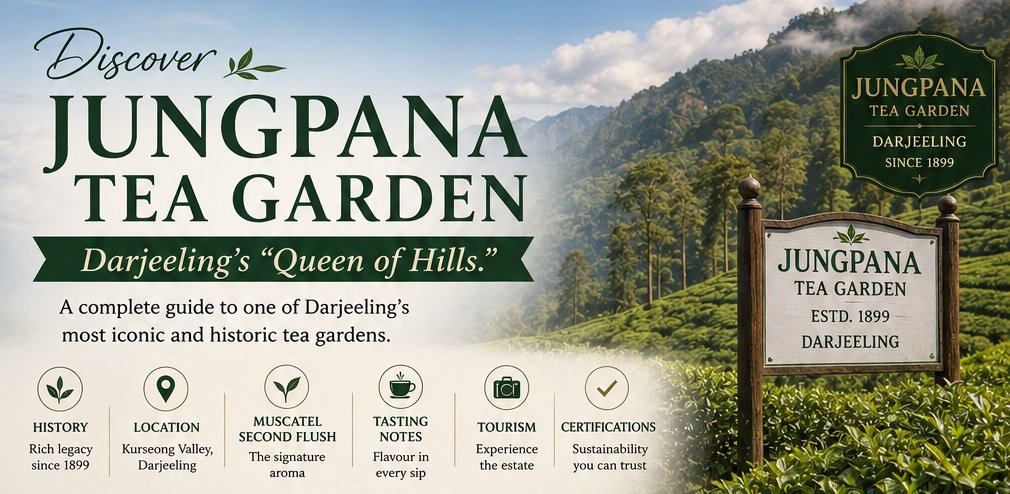
Jungpana Tea Garden: The Complete Guide to Darjeeling’s Queen of Hills
By TeaFlush.com | Last Updated: June 2026
“In Darjeeling, Jungpana hardly needs an introduction.” — Camellia Sinensis Tea House
Table of Contents
What Is Jungpana Tea Garden?
Jungpana Tea Garden is one of the most celebrated and storied tea estates in the Darjeeling district of West Bengal, India. Fondly called the “Queen of the Darjeeling Hills”, this legendary estate has earned a global reputation for producing some of the finest, most sought-after Darjeeling teas — particularly its iconic Muscatel Second Flush.
Tucked away in an extraordinarily remote corner of the Kurseong Valley, Jungpana is not just a tea garden — it is a living heritage site, an ecological wonder, and a sensory destination that every serious tea lover should know about. Its teas have graced the shelves of Fortnum & Mason and Harrods of Knightsbridge in the UK, and have been savoured at the British Royal Court. They are particularly revered in Japan and Germany, where discerning tea culture demands nothing but the best.
Quick Facts at a Glance
| Detail | Information |
|---|---|
| Location | Kurseong subdivision, Darjeeling district, West Bengal, India |
| Coordinates | 26°54′02″N 88°19′22″E |
| Established | 1899 (with Mahalderam section dating to 1860–1864) |
| Area | 400+ acres (Jungpana & Mahalderam/Maldiram division combined) |
| Elevation | 1,000 m to 1,800 m (approx. 3,300 ft to 6,100 ft) |
| Annual Production | ~60,000 kg of tea |
| Distance from Kurseong | ~12 km |
| Current Owner | Mayfair Hotels & Resorts (acquired January 2022) |
| Certifications | Rainforest Alliance, Organic, ISO |
| Famous For | Muscatel Second Flush, FTGFOP1 grade teas |
The Origin of the Name “Jungpana”
The name “Jungpana” carries two fascinating stories — one rooted in legend, the other in geography.
The Nepali Legend of Jung
According to local folklore, the estate’s name traces back to a nobleman named Jung, who was fatally wounded by a leopard while patrolling the tea fields during early plantings in 1898. As he lay mortally wounded, his last whispered word was “pani” — the Nepali word for water. His plea became the estate’s name: Jung-pana, or “Jung’s water.”
In another version of the legend, it was a trusted ranger named Jung Bahadur Rai who fought off the leopard — armed with his traditional Nepali kukri knife — to save the plantation overseer. In either telling, Jung’s bravery and sacrifice are immortalized in the estate’s identity.
The Geographic Meaning
Beyond legend, the word Jungpana in Nepali literally translates to “Fountain Head” or “Source of Mahaldi” — a reference to the ridge near Kurseong from which the Mahaldi river rises below. This geography-rooted meaning connects the estate deeply to its physical landscape: a land where water springs eternally from the mountains, nourishing both the soil and the soul of the tea.
A Rich History: From British Planters to the Mayfair Group
1860s–1899: The Seeds Are Planted
The history of Jungpana begins before its formal establishment. The upper section of the estate, known as Mahalderam (also spelled Maldiram), was actually planted as a separate tea garden sometime between 1860 and 1864 — making it one of the older tea patches in the region, predating even the main Jungpana estate.
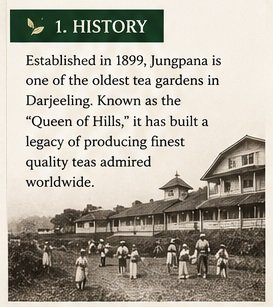
The formal establishment of Jungpana Tea Estate is attributed to Mr. Henry Montgomery Lennox, who planted the garden in 1899 during the height of British colonial enterprise in Darjeeling. Lennox, like many British colonists of his era, recognized the extraordinary potential of the Kurseong hillsides — their altitude, mist, and soil were tailor-made for Camellia sinensis.
Early 20th Century: British Management
Ownership then passed to Mr. G. W. O’Brien, who managed the estate through the early decades of the 20th century. World War II, however, created significant disruptions across Indian tea estates, and the economic aftermath eventually compelled O’Brien to sell the property.
Post-War: The Rana of Nepal
After the sale by O’Brien, Jungpana passed into the hands of the ruling Rana of Nepal, reflecting the estate’s regional prestige and its desirability as both an economic and symbolic asset.
1956 Onwards: The Kejriwal Family Era
With Indian independence came further change. Around 1956, the Kejriwal family took ownership of Jungpana Tea Estate — and for the next six decades, they stewarded its reputation with dedication and skill. Under their management, Jungpana’s Muscatel teas became globally renowned, its FTGFOP1 grade lots became collector’s items, and the garden solidified its status as one of Darjeeling’s premier tea estates.
2022: The Mayfair Chapter Begins
In January 2022, Mayfair Hotels & Resorts — a leading Indian hospitality group — acquired Jungpana Tea Garden, marking a transformative new chapter. The group invested heavily in estate infrastructure, increased productivity, launched new tea blends, and converted a historic Director’s bungalow (built in 1910) into the luxurious Mayfair Manor boutique resort. Mayfair also committed to the welfare of the 250 families of the local community who depend on the garden.
Location, Geography & Terroir
Where Is Jungpana Tea Garden?
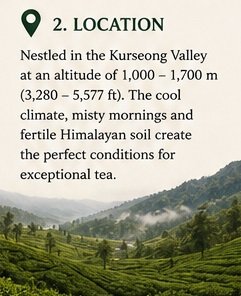
Jungpana is located in the Kurseong Community Development Block within the Kurseong subdivision of Darjeeling district, roughly 12 km from Kurseong town in a remote, almost mythically isolated part of the Himalayan foothills.
Accessibility has long defined Jungpana’s character. For most of its history, the estate was reachable only on foot — via a narrow, snaking mountain path, followed by a climb of 350+ steep steps, and then across a wooden footbridge spanning the river Changey Khola (a local stream). Even today, while some motorable access exists, the garden retains its otherworldly seclusion. To transport freshly plucked leaves from the high fields down to the factory, ropeways are still used to carry loaded bags along the slopes.
Altitude & Climate
- Elevation range: 1,000 m to 1,800 m above sea level (approximately 3,300 ft to 6,100 ft)
- Aspect: Primarily south and southeast-facing slopes, which maximize sun exposure
- Streams: Changey Khola and several rivulets run through the garden; the estate is surrounded by seven waterfalls
- Vegetation: Dense forests of pine, rhododendron, and native flora border the tea fields
- Climate: Classic Darjeeling — cool winters, mild summers, heavy monsoon rainfall, and long periods of Himalayan mist
Soil & Terroir
The soils at Jungpana are rich in organic matter, well-drained on the steep slopes, and underlaid by mineral-rich Himalayan geology. The combination of altitude, mist, cool temperatures, and slow-draining rainwater creates what tea scientists call a stress-growing environment — where the tea plant grows slowly, concentrating flavor compounds in each leaf.
The south-facing slopes receive extra hours of sunlight through the growing season, which enhances the development of complex aromatic molecules — particularly the monoterpene compounds responsible for the famous Muscatel character.
What Makes Jungpana Tea Unique?
Jungpana’s teas stand apart from the broader Darjeeling canon for several interconnected reasons:
1. Extreme Isolation
The estate’s remote, high-altitude location limits outside interference and creates a microclimate of unusual purity and stability. Tea plants here exist in one of Darjeeling’s most undisturbed natural environments.
2. Old Chinese Hybrid & Clonal Cultivars
Jungpana grows both heritage China hybrid (Chinary) cultivars — the ancient Camellia sinensis var. sinensis — and modern clonal varieties developed through selective propagation. The Chinary cultivars, in particular, are prized for producing the deep, fruity, grape-like Muscatel character that Jungpana is most famous for.
3. South-Facing Slope Advantage
The predominantly southeast orientation means tea bushes at Jungpana bask in extra sunlight during the critical second flush growing period (May–June), intensifying flavor development.
4. Skilled Craftsmanship Through Generations
Decades of accumulated expertise — first under the Kejriwal family and now under Mayfair’s stewardship — have refined every step of Jungpana’s production, from the timing of the pluck to the precision of the oxidation process.
5. Rarity & Small Production
With an annual output of approximately 60,000 kg across a 400-acre estate, Jungpana’s per-acre yield is deliberately modest. Quality is prioritized over volume, making its teas scarce and highly valued.
The Flush Seasons: A Complete Harvest Guide
Darjeeling tea is defined by its distinct harvest seasons, called flushes. At Jungpana, each flush has its own personality and following.
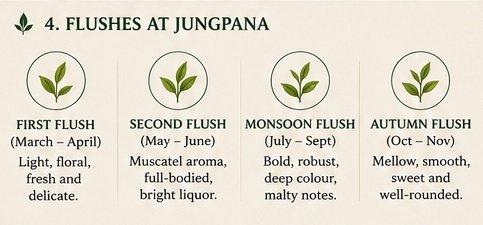
First Flush (March–April): The Spring Awakening
The first flush marks the year’s initial harvest after winter dormancy. At Jungpana, first flush teas are characterized by:
- Light, bright, greenish liquor
- Floral, vegetal, and fresh grass notes
- A delicate, astringent edge
- Grades often reaching FTGFOP1 (Fine Tippy Golden Flowery Orange Pekoe First Grade) — the highest designation in Indian tea grading
- The very finest plucked leaves are called “Ghannis” — considered some of the most aromatic of the entire year
First flush Jungpana teas are beloved among spring tea enthusiasts and are often compared to Japan’s shincha — a celebration of seasonal renewal in a cup.
Second Flush (May–June): The Muscatel Masterpiece
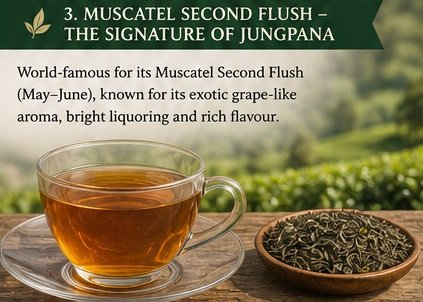
This is Jungpana’s signature season, and arguably the most celebrated second flush in all of Darjeeling. The second flush period produces:
- Deep amber to copper-colored liquor
- The legendary Muscatel character: a distinct grape-like, raisin, and musky sweetness
- Warm, full-bodied, layered flavor with remarkable complexity
- A long, lingering finish that evolves on the palate well after the final sip
The term “Muscatel” was coined in 1986 by iconic Darjeeling tea planter Mr. Arun Kumar Gomden, who first identified the unique grape-like character in second flush Chinary teas and named it after the Muscat grape. At Jungpana, this quality reaches some of its highest expressions.
Monsoon / Rains Flush (July–September)
The monsoon flush produces robust, bold, and malty teas with heavier body and less aromatic refinement. These are often used in blends and are more accessible in price. While not Jungpana’s prestige season, they represent good everyday drinking teas.
Autumn Flush (October–November): The Hidden Gem
The autumn flush is often underrated. At Jungpana, autumnal teas offer:
- Soft, mellow, and rounded character
- Earthy, woody, and sometimes spicy notes
- Greater body than first flush, with less intensity than second flush
- A meditative, warming quality perfect for the cooler months
Teas Produced at Jungpana
Jungpana is far more than a one-trick pony. The garden’s range spans:
Black Teas
The backbone of Jungpana’s output. Ranging from the bright, floral first flush to the muscatel-laden second flush and the earthy autumnals.
Green Teas
Produced with minimal oxidation, Jungpana’s green teas offer the terroir-forward character of the garden in a lighter, more delicate format — grassy, sweet, and high in antioxidants.
White Teas
Made from only the youngest, most tender buds, Jungpana’s white teas (including Silver Tips) are among the most prized in the estate’s portfolio — extraordinarily delicate, sweet, and rare.
Yellow Teas
A rare and lesser-known category, Jungpana’s yellow teas undergo a unique “smothering” step that softens the vegetal notes and adds a mellow, smooth quality not found in other tea types.
Oolong Teas
Jungpana produces exclusive oolongs — partially oxidized teas that bridge the world of green and black. These are particularly popular in East Asian markets where oolong tradition runs deep.
The Art of the Muscatel: Jungpana’s Crown Jewel
No discussion of Jungpana is complete without a deep dive into the Muscatel — the tea that made the estate legendary.
What Is Muscatel Character?
Muscatel refers to a rare, naturally occurring flavor profile in certain Darjeeling second flush teas. It is marked by:
- A fruity sweetness reminiscent of Muscat grapes or Muscat wine
- Notes of raisins, dried apricot, and honey
- Subtle floral undertones of geranium, rose, and hawthorn
- A distinctive musky, warm spice on the finish
Crucially, Muscatel is not an additive or artificial flavoring — it is a product of the tea plant’s chemistry interacting with specific terroir, cultivar, season, and processing conditions.
The Jassid Connection
One of the most fascinating aspects of Muscatel character is its link to a tiny leafhopper insect called the Empoasca flavescens — commonly known as the jassid. When this insect feeds on tea leaves during the warm summer months (May–June), it triggers a natural defense response in the plant. The plant produces specific terpene compounds (including hotrienol and linalool oxide) that paradoxically create the very aromatic complexity prized in Muscatel teas. This is the same phenomenon behind Taiwan’s famous Oriental Beauty Oolong.
At Jungpana, the combination of Chinary cultivars and the right climatic conditions during second flush allows this process to occur at a level of intensity and quality that is rarely matched elsewhere.
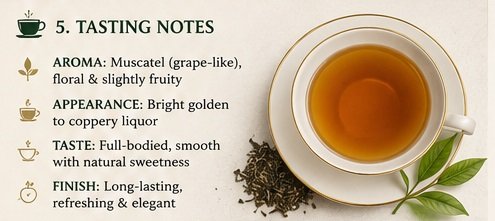
Tasting Profile
- Liquor color: Deep amber to bright copper-gold
- Aroma: Ripe muscat grape, dried rose petals, woody green notes, warm honey
- Taste: Fruity sweetness upfront, smooth and round mid-palate, complex spiced finish
- Astringency: Medium — pleasantly brisk, never harsh
- Aftertaste: Long and evolving; up to 3 minutes of steeping gives balanced sweetness; beyond 3 minutes, muscatel notes intensify into a spiced, resinous character
Tea Processing at Jungpana
Jungpana’s teas are processed with a blend of time-honored tradition and careful modern quality control.
Step 1: Plucking
Only the finest two leaves and a bud are hand-plucked by experienced workers. Timing is critical — the best second flush muscatel windows are narrow, often just days long, during the peak of May to June.
Step 2: Withering
Freshly plucked leaves are spread on withering troughs and exposed to air for 14–18 hours to reduce moisture content by about 50%. This softens the leaves and initiates enzymatic activity.
Step 3: Rolling
The withered leaves are passed through rolling machines that rupture cell walls and release the essential oils responsible for flavor and aroma. For orthodox teas (which Jungpana primarily produces), this is done gently to preserve leaf integrity.
Step 4: Oxidation (Fermentation)
This is the most critical step for Muscatel development. Rolled leaves are spread in cool, humid rooms and allowed to oxidize for controlled periods. Tea masters monitor temperature, humidity, and color change closely — the oxidation must be precisely timed to develop the signature fruity complexity without over-fermentation.
Step 5: Firing (Drying)
Oxidized leaves are passed through dryers at high temperatures to halt the oxidation process and reduce moisture to around 3–4%. This locks in the developed flavors and gives the tea its shelf stability.
Step 6: Sorting & Grading
Dried teas are sifted, sorted by leaf size and grade (FTGFOP1, FTGFOP, TGFOP, etc.), and inspected for quality. The finest lots — often designated by a DJ (Darjeeling Invoice) number and harvest date — are auctioned or sold directly to global buyers.
Certifications & Sustainability
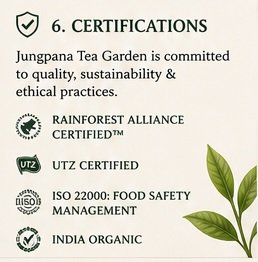
Jungpana Tea Garden has long been committed to responsible, sustainable tea production:
- 🌿 Certified Organic — No synthetic pesticides or chemical fertilizers
- 🌧️ Rainforest Alliance Certified — Meets international standards for biodiversity conservation, worker welfare, and environmental management
- 📋 ISO Certified — Meets international quality management standards
- 👨👩👧 Community Welfare — Under Mayfair’s ownership, the livelihoods of 250 local families are actively supported
- 🌳 Shade-grown & Biodiverse — The estate is surrounded by native forest, supporting a rich ecosystem of flora and fauna, including leopards, Himalayan birds, and medicinal plants
Jungpana Tea on the World Stage
Jungpana’s teas have long commanded respect at the highest levels of global tea culture:
- Fortnum & Mason, London — One of the world’s most prestigious luxury retailers has stocked Jungpana Darjeeling
- Harrods of Knightsbridge, London — Another iconic British institution that has featured Jungpana teas
- Mariage Frères, Paris — The legendary French tea house has included Jungpana in its curated selections
- British Royal Court — Jungpana teas have reportedly been consumed by the Royal household
- Japan & Germany — Two of the world’s most discerning tea markets hold Jungpana in particularly high regard
- Global auction circuits — Jungpana’s premium second flush lots regularly command top prices at Darjeeling tea auctions
The garden has been consistently featured by specialty tea houses and importers across North America, Europe, and Asia for well over a decade.
Visiting Jungpana: Tea Tourism & Mayfair Manor
Getting There
Jungpana is located approximately 12 km from Kurseong and is accessible from:
- Bagdogra International Airport (NJB) — the nearest major airport, followed by a scenic mountain drive
- New Jalpaiguri (NJP) Railway Station — the main railhead, with onward connections by road
- Mahanadi Railway Station — the nearby station on the famous Darjeeling Himalayan Toy Train heritage railway line, which passes through the estate’s vicinity
Note: The estate road is steep and the final approach may still involve walking, contributing to its sense of magical remoteness.
Mayfair Manor Jungpana: Luxury in the Clouds
Since Mayfair Hotels & Resorts acquired Jungpana in 2022, the estate has been transformed into a world-class tea tourism destination. The centerpiece is Mayfair Manor — a boutique luxury resort built around the original Director’s bungalow from 1910.
The Manor features:
- 12 bedrooms exuding warmth and heritage, many with working fireplaces and heirloom furniture from the royal family of Nepal
- A heated swimming pool — a remarkable luxury at this altitude, possible only here in the Darjeeling hills
- A well-stocked heritage library from the colonial era, perfect for rainy afternoon reading
- A modern spa and massage facilities
- A gazebo and gas-fired barbeque area
- Billiards room, table tennis, and a game room
- 24-hour room service with an all-inclusive dining experience
Dining at Mayfair Manor Jungpana: Guests are treated to a menu spanning traditional North Indian dishes (kebabs, biryani, dal makhani, gobi masala) and authentic Nepali fare — light, nourishing mountain food with greens, light lentils, and subtly spiced mutton and chicken. Every meal is complemented, naturally, by Jungpana’s finest teas.
Tea Experiences Offered:
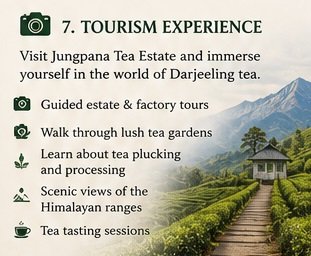
- Factory tours — guided walks through the processing facility with expert commentary on each step of tea production
- Curated tea tastings — guided sessions pairing Jungpana’s seasonal teas with artisanal treats
- Garden walks — immersive strolls through the tea fields, forest, and past the estate’s seven waterfalls
- Sunrise views — watching the sun lift over the verdant humps of Jungpana’s hills is described by visitors as “nothing short of breathtaking”
Ideal For:
- Romantic getaways and honeymoons
- Family retreats
- Small conferences and corporate off-sites
- Solo travelers seeking solitude and nature
How to Brew Jungpana Tea Perfectly
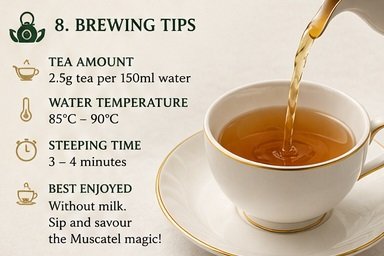
Getting the best from Jungpana’s teas requires attention to water, temperature, and timing.
Brewing Guide by Tea Type
| Tea Type | Water Temperature | Leaf Quantity | Steeping Time | Notes |
|---|---|---|---|---|
| First Flush (Black) | 90–95°C | 2.5g per 200ml | 2.5–3 minutes | Brew lighter to preserve delicacy |
| Second Flush Muscatel | 95–100°C | 2.5–3g per 200ml | 3–4 minutes | At 3 min: balanced; at 4 min: muscatel intensifies |
| Green Tea | 75–80°C | 2g per 200ml | 2–2.5 minutes | Never use boiling water |
| White Tea / Silver Tips | 75–85°C | 2–3g per 200ml | 3–4 minutes | Gentle and slow |
| Oolong | 85–90°C | 3g per 200ml | 2–3 minutes | Can resteep 2–3 times |
| Autumn Flush | 95°C | 2.5g per 200ml | 3–4 minutes | Works well with a splash of milk |
General Tips
- Always use fresh, cold, filtered water — never re-boiled water, which loses dissolved oxygen
- Pre-warm your teapot or cup with a rinse of hot water before brewing
- Darjeeling teas are best enjoyed without milk — especially first and second flush — to appreciate their aromatic complexity
- Invest in a small kitchen scale — measuring by weight rather than teaspoon gives consistently better results
- Multiple infusions are possible with Jungpana’s high-quality orthodox teas, especially the oolongs and second flush
Where to Buy Authentic Jungpana Tea
With Jungpana’s reputation, the market is unfortunately not free from mislabeled or blended teas sold under the estate’s name. Here is how to ensure authenticity:
What to Look For
- DJ invoice number on premium lots (e.g., “DJ 120” indicates the 120th invoice of the season)
- Harvest date and flush clearly stated
- Estate name prominently listed (not just “Darjeeling tea”)
- FTGFOP or SFTGFOP grade for premium picks
- Organic or Rainforest Alliance certification markings
Trusted Retailers (Global)
- Vahdam India — offers authenticated estate teas directly from India with harvest traceability
- Teabox — direct-from-garden sourcing with freshness-focused packaging
- Fortnum & Mason (UK) — historic stockist of Jungpana
- Harrods (UK) — premium retailer with Darjeeling estate teas
- Camellia Sinensis (Canada) — specialist importer with deep relationships with Darjeeling gardens
- Mayfair Manor Jungpana — purchase directly during a visit to the estate
Price Range
Jungpana teas, particularly second flush Muscatels, are premium products. Expect to pay:
- ₹1,500–₹5,000 per 100g for premium second flush lots in India
- £15–£50+ per 50g at UK specialty retailers
- Rare, vintage, or ultra-premium lots can command significantly higher prices at auction
Frequently Asked Questions
Q: What is Jungpana tea garden famous for?
Jungpana is primarily famous for its exceptional Muscatel Second Flush Darjeeling tea — one of the most prized and sought-after teas in the world. It is also known for its extraordinary isolation, rich history, and FTGFOP1 grade teas.
Q: Where is Jungpana tea garden located?
Jungpana Tea Garden is located in the Kurseong subdivision of the Darjeeling district in West Bengal, India — approximately 12 km from Kurseong town.
Q: When was Jungpana established?
The formal estate was established in 1899 by Henry Montgomery Lennox, though the upper Mahalderam section dates back to 1860–1864.
Q: Who owns Jungpana Tea Garden now? As of January 2022, Jungpana Tea Garden is owned by Mayfair Hotels & Resorts, which has invested in both tea production and luxury hospitality on the estate.
Q: What is the best Jungpana tea to buy? For most tea lovers, the Second Flush Muscatel is the definitive Jungpana experience. If you’re new to Darjeeling tea, the second flush is the best starting point. Advanced tea drinkers may also love exploring the First Flush FTGFOP1 or the estate’s rare White Silver Tips.
Q: Is Jungpana tea organic? Yes. Jungpana Tea Garden holds Organic, Rainforest Alliance, and ISO certifications, reflecting its commitment to chemical-free, sustainable cultivation.
Q: Can you visit Jungpana Tea Garden? Yes! Jungpana now operates Mayfair Manor, a luxury boutique resort on the estate. Guests can stay, dine, take tea factory tours, guided garden walks, and participate in curated tasting sessions.
Q: What does Muscatel mean in tea? Muscatel refers to a rare, naturally occurring grape-like, fruity sweetness in certain Darjeeling second flush teas. It is produced by the interaction of specific cultivars, high-altitude terroir, seasonal timing, and the leaf activity caused by tiny leafhopper insects called jassids. It is not artificial flavoring.
Q: What grade is Jungpana tea? Jungpana’s premium lots are graded FTGFOP1 — Fine Tippy Golden Flowery Orange Pekoe First Grade — the highest grade in the Indian tea grading system, indicating the highest proportion of golden tips (young leaf buds) in the blend.
Q: What does “DJ” mean on Darjeeling tea labels? “DJ” stands for Darjeeling Invoice — a sequential numbering system used to track each lot of tea produced in a given season. A label reading “DJ 120” means it is the 120th invoice lot of that year. This traceability system helps ensure authenticity and allows connoisseurs to track specific harvest batches.
Final Thoughts
Jungpana Tea Garden is not merely a place where tea is grown — it is a place where history, landscape, legend, and craftsmanship converge in every cup. From the heroic tale of Jung Bahadur Rai fighting off a leopard to the meticulous hand-plucking of Muscatel leaves on sun-drenched Himalayan slopes, every aspect of Jungpana’s story is extraordinary.
Its teas are the result of more than 125 years of cultivation on some of Darjeeling’s most remote and beautiful terrain — teas that have been savored by royalty, curated by the world’s finest luxury tea houses, and cherished by enthusiasts from Tokyo to Hamburg to London.
Whether you are sipping a golden cup of Jungpana First Flush on a quiet morning, exploring the grape-drenched complexity of a peak Second Flush Muscatel, or planning a visit to the newly luxurious Mayfair Manor to experience the estate firsthand — Jungpana invites you into one of tea culture’s most rarefied experiences.
At TeaFlush.com, we believe that understanding the story behind the leaf makes every sip more meaningful. And few stories in the world of tea are as rich, as layered, or as deeply satisfying as the story of Jungpana.
Explore more Darjeeling estate profiles, tea brewing guides, and seasonal flush reviews at TeaFlush.com.
Tags
Jungpana Tea Garden · Darjeeling Tea · Muscatel Tea · Second Flush · Darjeeling Second Flush · Jungpana Muscatel · Best Darjeeling Tea · Kurseong Tea Garden · Tea Tourism India · FTGFOP1 Tea · Mayfair Manor Jungpana · Darjeeling Tea Estates · Single Estate Tea · Organic Darjeeling Tea · Tea Garden India
Discover Jungpana Tea Garden — Darjeeling’s “Queen of Hills.” A complete guide covering history, location, Muscatel second flush, flushes, tasting notes, certifications, tourism, and brewing tips. Last updated June 2026.