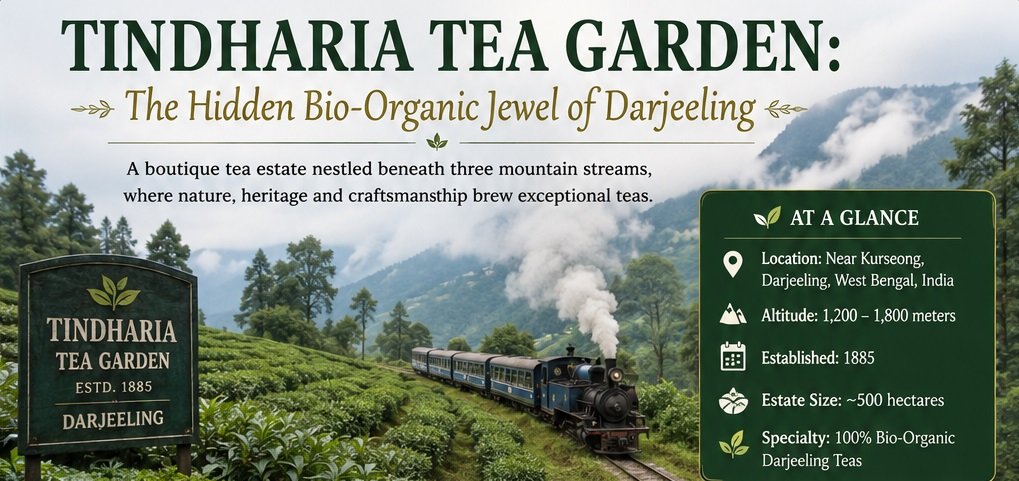
Tindharia Tea Garden: The Hidden Bio-Organic Jewel of Darjeeling
Table of Contents
Introduction: A Tea Estate Born at the Confluence of Three Streams
Tucked away in the southern reaches of Kurseong, in the misty folds of the Darjeeling hills, lies one of India’s most understated tea treasures — Tindharia Tea Garden. Unlike the more famous estates that dominate Darjeeling tourism brochures, Tindharia has quietly built a reputation among connoisseurs as a boutique, bio-organic producer of exceptional black, green, and white teas.
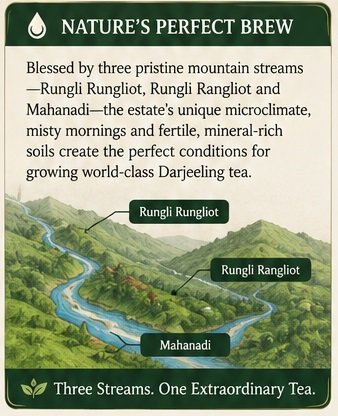
The name “Tindharia” (sometimes spelled Tindharay) comes from the Nepali words meaning “three streams” or “three ridges” — a fitting description for an estate that sits at the confluence of three mountain streams, beneath three converging ridgelines. For anyone exploring Darjeeling tea culture beyond the well-trodden path, Tindharia offers a story of nature, heritage railways, and quiet craftsmanship that deserves far more attention than it currently receives.
In this guide, we’ll walk through everything there is to know about Tindharia Tea Garden — its history, geography, tea-making philosophy, signature teas, and what makes it worth seeking out, whether you’re a tea lover, a traveler, or simply curious about Darjeeling’s tea heritage.
Where Is Tindharia Tea Garden Located?
Tindharia is a village and tea estate located in the Kurseong CD Block, within the Kurseong subdivision of Darjeeling district, West Bengal, India. It sits in the southern part of Kurseong, along the historic route that connects the plains of Siliguri to the hill town of Darjeeling.
Geographically, the estate is genuinely unique among Darjeeling tea gardens:
- Elevation: Ranges from approximately 400 meters to 1,100 meters above sea level
- Area under tea cultivation: Around 150–170 hectares
- Setting: Nestled beneath three mountain ridges at the confluence of three mountain streams
- Nearby landmarks: Gayabari, Sukna, and Mahanadi forest areas
This lower-elevation positioning compared to estates like Happy Valley or Goomtee gives Tindharia’s tea a distinct character, often described as smooth, sweet, and gently aromatic rather than the sharp, muscatel-forward profile typical of higher-altitude Darjeeling first flush teas.
A Brief History of Tindharia
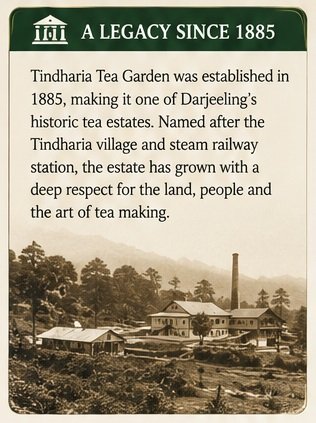
While the exact date the tea bushes were first planted at Tindharia isn’t precisely recorded, tea cultivation in the area is believed to date back well over a century, aligning with the broader expansion of Darjeeling’s tea industry during British colonial rule in the latter half of the 19th century.
The Railway Connection
Tindharia’s history is inseparable from one of India’s most celebrated engineering marvels — the Darjeeling Himalayan Railway (DHR), affectionately known as the “Toy Train.” By March 1880, the railway track had been laid as far as Tindharia, and Lord Lytton, the first viceroy to visit Darjeeling, rode the train to Tindharia.
The strategic importance of Tindharia to the railway grew over the decades. At Tindharia, the railway works were eventually relocated from behind the locomotive shed to a larger site as the DHR expanded. This workshop became — and remains — a critical maintenance hub for the narrow-gauge steam and diesel locomotives that climb the dramatic gradients between Siliguri and Darjeeling.
Today, the Tindharia Railway Station and Workshop stands as a heritage landmark in its own right. Tindharia is described as a small village whose name stands for “three ridges,” populated mostly by Nepali locals, with the station opened in August 1880 and a DHR workshop established in 1910 for overhauling locomotive engines and repairing coaches. The Darjeeling Himalayan Railway as a whole was inscribed as a UNESCO World Heritage Site in 1999, and Tindharia’s workshop remains one of its most significant operational sites.
Just Past Tindharia: Agony Point
Tea and rail history intertwine dramatically just beyond the Tindharia station. The stretch between Tindharia and the next station, Gayabari, is among the steepest on the entire route, featuring a zigzag followed by the famous “Agony Point” loop — one of the most thrilling and photographed sections of the entire DHR journey, where the train negotiates an extraordinarily sharp curve overlooking a deep gorge.
What Makes Tindharia Tea Garden Special?
A Boutique, Bio-Organic Philosophy
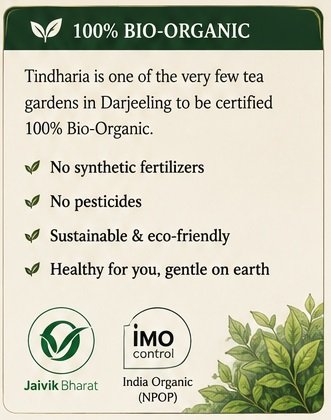
Tindharia has positioned itself as a boutique bio-organic Darjeeling tea estate, a deliberate departure from large-scale industrial production. Several elements define its approach to tea cultivation and processing:
- Plantation composition: Roughly 50% China bushes, 15% AV2 clonal varieties, 15% hybrids, and the remainder Assam-type bushes
- Sustainability practices: Ongoing replanting of weak, older bushes with high-quality clonal stock, soil conservation through shade-tree planting, and continuous drainage renewal
- Certifications: HACCP, ISO 9001:2008, and ISO 22000:2005 certified, along with FSSAI (Food Safety and Standards Authority of India) compliance
- Traceability: Every batch of tea is traceable from bush to cup, with personal attention given to each invoice — a hallmark of boutique-scale operations
The Old-Fashioned Green Tea Process
What truly sets Tindharia apart from most Darjeeling estates is its traditional method of producing green tea. Most Indian tea gardens manufacture green tea using steam piped from a boiler into a roaster filled with green leaf. Tindharia instead uses an old-fashioned, hands-on technique: fresh green leaves are individually “bathed” in boiling water, allowing for more even steaming. This labor-intensive process produces a naturally sweet, high-quality flavor that is rarely achieved through mechanized steaming — a technique that has earned the estate a loyal following, particularly among buyers in Europe.
Award-Winning Quality
Tindharia’s commitment to craftsmanship hasn’t gone unnoticed on the global stage. The estate’s signature white tea, marketed as “Pearl,” won the Gold Medal for Best Indian Tea at the U.S. Annual Tea Conference in 2012 — a remarkable achievement for a relatively small, lesser-known garden competing against far larger and more famous estates.
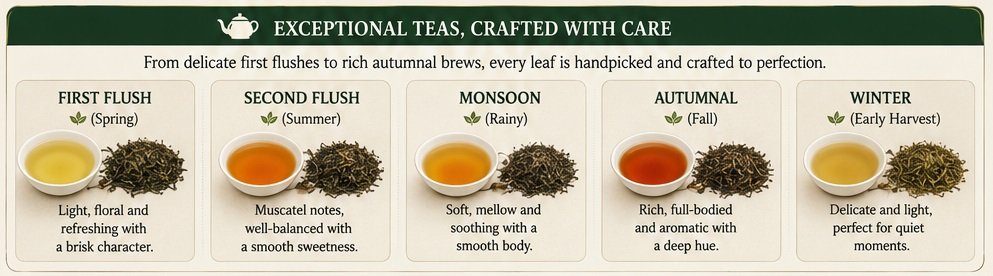
Tindharia’s Signature Teas
Tindharia produces a diverse and refined range of teas, manufactured using both traditional and modern orthodox methods:
| Tea Type | Notes |
|---|---|
| Black Tea (Orthodox) | Classic Darjeeling character with smooth, mellow notes |
| Green Tea | Hand-steeped using the traditional “leaf bath” method; sweet and aromatic |
| White Tea (“Pearl”) | Gold Medal-winning specialty tea, delicate and prized internationally |
| Oolong Tea | A semi-oxidized specialty offering, less common among Darjeeling gardens |
The estate produces an annual crop of approximately 70 metric tons of tea, a modest figure that underscores its boutique, quality-over-quantity philosophy.
Where Tindharia Tea Travels
Tindharia’s reputation extends well beyond India’s borders. The bulk of its production — around half — is exported to Germany, with Japan accounting for a significant share as well. The remainder is split between other international markets, including the United States, and India’s own domestic specialty tea market.
The Tindharia Experience: Nature, Peace, and Storytelling
Visitors and buyers who have spent time at Tindharia often describe an almost meditative quality to the estate. One frequently shared anecdote tells of a Japanese tea buyer who visited around 2016 and, while sitting in the estate’s Director’s Bungalow, became so absorbed in the natural surroundings that he later remarked the peace there felt like “washing his soul.” It’s an evocative image that captures what makes Tindharia distinct — not grandeur or scale, but an intimate, almost spiritual connection to its landscape of streams, ridges, and tea bushes.
The estate also takes pride in its workforce, considering its roughly 250 workers and their families to be central to its identity and sustainability. This community-first approach reflects a broader philosophy increasingly valued by ethically-minded tea drinkers worldwide.
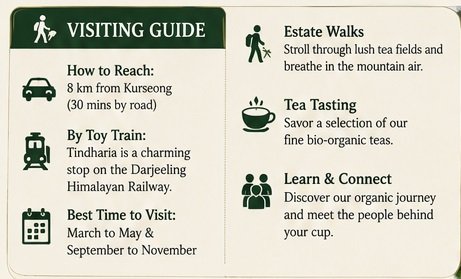
How to Visit Tindharia Tea Garden
While Tindharia isn’t as commercialized for tourism as estates like Glenburn or Happy Valley, it remains accessible and rewarding for travelers seeking an authentic, off-the-beaten-path experience.
Getting There
Tindharia lies along one of the classic routes connecting Siliguri to Darjeeling — the Tindharia–Kurseong road route — making it a natural stop for travelers driving up from the plains. It’s also reachable via the Darjeeling Himalayan Railway, with Tindharia station itself being a scheduled stop on the New Jalpaiguri–Darjeeling toy train line.
Approximate distances:
- From Siliguri/NJP: roughly 25–30 km
- From Kurseong: around 14 km
- From Darjeeling town: roughly 45–50 km
Best Time to Visit
- March to May (First Flush season): Ideal for seeing fresh plucking and the early spring harvest
- June to September: Lush, monsoon-green landscapes, though travel can be affected by rain
- October to November (Autumn Flush): A beautiful, less-touristy time with clear mountain views
- Winter (December–February): Quieter estate activity but excellent visibility and crisp weather
What You Can Experience
- A scenic, peaceful retreat away from Darjeeling’s more crowded tourist circuits
- Views of the estate’s distinctive landscape — three mountain streams converging beneath forested ridges
- Proximity to the Agony Point loop and the historic Tindharia DHR Workshop, a must for railway and heritage enthusiasts
- A glimpse into traditional, small-batch tea processing methods rarely seen at larger commercial estates
Tindharia vs. Other Darjeeling Tea Gardens
Darjeeling is home to roughly 87 operational tea gardens spread across approximately 19,000 hectares, ranging from world-famous names like Makaibari and Glenburn to lesser-known boutique estates like Tindharia. What distinguishes Tindharia within this crowded field is its combination of low-to-mid elevation terroir, hands-on green tea craftsmanship, and a genuinely boutique production scale — qualities that appeal strongly to specialty tea importers and connoisseurs who value distinctiveness over brand recognition.
| Feature | Tindharia | Typical Darjeeling Estate |
|---|---|---|
| Elevation | 400–1,100 m | Often 1,200–2,200 m |
| Production scale | ~70 MT/year (boutique) | Often 100+ MT/year |
| Specialty | Hand-steeped green tea, white tea | Primarily black orthodox tea |
| Certification | Bio-organic, HACCP, ISO certified | Varies widely |
| Tourism infrastructure | Minimal, authentic | Often well-developed |
Why Tea Lovers Should Know About Tindharia
For tea enthusiasts exploring beyond mainstream Darjeeling labels, Tindharia represents exactly the kind of discovery worth making: a small, dedicated estate producing genuinely distinctive tea through methods that prioritize quality and tradition over mass output. Its award-winning white tea, internationally celebrated green tea, and deep-rooted connection to Darjeeling’s railway heritage make it a compelling chapter in the larger story of Darjeeling tea.
Whether you’re sourcing specialty teas for your own collection, planning an offbeat itinerary through the Darjeeling hills, or simply researching the rich tapestry of estates that make up the world’s most famous tea-growing region, Tindharia Tea Garden offers a story — and a cup — well worth exploring.
Frequently Asked Questions
What does “Tindharia” mean?
Tindharia translates to “three streams” or “three ridges” in Nepali, referencing the estate’s location at the confluence of three mountain streams beneath three converging ridges.
What does “Tindharia” mean?
Is Tindharia Tea Garden organic? Yes. Tindharia operates as a bio-organic estate, with HACCP, ISO 9001:2008, and ISO 22000:2005 certifications, and is registered with the Food Safety and Standards Authority of India.
What is Tindharia best known for? Tindharia is particularly celebrated for its hand-steeped green tea and its Gold Medal-winning white tea, “Pearl,” which won Best Indian Tea at the 2012 U.S. Annual Tea Conference.
How do I get to Tindharia from Siliguri or Darjeeling? Tindharia lies along the Tindharia–Kurseong road route and is also a stop on the Darjeeling Himalayan Railway (Toy Train) line between New Jalpaiguri and Darjeeling.
What is the best time to visit Tindharia Tea Garden? March to May for the first flush harvest, or October to November for clear views and a quieter autumn flush season.
Looking for authentic Darjeeling teas, including rare boutique estate selections like Tindharia? Explore our curated collection at TeaFlush.com and discover the difference small-batch craftsmanship makes in every cup.