Selim Hill Tea Garden: A Complete Guide to Darjeeling’s Hidden Organic Gem
Discover the history, location, teas, and tourism experience of Selim Hill Tea Garden — one of Darjeeling’s oldest and most enchanting organic estates.
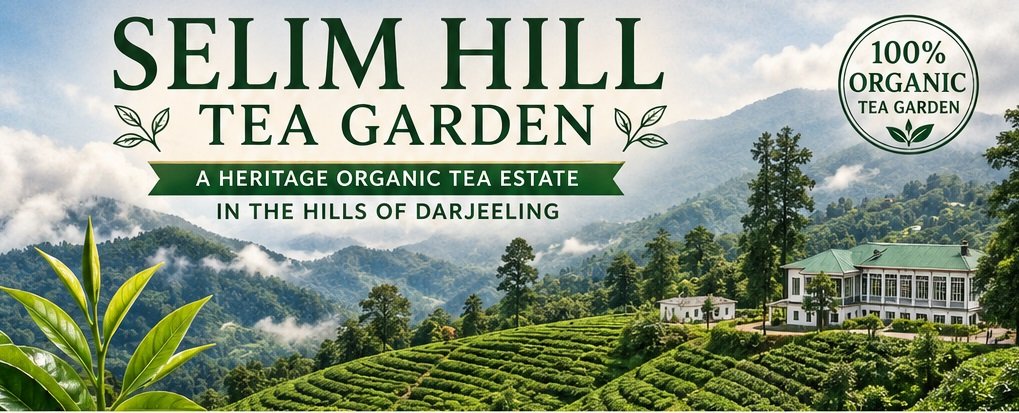
Tucked into the misty slopes above Kurseong, Selim Hill Tea Garden is one of the most evocative names in the world of Darjeeling tea. It’s a place where 150-year-old colonial history, biodynamic farming, and breathtaking Himalayan views come together in a single tea estate. If you’re a tea lover searching for your next favorite flush, or a traveler planning a tea-tourism getaway in North Bengal, this guide covers everything you need to know about Selim Hill — its history, geography, teas, and visitor experience.
Table of Contents
Where Is Selim Hill Tea Garden Located?
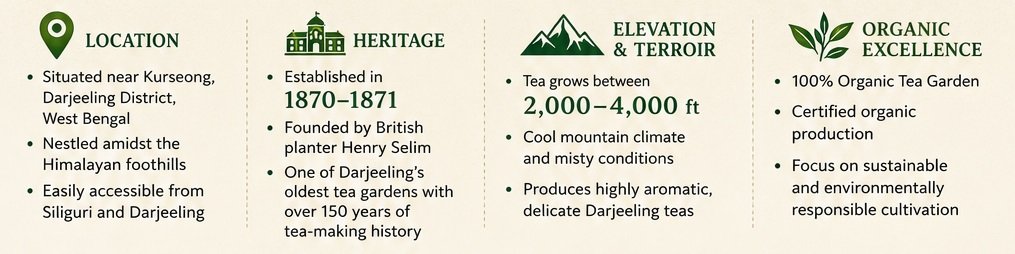
Selim Hill Tea Estate sits on the hill slopes of Kurseong, in the Darjeeling district of West Bengal, India. The estate is perched on a hill slope with varying elevations rising to around 3,500 feet, facing the mountains to its north. Other sources place specific sections of the garden at elevations between 850 and 4,500 feet, reflecting its sprawling, multi-tiered terrain that stretches across upper and lower segments of the hillside.
The garden is roughly 35 kilometers from Siliguri, making it an easily accessible day trip or weekend escape from the plains. It’s also well connected to Darjeeling town, lying along the route most travelers take when journeying up from Siliguri or New Jalpaiguri (NJP) toward Darjeeling.
For those who love a touch of heritage rail travel, there’s a charming option: visitors can take the Darjeeling Himalayan Railway from New Jalpaiguri and disembark at Gayabari Station, which is just a short walk from the estate.
What Surrounds Selim Hill?
One of the most magical things about Selim Hill is its setting. The tea garden is bordered by the Mahananda Wildlife Sanctuary, and neighboring estates include Rohini Tea Estate to the west and Jogmaya and Giddhapahar Tea Estates to the north. This proximity to protected forest means the garden isn’t just an agricultural plot — it’s part of a living, breathing ecosystem.
From the estate, visitors can take in sweeping views of the Mahananda Wildlife Sanctuary on one side and Mount Kanchenjunga on the other, making it one of the more visually spectacular tea gardens in the entire Darjeeling hills.
The History of Selim Hill Tea Garden
Selim Hill’s story stretches back over a century and a half, to the earliest days of Darjeeling’s tea industry.
The garden’s history dates back more than 150 years, to the 1870s, when it was established by a British planter named Henry — a man the local community affectionately called “Selim Sahab.” Different sources place the exact founding year slightly differently — some cite 1870, others 1871, and one even references 1800 — but the consistent thread across all of them is that it was a 19th-century British planter named Henry who founded the estate, and that the garden’s evocative name comes directly from him.
Where Does the Name “Selim Hill” Come From?
The origin of the name is part historical record, part local legend. According to the most widely repeated story, locals referred to planter Henry as “Selim Sahab,” and the name stuck — though this account is acknowledged to be more folklore than documented fact, passed down through generations by word of mouth.
A second theory offers an alternative explanation: some believe the estate took its name not from the planter at all, but from the dramatic, sweeping hills that border the property. Either way, the mystery only adds to the garden’s old-world charm.
Interestingly, one source associated with a specialty tea brand sourcing from the estate gives the founder’s full name as Henry Selim, suggesting the surname itself may be the true origin of “Selim Hill” — though this remains one version among several competing local narratives.
A Milestone Anniversary
In 2021, Selim Hill marked a significant milestone. To celebrate the estate’s 150th anniversary, the Selim Hill Collective was founded under the chairmanship of Rajah Banerjee, with a vision of reimagining the tea garden as an inclusive and sustainable space rather than a purely commercial plantation. The Collective’s broader mission is to build a more just model for the garden — one where workers are properly compensated, biodiversity is protected, and Selim Hill becomes a center of cultural renewal for the wider Darjeeling region.
The Size and Scale of the Estate
Selim Hill is a genuinely large tea property, and figures vary depending on whether sources are describing the total estate or just the area under active cultivation.
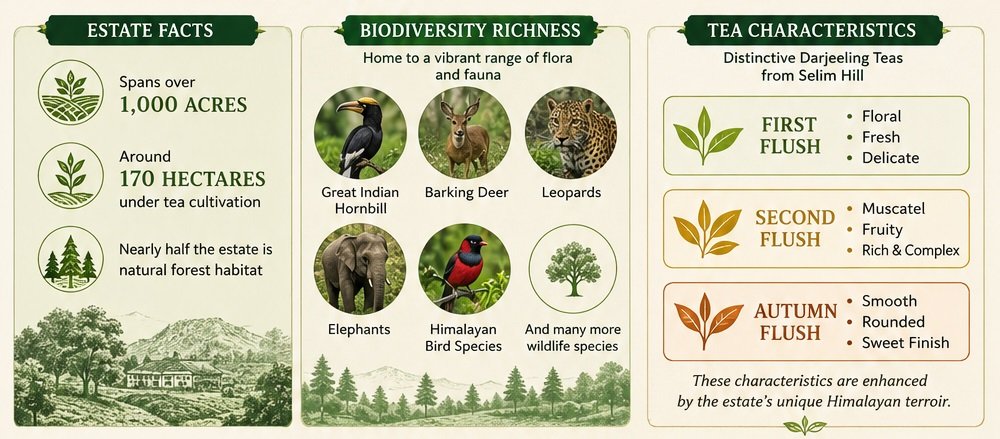
The estate covers a gross area of 370 hectares, of which 170 hectares are planted with tea, split into upper and lower segments spanning four villages. A separate source describes the estate as spanning over 1,000 acres in total. Of this larger footprint, roughly half is covered by the Selim Hill Forest itself, a haven for an extraordinary range of wildlife.
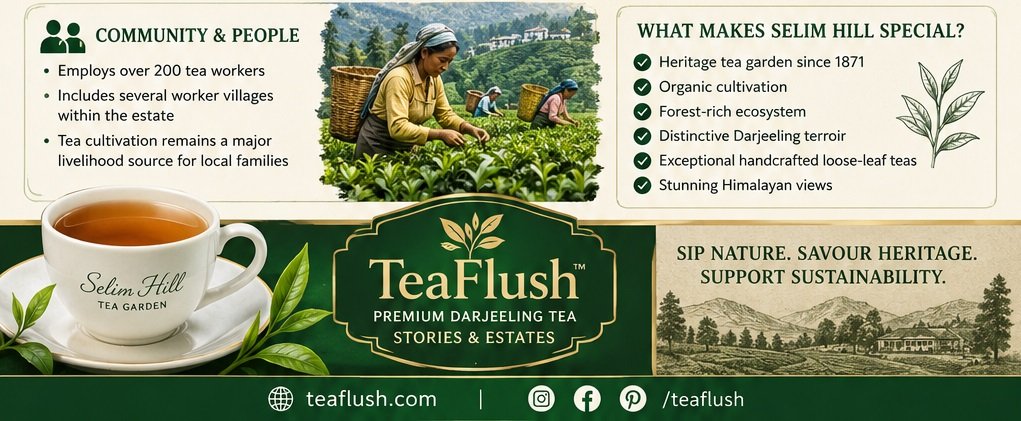
The garden employs more than 200 workers, drawn from the surrounding villages that form part of the estate community — underscoring that Selim Hill isn’t just a business, but the economic and social heart of the area it occupies.
Selim Hill’s Organic and Biodynamic Identity
Long before “organic” and “sustainable” became buzzwords in the global tea industry, Selim Hill was already moving in that direction. The estate is fully organic and certified to manufacture bio-organic Darjeeling teas.
Its credentials go further still: Selim Hill’s teas are 100% organic and are certified by USDA Organic as well as the Rainforest Alliance, recognizing the estate’s commitment to environmental stewardship and sustainability.
Visitors and tea buyers alike can witness this philosophy in action. Walking through Selim Hill means strolling through biodynamic tea gardens, watching the plucking process firsthand, speaking with the workers who tend the bushes, and observing live tea processing inside the estate’s working factory.
What Makes Selim Hill Tea Special?
Tea connoisseurs prize Selim Hill primarily for its orthodox, loose-leaf Darjeeling teas — the gold standard for serious tea drinkers who want full-leaf character rather than processed CTC (crush-tear-curl) tea.
Beyond its tea, the estate is celebrated for its stunning scenery and ambiance, framed by dense forest cover rich with local flora and fauna.
A specialty tea retailer offering Selim Hill’s First Flush black tea describes the experience vividly: grown at elevations between 850 and 1,050 meters in the “Kurseong South” valley, this biodynamically grown Darjeeling delivers the classic character of a high-quality first flush black tea, with a light amber liquor that is fresh, lively, and layered in complexity.
For Darjeeling enthusiasts, this combination — high altitude, biodynamic cultivation, and the unique terroir of the Kurseong valley — is exactly what produces the muscatel notes and floral brightness that Darjeeling First Flush teas are famous for around the world.
Tea Tourism at Selim Hill: What Visitors Can Experience
Selim Hill has quietly become one of the more rewarding tea-tourism destinations in the Darjeeling hills, largely because it offers an authentic, lived-in experience rather than a polished commercial tour.
Stay in a Heritage Planter’s Bungalow
The centerpiece of any visit is the estate’s colonial-era accommodation. The Selim Hill Planter’s Bungalow is a two-storied building constructed of wood and stone, and the structure itself is around 150 years old.
The bungalow houses four comfortable double-bed rooms, each with an attached bath and modern amenities, while still preserving its period furniture and old-world planter’s charm. From its windows, guests can take in spectacular views of the Himalayan ranges and deep gorges below. Compared to many other heritage tea bungalows in the region, Selim Hill’s accommodation is notably more affordable, making it accessible to a wider range of travelers.
Explore the Estate and Its Wildlife
A stay at Selim Hill isn’t just about the tea — it’s about the entire ecosystem the garden is woven into. Half of the wider estate area is covered by the Selim Hill Forest, home to hundreds of bird species (including the great Indian hornbill), along with leopards, barking deer, elephants, and numerous species of spiders and snakes.
Just beyond the estate lies one of the region’s premier wildlife destinations. Visitors can take a guided tour of the neighboring Mahananda Wildlife Sanctuary, which spans 160 square kilometers across varying elevations and is home to Royal Bengal Tigers, elephants, bison, leopards, deer, and many other species of birds and animals.
A particularly memorable vantage point awaits hikers and nature lovers: from the estate, one can view the Mahananda and Balasun river valleys, with the rare and beautiful sight of two rivers flowing side by side in the distance.
Pony Rides and Nearby Attractions
For a slower, scenic way to explore, guests can take a pony ride along a picturesque route leading to the highest point of the Selim Hills.
History and rail enthusiasts shouldn’t miss a nearby landmark either. Agony Point Loop in Tindharia, located close to the estate, is the fourth loop in the original design of the Darjeeling Himalayan Railway’s narrow-gauge toy train track — so named because it is the tightest loop in the entire route.
Best Time to Visit Selim Hill
One of the appealing things about Selim Hill is that it doesn’t really have an “off-season” for visitors, even though tea pluckers follow the traditional Darjeeling flush calendar (First Flush in spring, Second Flush in summer, and so on).
According to local guides, Selim Hill can be visited any time of year — the winters are described as addictive, the monsoons as lush, and the summers as cool, each season offering a distinctly different mood across the forested hillsides.
How to Reach Selim Hill Tea Garden
Getting to Selim Hill is straightforward from the major regional hubs:
By road: Selim Hill is about 35 kilometers from Siliguri, and the estate can also be reached via the national highway toward Tindharia, with the garden located off the Hill Cart Road on the route to Darjeeling.
By rail: Travelers can also board the Darjeeling Himalayan Railway from New Jalpaiguri and disembark at Gayabari Station, from where Selim Hill is just a short walk away. This option is ideal for anyone wanting to combine their tea-garden visit with a ride on the UNESCO-listed “toy train.”
By car: A private vehicle from Siliguri, NJP, or Bagdogra Airport remains the most flexible option, particularly if you intend to combine the visit with stops at other Kurseong-area tea estates.
Why Selim Hill Matters for the Future of Darjeeling Tea
What sets Selim Hill apart from many of Darjeeling’s other historic gardens is its forward-looking approach to sustainability and community welfare. Through the Selim Hill Collective, the estate is positioning itself not just as a producer of fine orthodox tea, but as a model for how heritage tea gardens can evolve — protecting biodiversity, supporting the families who have worked the land for generations, and inviting the wider world in to experience that story firsthand.
For tea drinkers, that translates into a cup with real provenance: organic, biodynamically grown, high-altitude Darjeeling tea from a garden whose forests, rivers, and workers are as much a part of the flavor story as the leaves themselves.
Final Sip: Is Selim Hill Worth Visiting?
Whether you’re drawn in by the promise of a fragrant First Flush Darjeeling, the chance to spot a Royal Bengal Tiger in the neighboring sanctuary, or simply a quiet weekend in a 150-year-old planter’s bungalow with Kanchenjunga on the horizon, Selim Hill Tea Garden offers something increasingly rare: an authentic, working tea estate that welcomes visitors into its story rather than performing one for them.
For tea lovers exploring Darjeeling’s 87 gardens, Selim Hill deserves a firm spot on the itinerary — both for the cup it produces and the landscape it’s grown in.
Looking for more deep dives into the gardens behind your favorite Darjeeling teas? Explore more estate guides on TeaFlush.com.