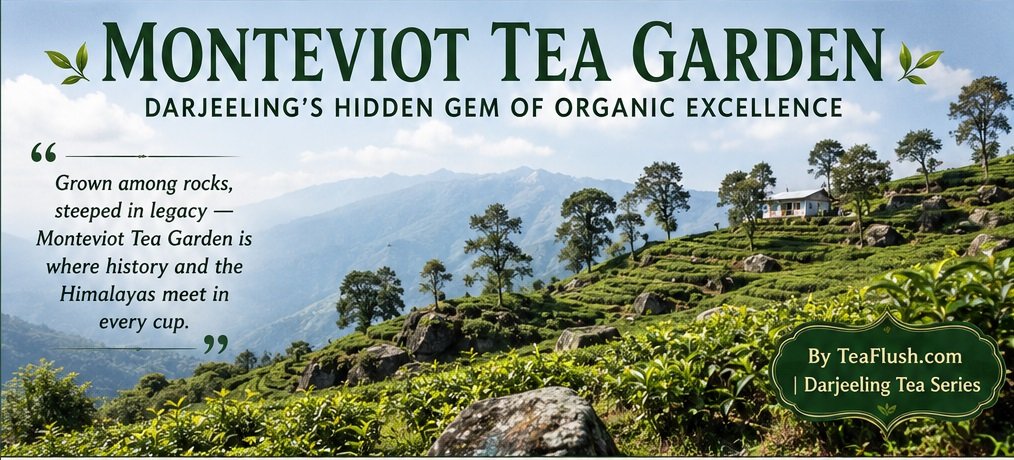
Monteviot Tea Garden: Darjeeling’s Hidden Gem of Organic Excellence
By TeaFlush.com | Darjeeling Tea Series
“Grown among rocks, steeped in legacy — Monteviot Tea Garden is where history and the Himalayas meet in every cup.”
Table of Contents
Introduction
Tucked into the mist-kissed slopes of the northern Kurseong Valley in Darjeeling, West Bengal, Monteviot Tea Garden is one of India’s oldest, most storied, and most celebrated organic tea estates. Established in 1856, this compact yet remarkably productive garden covers 88 hectares (220 acres) of some of the most breathtaking terrain in the Darjeeling Himalayan hill region.
Monteviot is not merely a tea garden — it is a living chronicle of colonial history, ecological redemption, and artisanal craftsmanship. Its teas are prized by connoisseurs around the world for their extraordinary flavour complexity, and its story is one of dramatic revival after near-collapse.
At TeaFlush.com, we believe that understanding where your tea comes from transforms every sip into something richer. So, let’s take a deep dive into everything you need to know about Monteviot Tea Garden — from its rocky roots to the golden cup it produces.
What Does “Monteviot” Mean?
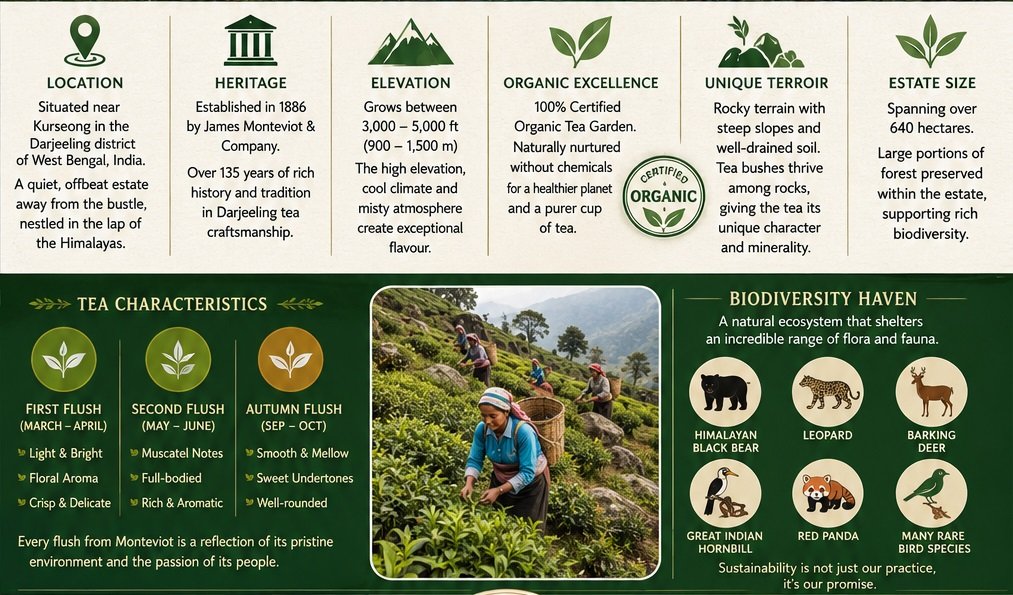
The name “Monteviot” is derived from a French word meaning ‘rock’ — a fitting name for a tea garden perched dramatically on the rocky, mineral-rich slopes of the Darjeeling hills. The rugged terrain that gives the garden its name is also integral to what makes its teas so uniquely complex. The well-drained rocky soils, combined with high altitude and misty climate, are the very conditions that impart Darjeeling teas with their legendary character.
Interestingly, the name also echoes across the globe — there is a famous Monteviot House and estate in the Scottish Borders, Roxburghshire, though the two locations are entirely unrelated. The Darjeeling garden stands entirely on its own identity.
Location & Geography
| Detail | Information |
|---|---|
| Region | Kurseong South, Darjeeling District, West Bengal, India |
| Subdivision | Kurseong CD Block, Kurseong Subdivision |
| Distance from Kurseong Town | Less than 2 kilometres |
| Coordinates | 26°53′09″N, 88°16′09″E |
| Altitude | 950 m to 1,700 m (3,120 ft to 5,580 ft) above sea level |
| Area Under Cultivation | 88 hectares (220 acres) |
Monteviot sits below the town of Kurseong in the northern Kurseong Valley, at an elevation ranging from 950 to 1,700 metres above sea level. On a clear day, the majestic Kanchenjunga — the world’s third highest peak — can be seen rising above the horizon from the garden, a sight that fills workers and visitors alike with wonder.
The garden benefits from:
- Cool mountain temperatures that slow the growth of tea leaves, concentrating flavour
- Abundant seasonal rainfall from Bay of Bengal monsoons
- Afternoon cloud cover and mist that shields tea bushes from harsh sunlight
- Well-drained, slightly acidic rocky soils rich in minerals
- High altitude that intensifies the aromatic and chemical complexity of the leaf
These natural conditions collectively define what tea experts call the terroir of Monteviot — and it is this terroir that makes every cup unmistakably distinct.
A Brief History of Monteviot Tea Garden
The story of Monteviot Tea Garden begins in the mid-19th century, during the golden age of British tea cultivation in India.
1856 — Establishment
Monteviot was founded in 1856, making it among the very first commercial tea gardens established in the Darjeeling region. The British were expanding their tea cultivation across the Himalayan foothills at the time, having identified Darjeeling’s unique climate as ideal for growing Camellia sinensis var. sinensis — the China variety of the tea plant.
The garden was established by a British gentleman named Mr. Kerr, who reportedly built the original bungalow on the property for his wife. This colonial-era bungalow still stands today, now repurposed as a much-loved heritage homestay.
Early Legacy — Retail Innovation
As early as 1940, Monteviot created a significant industry first: it became one of the pioneering estates to market retail packs of tea packed directly at the tea garden itself, rather than sending bulk tea to external packers. This was a landmark moment in the history of tea commercialisation in India.
2004 — The Fire
In 2004, tragedy struck Monteviot when its tea processing factory was completely burnt down in a devastating fire. This catastrophic event left the garden without the means to process its leaf, sending it into serious decline and threatening the livelihoods of everyone who depended on it.
The Ambootia Rescue
After the fire left the estate ailing, the Ambootia Group stepped in, taking over the garden and embarking on a full restoration — both of the estate’s infrastructure and its farming philosophy. This intervention would transform Monteviot into the certified organic and biodynamic haven it is today.
The Ambootia Group Revival
Today, Monteviot Tea Garden is owned and managed by the Ambootia Group, operating under the umbrella of Darjeeling Organic Tea Estates Private Limited (DOTEPL). The Ambootia Group is one of the most respected names in the Darjeeling tea industry, renowned for its commitment to organic farming, biodynamic agriculture, and fair trade practices.
Under the Ambootia Group, Monteviot is part of a portfolio of distinguished Darjeeling tea gardens that includes:
- Ambootia
- Chongtong
- Happy Valley
- Moondakotee
- Mullootar
- Nagri
- Noorbong
- Sepoydhurah (Chamling)
- Sivitar
- Rangmook Ceder
- Rangaroon
- Pandam
- Aloobari
The Group’s vision of converting all its gardens to fully organic and biodynamic systems has been thoroughly realised at Monteviot, where no synthetic fertilisers or pesticides are used — instead, natural composting, biodynamic preparations, and a deep respect for the land define every farming decision.
Certifications: Organic, Biodynamic & Fairtrade
Monteviot Tea Garden holds three internationally recognised certifications that set it apart as a model of ethical and sustainable tea production:
✅ Certified Organic by IMO
The Institute for Marketecology (IMO) organic certification confirms that Monteviot’s teas are grown entirely without synthetic chemicals. The garden adheres to strict guidelines that prohibit the use of artificial fertilisers and pesticides, relying instead on natural soil amendment techniques.
✅ Certified Biodynamic by Demeter
Demeter International is the world’s foremost certifying body for biodynamic agriculture. Biodynamic farming goes beyond organic — it treats the farm as a living, self-sustaining ecosystem. At Monteviot, biodynamic principles guide everything from planting schedules (often aligned with lunar and cosmic rhythms) to the use of specially prepared natural compost formulations. This approach creates extraordinarily healthy, biodiverse soils that produce teas of exceptional complexity.
✅ Certified Fairtrade by FLO International
The Fairtrade Labelling Organisations International certification recognises Monteviot’s commitment to fair wages, safe working conditions, and improved social and living standards for all estate workers and their families. This means that every Fairtrade-certified Monteviot tea you buy contributes directly to the wellbeing of the people who grow it.
Tea Cultivars & Tea Bush Varieties
One of the defining characteristics of Monteviot Tea Garden is that almost all of its tea bushes belong to the China cultivar (Camellia sinensis var. sinensis). This is the original tea variety brought to Darjeeling by the British in the 1840s–1850s, and it is responsible for the lighter, more aromatic, and florally complex character that distinguishes Darjeeling teas from the bolder, maltier Assam variety (var. assamica).
The China cultivar thrives at high altitudes, grows more slowly than the Assam variety, and produces smaller but profoundly flavourful leaves. Its unhurried growth rate is a key reason why Darjeeling teas are produced in relatively small quantities — a hallmark of their rarity and premium status.
Types of Tea Produced
Monteviot Tea Garden primarily produces the following types of tea:
🍵 Black Tea (Primary Production)
The majority of teas produced at Monteviot are black teas, harvested across three distinct seasonal flushes:
- First Flush (Spring: March–May)
- Second Flush (Summer: June–August)
- Autumn Flush (Autumn: October–November)
🟢 Organic Green Tea (Occasional Production)
Monteviot also occasionally manufactures organic green teas, showcasing the versatility of the estate’s leaf and its skilled tea makers. The Wikipedia entry on Monteviot specifically notes green tea as a core production type of the estate.
Annual Production
The garden produces approximately 25 tonnes of tea per year from its 220 acres — a deliberately modest output that reflects the premium, artisanal approach of the estate. Quality over quantity is the Monteviot philosophy.
Flavour Profile of Monteviot Tea
Monteviot teas are consistently praised by global tea experts and connoisseurs for their extraordinary complexity and elegance. The flavour profile varies by flush but shares certain hallmarks of the estate’s terroir:
First Flush (Spring Harvest)
The first flush is the most celebrated of Monteviot’s seasonal harvests. Classified as FTGFOP1 (Finest Tippy Golden Flowery Orange Pekoe Grade 1) — the highest quality grade in Indian tea classification — it features:
- Appearance: Fine, whole leaves with green and silvery tips; brews to a beautiful, clear golden colour
- Aroma: Fresh, floral, and lightly vegetal with a sweet, uplifting character
- Flavour: Crisp, herbaceous, and bright with notes of orange blossom, honeysuckle nectar, lilac, stone fruit, and white grape
- Muscatel Character: A pronounced muscatel note — that distinctive mix of woodsy, honey, fresh grape, hay, and grassy flavours that defines the finest Darjeeling teas
- Finish: Slightly astringent, clean, and refreshingly dry — lingering pleasantly on the palate
Second Flush (Summer Harvest)
Second flush Monteviot teas are fuller-bodied and richer, often exhibiting deeper muscat grape notes and a more rounded, honey-sweet character that comes from the natural stressing of the tea plant by leaf-feeding insects during the warmer months.
Autumn Flush
Autumn flush teas from Monteviot tend to be mellow, earthy, and balanced — a gentler expression perfect for those who prefer their Darjeeling without the brightness and astringency of spring harvests.
The Flushes Explained
Understanding Darjeeling’s flush system is key to appreciating why Monteviot teas are so extraordinary. The tea plant (Camellia sinensis) goes through periods of active growth and dormancy throughout the year. Each harvest period, or “flush,” produces tea with its own unique character:
| Flush | Season | Harvest Period | Character |
|---|---|---|---|
| First Flush | Spring | March – May | Light, floral, fresh, astringent |
| Second Flush | Summer | June – August | Richer, musky, muscatel |
| Monsoon / Rain Flush | Monsoon | July – September | Bold, less nuanced |
| Autumn Flush | Autumn | October – November | Mellow, earthy, balanced |
Darjeeling tea carries a Protected Geographical Indication (GI) status — similar to how Champagne is protected in the wine world. Only tea produced in specific gardens within the Darjeeling and Kalimpong districts can legally carry the Darjeeling name.
How to Brew Monteviot Tea
To get the very best from your Monteviot tea, follow these brewing guidelines:
For First Flush Black Tea
- Amount: 1 level teaspoon per 6 oz (180 ml) of water
- Water Temperature: Just off the boil, approximately 90–95°C (194–203°F) — not a rolling boil
- Steep Time: 2 to 4 minutes (start with 2 minutes for your first brew)
- Vessel: Use a teapot or loose-leaf infuser to allow leaves to fully expand
- Milk & Sugar: Best enjoyed black, without milk or sugar to fully appreciate the delicate floral and muscatel notes
- Re-steeping: The finest first flush Darjeelings can be infused twice
Pro Tips from TeaFlush
- Store your Monteviot first flush in an airtight, non-transparent container — the vibrant spring freshness can fade quickly if exposed to light and air
- Drink first flush as soon as possible after purchase; it is at its most magical when fresh
- Never use boiling water — it will destroy the delicate top notes and result in excessive bitterness
- If you’re steeping for the second time, increase the water temperature slightly and extend steep time by 30–60 seconds
Population & Community
Monteviot Tea Garden is not only an agricultural estate — it is also a village community within the Kurseong CD Block, Darjeeling District. According to the 2011 Census of India:
- Total Population: 743 residents
- Male Population: 357 (48%)
- Female Population: 386 (52%)
- Children (Ages 0–6): 40
- Literacy Rate: 82.91% (616 literate persons out of the population above age 6)
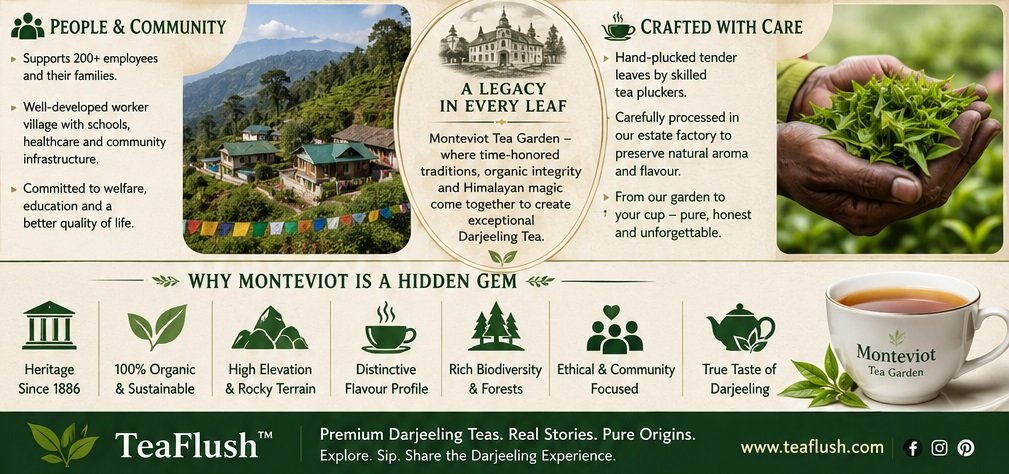
The community living within the tea garden is central to its identity. The estate’s Fairtrade certification ensures that the men and women who pluck, sort, and process the tea receive fair wages and access to improved healthcare, education, and housing facilities.
Visiting Monteviot: Homestay & Tourism
If you dream of waking up amid rows of emerald tea bushes with the Kanchenjunga glowing at dawn, Monteviot makes that dream possible.
11 Monteviot — Heritage Luxury Homestay
The original colonial-era bungalow on the estate — 11 Monteviot — has been lovingly restored into a celebrated luxury self-catering homestay that has become a word-of-mouth favourite among travellers seeking an authentic Himalayan tea country experience.
Key highlights of the homestay:
- Built in 1856 by Mr. Kerr, the estate’s British founder
- Situated in Kharsang, known locally as the “land of white orchids”
- Large windows and private balconies opening directly onto the tea garden
- Breathtaking views of snowy Kanchenjunga peaks and the Balasun River
- Intimate, personalised hosting — not a hotel, but a genuine home
Nearby Distances:
- Kurseong Town: ~2 km
- Tiger Hill: ~27 km
- Ghum Monastery: ~24 km
- Bagdogra International Airport: ~38 km
Guests consistently rave about the food, the views, the peace, and the incomparable sensation of drinking fresh Monteviot tea while gazing out at the very garden it came from. Couples in particular rate the property very highly for romantic getaways.
Monteviot Tea on the World Stage
Despite its small size and modest annual production, Monteviot Tea Garden punches far above its weight on the global tea stage. Its teas are exported and sold by specialty tea retailers across the United States, Europe, and Japan — countries that prize single-estate, traceable, high-quality artisanal teas.
Retailers and tea connoisseurs specifically seek out Monteviot’s:
- FTGFOP1 First Flush for its extraordinary floral complexity
- Organic and biodynamic credentials for health-conscious and ethically minded consumers
- Fairtrade certification for those committed to supporting fair wages and sustainable livelihoods
The estate’s tea has been described as producing “all the wonderful qualities of an exceptional first flush” — a true ambassador of what Darjeeling tea can be at its finest.
Frequently Asked Questions
Where is Monteviot Tea Garden located?
Monteviot Tea Garden is located in the northern Kurseong Valley, within the Kurseong subdivision of Darjeeling District, West Bengal, India. It is less than 2 km from Kurseong town.
When was Monteviot Tea Garden established?
Monteviot Tea Garden was established in 1856, making it one of the oldest tea gardens in the Darjeeling region and in India.
Who owns Monteviot Tea Garden?
Monteviot Tea Garden is currently owned and operated by the Ambootia Group, under the umbrella company Darjeeling Organic Tea Estates Private Limited (DOTEPL).
Is Monteviot Tea Garden organic?
Yes. Monteviot Tea Garden is certified organic by IMO, biodynamic by Demeter, and Fairtrade certified by FLO International. All teas produced there are grown without synthetic fertilisers or pesticides.
What types of tea does Monteviot produce?
Monteviot primarily produces organic black teas across three seasonal harvests (First Flush, Second Flush, and Autumn Flush). It also occasionally produces organic green teas.
What does Monteviot First Flush taste like?
Monteviot First Flush is lively, fresh, and floral, with notes of orange blossom, honeysuckle, lilac, stone fruit, and white grape, and a characteristic muscatel finish. It is classified as FTGFOP1 — the highest grade of Indian tea.
Can I visit Monteviot Tea Garden?
Yes! The original colonial bungalow on the estate — 11 Monteviot — operates as a luxury homestay, offering guests an intimate, immersive experience surrounded by the tea garden with spectacular mountain views.
What does “Monteviot” mean?
The name Monteviot is derived from a French word meaning ‘rock’, reflecting the rugged, rocky terrain on which the garden is situated.
Why did Monteviot Tea Garden nearly close?
In 2004, the tea processing factory at Monteviot was completely destroyed by fire, sending the estate into decline. It was subsequently revived by the Ambootia Group, which rebuilt the factory and converted the garden to organic and biodynamic farming.
How much tea does Monteviot produce annually?
Monteviot Tea Garden produces approximately 25 tonnes of tea per year from its 88-hectare estate — a deliberately small output in keeping with its artisanal, quality-first ethos.
Final Thoughts
Monteviot Tea Garden is, in every sense, a remarkable place. Born from rocky Himalayan slopes in the colonial era of 1856, it survived fire and near-collapse to emerge as one of Darjeeling’s most celebrated certified organic and biodynamic estates. Under the stewardship of the Ambootia Group, it now produces some of the most sought-after first flush teas on the planet — teas that carry the soul of the land in every cup.
When you drink a cup of Monteviot First Flush, you are not just tasting tea. You are tasting 170 years of history, the mineral clarity of Himalayan rock, the misty embrace of the Kurseong Valley, and the dedication of an entire community of tea workers and farmers committed to growing something extraordinary.
At TeaFlush.com, we celebrate teas like Monteviot because they remind us why tea is not just a beverage — it is a story. And Monteviot has one of the most compelling stories in the world of tea.
Explore more Darjeeling tea garden profiles, brewing guides, and tasting notes at TeaFlush.com.
Tags: Monteviot Tea Garden, Darjeeling Tea, Organic Darjeeling Tea, First Flush Darjeeling, Biodynamic Tea, Kurseong Tea Gardens, FTGFOP1 Tea, Ambootia Group, Fairtrade Tea India, Best Darjeeling Tea Gardens, Single Estate Tea, TeaFlush
© TeaFlush.com — Your Guide to the World’s Finest Teas