Published on TeaFlush.com | Category: Tea Gardens of India | Reading Time: ~10 minutes
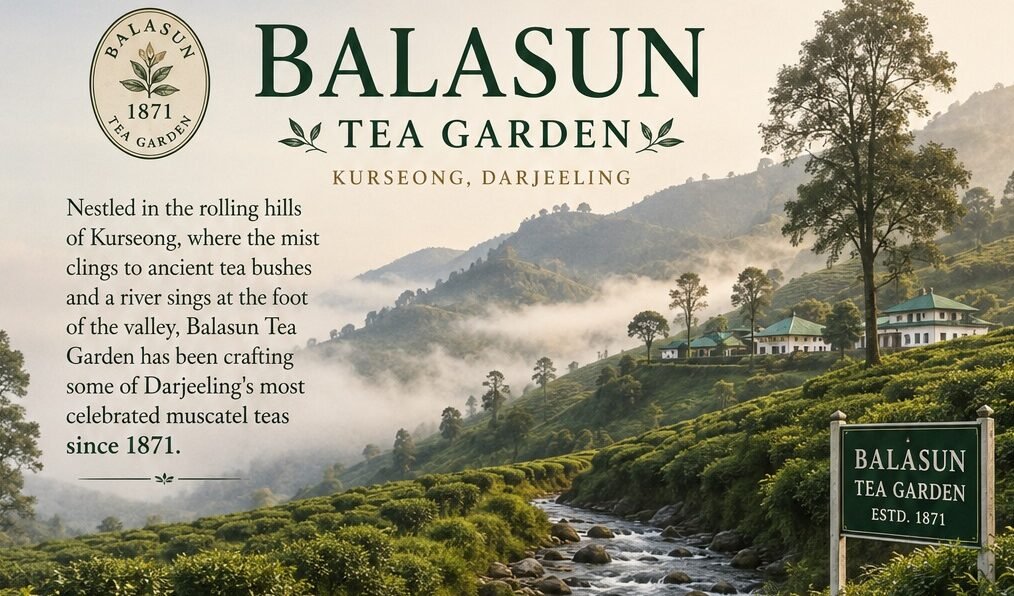
Nestled in the rolling hills of Kurseong, where the mist clings to ancient tea bushes and a river sings at the foot of the valley, Balasun Tea Garden has been crafting some of Darjeeling’s most celebrated muscatel teas since 1871.
Table of Contents
What Is Balasun Tea Garden?
Balasun Tea Garden is one of the most distinguished tea estates in the Kurseong subdivision of Darjeeling district, West Bengal, India. Recognized by the Tea Board of India as one of Darjeeling’s 87 operational estates, Balasun is celebrated for producing teas with a fuller body and unmistakable muscatel character — a hallmark that sets it apart from high-altitude Darjeeling gardens.
Sprawling across 181.38 hectares (approximately 448 acres) of gently sloping hills, the estate is currently managed by Jay Shree Tea & Industries Ltd., part of the prestigious B.K. Birla Group. With an annual production of over 100,000 kg of organic Darjeeling tea, Balasun is both a heritage estate and a modern benchmark for ethical, quality-driven tea cultivation.
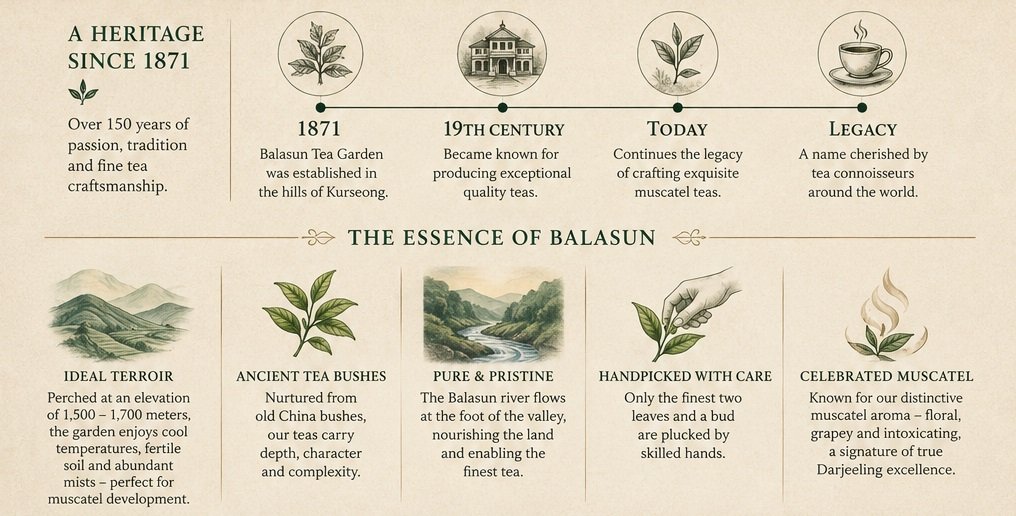
A Brief History of Balasun Tea Estate
Origins in the British Colonial Era (1871)
Balasun Tea Garden was established in 1871 by M/s Devenport & Company Ltd., during the golden age of British tea cultivation in the Darjeeling hills. At its inception, the estate was known as “Nahore Balasun” — a name derived from the Lepcha dialect, the language of one of the indigenous communities of the Darjeeling region.
The name was later simplified to “Balasun”, after the Balasun River that flows gracefully through the lower reaches of the garden, giving the estate both its identity and a natural lifeline.
Changing Hands Through the Decades
Like many of Darjeeling’s storied tea estates, Balasun passed through several ownerships over the course of the 20th century:
| Year | Milestone |
|---|---|
| 1871 | Founded by M/s Devenport & Company Ltd. as Nahore Balasun Tea Estate |
| 1963 | Taken over by M/s Darjeeling Consolidated Tea Company Ltd. (Bajoria Group) |
| 2005 | Acquired by Jay Shree Tea & Industries Ltd. (B.K. Birla Group) |
| 2005–Present | Modernization of factory, infrastructure, and worker welfare under Jayshree management |
The Jayshree Era: Renaissance of Quality
When Jay Shree Tea & Industries Ltd. took over in February 2005, it marked a turning point for Balasun. The new management invested heavily in:
- Complete renovation of factory buildings, roads, and staff housing
- Upgradation of the processing factory with the latest technology
- Planned afforestation programs for ecological conservation
- Regular in-filling initiatives to maintain and improve tea bush quality
- Enhanced employee welfare programs
As a direct result of these investments, Balasun’s tea per unit realisation improved substantially, and the estate earned a series of prestigious international certifications.
Location and How to Reach Balasun Tea Garden
Where Is Balasun Tea Garden Located?
Balasun Tea Estate is located in the Kurseong CD Block, under the Kurseong Subdivision of Darjeeling District, West Bengal. The estate lies near the tiny hamlet of Sonada — a charming stop on the iconic Darjeeling Himalayan Railway (Toy Train) route.
Postal Address: P.O. Sonada, Pin – 734219, Dist.: Darjeeling, West Bengal, India
Neighboring Tea Gardens
Balasun is flanked by some of Darjeeling’s most renowned estates:
- North: Moondakotee Tea Estate
- East: Margaret’s Hope Tea Estate
- West: Nagari Farm
- South: Ambootia Tea Garden
This clustering in the Kurseong sub-region contributes to the shared microclimatic advantages that make the area exceptional for tea cultivation.
How to Reach Balasun Tea Garden
By Air: The nearest airport is Bagdogra Airport (IXB), located approximately 65–70 km from the estate. Cabs and shared jeeps are readily available from the airport.
By Road: The estate is situated 7 km below NH-55A (the Siliguri–Darjeeling National Highway) near Sonada town. It is well-connected by road from Siliguri (approximately 50 km) and Darjeeling town.
By Rail (Toy Train): Sonada is a station on the UNESCO-listed Darjeeling Himalayan Railway — the beloved Toy Train. Taking the Toy Train to Sonada is arguably the most scenic and romantic way to arrive near Balasun.
Geography, Altitude & Climate
Altitude Range
One of the most defining characteristics of Balasun Tea Garden is its wide altitudinal range — from 365 metres to 1,375 metres above mean sea level. This dramatic span of over 1,000 metres within a single estate creates highly diverse growing conditions, allowing the garden to produce teas with a broad spectrum of flavor profiles.
The lower-altitude sections produce fuller-bodied teas with more robust character, while the upper sections yield more aromatic, delicate profiles — all within the same estate.
Climate
The estate experiences a classic sub-Himalayan climate:
| Season | Temperature Range |
|---|---|
| Winter | As low as 7°C |
| Summer | Up to 30°C |
Monsoon rains, cool mountain breezes, morning mist, and adequate sunshine combine to create the ideal terroir for growing Darjeeling tea. The Balasun River flowing at the base of the garden ensures natural irrigation and maintains humidity in the lower sections of the estate.
Terrain
The landscape of Balasun is defined by moderately gentle slopes with wide open valley views, quite different from the steep, cliff-like terrain of some other Darjeeling estates. This gentler topography facilitates easier cultivation while the river valley below keeps the air moist and cool.
Tea Varieties Grown at Balasun
Balasun Tea Garden cultivates a carefully balanced blend of three tea plant varieties, each contributing distinct characteristics to the final cup:
| Variety | Proportion | Character |
|---|---|---|
| Pure China (Camellia sinensis var. sinensis) | 51% | Delicate, floral, muscatel, lighter body |
| Hybrid Assam Type | 40% | Fuller body, malty notes, stronger infusion |
| Darjeeling Quality Clonal Varieties | 9% | Aromatic, nuanced, experimental premium teas |
This thoughtful blend of Chinese cultivars, Assam hybrids, and quality clonals is precisely what gives Balasun teas their signature characteristic: a fuller body than typical high-altitude Darjeeling teas, combined with the floral muscatel notes that Darjeeling is world-famous for.
The Four Flushes of Balasun Tea
Like all Darjeeling estates, Balasun harvests tea across four distinct flushes throughout the year. Each flush produces teas with dramatically different character.
🌱 First Flush (March – April)
The first flush marks the awakening of the tea garden after winter dormancy. Tender new leaves burst forth after the cold months, producing teas that are:
- Light, bright, and floral in character
- Pale golden or greenish-yellow in the cup
- Refreshing with a vegetal, spring-like freshness
- Highly prized by collectors and connoisseurs worldwide
Balasun First Flush is particularly popular among European tea enthusiasts who seek the “new season” Darjeeling experience.
☀️ Second Flush (May – June)
This is arguably Balasun’s most celebrated harvest — and for good reason. The Second Flush, plucked during the warm pre-monsoon weeks, is where Balasun truly shines:
- Rich, round, and mellow liquor
- Bright copper or amber infusion
- Pronounced muscatel character — the hallmark of great Darjeeling
- Notes of stone fruit, red plum, honey, and warm molasses
- Lifted by a gentle floral undertone
- Long, dry, satisfying finish
The Second Flush Muscatel from Balasun, often graded as FTGFOP1 (Finest Tippy Golden Flowery Orange Pekoe Grade 1), is a collector’s treasure. The manufacturing process itself is meticulous — typically involving 16 hours of withering, 67% moisture reduction, 2 hours 40 minutes of rolling and fermentation, and precise drying at 115.6°C.
🌧️ Monsoon / Rain Flush (July – October)
The monsoon flush produces teas that are:
- Bolder, earthier, and more robust
- Higher in volume but considered less premium
- Primarily used for blending purposes
- Rich and hearty, ideal for strong milk teas
🍂 Autumn Flush (October – November)
The final harvest of the year yields teas that are:
- Mellow and nuanced in character
- Full-bodied with a gentle sweetness
- Copper-toned infusion with smooth finish
- Often underrated but cherished by seasoned tea drinkers
Flavor Profile: What Makes Balasun Tea Special?
Balasun Tea Garden occupies a unique position in the Darjeeling tea landscape. Because the estate spans lower altitudes compared to gardens like Castleton or Margaret’s Hope, its teas have a distinctly fuller body while still carrying the classic Darjeeling aromatics.
Tasting Notes at a Glance
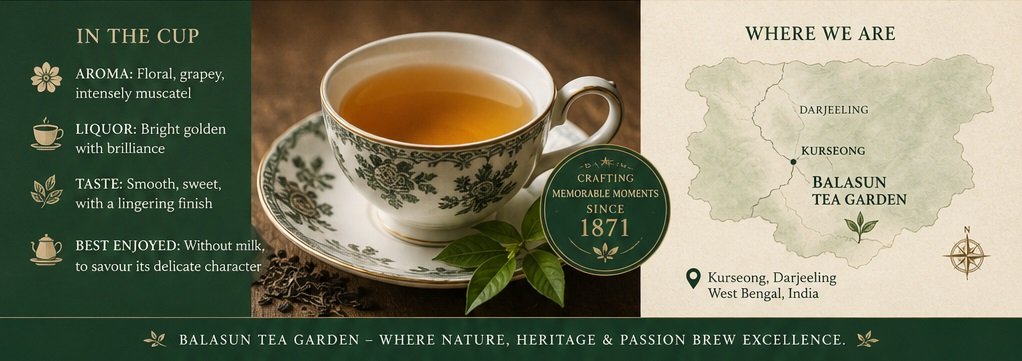
Aroma: Floral, fruity, stone fruit, subtle muscatel grape
Appearance of Leaves: Dark green, rich brown, and black-violet hues; well-rolled leaves with occasional silver tips
Liquor Color: Champagne to bright copper, depending on flush
Taste: Honey, fruity, woody, muscatel; round and mellow with an intense finish
Finish: Dry, long, satisfying — the hallmark of fine Darjeeling muscatel
The China bush component (51%) gives Balasun teas their floral elegance and muscatel lift, while the Assam hybrid element (40%) adds the body and depth that make it such a satisfying, full-flavored cup. This balance makes Balasun tea approachable for everyday drinkers while being complex enough to excite the dedicated connoisseur.
Certifications & Sustainability
Balasun Tea Garden holds an impressive array of international certifications, making it one of Darjeeling’s most ethically and environmentally responsible estates:
| Certification | Certifying Body | What It Means |
|---|---|---|
| HACCP | TUV-NORD (also SGS India) | Hazard Analysis & Critical Control Point — ensuring food safety standards |
| UTZ Certified | IMO | Responsible farming and better opportunities for tea workers |
| SAN / Rainforest Alliance | IMO | Biodiversity conservation, worker rights, and sustainable farming |
| Fair Trade | FLO-CERT | Ensures fair wages and community development for tea workers |
Together, these certifications reflect Balasun’s commitment to producing tea that is good for the earth, good for its workers, and exceptional in the cup.
The Jayshree management has also pursued planned afforestation across the estate, planting trees to conserve the local climate and protect the delicate ecosystem that makes Balasun’s tea so distinctive.
Annual Production
Balasun Tea Estate produces approximately 100,000 kg of organic Darjeeling tea annually, making it one of the more productive estates in the Kurseong subdivision while maintaining strict quality standards.
Nearby Attractions Around Balasun Tea Garden
One of Balasun Tea Garden’s great advantages is its proximity to some of the most beautiful natural and cultural attractions in the Darjeeling hills. A visit to the estate can easily be combined with:
🏔️ Tiger Hill
Famous for the most spectacular sunrise view of Kanchenjunga and the Himalayas, Tiger Hill is just a short drive from Sonada. The sight of the first rays of sunlight illuminating the snow-capped peaks is unforgettable.
🛕 Tibetan Chorten (Stupa) near Sonada
A beautiful Tibetan Buddhist stupa near the estate offers spiritual calm and a glimpse into the rich Tibetan Buddhist culture of the Darjeeling hills.
🌲 Senchel Lake & Senchel Reserve Forest
The Senchel Wildlife Sanctuary and its reservoir lake are home to a stunning array of Himalayan flora — oaks, chestnuts, walnuts, magnolias, and rhododendrons. During spring, the forest explodes with bright rhododendron blooms, cream magnolias, and orchids amidst moss-covered trees.
🌿 Chatkput Eco Village
A nearby eco-tourism destination perfect for those who want to combine their tea experience with responsible travel and immersive village life.
🚂 Darjeeling Toy Train (DHR)
Sonada is a station on the Darjeeling Himalayan Railway, a UNESCO World Heritage Site. The Toy Train journey through the hills, with views of tea gardens, mountain villages, and forest is one of the most iconic rail experiences in the world.
🐦 Bird Watching & Trekking
The forested slopes around Balasun are renowned for bird watching — the Eastern Himalayas is a globally significant biodiversity hotspot. Trekking routes in the area offer everything from gentle nature walks to challenging hill trails.
How to Brew Balasun Tea Perfectly
To truly appreciate the nuanced flavors of Balasun Darjeeling tea, brewing technique matters. Here’s how to get the best from every cup:
For First Flush Balasun Tea
- Water Temperature: 80–85°C (do not use boiling water — it scalds the delicate leaves)
- Quantity: 2–3 grams per 150 ml of water
- Steep Time: 2–3 minutes
- Serve: Without milk — enjoy the pale golden liquor and delicate florals as they are
For Second Flush / Muscatel Balasun Tea
- Water Temperature: 90–95°C
- Quantity: 2.5–3 grams per 150 ml of water
- Steep Time: 3–4 minutes
- Serve: Wonderful without milk, but a small dash of milk can round out the fuller body beautifully
General Tips
- Use filtered or spring water — the mineral quality of water significantly affects the taste of fine Darjeeling tea
- Warm your teapot before brewing
- Avoid over-steeping — Darjeeling teas can turn astringent quickly
- Store your Balasun tea in an airtight container, away from light, heat, and strong odors
- Best consumed within 2 years of the production date
Where to Buy Authentic Balasun Tea
Buying authentic Balasun Darjeeling tea requires care, as the Darjeeling tea market is unfortunately plagued by counterfeits and mislabeled products. Here are the safest options:
Official Sources:
- Jayshree Tea’s official website (jayshreetea.com / jayshreetea.in) — the estate’s direct online store offers First Flush and Second Flush Balasun teas, including limited-edition muscatels
- Darjeeling Himalayan Railway stations and authorized Darjeeling tea shops in the hills
What to Look For:
- The Darjeeling GI (Geographical Indication) logo on packaging — mandatory for genuine Darjeeling tea
- Estate name clearly printed as “Balasun Tea Estate”
- Flush type and harvest year labeled on the pack
- Valid certifications (Fair Trade, UTZ, HACCP) mentioned
Grades to Seek:
- FTGFOP1 — the finest grade, featuring tippy golden orange pekoe
- Second Flush Muscatel — the most iconic Balasun offering
FAQs About Balasun Tea Garden
Where is Balasun Tea Garden located?
Balasun Tea Garden is located in the Kurseong subdivision of Darjeeling district, West Bengal, India — near the hamlet of Sonada, about 65–70 km from Bagdogra Airport.
Q: Who owns Balasun Tea Estate? Balasun Tea Estate is currently owned and managed by Jay Shree Tea & Industries Ltd., part of the B.K. Birla Group, since 2005.
Q: When was Balasun Tea Garden established? Balasun Tea Garden was established in 1871 by M/s Devenport & Company Ltd. under its original name, Nahore Balasun Tea Estate.
Q: What type of tea does Balasun produce? Balasun primarily produces organic Darjeeling black tea across four flushes — First Flush, Second Flush (the renowned Muscatel), Monsoon Flush, and Autumn Flush. The estate plants 51% China, 40% hybrid Assam, and 9% Darjeeling quality clonal varieties.
Q: Is Balasun tea organic? Yes. Balasun Tea Estate produces 100,000 kg of organic Darjeeling tea annually and holds certifications including UTZ, SAN/Rainforest Alliance, HACCP, and Fair Trade from FLO-CERT.
Q: What is the muscatel flavor in Balasun tea? Muscatel refers to the distinctive musky, grape-like aroma and flavor found in quality Darjeeling second flush teas. At Balasun, it manifests as notes of stone fruit, honey, and a characteristic dry finish — enhanced by the estate’s unique China bush cultivars.
Q: Can I visit Balasun Tea Garden? While Balasun is a working commercial estate, the surrounding Sonada area is easily accessible to visitors. The garden’s proximity to Sonada town, the Toy Train station, Tiger Hill, and Senchel forest makes it a rewarding destination for tea and nature enthusiasts.
Q: What altitude is Balasun Tea Garden? The estate spans an altitude of 365 metres to 1,375 metres above mean sea level — one of the widest altitudinal ranges among Darjeeling tea gardens.
Final Sip: Why Balasun Belongs in Every Tea Lover’s Cup
Balasun Tea Garden represents everything that makes Darjeeling tea extraordinary. It is a place where history, geography, craftsmanship, and nature converge to produce something truly exceptional. From its origins as a colonial British estate in 1871, through decades of changing ownership, to its current renaissance under the Birla-owned Jayshree Tea management, Balasun has consistently delivered teas of remarkable character.
What makes Balasun truly special is its democratic body — it bridges the gap between the rarefied, delicate teas of the highest Darjeeling gardens and the bold, full teas of the plains. That wide altitudinal range, those ancient China bushes, and that shimmering Balasun River at the valley floor all conspire to create a tea that is both approachable and complex — a cup for every occasion.
If you have yet to try a Balasun Second Flush Muscatel, make that your next tea adventure. Its champagne-hued liquor, stone fruit nose, and long dry finish are the distilled essence of Darjeeling — and one of India’s greatest gifts to the world of tea.
At TeaFlush.com, we celebrate the stories behind every cup. Explore more about Darjeeling tea gardens, brewing guides, and curated recommendations from the finest estates in India.
Balasun Tea Garden, Darjeeling Tea Estate, Muscatel Darjeeling, Kurseong Tea Garden, Jay Shree Tea, Second Flush Darjeeling, Organic Darjeeling Tea, Darjeeling Tea Flushes, Sonada Tea Garden, India Tea Estates, Darjeeling GI Tea, FTGFOP1 Darjeeling
Explore Balasun Tea Garden — Darjeeling’s heritage estate established in 1871, known for its exceptional muscatel second flush teas, organic certifications, and breathtaking Himalayan terroir near Sonada. A complete guide on TeaFlush.com