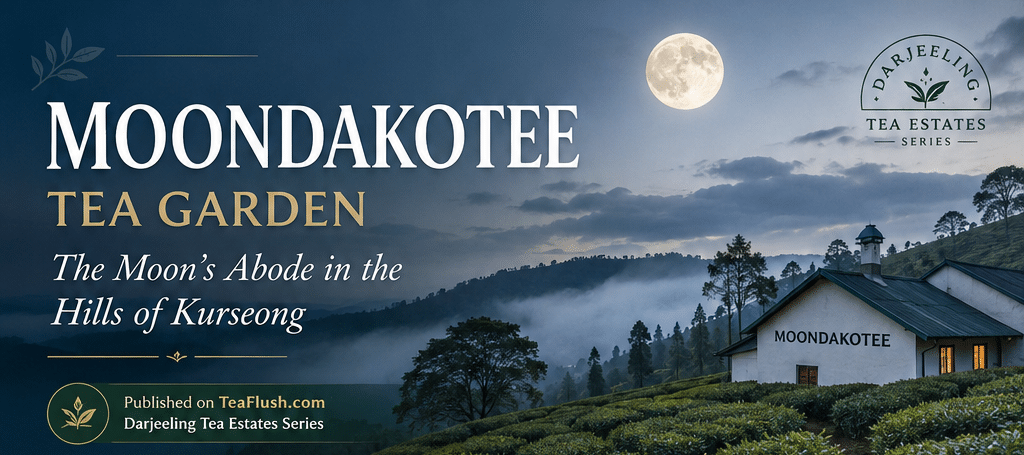
Moondakotee Tea Garden: The Moon’s Abode in the Hills of Kurseong
Published on TeaFlush.com | Darjeeling Tea Estates Series
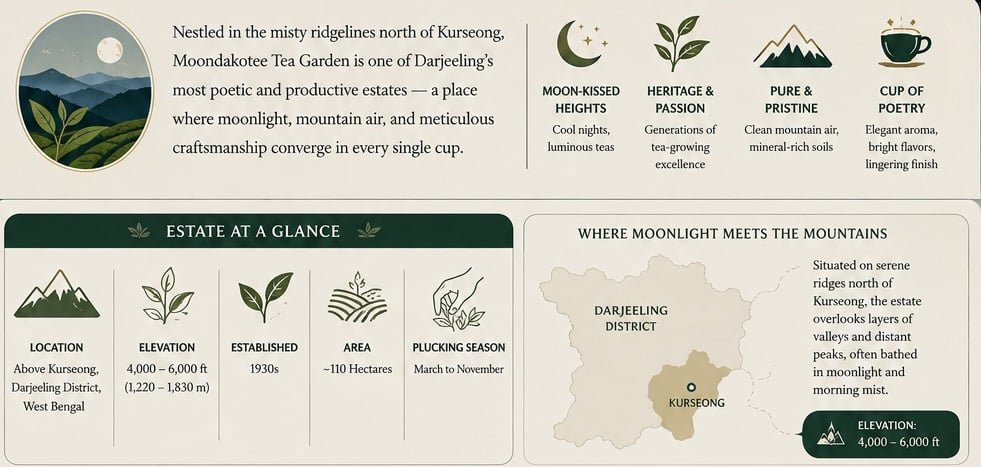
Nestled in the misty ridgelines north of Kurseong, Moondakotee Tea Garden is one of Darjeeling’s most poetic and productive estates — a place where moonlight, mountain air, and meticulous craftsmanship converge in every single cup.
Table of Contents
What Does “Moondakotee” Mean?
The name Moondakotee (also spelled Moonda Kotee or Mondakotee) is rooted in the local hill dialect and translates poetically to “moon’s abode” or “the sanctuary of the moon.” Some sources describe it as “the refuge of the moon.”
This is no arbitrary name. The garden is situated on a spur of Tiger Hill in the north Kurseong valley, where the topography creates an unusually prolonged exposure to moonlight. On clear nights, the moon bathes the tea bushes in its shimmering silver glow for hours on end — a phenomenon the local tea community has long associated with the garden’s mysteriously layered, luminous character.
For tea lovers and seekers of fine Darjeeling, the name itself is an invitation: come taste the moonlight.
Location & Geography
Moondakotee Tea Garden is located in the Kurseong (North) sub-division of Darjeeling district, West Bengal, India. Specifically, it sits on the spur between Darjeeling East and the valleys of Kurseong, approximately 30 kilometres from the town of Darjeeling.
Key Geographic Facts
| Feature | Details |
|---|---|
| Location | North Kurseong Valley, West Bengal |
| Region Classification | Kurseong (North) Sub-division |
| Topographic Position | Spur on Tiger Hill, between Darjeeling East and Kurseong valleys |
| Distance from Darjeeling | ~30 km |
| Access | Via Kurseong town or from Siliguri/Bagdogra |
The garden is wrapped in the classic Darjeeling microclimate: cool rolling breezes from the higher ridges, frequent morning mist, well-drained mountain soils, and seasonal monsoon rains. This combination is exactly what makes the Kurseong North belt so special — the cool air slows leaf growth, concentrating flavour and aroma in every bud and leaf.
The estate’s position on Tiger Hill is particularly significant. The spur formation channels morning mist through the plantation while allowing afternoon sun to warm the soil, creating ideal diurnal temperature variation — a key driver of Darjeeling tea’s famous complexity.
A Brief History of Moondakotee Tea Garden
Moondakotee is one of Darjeeling’s historic tea estates, with its origins tracing back to the mid-nineteenth century era of British tea plantation expansion across the Darjeeling hills. Most sources date its establishment to around 1852–1862, placing it squarely in the pioneering generation of Darjeeling tea gardens.
The history of the Darjeeling tea industry itself provides the backdrop. When the British administration began developing tea nurseries in 1847, the hill regions of Kurseong and Darjeeling rapidly became targets for commercial tea cultivation. By 1866, Darjeeling had approximately 39 gardens producing 21,000 kilograms of tea annually. Moondakotee was among the gardens established in this formative era.
For over a century, Moondakotee produced fine Darjeeling teas under various ownerships. By the late twentieth century, however, like many heritage estates, it faced the challenges of ageing infrastructure, difficult labour economics, and dwindling investment. The garden underwent a period of difficulty before being rescued and revitalised in the early 2000s.
The transformation that followed — from a struggling heritage estate to a certified organic, biodynamic model garden — is one of the quiet success stories of the Darjeeling tea world.
Ownership & Management
In 2004, Moondakotee Tea Estate came under new management, marking a turning point in its modern history. The garden is part of the Darjeeling Organic Tea Estates Private Ltd. (DOTEPL) portfolio, managed under the larger Ambootia Group led by Mr. Sushil Agarwal of Lemongrass Organic Tea Estates Pvt. Ltd.
This group manages a collection of historic Darjeeling tea estates, including:
- Ambootia Tea Estate
- Chongtong Tea Estate
- Happy Valley Tea Estate
- Monteviot Tea Estate
- Moondakotee Tea Estate
- Mullootar Tea Estate
- Nagri Tea Estate
- Sepoydhoorah (Chamling) Tea Estate
- Sivitar Tea Estate
The Ambootia Group is widely known for reviving ailing and closed Darjeeling tea estates, converting them into certified organic plantations and improving conditions for tea workers. Moondakotee is a flagship example of this revival philosophy.
After the 2004 takeover, the entire concept of the estate was fundamentally reimagined: synthetic inputs were phased out, biodynamic cultivation methods were introduced, and the factory was upgraded to international food safety standards.
The Plantation: Scale, Terrain & Cultivation
Moondakotee is a sizeable estate by Darjeeling standards.
| Metric | Figure |
|---|---|
| Total Plantation Area | ~583 hectares |
| Tea Growing Area | ~300 hectares |
| Annual Production | ~140,000 kilograms of tea |
| Irrigation | Natural spring water system for select sections |
The tea bushes are predominantly of the China cultivar (Camellia sinensis var. sinensis), the classic varietal responsible for Darjeeling’s delicate, floral, and aromatic character. China bush teas grow more slowly than their Assam counterparts and produce smaller, more complex leaves — but the flavour payoff is extraordinary.
A noteworthy feature of Moondakotee is its special irrigation system that taps water from natural mountain springs in certain sections of the garden. This mineral-rich spring water, combined with the garden’s volcanic hillside soils and the extended moonlight exposure, contributes to the distinctive mineral undertone found in some Moondakotee teas.
The terrain itself is steep and varied — typical of Kurseong North — which means hand-plucking by skilled workers remains the only viable method of harvesting. This labour-intensive approach ensures only the finest leaves make it to the factory floor.
Organic & Biodynamic Farming Practices
Moondakotee Tea Garden is one of the certified organic estates in the Darjeeling district, operating under strict guidelines that eliminate synthetic fertilisers, pesticides, and herbicides.
Certifications
The DOTEPL group’s estates, including Moondakotee, carry certifications including:
- USDA Organic
- JAS (Japanese Agricultural Standard)
- IMO (Institute for Marketecology)
- HACCP (Hazard Analysis and Critical Control Points)
These are among the most rigorous certification standards in global food production and reflect a genuine commitment to clean, traceable tea.
Biodynamic Cultivation
Beyond standard organic farming, Moondakotee follows biodynamic principles, a holistic approach to agriculture that treats the farm as a self-sustaining ecosystem. Key practices include:
- Natural composting using on-estate materials to enrich the soil
- Biodiversity cultivation to maintain healthy insect populations and plant ecology
- Lunar calendar farming — planting, pruning, and harvesting aligned with moon phases (fitting, given the garden’s name!)
- No synthetic chemical inputs of any kind
- On-farm livestock that contributes to composting and soil health
The biodynamic approach is particularly significant for Moondakotee because it connects the garden’s ancient name — moon’s abode — to a genuinely moon-aware agricultural practice. This is not marketing poetry; the estate takes its relationship with lunar cycles seriously in its cultivation calendar.
Tea Production at Moondakotee
Like all fine Darjeeling gardens, Moondakotee’s teas are organised by flush season — the period in which the leaves are harvested. Each flush produces teas with dramatically different character.
First Flush (March – April)
The First Flush is the most anticipated harvest of the year. After the dormant winter months, the tea bushes awaken in early spring and put out their first tender shoots. Moondakotee’s First Flush teas are characterised by:
- Light, bright, and lively character
- Floral and vegetal notes
- Fresh, crisp liquor with minimal astringency
- A luminous, greenish-gold cup colour
First Flush teas from Moondakotee are especially prized by Japanese and European buyers who favour their delicacy and aromatic lift.
Second Flush (May – June)
The Second Flush is the peak of Darjeeling’s muscatel season. The warm summer sun brings out the garden’s fuller, more complex side:
- Richer, fuller-bodied liquor
- Classic muscatel notes — that distinctive musky-sweet quality unique to Darjeeling
- Fruity undertones of apricot, white currant, and stone fruit
- A warm amber or sequoia-brown cup colour
The Second Flush is what many tea connoisseurs consider the truest expression of a Darjeeling garden’s identity.
Monsoon / Rain Flush (July – September)
Heavy rains during the monsoon season produce teas with a bolder, more robust character, typically used in blending or offered at accessible price points. Some estates, including Moondakotee, produce specialty monsoon lots that showcase the garden’s structure even under these growing conditions.
Autumn Flush (October – November)
The Autumn Flush — also called the autumnal — is a hidden gem. Harvested as the rains recede, these teas develop a copper-bronze liquor with earthy, mellow sweetness and a smooth, rounded finish. Moondakotee’s autumn teas have found particular appreciation among European connoisseurs.
Tea Grades at Moondakotee
Moondakotee produces orthodox teas across standard Darjeeling grades:
- SFTGFOP1 – Special Finest Tippy Golden Flowery Orange Pekoe (Grade 1) — the highest and most coveted grade
- FTGFOP – Finest Tippy Golden Flowery Orange Pekoe
- TGFOP – Tippy Golden Flowery Orange Pekoe
- Organic black teas, green teas (occasional)
Tasting Notes: What Does Moondakotee Tea Taste Like?
Moondakotee teas are known for their luminous, layered, and aromatic character — a reflection of the garden’s unique terroir, biodynamic farming, and expert craftsmanship. Here is what the finest palates have noted:
Dry Leaf
The tender buds and young leaves carry fruity fragrances — notes of mangosteen, nashi pear, lychee honey, and candied tamarind can be detected on the dry leaf, depending on the flush.
Infused Leaf
When the leaves unfurl in hot water, they release aromas of fresh hazelnut, wild orchid under morning dew, and the sweet scent of a first-harvest Mirabelle plum.
The Liquor (Cup)
The brewed cup is where Moondakotee truly shines:
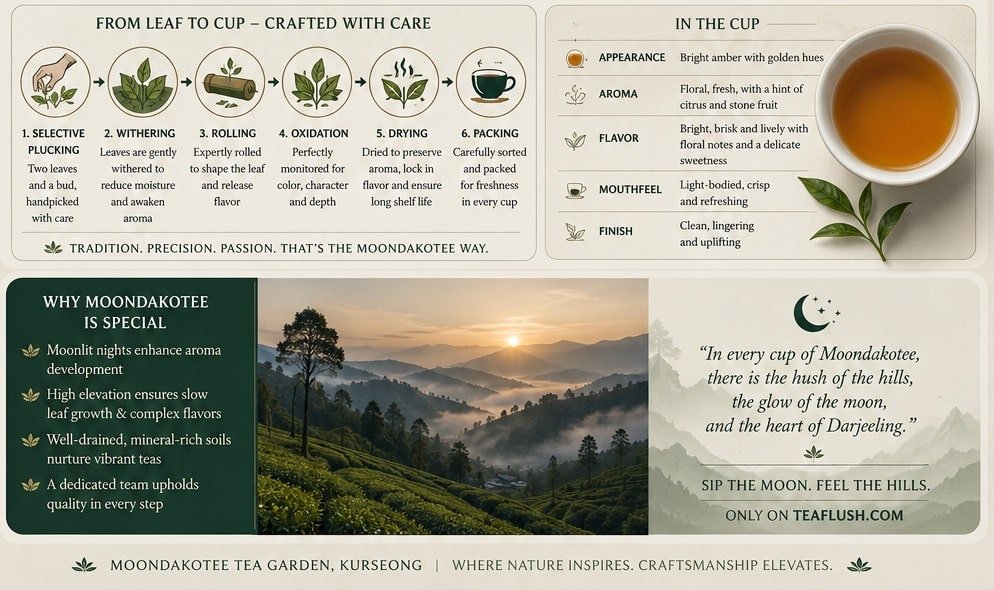
- Colour: Sparkling amber to sequoia brown, clear and crystalline
- Aroma: Fruity-floral with notes of apricot, bergamot, and white currant
- Flavour: A silky, creamy sensation — vanilla ganache, blood peach, and sweet floral notes reminiscent of a springtime meadow
- Finish: Long, persistent, with a delicate brume of vetiver and a zesty citrus lift
In one word: luminous. Moondakotee teas tend to have that rare quality of brightness — in colour, aroma, and flavour — that makes them deeply memorable and highly collectible.
Moondakotee’s Social & Community Initiatives
True sustainability means caring for people, not just plants. Moondakotee Tea Estate, under its current management, has demonstrated a genuine commitment to the communities surrounding the garden.
Drinking Water Supply
The estate is actively involved in the drinking water supply of multiple villages in the surrounding area, ensuring that local communities have access to clean water — a critical resource in remote hillside villages.
Free Milk for Children
Moondakotee operates a livestock farm on the estate that, among other purposes, provides free milk to children in the local community. This directly addresses nutritional needs of families dependent on the tea garden economy.
Worker Welfare
As part of the Ambootia/DOTEPL group, Moon dakotee workers have access to welfare amenities consistent with the group’s broader commitment to improving quality of life on its tea estates. This includes housing, healthcare support, and food access for workers and their families.
These initiatives reflect a model of tea production that goes beyond commodity output — treating the garden as an integrated community, not just a commercial enterprise.
Moondakotee on the World Stage
Moondakotee Tea Garden has earned recognition among the world’s finest tea buyers and connoisseurs. Notably:
- The garden’s teas are featured by Mariage Frères, the legendary Parisian tea house, as a Jardin Premier (Premier Garden) selection — one of the most prestigious designations in fine tea retail. Mariage Frères describes it as a garden that soaks in the beneficent virtues of the Moon and sources its finest seasonal lots for European markets.
- German specialty tea brand Samova has featured Moondakotee as part of its premium organic Darjeeling offerings, highlighting the garden’s biodynamic credentials.
- Moondakotee is listed among the 87 official Darjeeling Tea Gardens recognised by the Tea Board of India, the regulatory body that controls the prestigious Darjeeling GI (Geographical Indication) tag.
This international recognition places Moondakotee in elite company alongside Darjeeling legends like Castleton, Margaret’s Hope, and Makaibari.
How to Buy Moondakotee Tea
Moondakotee teas are available through several channels, though they require a little seeking out — which is part of their charm:
Where to Find Moondakotee Teas
- Specialty tea retailers online — search specifically for “Moondakotee First Flush” or “Moondakotee SFTGFOP1”
- Mariage Frères (Paris & online) — they carry seasonal Moondakotee jardin premier lots
- DOTEPL / Ambootia Group direct
- German and European specialty importers — Samova and similar brands often carry Moondakotee organics
- Indian tea auction portals — Moondakotee lots appear regularly in the Kolkata Tea Auction
What to Look For on the Label
When buying Moondakotee tea, look for:
- ✅ Estate name: Moondakotee (or Moonda Kotee / Mondakotee)
- ✅ Flush season and year (e.g., “First Flush 2024”)
- ✅ Grade: SFTGFOP1 for top-tier lots
- ✅ Organic certification mark (USDA, JAS, IMO)
- ✅ Darjeeling GI tag certification
Vintage matters enormously in fine Darjeeling. A 2023 or 2024 Second Flush from Moondakotee can taste quite different from a 2022 lot due to rainfall, temperature, and seasonal variation. When in doubt, buy from a trusted specialist.
Brewing Guide: Getting the Most from Your Moondakotee Tea
Moondakotee teas reward careful brewing. Follow these guidelines to unlock their full spectrum of flavour.
How to use?
Recommended Brewing Parameters
| Parameter | First Flush | Second Flush | Autumn |
|---|---|---|---|
| Water Temperature | 80–85°C (176–185°F) | 85–90°C (185–194°F) | 90°C (194°F) |
| Leaf Quantity | 2.5g per 200ml | 2.5g per 200ml | 2–3g per 200ml |
| Steeping Time | 2–3 minutes | 3–4 minutes | 3–4 minutes |
| Milk? | No | Optional (light) | Optional |
| Sugar? | No — enjoy pure | No recommended | No recommended |
| Re-steeps | 1–2 additional steeps | 1 additional steep | 1 additional steep |
Key Tips
Use fresh, filtered water. Chlorinated tap water will dull the delicate aromatics of a fine Darjeeling. Spring water or filtered water is ideal — fittingly, just like the natural spring water that partly irrigates Moondakotee itself.
Don’t over-brew. First Flush especially is delicate. Exceeding 3 minutes can bring out unwanted bitterness and mask the floral lift that makes these teas special.
Try multiple infusions. High-grade Moondakotee SFTGFOP1 can yield 2–3 excellent infusions. The second steep sometimes reveals a softer, sweeter dimension not apparent in the first.
Use a glass or white porcelain cup. The beautiful amber and golden hues of the liquor are part of the experience. Let your eyes enjoy it first.
Drink it in the morning. Moondakotee’s aromatic brightness makes it a perfect sunrise tea — as the moon retreats and the sun rises over Tiger Hill.
Frequently Asked Questions
Q: Is Moondakotee Tea certified organic?
Yes. Moondakotee Tea Estate is certified organic under multiple international standards including USDA Organic, JAS, and IMO. The garden follows biodynamic farming practices and has been verified for compliance with European food safety standards (EC No. 396/2005).
Q: Which is better — Moondakotee First Flush or Second Flush?
It depends on your taste preference. First Flush offers delicate, fresh, floral notes — ideal for those who enjoy lighter, more tea-like teas. Second Flush delivers the famous Darjeeling muscatel character with more body and complexity. Both are exceptional; many connoisseurs collect both each season.
Q: How does Moondakotee compare to other Darjeeling gardens? Moondakotee sits in the Kurseong North belt, which is known for producing teas with fine, delicate character and aromatic brightness. It is in the same high-quality zone as estates like Ambootia and Monteviot. Its biodynamic certification and relatively large production (140,000 kg/year) make it both a premium and accessible estate.
Q: What does “GI Tag” mean for Darjeeling tea? A Geographical Indication (GI) Tag is a certification that the tea is genuinely grown and manufactured in the Darjeeling district. Moondakotee, as one of the 87 officially recognised Darjeeling estates, produces authentic GI-certified Darjeeling tea.
Q: Can I visit Moondakotee Tea Garden? Moondakotee is a working estate. Visits are best arranged through the Ambootia Group / DOTEPL or through specialist tea tour operators in the Kurseong/Darjeeling region. The closest entry point is Kurseong town, about 2 km away from the broader estate zone.
Q: What is the best way to store Moondakotee tea? Store in an airtight container, away from direct light, heat, and strong odours. Do not refrigerate. Consume First Flush within 12–18 months of harvest and Second Flush within 2 years for optimum character.
Final Thoughts
Moondakotee Tea Garden is more than just a place where tea is grown. It is a living relationship between a hillside, a moon, a community, and a cup.
From its nineteenth-century origins as one of Darjeeling’s founding tea estates to its modern incarnation as a certified organic, biodynamically farmed, and socially responsible plantation, Moondakotee has earned its place among the great names of fine tea.
Every lot from this garden carries something intangible — a quality that experienced tasters describe as luminous, a brightness in the leaf and the liquor that echoes the moonlight that gave this garden its name. Whether you encounter it in a Parisian tea salon under the Mariage Frères label or ordered directly from an Indian specialty importer, the experience is unmistakable.
If you love Darjeeling tea — truly love it — then Moondakotee deserves a place in your tea cabinet.
Explore more exceptional Indian tea gardens and brewing guides on TeaFlush.com — your guide to the world’s finest teas, one flush at a time.