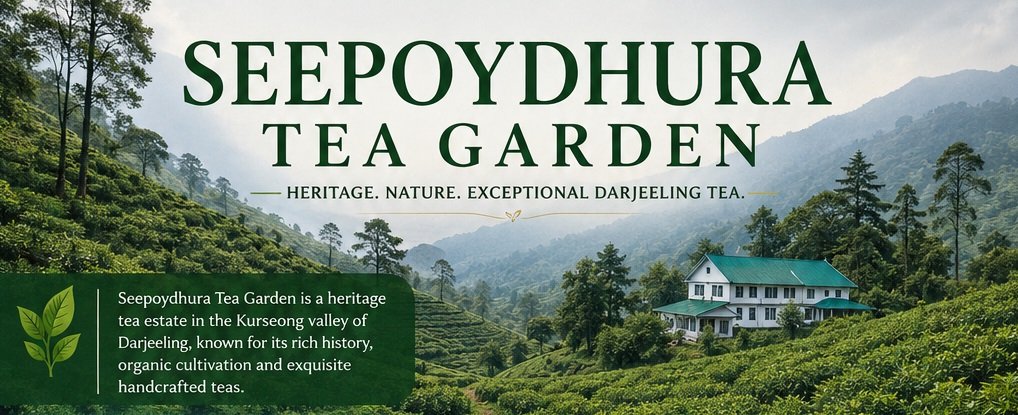
Seepoydhura Tea Garden: A Complete Guide to Kurseong’s Hidden Gem of Darjeeling Tea
Published on TeaFlush.com | Category: Tea Gardens | Reading Time: ~10 minutes
“Where the mists of Kurseong kiss the tea leaves, and every sip tells a story of the Himalayas.”
Table of Contents
1. Introduction
Nestled in the verdant hills of Kurseong South in the Darjeeling district of West Bengal, India, Seepoydhura Tea Garden — also spelled Sepoydhura, Sepoydhoorah, or Chamling Tea Estate — is one of those quietly extraordinary places that serious tea lovers seek out. Unlike the more tourist-frequented gardens such as Makaibari or Happy Valley, Seepoydhura carries an air of tranquil authenticity, producing teas that are as wholesome and organic as the pure mountain air and soil from which they grow.
If you are a tea enthusiast searching for a garden that embodies the soul of Darjeeling tea — the muscatel, the misty terroir, the sustainable ethos — then Seepoydhura deserves a prominent place on your tea map.
In this comprehensive guide, we at TeaFlush.com bring you every detail about Seepoydhura Tea Garden: its history, location, teas, flushes, organic practices, how to visit, and how to brew a perfect cup.
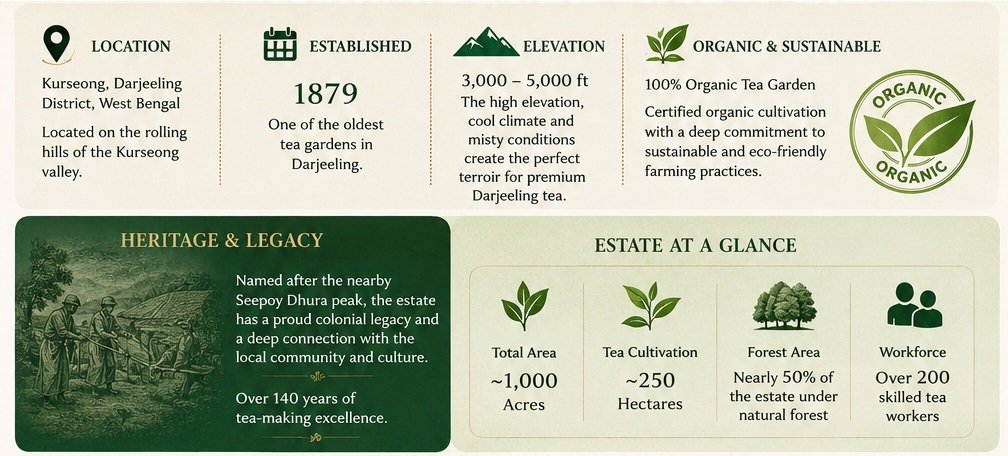
2. Where Is Seepoydhura Tea Garden?
| Detail | Information |
|---|---|
| Region | Kurseong South, Darjeeling District |
| State | West Bengal, India |
| Subdivision | Kurseong Subdivision |
| Gram Panchayat | Shivakhola |
| PIN Code | 734224 |
| Nearest Major Town | Siliguri (~17–20 km) |
| Distance from Kurseong | ~18.5 km from Kurseong town |
| Total Geographical Area | ~288.05 hectares |
Seepoydhura Tea Garden is situated in the Kurseong South cluster of Darjeeling’s famous Seven Valleys — a region celebrated for producing some of the most complex and premium teas in all of India. The garden village of Sepoy Dhura lies approximately 18.5 km from Kurseong town and about 17–20 km from Siliguri, making it accessible yet refreshingly off the beaten tourist trail.
The roads snaking their way through Kurseong are flanked on both sides by lush tea plantations, and Seepoydhura is no exception — the curvy, cloud-dappled hill roads leading to the estate offer breathtaking views of emerald-green tea bushes cascading down terraced hillsides.
Nearby Tea Gardens in Kurseong South include:
- Castleton Tea Garden
- Goomtee Tea Garden
- Jungpana Tea Garden
- Makaibari Tea Garden
- Mullootar Tea Garden
- Rohini Tea Garden
- Selim Hill Tea Garden
- Sivitar Tea Garden
- Tindharia Tea Garden
3. History of Seepoydhura Tea Garden
The story of Seepoydhura is deeply woven into the broader tapestry of Darjeeling’s colonial-era tea legacy. Like most estates in this Himalayan region, Seepoydhura was established during the British colonial period, when the East India Company — and later private British planters — developed the Darjeeling hills into the world’s most celebrated tea-growing region.
The name “Seepoydhura” (or Sepoy Dhura) is believed to have roots in the local language — dhura in Nepali meaning “hill” or “ridge,” while sepoy is an Anglicization relating to soldiers or local guards, suggesting a historical significance tied to the landscape’s colonial administration.
Key Historical Milestones:
- Colonial Era: Established as a tea garden during the British Raj, when Darjeeling’s 87 estates began transforming the Himalayan hills into a global tea powerhouse.
- Post-Independence Era: After Indian Independence in 1947, like most Darjeeling estates, Seepoydhura gradually transitioned from British to Indian ownership and management.
- Under Darjeeling Organic Tea Estates (DOTEPL): For a significant period, Seepoydhura operated under the banner of Darjeeling Organic Tea Estates Pvt. Ltd. (DOTEPL), which championed organic and biodynamic cultivation across its portfolio of estates.
- 2021 — Transfer to Lemongrass: Seepoydhura was among the first three gardens (along with Sivitar and Malatoor) that Lemongrass Organic Tea Estates Pvt. Ltd. (LOTEPL), based in Siliguri, acquired from DOTEPL — marking their entry into the Darjeeling tea industry.
- 2022 — Consolidation under LOTEPL: When DOTEPL faced significant financial distress, Lemongrass expanded further, ultimately coming to manage 9 tea estates across the Darjeeling region. Seepoydhura — also known as Chamling Tea Estate — officially became part of the LOTEPL family.
4. Geography & Climate: The Perfect Terroir
Understanding why Seepoydhura produces such distinctive tea requires understanding its terroir — the combination of geography, soil, climate, and microecology that gives Darjeeling tea its world-famous character.
Elevation & Landscape
Seepoydhura sits in the foothills of the Eastern Himalayas within the Kurseong subdivision. The Darjeeling tea gardens are broadly located between 600 and 2,000 metres above sea level, and Kurseong town itself is perched at approximately 1,458 metres (4,783 feet). The gardens of Kurseong South, including Seepoydhura, benefit from a range of elevations that influence the character of different tea lots.
Soil
The soil in Darjeeling’s tea country is slightly acidic and mineral-rich, derived from centuries of Himalayan geological processes. This, combined with ample rainfall and decomposed organic matter, creates conditions perfect for Camellia sinensis — the tea plant.
Climate & Rainfall
The region experiences:
- Heavy monsoon rainfall (July–September), which nourishes the tea bushes
- Cool, misty winters that slow growth and concentrate flavour
- Mild, sunny springs that produce the prized First Flush harvests
- Afternoon cloud cover year-round that gently shields the tender leaves from harsh sun
This climatic combination — alongside the unique high-altitude air and mountain mist — creates the terroir that makes Darjeeling tea, including that from Seepoydhura, utterly impossible to replicate anywhere else on Earth. Darjeeling tea holds a Protected Geographical Indication (GI) status, much like Champagne in France or Roquefort cheese, meaning only tea grown in this specific region can legitimately carry the “Darjeeling” name.
The River Influence
Like its neighbor Sivitar, which is nourished by the crystal waters of the Mahanadi River, Seepoydhura’s proximity to Himalayan water sources contributes to the fertile mountain soil that underpins the garden’s tea quality.
5. Teas Produced at Seepoydhura
Seepoydhura Tea Garden, operating as Chamling Tea Estate, produces a range of teas characterized by an environmentally conscious, holistic approach to cultivation. The estate is known for:
- Darjeeling Black Tea — the classic, in all its flush-season glory
- Darjeeling Green Tea — light, grassy, and revitalizing
- First Flush Darjeeling — bright, floral, and delicate
- Second Flush Darjeeling — the celebrated muscatel character
- Autumnal Flush — bold, full-bodied, and piquant
The overarching ethos of Seepoydhura’s tea production is that “the teas are as wholesome and organic as the pure air and soil that they grow in” — a philosophy that defines every stage of cultivation and processing at the estate.
6. The Four Flushes Explained
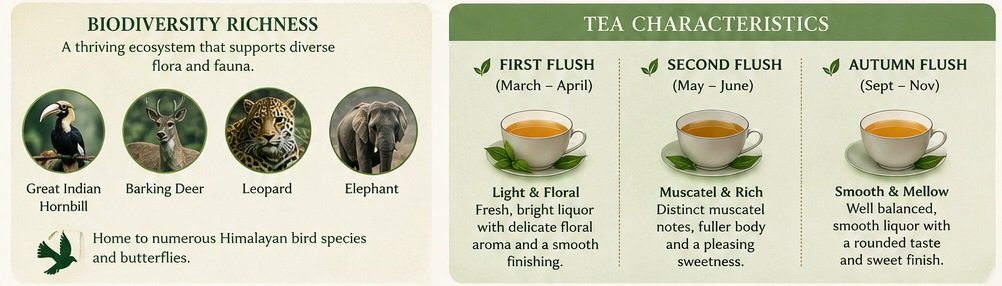
One of the most defining aspects of Darjeeling tea — and therefore Seepoydhura’s output — is the flush system, which categorizes tea by the season in which it is harvested. Each flush produces a distinctly different cup.
🌱 First Flush (March – April)
The spring harvest is the most eagerly anticipated tea event in the Darjeeling calendar. First Flush teas use the youngest, most delicate leaves that emerge after winter dormancy. Seepoydhura’s First Flush teas offer:
- A greenish, bright appearance
- Delicate, floral aromas — think jasmine, orchid, and fresh grass
- A light, almost champagne-like liquor in the cup
- A brisk, slightly astringent finish
These teas are the most expensive and are snapped up by connoisseurs in Japan, Germany, and across Europe the moment they are released.
☀️ Second Flush (May – June)
The summer harvest is what Darjeeling is arguably most famous for globally. Second Flush leaves are more mature, and the resulting tea possesses:
- The legendary muscatel flavour — a complex, grape-like, wine-y note unique to Darjeeling
- Amber to copper-coloured liquor
- Fuller body compared to First Flush
- Rich, heady aromatic notes — fruity, woody, and deeply satisfying
The muscatel character is intensified at higher altitudes and by organic farming practices — both hallmarks of Seepoydhura’s production.
🌧️ Monsoon / Rain Flush (July – September)
Produced during the heavy rains, Monsoon Flush tea is:
- More robust and bold
- Lower in price due to higher volume
- Ideal for everyday drinking or blending
🍂 Autumnal Flush (October – November)
The final harvest of the year delivers:
- Piquant, distinctive aroma
- The boldest, most robust flavour of all flushes
- Copper-toned liquor with a mellow warmth perfect for cooler months
7. Organic & Biodynamic Farming at Seepoydhura
One of the most compelling aspects of Seepoydhura Tea Garden is its commitment to organic and biodynamic agriculture — a practice that distinguishes Lemongrass Organic Tea Estates’ portfolio from conventional tea production.
What is Biodynamic Tea Farming?
Biodynamic farming goes beyond organic certification. It is a holistic, ecological approach that treats the farm as a living organism, working in tune with the rhythms of nature — lunar cycles, seasonal patterns, and ecological interdependence.
At Seepoydhura / Chamling Tea Estate, this means:
- No synthetic pesticides, herbicides, or chemical fertilizers
- Composting and natural soil nourishment
- Biodiversity conservation — natural forest buffers, wild species corridors
- Working with natural cycles to optimize harvests without depleting the land
- Healthy ecosystems that sustain not just the tea, but the entire community living and working on the estate
LOTEPL’s vision for estates like Seepoydhura is to make them “well-integrated, self-sustaining, ecologically balanced, and economically viable” — a forward-thinking model that has earned these gardens recognition among the world’s most sustainability-conscious tea buyers.
Why Does Organic Matter for Flavour?
The organic and biodynamic methods don’t just protect the environment — they directly enhance the quality of the tea leaf. By nurturing healthy soil microbiomes and allowing the tea plants to grow at their natural pace without chemical shortcuts, Seepoydhura’s teas develop greater complexity, depth, and purity of flavour than conventionally farmed equivalents.
8. Current Ownership: Lemongrass Organic Tea Estates (LOTEPL)
Seepoydhura Tea Garden (Chamling Tea Estate) is currently operated by Lemongrass Organic Tea Estates Pvt. Ltd. (LOTEPL), a joint venture between the MLA Group and the KK Group, led by Mr. Sushil Kumar Agarwal of Siliguri.
LOTEPL now manages 9 tea estates across the Darjeeling region, including marquee properties such as:
- Ambootia Tea Garden (one of India’s oldest organic and biodynamic estates)
- Happy Valley Tea Estate (Darjeeling’s second-oldest estate, established 1854)
- Sivitar Tea Garden (Kurseong)
- Chongtong, Nagri, Moondakotee, Mullootar estates
LOTEPL’s stated mission is to produce biodynamic organic tea of the highest calibre, reviving ailing estates and bringing them back to ecological and economic health. Their approach — described as “following Earth’s DNA” — has positioned them as one of the most sought-after Darjeeling tea producers on the global stage.
For Seepoydhura, this ownership brings:
- Dedicated investment in organic infrastructure
- Global export reach to premium tea markets
- Sustainability commitment embedded at every level
9. The Community & Workforce
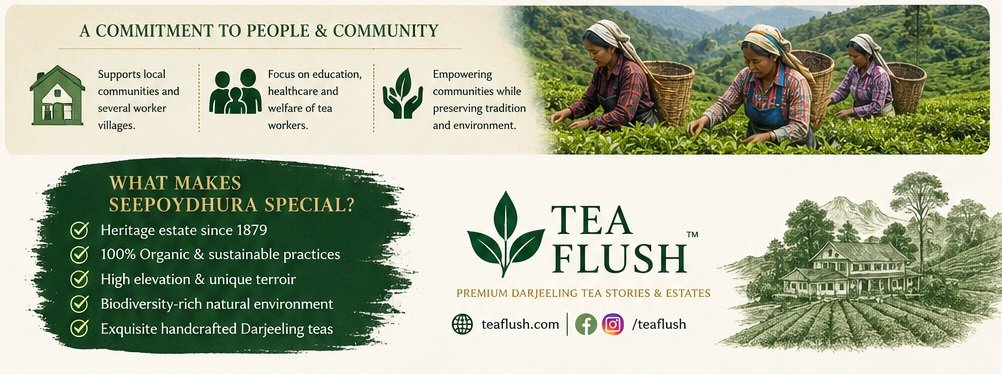
Tea gardens in Darjeeling are not just agricultural enterprises — they are self-contained communities. Seepoydhura Tea Garden is home to a village population (Sepoy Dhura Tea Garden village) of approximately 1,112 residents (as per the 2011 Census), with 249 households and a workforce of both permanent and casual tea pluckers and factory workers.
The workforce is predominantly drawn from the Gorkha and Nepali-speaking communities of the Eastern Himalayan region, whose families have tended these gardens for generations. The daily rhythm of life in Seepoydhura revolves around:
- Early morning plucking rounds — tea pickers (predominantly women) moving through the rows with baskets strapped to their backs, hand-plucking the tender two-leaves-and-a-bud
- Factory processing — withering, rolling, oxidation, drying, sorting
- Community life — schools, health facilities, and housing provided within the garden estate
Under LOTEPL’s management, there is a broader commitment to worker welfare and community integration, echoing practices seen across their estate portfolio, where subsidized essentials and improved infrastructure are prioritized alongside tea production.
10. How to Visit Seepoydhura Tea Garden
While Seepoydhura is not as prominently marketed for tourism as estates like Makaibari or Happy Valley, its raw, unspoiled charm makes it a hidden gem for intrepid tea travelers.
Getting There
- From Siliguri: Approximately 17–20 km (around 40 minutes by road) — the most common access point
- From Kurseong: Approximately 18.5 km via hill roads
- From Darjeeling: Approximately 50–60 km via Kurseong
- Nearest Airport: Bagdogra Airport, Siliguri (approximately 20–25 km)
- Nearest Railway Station: New Jalpaiguri (NJP), with the iconic Darjeeling Himalayan Railway (Toy Train) connection to Kurseong
Best Time to Visit
| Season | Why Visit |
|---|---|
| March to May | First Flush harvest in full swing; lush and green; pleasant weather |
| June | Second Flush season; witness muscatel teas being made |
| October | Autumnal Flush; post-monsoon freshness; clear skies |
The months of March to May are widely considered the best time to experience tea gardens in Darjeeling — the weather is ideal, the gardens are bursting with new growth, and the first flush process offers the most visually captivating experience.
What to Do at Seepoydhura
- Walk amidst the tea gardens and breathe in the mountain-fresh air
- Watch the tea-picking process at close quarters
- Observe the factory — withering troughs, rolling machines, oxidation chambers, drying rooms
- Tea tasting of fresh-from-the-garden Darjeeling teas
- Photography — the terraced hillsides, the pluckers in colourful attire, the mist-laden valleys
11. How to Buy Seepoydhura Tea
Seepoydhura Tea Garden’s output, marketed under the Chamling Tea Estate identity and through the LOTEPL portfolio, is available through:
- LOTEPL’s official channels (lotepl.com) for direct garden-to-consumer purchases
- Premium Darjeeling tea retailers globally — look for teas labelled “Seepoydhura,” “Sepoydhoorah,” or “Chamling Estate”
- Specialty tea boutiques in India, Germany, Japan, the UK, and the USA
- Online tea marketplaces specializing in estate Darjeeling teas
What to Look For on the Label
When buying Seepoydhura tea, look for:
- ✅ The estate name (Seepoydhura / Chamling)
- ✅ The flush (First, Second, or Autumnal)
- ✅ The year of harvest — freshness matters enormously for First Flush
- ✅ Organic certification — LOTEPL’s biodynamic and organic credentials
- ✅ The Darjeeling GI logo — a guarantee of authentic origin
12. Brewing Guide for Seepoydhura Tea
Getting the best out of a Seepoydhura tea requires respecting the delicacy of Darjeeling leaves. Here is a quick flush-by-flush brewing reference:
| Flush | Water Temp | Steeping Time | Leaf Quantity (per 200ml) | Milk? |
|---|---|---|---|---|
| First Flush | 85–90°C | 2.5–3 minutes | 2–2.5g | No — enjoy plain |
| Second Flush | 90–95°C | 3–4 minutes | 2.5g | Optional |
| Autumnal Flush | 95–100°C | 3.5–4 minutes | 2.5–3g | Yes, if desired |
Pro Tips from TeaFlush:
- Use filtered or spring water — tap water with high chlorine can mask Darjeeling’s delicate notes
- Always warm your teapot before brewing
- Never over-steep — Darjeeling can turn bitter if left too long
- First Flush especially benefits from a slightly lower temperature to preserve its floral, grassy character
- For Second Flush, allow the muscatel to breathe — let the cup sit for 30 seconds before your first sip
13. Seepoydhura vs. Other Kurseong South Tea Gardens
How does Seepoydhura stack up against its neighbours in the Kurseong South cluster?
| Tea Garden | Known For | Organic? | Visitor-Friendly? |
|---|---|---|---|
| Seepoydhura (Chamling) | Holistic organic teas, muscatel second flush | ✅ Yes (LOTEPL) | Moderate |
| Makaibari | World’s first biodynamic garden, tea tourism | ✅ Yes | ✅ Very |
| Castleton | Premium muscatel, auction records | ❌ Conventional | Limited |
| Jungpana | Rare, connoisseur-grade teas | Partial | Limited |
| Rohini | Experimental teas, specialty | ✅ Yes | Moderate |
| Sivitar | Floral teas, crystal river influence | ✅ Yes (LOTEPL) | Moderate |
Seepoydhura holds its own in this illustrious neighbourhood — its commitment to organic and biodynamic practices, combined with the characteristic Kurseong South terroir, makes its teas a worthy rival to far better-known estates.
14. Frequently Asked Questions (FAQs)
Q1: What is Seepoydhura Tea Garden also known as?
Seepoydhura Tea Garden is also known as Chamling Tea Estate or Sepoydhoorah. It is part of the Lemongrass Organic Tea Estates Pvt. Ltd. (LOTEPL) portfolio.
Q2: Where exactly is Seepoydhura Tea Garden located?
It is located in the Kurseong South sub-region of the Darjeeling District, West Bengal, India. The village spans approximately 288 hectares and has the PIN code 734224. It is about 17–20 km from Siliguri.
Q3: Is Seepoydhura Tea Garden organic? Yes. Seepoydhura Tea Garden operates under the biodynamic organic farming philosophy of LOTEPL, which prohibits synthetic chemicals and promotes ecological sustainability.
Q4: Which teas are produced at Seepoydhura? The garden produces First Flush, Second Flush, Monsoon Flush, and Autumnal Flush Darjeeling teas, predominantly black tea, with some green tea variants.
Q5: Who owns Seepoydhura Tea Garden? It is currently owned and operated by Lemongrass Organic Tea Estates Pvt. Ltd. (LOTEPL), a joint venture between the MLA Group and KK Group, led by Mr. Sushil Kumar Agarwal of Siliguri.
Q6: Can I visit Seepoydhura Tea Garden as a tourist? Yes, though it is not as developed for mass tourism as some Darjeeling estates. Visitors can take walks through the gardens, observe the tea-picking process, and sample fresh teas. The best time to visit is March to May or October.
Q7: How is Seepoydhura tea different from other Darjeeling teas? Seepoydhura’s teas reflect the Kurseong South terroir — known for nuanced, complex flavours — enhanced by biodynamic organic farming. This results in teas with exceptional purity, layered muscatel notes, and a clean, vibrant finish.
Q8: Where can I buy Seepoydhura / Chamling Estate tea? Through LOTEPL’s official channels, premium Darjeeling tea retailers in India and internationally, and specialty online tea platforms. Always look for the flush year and estate name on the label.
15. Conclusion
Seepoydhura Tea Garden — whether you know it as Chamling Estate, Sepoydhoorah, or simply as one of Kurseong South’s best-kept secrets — is a compelling destination in the world of Darjeeling tea. It embodies everything that makes this region legendary: the extraordinary Himalayan terroir, the meticulous hand-plucking and artisanal processing, the commitment to organic and biodynamic cultivation, and the deep human connection between a landscape and the generations who have tended it.
For the tea lover, Seepoydhura offers a chance to connect with tea at its most authentic — free of compromise, rich with character, and rooted in a philosophy of living in harmony with the earth. Whether you visit in person to walk the misty rows of tea bushes, or you brew a perfect cup of its First Flush at home and let the floral Himalayan notes wash over you, Seepoydhura is a tea experience you will not forget.
At TeaFlush.com, we believe that every cup of great tea carries a story — and Seepoydhura’s story is one of resilience, renewal, and extraordinary flavour.
Happy sipping. 🍵
Explore more tea garden guides on TeaFlush.com — your trusted companion for the finest teas from the hills of Darjeeling and beyond.
Related Articles You May Enjoy:
- Makaibari Tea Garden: The World’s First Biodynamic Estate
- Kurseong South Tea Gardens: A Complete Guide
- What Is Muscatel? The Flavour That Made Darjeeling Famous
- First Flush vs Second Flush Darjeeling: What’s the Difference?
- How to Brew the Perfect Cup of Darjeeling Tea
Seepoydhura Tea Garden | Chamling Tea Estate | Darjeeling Tea | Kurseong Tea Gardens | Organic Darjeeling Tea | Biodynamic Tea | Lemongrass Organic Tea Estates | Darjeeling First Flush | Muscatel Tea | Tea Tourism India | TeaFlush
Discover everything about Seepoydhura Tea Garden (Chamling Estate) in Kurseong, Darjeeling — its history, organic teas, flushes, how to visit, and where to buy. A complete SEO-optimized guide by TeaFlush.com.
Seepoydhura Tea Garden