Published on TeaFlush.com | Your Complete Tea Resource
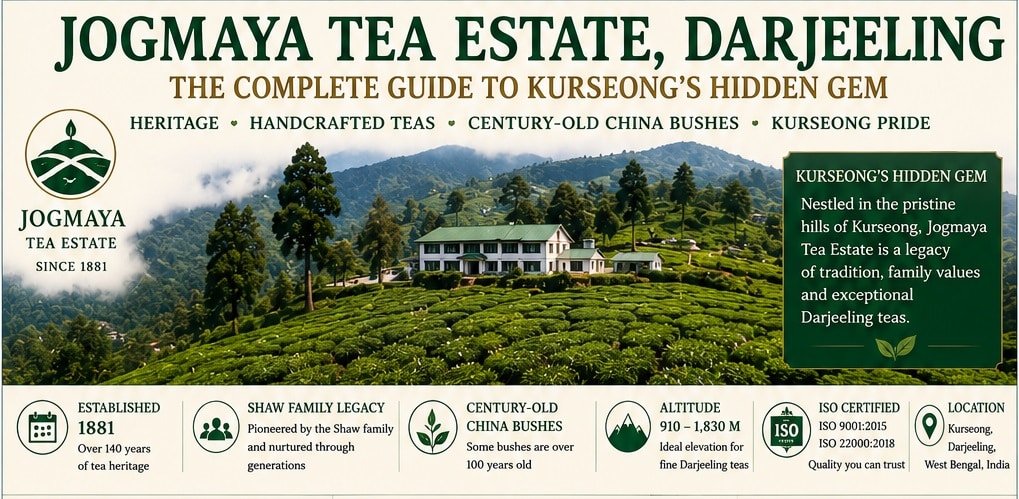
In the heart of the Kurseong Valley — four kilometres from Kurseong town, on the gentle slopes of the Himalayan foothills — sits a tea estate that most of the world has never heard of.
Jogmaya Tea Estate does not appear in glossy travel brochures. It has no celebrity endorsement, no luxury resort within its boundaries, no world-record auction price attached to its name. What it has is something rarer and more enduring: a continuous heritage of over 140 years of tea cultivation on the same land, century-old China-variety tea bushes whose roots penetrate deep into the mineral-rich Himalayan substrate, and a commitment to producing exquisite, hand-crafted Darjeeling teas that have found their way into the cups of connoisseurs from India to Europe to Japan.
Table of Contents
Jogmaya is one of the 87 certified Darjeeling tea gardens — a name that appears alongside Giddapahar, Castleton, and Sivitar in the Kurseong South growing zone, listed as a neighbour of those prestigious estates. It occupies the same elevated, mist-rich terrain as its celebrated neighbours. And the teas it produces — particularly its first flush from ancient China bushes and its handcrafted white tea from AV2 clonal cultivars — are, to those who know them, among the most characterful and honest expressions of high-altitude Kurseong terroir available.
This is the complete guide to Jogmaya Tea Estate, Darjeeling.
What Does “Jogmaya” Mean?
Jogmaya (also written as Yogmaya or Jugmaya) is a name with deep roots in both Sanskrit and Bengali-Nepali cultural tradition.
In Sanskrit, “Yoga” refers to union, discipline, or connection — as in the spiritual practice — while “Maya” means illusion, magic, or the creative power of the divine. Together, Jogmaya (from Yogamaya) refers to the divine creative power through which the universe manifests — sometimes translated as “the magic of union” or “divine illusion.”
In Hindu tradition, Jogmaya is one of the names of the goddess Durga or Shakti — the divine feminine power. It is also the name of a famous ancient temple in Delhi (the Yogmaya Temple, considered one of the oldest in the city), reflecting how deeply embedded this name is in Indian spiritual geography.
For a tea estate named Jogmaya, there is a poetic appropriateness: tea itself is a kind of Yogamaya — a magical union of soil, water, altitude, mist, and human craft that produces something extraordinary from something simple. The transformation of a green leaf into the cup in your hand is, in its own small way, a creative miracle.
Quick Reference: Jogmaya Tea Estate at a Glance
| Detail | Information |
|---|---|
| Full Name | Jogmaya Tea Estate (also: Jogmaya Tea Garden) |
| Corporate Name | Jogmaya Tea Estate Private Limited |
| CIN | U15491WB1996PTC076302 |
| Incorporated | 1996 (as Pvt. Ltd.); garden operational since 1881 |
| Registered Address | Mouza Ghayabari Tea Garden, J.L.No. 36, P.S. Kurseong, Darjeeling, West Bengal — 734223 |
| Location | Kurseong Valley, Kurseong sub-division, Darjeeling district, West Bengal, India |
| Distance from Kurseong | 4 kilometres |
| Altitude | 4,500 to 5,200 feet (approx. 1,370–1,585 m) above sea level |
| Total Garden Area | 115 hectares |
| Tea Cultivation Area | 94 hectares |
| Annual Production | ~30,000 kg of Darjeeling teas |
| Tea Bush Composition | Primarily Chinary (China-variety) bushes + AV2 clonal cultivars |
| Tea Types | Black (first flush, second flush, autumnal), white (handcrafted, AV2) |
| Certifications | Darjeeling GI Certified (Tea Board of India) |
| Nearby Estates | Giddapahar Tea Estate, Castleton Tea Estate, Sivitar Tea Estate, Selim Hill Tea Estate, Rohini Tea Estate |
| Local Area Name | “Land of White Orchid” (Kurseong’s regional designation) |
Part 1: The History of Jogmaya Tea Estate
The Context: 1881 in Darjeeling’s Tea Landscape
By 1881, the Darjeeling tea industry was nearly three decades into its commercial existence. The first three estates — Tukvar, Steinthal, and Aloobari — had been established in 1852. The Victorian expansion had followed rapidly: by 1870, there were 56 tea gardens in Darjeeling; by 1874, over 113.
The year 1881 was a particularly significant one for Darjeeling tea: it was the same year that Gopaldhara Tea Estate was established in the Mirik Valley, and the same period that the Kurseong Valley was emerging as one of the district’s most prestigious growing zones. The establishment of Jogmaya Tea Estate in 1881 placed it firmly within this golden era of Darjeeling’s tea founding — a garden whose first bushes were planted when the industry was still young enough to feel its own history being made.
The Shaw Family: 140+ Years of Continuous Ownership
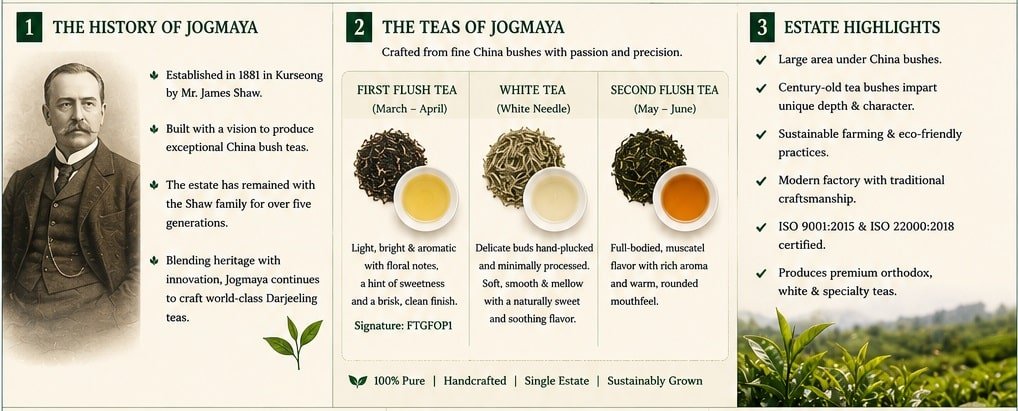
The most defining fact about Jogmaya Tea Estate’s history is one of extraordinary continuity: this Darjeeling tea garden was established in the year 1881 and ever since has been under the management and ownership of the Shaw Family.
The Shaw family — an Indian family whose surname carries a certain quiet dignity — planted the first China-variety tea bushes on the gentle slopes of the Kurseong Valley in the early 1880s and have never relinquished ownership or management of the estate. There was no colonial company, no British planter, no post-independence corporate takeover. The family that planted the first seeds is the family that manages the estate today.
This makes Jogmaya Tea Estate one of the genuinely rare examples of uninterrupted Indian family ownership in Darjeeling’s tea landscape — a garden whose entire life has been shaped by a single family’s values, knowledge, and commitment.
The Corporate Registration: 1996
While the garden has operated since 1881, the formal corporate entity — Jogmaya Tea Estate Private Limited — was registered in 1996 with an authorised share capital of ₹75,00,000. The registered address, Mouza Ghayabari Tea Garden, J.L.No. 36, Ps. Kurseong, Darjeeling, West Bengal — 734223, is the formal legal identity of the estate under Indian company law.
The company is engaged in processing and blending of tea, including the manufacture of instant tea, as classified under agricultural processing activities by India’s Ministry of Corporate Affairs. According to financial reports for fiscal year 2022, revenue trended upward by 23.32% — indicating a healthy growth trajectory for the estate in the post-pandemic period.
The Neighbourhood: A Prestigious Growing Zone
Jogmaya Tea Estate sits within one of the most prestigious tea-growing clusters in Darjeeling — the Kurseong South zone. Selim Tea Estate is adjacent to Rohini Tea Estate, Giddapahar Tea Estate, and Jogmaya Tea Estate.
Nearby estate neighbours include:
- Giddapahar Tea Estate — India’s only fourth-generation, continuously family-owned estate; home to the famous “Delight” micro-lot and a century-old Birmingham rolling machine
- Castleton Tea Estate — the benchmark estate for second flush muscatel, owned by the Goodricke Group
- Sivitar Tea Estate — a neighbouring Kurseong estate
- Selim Hill Tea Estate — the adjacent estate that was established in 1870 by the locally popular gentleman known as Selim Saheb (Mr. Henry)
- Rohini Tea Estate — managed by the Saria family, who also own Gopaldhara
This neighbourhood is the Kurseong Valley‘s most concentrated zone of premium production — estates separated by hillsides and ridges, each with its own microclimate and character, collectively defining the southern Kurseong growing style.
Part 2: Geography and Terroir of Jogmaya Tea Estate
Location: The Gentle Slopes of Kurseong Valley
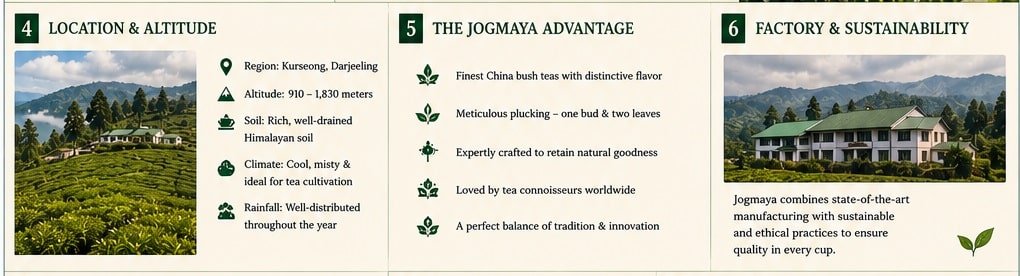
Jogmaya Tea Garden is located on the gentle slopes of Kurseong valley, which is at a distance of 4 kilometres from Kurseong town.
The phrase “gentle slopes” is significant in the Darjeeling context. Many Darjeeling tea gardens — particularly those at higher altitudes — are characterised by steep, dramatic terrain that makes both cultivation and management challenging. The Kurseong Valley‘s gentler gradient in the areas around Jogmaya creates more favourable growing conditions: better water retention between rains, more accessible plucking, and a slightly more moderate microclimate compared to the most dramatically positioned high-altitude estates.
This gentle topography does not mean lower quality — quite the opposite. The mineral-rich Himalayan soil on these gentler slopes, combined with excellent altitude and the valley’s characteristic mist, creates growing conditions of genuine excellence.
Altitude: 4,500 to 5,200 Feet
The Chinary tea bushes along with some clonal varietals in this garden are grown at an elevation from 4,500 feet to 5,200 feet from sea level.
At approximately 1,370 to 1,585 metres above sea level, Jogmaya occupies a high-altitude growing position that defines its tea character:
Cool temperatures year-round. Even in the warmest summer months, the mean temperature at this altitude rarely exceeds 18–20°C. Cool growing conditions slow the tea plant’s metabolism, concentrating flavour compounds in fewer, more intensively developed cells.
Wide day-night temperature variation. Warm afternoons — beneficial for photosynthesis and aromatic compound development — contrast with cool to cold nights that slow respiration and retain the compounds developed during the day within the leaf. This diurnal temperature swing is one of the most important contributors to Darjeeling tea’s aromatic complexity.
Daily morning mist. The Kurseong Valley generates morning mist almost every day of the growing season. At 4,500–5,200 feet, this mist settles over the tea gardens for hours — moderating transpiration, maintaining leaf moisture, and contributing the characteristic “mist character” that experienced tasters associate with Kurseong teas.
Elevated UV radiation. At high altitude, UV exposure is meaningfully greater than at sea level. The tea plant responds by producing more polyphenols and flavonoids — the very compounds that give high-altitude Darjeeling teas their exceptional antioxidant richness and flavour complexity.
The Land of White Orchid
Jogmaya Tea Estate, which is located in the land of white orchid (Kurseong), is certified as an ISO:9001 and ISO:21000 company.
Kurseong is widely known as the “land of white orchid” — a designation that reflects the extraordinary biodiversity of this Himalayan zone, where wild white orchids (Coelogyne cristata and other species) grow along forest margins. This ecological richness — which Kurseong’s moderate altitude, abundant moisture, and varied terrain support — is the same environmental complexity that makes the tea grown here exceptional.
The white orchid association is more than poetic: it speaks to the biodiversity of the surrounding ecosystem, which includes the complex insect communities (including the green leafhopper responsible for the muscatel character) and the rich microbial soil communities that contribute to the depth and complexity of Kurseong’s finest teas.
Tea Cultivation Area
The tea bushes are planted in an area of 94 hectares out of the total 115 hectares of the garden area.
This means approximately 82% of the garden’s total area is under tea cultivation — a relatively high proportion compared to estates like Makaibari, which deliberately reserves 65% of its land for forest. The remaining 21 hectares at Jogmaya encompasses factory buildings, worker housing, roads, forest margins, and non-cultivated land.
Part 3: The Tea Bushes — Century-Old China Heritage
The Chinary Bush: Jogmaya’s Most Precious Asset
Jogmaya tea estate is known for its exquisite and characteristic Darjeeling teas grown from the century-old China bushes.
The term “Chinary” is the Indian industry’s rendering of “Chinese” — specifically referring to Camellia sinensis var. sinensis, the small-leafed Chinese variety of the tea plant that was introduced to Darjeeling from Chinese growing regions in the mid-19th century. These plants are fundamentally different from the Camellia sinensis var. assamica (Assam variety) that dominates lower-altitude Indian tea production:
| Feature | Chinary (China variety) | Assamica (Assam variety) |
|---|---|---|
| Leaf size | Small, delicate | Large, robust |
| Growth rate | Slow | Fast |
| Yield per bush | Lower | Higher |
| Flavour complexity | Higher — more aromatic, more complex | Lower — bolder, more straightforward |
| Cold tolerance | Excellent — adapted to mountain conditions | Poor |
| Altitude adaptation | Superior — thrives at 4,000–7,000 ft | Better at lower altitudes |
| Root depth | Deep — decades to establish | Shallower |
| Ideal for | Premium Darjeeling, nuanced teas | CTC production, strong everyday teas |
At Jogmaya, the century-old Chinary bushes — planted in the 1880s by the founding Shaw family — have had over 140 years to establish themselves in the Himalayan soil. Their root systems penetrate deep into the Himalayan substrate, accessing mineral layers and moisture reserves that younger plantings or shallow-rooted varieties cannot reach. This depth of root establishment is directly reflected in the complexity and depth of the teas they produce.
The AV2 Clonal Cultivars: Innovation on Ancient Land
Alongside the ancient Chinary bushes, Jogmaya also grows some clonal varietals — specifically the AV2 (Ambari Vegetative 2) clonal cultivar, which is used for the estate’s handcrafted white tea production.
The AV2 cultivar was developed specifically for high-altitude Darjeeling growing conditions. It is one of the most prestigious clonal varieties in Indian tea production, known for:
- Exceptionally large, downy buds with high tip content
- High EGCG and L-theanine concentrations
- Pronounced floral and muscatel aromatic development
- Excellent adaptation to cool, high-altitude conditions
The combination of ancient Chinary bushes (for the black and first flush teas) and AV2 clonal cultivars (for the white tea) gives Jogmaya a dual-heritage approach: reverence for the original founding plant material combined with selective adoption of the finest modern cultivar innovation.
Part 4: The Teas of Jogmaya Tea Estate — A Complete Sensory Guide
🌱 First Flush — The Estate’s Most Celebrated Tea
Season: Mid-March to late April
Primary cultivar: Chinary (China variety)
Grade: FTGFOP1 (Finest Tippy Golden Flowery Orange Pekoe, Grade 1) and selected higher grades
Oxidation: Low to medium (20–50%)
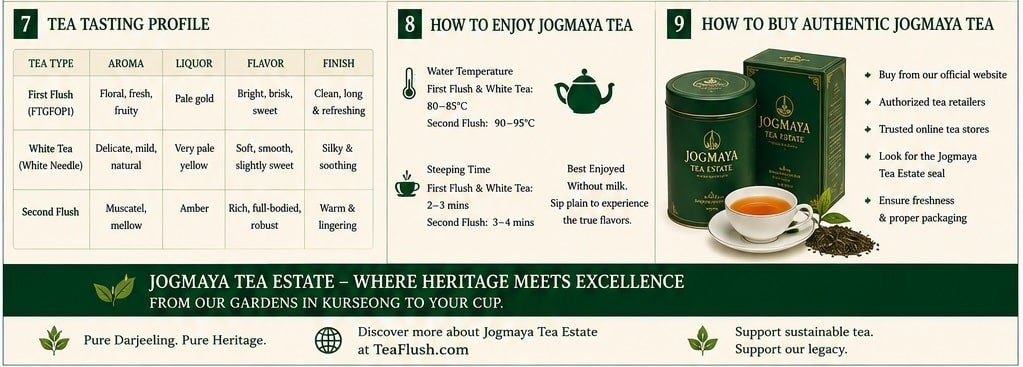
Its first flush teas from China bushes are most famous and much sought after. This tea from the spring season has a light yellowish liquor, is slightly astringent and mellow to taste, which is the characteristics of an excellent Darjeeling tea.
Jogmaya’s first flush is the estate’s signature offering — the tea that has built its reputation among specialty buyers and connoisseurs. Produced from century-old Chinary bushes at 4,500–5,200 feet, it expresses the Kurseong spring in its purest, most concentrated form.
Dry Leaf Appearance: Fine, twisted whole leaves in shades of olive green, silver-green, and light brown — the characteristic mottling of a well-made, lightly oxidised first flush from China-variety bushes. Silver and golden tips from the young buds are visible throughout premium grade lots. The dry leaf carries a fresh, slightly grassy, floral aroma that announces the spring season before the water even touches it.
Liquor Colour: Light yellowish liquor — pale gold to soft amber, clear and bright. The pale colour, sometimes mistaken by inexperienced drinkers for weakness, is the direct result of the Chinary bush’s naturally lower pigment content and the light oxidation level of the first flush processing. In a glass cup, it glows with a clean, luminous quality.
Aroma: The aroma of Jogmaya first flush rises immediately — floral, fresh, and distinctly Himalayan. Orchid, jasmine, and spring blossom notes dominate, with a clean mineral undertone that reflects the altitude and the Himalayan soil. Some lots carry a light, citrusy brightness — a lemon zest or bergamot note — and the characteristic faint muscatel whisper that hints at what the summer harvest will bring.
Flavour: Slightly astringent and mellow to taste — the two qualities that define a well-made first flush from century-old Chinary bushes. The astringency is clean and refreshing rather than harsh — the kind that makes you want another sip immediately. The mellowness is the natural sweetness of the Chinary leaf at spring — a quiet, unhurried depth that rewards patient attention.
Additional flavour notes that connoisseurs identify in Kurseong-zone China-bush first flush teas include:
- Fresh vegetal notes — spring grass, spinach, green herb
- Light stone fruit — apricot blossom, peach skin
- Subtle spice — ginger, white pepper whisper
- Clean mineral finish — the Himalayan terroir expressed directly
Mouthfeel: Light to medium body — airy and refreshing. The mouthfeel of a good Chinary-bush first flush at high altitude is distinctly lighter than the fuller body of the second flush, but with a precision and clarity that is entirely its own.
Finish: Clean and long — the floral note lingers on the back of the palate for minutes after the last sip. This lingering finish is one of the most valued qualities in high-altitude Darjeeling first flush, and Jogmaya’s century-old bushes deliver it consistently.
Best enjoyed: Plain, without milk or sugar. At 85–88°C for 2–2.5 minutes. In a glass or porcelain cup where the pale gold colour can be appreciated.
☀️ Second Flush — The Summer Expression
Season: May to mid-June
Primary cultivar: Chinary
Grade: FTGFOP1
Oxidation: Medium to high (60–80%)
Jogmaya’s second flush takes the same century-old Chinary bushes and processes them with higher oxidation — the summer heat and the activity of the green leafhopper insect trigger the development of the muscatel character that defines Darjeeling’s summer harvest.
Liquor Colour: Deep amber to copper-gold — warm, luminous, and distinctly summer in character.
Aroma: The muscatel arrives — warm, grape-like, wine-like — layered over stone fruit (apricot, peach) and a characteristic summer depth. The Chinary bush’s naturally fine-grained flavour profile means Jogmaya’s second flush muscatel has an elegance and precision that distinguishes it from bolder, more rustic second flush teas.
Flavour: Full-bodied, smooth, complex — the muscatel as the defining note, with warm spice undertones, a slight astringency that binds the flavours, and a long, warming finish.
Best enjoyed: Plain or with a very small amount of milk. At 90–95°C for 3–4 minutes.
🤍 White Tea — The Handcrafted Specialty
Season: Spring (early first flush period)
Cultivar: AV2 clonal
Processing: Handcrafted — minimal processing, no rolling machines
This garden also produces exquisite hand-rolled white teas mostly from its AV2 clonal cultivars. These white teas have a floral and smooth taste and are much sought after by tea lovers around the globe.
Jogmaya’s white tea is the estate’s most distinctive and labour-intensive specialty product — a handcrafted expression of the AV2 cultivar’s exceptional bud quality at high altitude.
The Handcraft Process: White tea production at Jogmaya involves:
- Selective plucking — only the youngest, most downy buds and the finest adjacent leaves are selected
- Gentle withering — spread on cloth or trays in a cool, shaded environment, allowing slow moisture loss without oxidation
- Hand-rolling — each bud rolled by skilled hands rather than mechanical machinery, preserving the delicate surface structure
- Natural drying — air-dried or very gently heat-dried to final moisture level
No machinery touches the white tea at any stage — every contact is human. This entirely manual approach preserves the silvery-white down that covers the young AV2 buds, the delicate aromatic compounds that would be bruised by mechanical handling, and the pristine purity that makes white tea from high-altitude Darjeeling so highly valued.
Tasting Profile: Reviewed by connoisseurs who have sourced Jogmaya white tea through specialty retailers, the verdict is consistent and effusive. One reviewer on Steepster described Jogmaya’s first flush white tea as: It’s just so good. Sweet, delicious, delicate, lovely spice notes … with a wonderfully silky texture. Very refreshing. It starts with notes of grass followed by gentle spice notes.
The same reviewer — a dedicated tea writer and reviewer — described Jogmaya’s white tea as: This Darjeeling White from What-Cha may be one of the very finest White Darjeeling teas I’ve come across in my years as a tea reviewer.
Full sensory profile:
Dry leaf: Long, silver-white rolled tips and buds — visually beautiful and immediately identifiable as a premium white tea. The silvery down of the AV2 bud covers each tip, giving the dry leaf an almost luminous appearance.
Liquor: Very pale, almost clear — sometimes described as “ivory” or “water-white with the faintest golden tint.” The lightest coloured infusion in the entire Darjeeling range.
Aroma: Honeyed, delicately floral, clean Himalayan freshness. Some lots carry a jasmine note that reflects the surrounding ecosystem of the Kurseong Valley.
Flavour: Sweet, delicious, delicate — the most direct translation of the AV2 bud at its most concentrated and unprocessed. Lovely spice notes with a wonderfully silky texture emerge over multiple infusions. It starts with notes of grass followed by gentle spice notes.
Mouthfeel: Silky and smooth — the texture is one of the defining pleasures of Jogmaya’s white tea; smooth and silky in a way that mechanical processing rarely achieves.
Best enjoyed: At 75–80°C for 3–5 minutes. No milk. No sugar. Multiple infusions (3–4) strongly recommended — each infusion reveals a different dimension, from the initial grassy brightness through the honeyed middle infusions to the quiet spice of the later ones.
🍂 Autumnal Flush — The Quiet Finale
Season: October to November
Cultivar: Chinary
Oxidation: Full
The post-monsoon period brings a final harvest at Jogmaya — cooler temperatures, clear Himalayan skies, and the autumnal calm of the valley producing a tea of warm, nutty depth.
Character: Warm amber liquor, woody-nutty aroma, smooth full body with hints of dried fruit and autumn spice. Less complex than first or second flush but deeply comforting — the tea for the transition from summer to winter, for wool blankets and quiet evenings.
Best enjoyed: With or without a small amount of milk. At 90–95°C for 3–4 minutes.
Part 5: ISO Certifications — Quality Verified
Jogmaya Tea Estate, which is located in the land of white orchid (Kurseong), is certified as an ISO:9001 and ISO:21000 company.
ISO 9001 — Quality Management System
ISO 9001 is the internationally recognised standard for Quality Management Systems. Certification requires:
- Documented quality processes covering every stage of production
- Consistent application of those processes across all batches and seasons
- Regular third-party auditing and verification
- Continuous improvement frameworks built into operational management
For a tea estate, ISO 9001 certification means that every cup of tea bearing the Jogmaya name has been produced according to documented, audited, consistently applied quality standards. This provides international buyers — particularly in Germany, Japan, and the UK — with the assurance of process integrity that their import regulations and consumer expectations demand.
ISO 21000 — Agricultural Quality Standards
ISO 21000 (sometimes cited as ISO 22000 in similar estate contexts) relates to food safety management systems — ensuring that Jogmaya’s teas are produced, handled, and stored according to international food safety standards. This certification is increasingly required for export to the EU and other premium markets where food safety compliance is a legal prerequisite for import.
The dual ISO certification positions Jogmaya’s teas for access to the world’s most demanding international specialty markets — a significant commercial advantage and a validation of the estate’s professional operational standards.
Part 6: Annual Production and Scale
On average, this tea garden produces 30,000 kg of Darjeeling teas annually from its 94 hectares of cultivable land.
At 30,000 kg per year from 94 hectares, Jogmaya produces approximately 319 kg per hectare — a deliberate restraint that reflects quality-focused, conservative plucking standards. Compare this to estates that pursue maximum yield at 500–700 kg per hectare, and the implicit philosophy is clear: Jogmaya’s production model prioritises the quality of each kilogram over the volume of kilograms produced.
This production restraint is directly linked to the estate’s Chinary-bush character. Century-old China-variety plants grow slowly and produce fewer leaves per bush than modern high-yield clonal cultivars — but those leaves carry far greater concentration of the aromatic and health-active compounds that make Darjeeling tea exceptional.
Scale in Context
| Estate | Annual Production | Area Under Tea | Production per Hectare |
|---|---|---|---|
| Jogmaya | ~30,000 kg | 94 ha | ~319 kg/ha (quality-focused) |
| Happy Valley | ~50,000 kg | 177 ha | ~282 kg/ha |
| Goomtee | ~60,000 kg | 110 ha | ~545 kg/ha |
| Puttabong (Tukvar) | ~430,000 kg | 437 ha | ~984 kg/ha |
Jogmaya’s 30,000 kg makes it a boutique-scale producer by Darjeeling standards — small enough that each tea lot receives individual attention, large enough to supply a genuine international specialty market.
Part 7: The Orthodox Processing Tradition
Like all premium Darjeeling tea estates, Jogmaya produces its teas using the traditional orthodox method — as opposed to the CTC (Crush-Tear-Curl) method used in mass-market black tea production.
Orthodox vs CTC: Why It Matters
| Aspect | Orthodox Method | CTC Method |
|---|---|---|
| Leaf form | Whole leaf preserved | Crushed into small uniform pellets |
| Processing time | 12–24 hours per batch | 1–2 hours |
| Flavour complexity | High — layered, nuanced, complex | Low — strong, consistent, simple |
| Aroma expression | Full — aromatic compounds preserved | Limited — most aromatics lost |
| Multiple infusions | Excellent — 2–4 infusions | Poor — 1 infusion typically |
| Health compounds | Higher — gentler processing preserves catechins | Lower — intense processing degrades compounds |
| Best for | Premium specialty markets | Mass-market tea bag production |
Jogmaya’s commitment to orthodox processing — specifically for its Chinary-bush teas and its handcrafted white tea — means that every batch preserves the full complexity of the century-old tea plant’s character. No shortcuts. No mechanical over-processing. The leaf is treated with the same care and patience as the ancient bushes that produced it.
The Processing Sequence at Jogmaya
1. Plucking Hand-plucking by skilled workers — the standard “two leaves and a bud” for first and second flush black teas, and the most selective bud-only or fine-tip plucking for the white tea. Plucking typically begins early in the morning when leaf moisture and temperature are optimal.
2. Withering (12–16 hours) Fresh leaves are spread on withering troughs with fans moving air through the leaf mass. Up to 65% of the leaf’s moisture is removed over 12–16 hours. For first flush, a “hard wither” — longer and more thorough — develops the aromatic precursors of the spring character.
3. Rolling The withered leaves pass through rolling machines (for black teas) that break cell walls and release the enzymes driving oxidation. The rolling also shapes the leaf into the twisted, elegant forms of orthodox Darjeeling tea. For white tea: hand-rolling only — no machinery involved.
4. Oxidation The rolled leaves are spread in cool, humid conditions and allowed to oxidise to the desired level. The tea maker monitors colour, aroma, and texture — halting oxidation at the precise moment the desired character has developed. First flush: 20–50%. Second flush: 60–80%. Monsoon/autumnal: 90–100%.
5. Firing High heat deactivates the oxidative enzymes, locks in the final character, and reduces moisture to safe storage levels. For first flush, lighter firing preserves volatile aromatics. For fully oxidised teas, fuller firing develops malty depth.
6. Sorting and Grading After firing, teas are sorted by size into the grades (FTGFOP1, BOP, etc.) that appear on packaging. Finest lots — most tip-abundant, most consistently sized — are designated for premium export.
Part 8: Leaf Grades at Jogmaya Tea Estate
| Grade | Full Name | Description |
|---|---|---|
| FTGFOP1 | Finest Tippy Golden Flowery Orange Pekoe, Grade 1 | Premium whole-leaf with abundant golden tips — the estate’s finest first flush designation |
| TGFOP1 | Tippy Golden Flowery Orange Pekoe, Grade 1 | Excellent whole-leaf, significant tip content |
| TGFOP | Tippy Golden Flowery Orange Pekoe | Good quality whole-leaf |
| FTGFOP | Finest Tippy Golden Flowery Orange Pekoe | Well-regarded mid-premium grade |
| BOP | Broken Orange Pekoe | Broken leaf for stronger, faster-brewing cup |
The 2025 first flush season has produced FTGFOP1 Special grade from Jogmaya — available through specialty retailers who source directly from Kurseong estates with Darjeeling GI certification and DJ invoice numbers for full traceability.
Part 9: How to Brew Jogmaya Tea Estate Teas
The century-old Chinary character of Jogmaya’s teas rewards careful, attentive brewing. Here is the complete guide for each tea type.
Brewing Jogmaya First Flush (FTGFOP1)
| Parameter | Guidance | Why |
|---|---|---|
| Water | Fresh, filtered — soft to neutral minerals | Chlorine and hard minerals suppress the delicate Chinary aromatics |
| Temperature | 85–88°C — never boiling | Boiling destroys EGCG and L-theanine; ruins the first flush character |
| Quantity | 2.5–3 g per 200 ml | Optimal extraction without over-strengthening |
| Steep time | 2–2.5 minutes | Over-steeping produces bitterness; timer essential |
| Vessel | Glass or porcelain — clear glass ideal | Observe the pale gold colour develop |
| Milk | Never | Destroys catechins and suppresses floral aromatics completely |
| Sugar | Not recommended | Masks the natural floral sweetness |
| Multiple infusions | 2–3 excellent infusions | 2nd infusion at 1.5 min often more floral than 1st |
Brewing Jogmaya Second Flush
| Parameter | Guidance |
|---|---|
| Temperature | 90–95°C |
| Quantity | 2.5–3 g per 200 ml |
| Steep time | 3–4 minutes |
| Milk | Optional — small amount works with the fuller body |
| Multiple infusions | 2 excellent infusions |
Brewing Jogmaya White Tea
| Parameter | Guidance |
|---|---|
| Temperature | 75–80°C (coolest of all — white tea is most delicate) |
| Quantity | 3–4 g per 200 ml (white tea is less dense) |
| Steep time | 3–5 minutes |
| Milk | Never |
| Multiple infusions | 3–4 infusions — each reveals a different dimension |
| Best moment | Morning or afternoon; low caffeine makes it suitable at any time |
Part 10: Where Jogmaya Tea Estate Fits in Darjeeling’s Landscape
Jogmaya is a tea estate that rewards curiosity. It sits in the shadow of more famous neighbours — Giddapahar with its celebrated Birmingham rolling machine and “Delight” micro-lot, Castleton with its world-famous muscatel — and that proximity can obscure its own genuine excellence.
But those who have sought out Jogmaya’s white tea — particularly through specialty retailers like What-Cha, who sourced it in 2014 and inspired a reviewer to call it potentially “one of the very finest White Darjeeling teas” they had encountered — understand what this estate quietly offers.
It offers what the finest small estates always offer: teas that are the honest, uncontrived expression of a specific place, specific bushes, and specific hands — produced without ambition to celebrity, without resort facilities or world-record auction pricing, and without the marketing infrastructure that makes some names more famous than their teas deserve.
Jogmaya’s first flush is mellow and slightly astringent — precisely what a century-old China-bush first flush at 4,500–5,200 feet should be. Its white tea is sweet, silky, and spiced with gentle warmth. Its second flush muscatel carries the elegance of Chinary character into the summer’s richness.
These are not dramatic teas. They are teas that reward returning to. That is, perhaps, the most honest recommendation of all.
Part 11: How to Buy Authentic Jogmaya Tea Estate Tea
What to Look For
Authentic Jogmaya Tea Estate tea should clearly state:
- ✅ Estate name: “Jogmaya Tea Estate” or “Jogmaya Tea Garden,” Kurseong, Darjeeling
- ✅ The Darjeeling GI certification mark — the Tea Board of India logo
- ✅ Flush and year — First Flush / Second Flush / Autumnal + harvest year
- ✅ Leaf grade — FTGFOP1, TGFOP1, etc.
- ✅ DJ invoice number (for direct-from-estate or premium retail purchases — e.g., DJ-XX/25)
Trusted Sourcing Channels
Specialty Retailers with Known Jogmaya Sourcing:
- What-Cha (UK, what-cha.com) — sourced Jogmaya first flush white tea to critical acclaim; specialist in rare single-estate teas from less well-known gardens
- Aromas of Darjeeling — India-based; sources FTGFOP1 first flush from Jogmaya with direct-from-garden provenance
- Indian specialty tea retailers who source directly from Kurseong gardens
Direct From Estate: Jogmaya Tea Estate Pvt. Ltd., Mouza Ghayabari Tea Garden, J.L.No. 36, Ps. Kurseong, Darjeeling, West Bengal — 734223
Pricing Guide
| Tea Type | Price Range (India) | Price Range (International) |
|---|---|---|
| First Flush FTGFOP1 | ₹900–2,500 per 100g | £8–20 per 100g |
| White Tea (handcrafted) | ₹1,500–4,000 per 100g | £15–35 per 100g |
| Second Flush | ₹800–2,000 per 100g | £7–18 per 100g |
| Autumnal | ₹500–1,200 per 100g | £5–12 per 100g |
Frequently Asked Questions About Jogmaya Tea Estate
Q: What is Jogmaya Tea Estate?
Jogmaya Tea Estate is a Darjeeling tea garden established in 1881, located on the gentle slopes of the Kurseong Valley, 4 kilometres from Kurseong town. It covers 94 hectares of tea cultivation across a total 115-hectare area at altitudes of 4,500–5,200 feet. It is one of Darjeeling’s 87 certified GI tea estates and is known for its century-old China-variety (Chinary) bushes and handcrafted white tea from AV2 clonal cultivars.
Q: Is Jogmaya Tea Estate related to Giddapahar Tea Estate?
Jogmaya and Giddapahar are two separate but adjacent tea estates in the Kurseong Valley. Giddapahar’s own descriptions list Jogmaya as a “notable nearby estate,” and Jogmaya’s descriptions similarly reference Giddapahar as a neighbour. They are distinct gardens with their own boundaries, ownership, and production.
Q: Who owns Jogmaya Tea Estate?
Jogmaya Tea Estate Private Limited (CIN: U15491WB1996PTC076302) is a private company registered in 1996, with its registered address at Mouza Ghayabari Tea Garden, Kurseong, Darjeeling. The directors of record are Manisha Arya and Jiyesh Rajaram Rode.
Q: What is Jogmaya Tea Estate’s altitude? The Chinary tea bushes at Jogmaya are grown at an elevation from 4,500 feet to 5,200 feet (approximately 1,370–1,585 metres) above sea level.
Q: What types of tea does Jogmaya produce? Jogmaya produces black teas across all four seasonal flushes (first flush, second flush, monsoon, and autumnal) and handcrafted white tea from AV2 clonal cultivars. The first flush and the white tea are the estate’s most celebrated offerings.
Q: What makes Jogmaya’s first flush special? Jogmaya’s first flush is produced entirely from century-old China-variety (Chinary) bushes whose roots have penetrated deep into the Himalayan Kurseong soil over 140+ years. This deep root establishment accesses mineral layers that younger plantings cannot reach, contributing a depth and complexity of flavour — particularly the mellow, slightly astringent, light yellowish liquor — that is distinctive of well-maintained ancient Chinary-bush first flush teas.
Q: Is Jogmaya Tea Estate certified? Yes. Jogmaya holds ISO 9001 (Quality Management System) and ISO 21000 (Food Safety/Agriculture Quality) certifications, and its teas carry the Darjeeling GI certification mark from the Tea Board of India.
Q: What does Jogmaya’s white tea taste like? Jogmaya’s handcrafted white tea from AV2 clonal cultivars has been described by reviewers as “sweet, delicious, delicate, with lovely spice notes and a wonderfully silky texture” — potentially among the finest white Darjeeling teas available. It starts with notes of grass followed by gentle spice notes, with a clean, fresh, high-altitude character throughout.
Q: How much tea does Jogmaya produce per year? Jogmaya produces approximately 30,000 kg of Darjeeling teas annually from its 94 hectares of cultivable land — a deliberately restrained yield that reflects the quality-focused, conservative plucking standards of a Chinary-bush estate.
Q: Where can I buy Jogmaya tea? Through specialty retailers including What-Cha (UK), Aromas of Darjeeling (India), and other specialist Darjeeling importers. When buying, look for the Darjeeling GI mark, the estate name clearly stated, and the DJ invoice number for traceability.
The TeaFlush Perspective: The Value of the Unknown
There is a particular pleasure in discovering a tea that the world has mostly walked past.
Jogmaya Tea Estate is not unknown — it is certified, operational, producing, and respected by the buyers who have found it. But it has not acquired the celebrity of Castleton or the mythology of Giddapahar. It does not have a luxury resort or a world-record auction price. It is simply a well-run, century-old estate, producing excellent Darjeeling teas from ancient Chinary bushes, on the gentle slopes of the Kurseong Valley, with the quiet consistency of a place that has been doing this since 1881 and sees no particular reason to stop.
That consistency — 140 years of growing the same ancient varieties in the same mineral-rich Himalayan soil, of processing with orthodox care, of producing teas that express exactly what they are and nothing more — is its own form of excellence. Not spectacular. Not award-winning. Just genuine.
The reviewer who called Jogmaya’s white tea “one of the very finest White Darjeeling teas I’ve come across in my years as a tea reviewer” was not surprised by fame or marketing. They were simply paying attention to what was in the cup. And what was in the cup was extraordinary.
That is what Jogmaya Tea Estate offers: the reward of paying attention. Of seeking past the obvious and finding something quietly excellent in a valley of white orchids, on slopes that ancient bushes have been feeding from for over a century.
Pour a cup. Pay attention.
Explore more Darjeeling tea estate profiles, brewing guides, and tea culture at TeaFlush.com
Tags: Jogmaya Tea Estate, Jogmaya Tea Estate Darjeeling, Jogmaya tea garden Kurseong, Jogmaya first flush, Jogmaya white tea AV2, Chinary bush Darjeeling tea, century-old tea bushes Darjeeling, Kurseong tea estate, Darjeeling GI certified tea, ISO 9001 tea estate, FTGFOP1 Darjeeling first flush, orthodox Darjeeling tea, ancient China bush tea, handcrafted white tea Darjeeling, What-Cha Jogmaya, specialty Darjeeling tea, 1881 tea estate India, land of white orchid Kurseong
Disclaimer: Corporate registration details are based on publicly available MCA filings. Estate details including tea bush composition, area, production, and certifications are based on multiple industry sources and may have changed since publication. For the most current information, contact the estate directly.