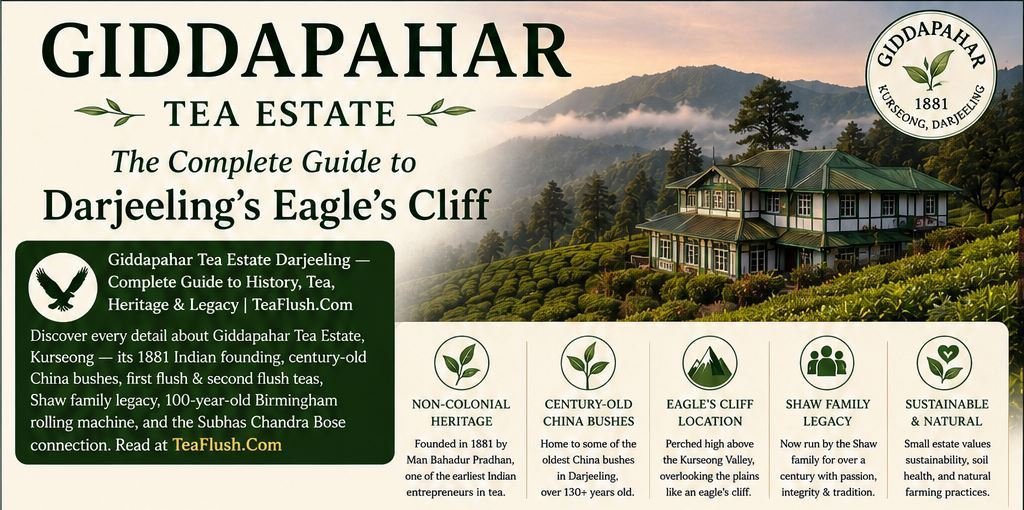
Published on TeaFlush.com | Tea, Mindfulness & Mindful Living
On the edge of a cliff in the Kurseong Valley, where the Himalayan mountains rise in every direction and birds of prey ride thermal currents above the green slopes, stands one of the most quietly extraordinary tea estates in India.
Giddapahar Tea Estate is not the largest Darjeeling garden. It is not the most famous. It does not appear on tourist brochures or produce the volumes that make it into mass-market blends. What it does produce — in careful, limited quantities from century-old China bushes on steep cliff-face terrain — has earned it the devoted admiration of some of the world’s most discerning tea merchants, connoisseurs, and buyers from Siliguri to Taipei to London.
| Image | Name | Summary | Stock | Price | Buy |
|---|---|---|---|---|---|
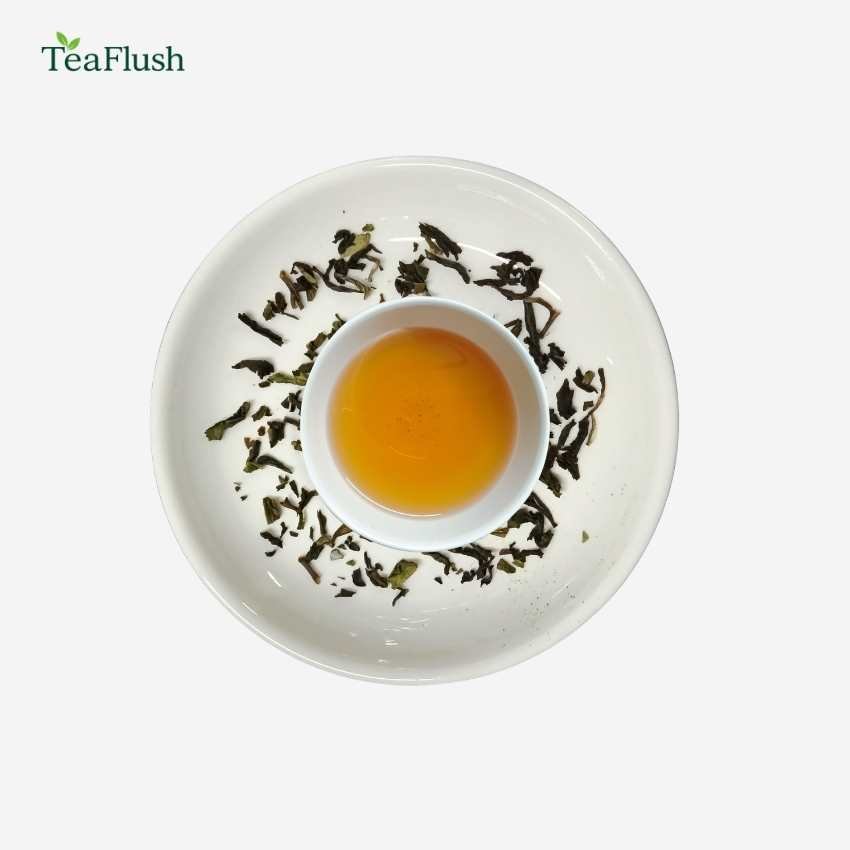 | Giddhapahar FTGFOP Tea 2026 100g | Giddapahar FTGFOP (Fine Tippy Golden Flowery Orange Pekoe) is an exquisite, artisanal black tea crafted from century-old heritage China bushes in Darjeeling’s boutique, family-run Giddapahar Estate.
| 1 in stock | ₹489,00 | |
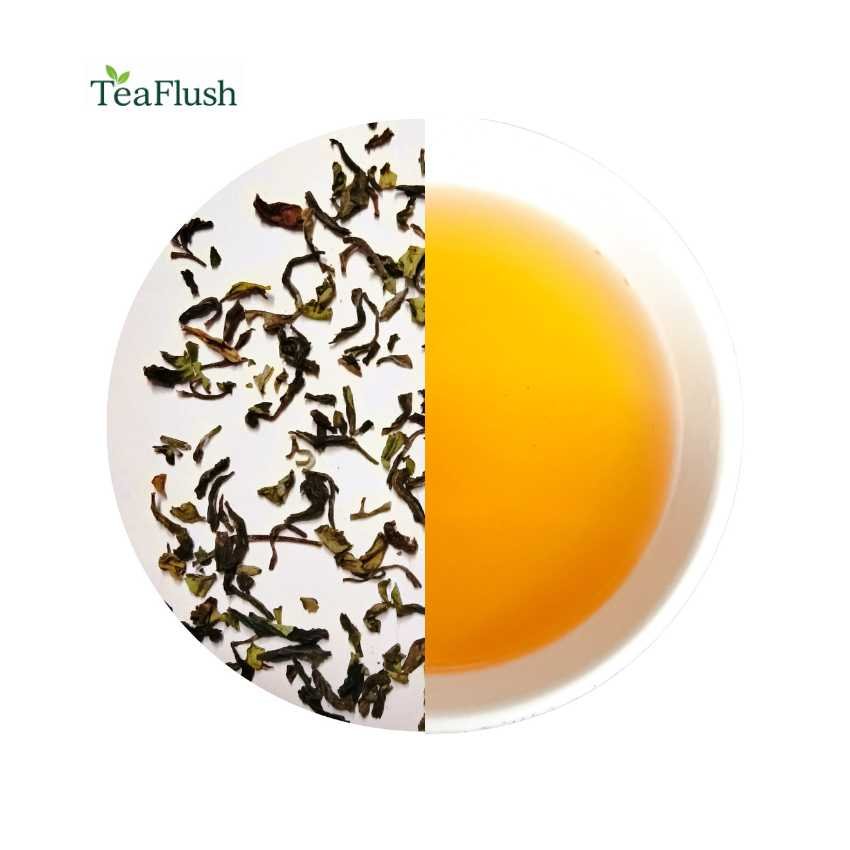 | Giddapahar China Special Tea | First Flush | Giddapahar China Special Tea – First Flush Tea Flush. The dry leaves are uncut and have a bright green shade. The long well twisted curled leaves are a visual delight. The aroma is pleasant. It has notes of roasted almonds with a hint of lime like aroma. | 100 in stock (can be backordered) | Price range: ₹450,00 through ₹900,00 | |
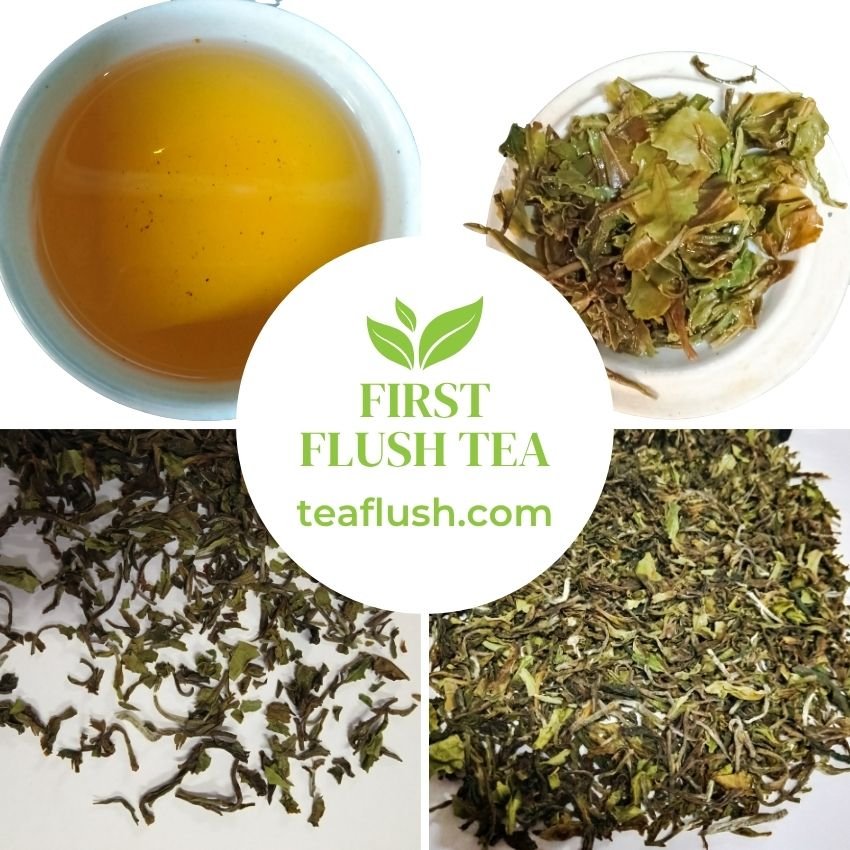 | Giddapahar - Clonal Delight Darjeeling Tea First Flush 2026 | Darjeeling First Flush Tea – Giddapahar’s Delight Tea, is a rare, limited spring harvest from one of Darjeeling’s most beloved boutique estates. It is a light-bodied, floral black tea hand-plucked from century-old China bushcultivars at 4,500 ft — delivering a crisp, luminous cup with fresh notes of white flower, green apple, and a signature caramel finish. A true “Champagne of Teas.” | 1 in stock | Price range: ₹530,00 through ₹750,00 | |
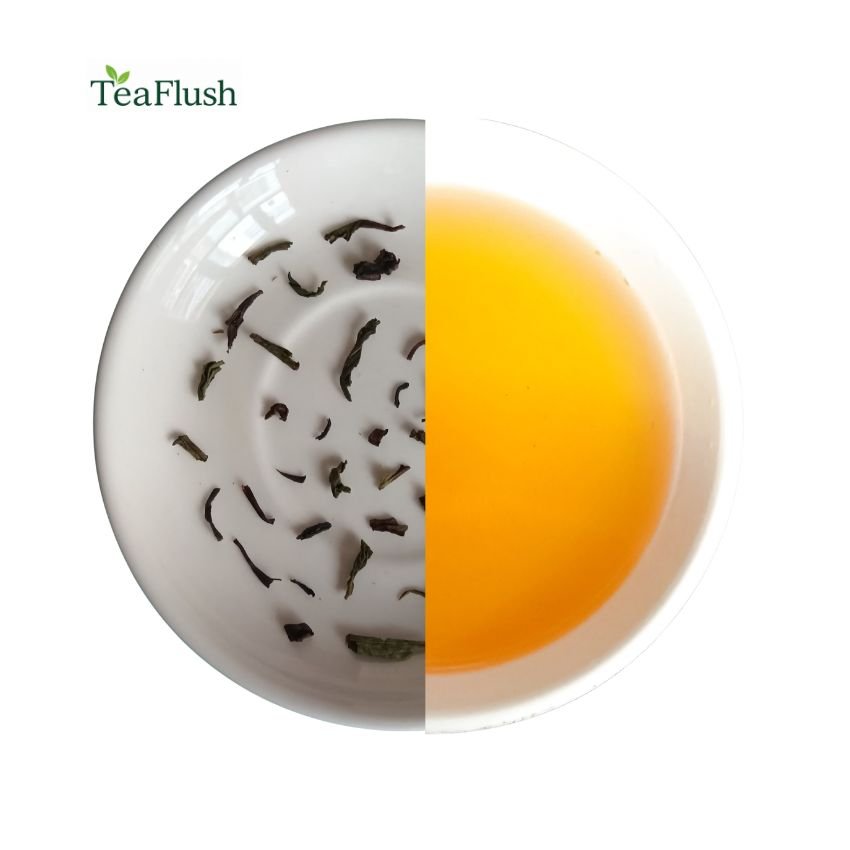 | Giddapahar SFTGFOP 100 grams | Giddapahar Tea Estate SFTGFOP — First Flush Darjeeling Black Tea. A rare, heritage single-estate Darjeeling from the 143-year-old Giddapahar garden perched at 4,800 ft on Eagle’s Cliff, Kurseong Valley. Crafted from century-old pure China tea bushes — prized for its light golden liquor, delicate muscatel character, and a lingering floral sweetness. | 2 in stock | ₹400,00 | |
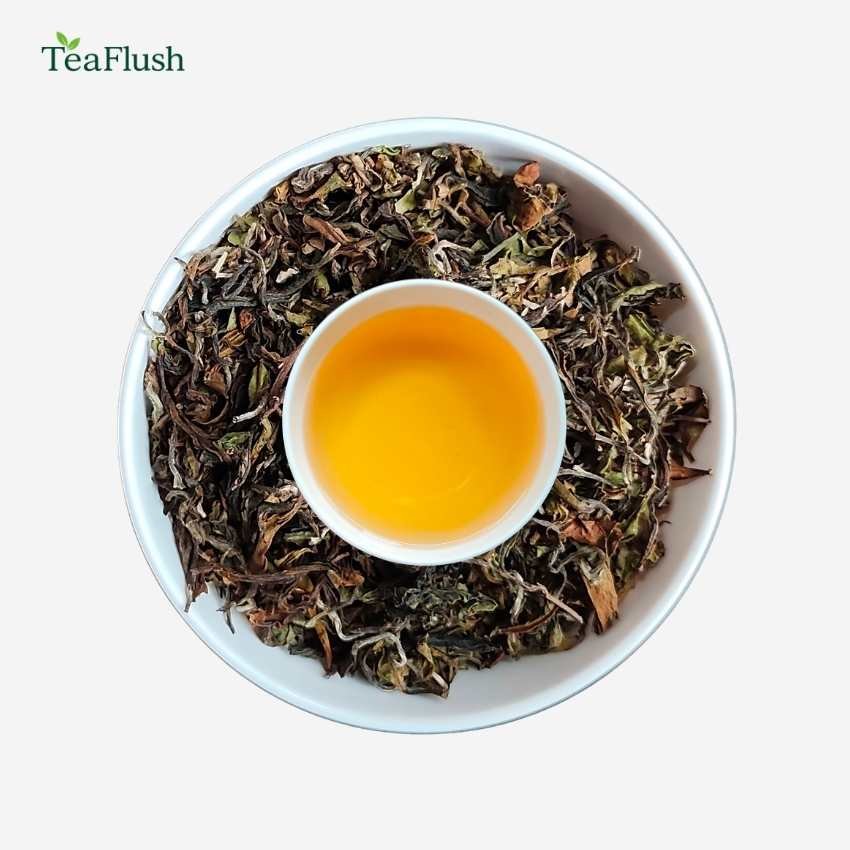 | Giddapahar - Clonal Wonder 1st Flush 2026 | 100 Grams | Giddapahar Clonal Wonder is harvested from elite AV2 clonal bushes during the very first emergence of spring — when the Himalayan air is still sharp, the soil freshly awakened, and every young leaf carries the energy of an entire winter’s rest. | 2 in stock | ₹959,00 | |
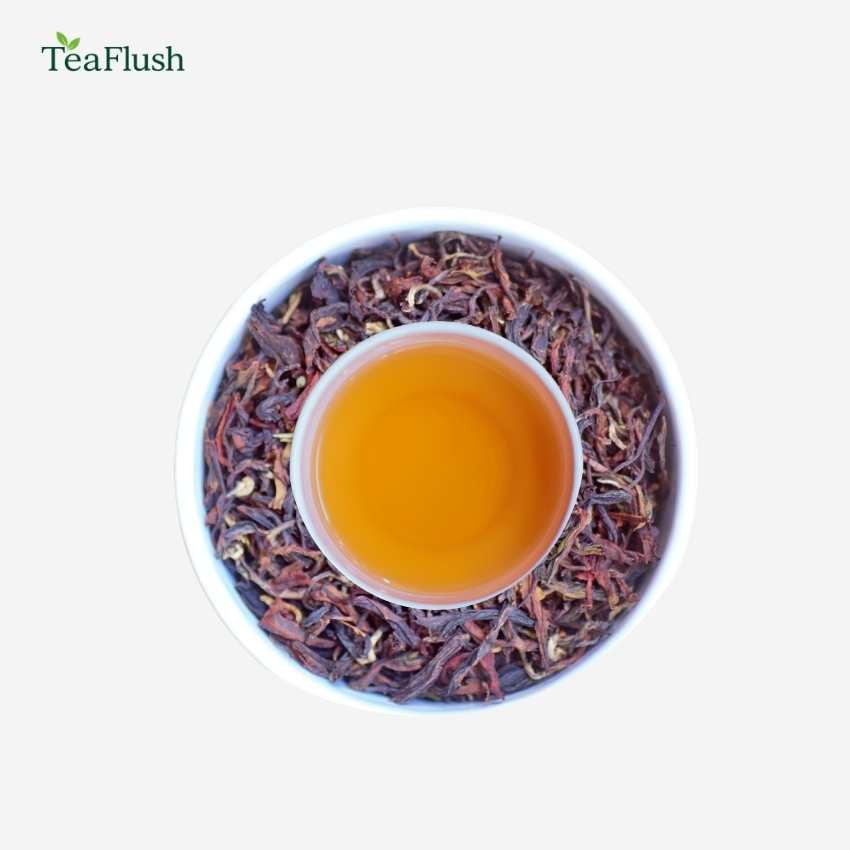 | Giddapahar - Clonal Delight 2nd Flush 2026 | 100 Grams | Giddapahar Clonal Delight 2nd Flush is a highly sought-after, premium summer-harvest black tea produced by the historic Giddapahar Tea Estate in Kurseong, Darjeeling. Crafted predominantly from select AV2 clonal cultivars, this second flush tea is celebrated by connoisseurs for its rich flavor profile and exquisite aromatics. | 4 in stock | ₹689,00 |
And it carries a distinction that only one other estate among Darjeeling‘s 87 certified gardens can claim: it was founded by Indians, and it has remained in Indian hands — in the same single family — for its entire existence.
In a district whose tea industry was built almost entirely by British colonists, Giddapahar is a rare exception. Founded in 1888 by the Shah family, passed through four generations to the present-day brothers Sudanshu and Himangsu Shah, it stands as living proof that the finest Darjeeling tea was never exclusively a colonial achievement. It was always, also, an Indian one.
This is the complete story of Giddapahar Tea Estate — from the cliff that gave it its name to the 100-year-old Birmingham rolling machine still turning in its small, family-run factory; from the delicate floral first flush that connoisseurs queue up for each spring to the autumn teas that carry stone fruit and warm nutty depth; from the freedom fighter who was held under house arrest on this hillside to the fourth-generation brothers who look out over Kurseong every night and carry the legacy of their ancestors in the tea they make with their hands.
At TeaFlush.com, we believe that the smallest things, tended with the greatest care, become extraordinary. Giddapahar is that belief, made manifest in a tea garden.
Table of Contents
What Does “Giddapahar” Mean?
The name of this estate is a compound of two Nepali words:
- Gidda / Gidh (गिद्ध) — eagle, falcon, or vulture (a bird of prey)
- Pahar (पहाड़) — mountain, cliff, or hill
Giddapahar translates to “Eagle’s Cliff” or “Falcon’s Cliff” — sometimes also rendered as “Eagle’s Mountain” or “the mountain of vultures,” depending on the interpretation of gidda.
The name is intensely evocative and entirely accurate. The estate is perched on the side of a steep rocky cliff face in the Kurseong Valley. Eagles, falcons, and vultures genuinely soar above the gardens. Perched on the side of a cliff, when co-owner of Giddapahar Tea Estate Sudanshu Shah looks down at the lights of Kurseong town at night, he wonders what the birds of prey for which his garden has been named would have seen when his forbears arrived at the plantation and began clearing the forest for tea cultivation.
To stand at Giddapahar and look outward is to understand, in a single glance, why this place produces extraordinary tea. Giddapahar Tea Estate is a tea garden in the sky — high, steep, mist-swept, and almost impossibly beautiful.
Quick Reference: Giddapahar Tea Estate at a Glance
| Detail | Information |
|---|---|
| Full Name | Giddapahar Tea Estate (also spelled: Giddhapahar, Gidhapahar) |
| Name Meaning | “Eagle’s Cliff” / “Falcon’s Cliff” (Nepali: Gidda = eagle/vulture; Pahar = cliff/mountain) |
| Established | 1881 (formal establishment); plantation began 1888 |
| Location | Kurseong Valley, Kurseong sub-division, Darjeeling district, West Bengal, India |
| Distance from Kurseong town | 4 kilometres |
| Altitude | 4,500 to 5,200 feet (approx. 1,370–1,585 m) |
| Average Altitude | ~4,800 feet (1,482 m) |
| Total Estate Area | 115 hectares |
| Area Under Tea | 94 hectares |
| Annual Production | ~30,000 kg (30 tonnes) |
| Founding Family | Shah family (Indian founders) |
| Current Owners | Sudanshu (Sudhanshu) Shah and Himangsu (Himanshu) Shah — 4th generation |
| Also referenced as | Shaw family (variant spelling of Shah) |
| Factory established | 1907 |
| Tea bush composition | 75% China bush, 15% young clonal, 10% Assamica |
| Notable machinery | ~100-year-old orthodox rolling machine made in Birmingham, England |
| Tea types | Black (first flush, second flush, autumnal), green, white (handcrafted) |
| Certifications | ISO 9001, ISO 22000 (ISO 21000 per some sources) |
| GI Certification | Certified Darjeeling Tea (Tea Board of India) |
| Ownership type | Private, single-family — non-corporate, non-colonial |
| Distinction | One of only two non-colonial tea gardens among Darjeeling’s 87 estates |
| Postal Address | Giddapahar Tea Estate, P.O. Kurseong, District Darjeeling, West Bengal — 734203 |
Part 1: The History of Giddapahar Tea Estate
Darjeeling’s Colonial Tea Industry: The Context
To understand what makes Giddapahar Tea Estate remarkable, you must first understand what nearly every other Darjeeling tea estate is.
Darjeeling’s tea industry was built by the British colonial government and by British, European, and British-managed commercial enterprises from the 1850s onwards. The Darjeeling Tea Company, the Lebong Tea Company, the Kurseong and Darjeeling Tea Company — these were the corporate vehicles through which the vast majority of Darjeeling’s 87 estates were planted, developed, and run. Even after Indian independence in 1947, most estates transitioned to Indian corporate ownership — but their origins, their founding stories, and often their management structures retained colonial DNA.
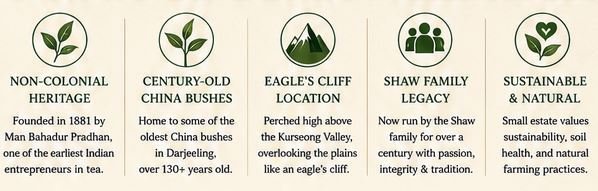
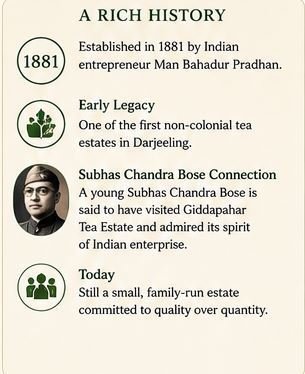
Unlike most other tea estates in Darjeeling, Giddapahar Tea Estate was not only established by Indians but has also remained in the hands of a single family for its entire existence.
This makes Giddapahar Tea Estate something genuinely rare: a tea estate with an unbroken Indian family lineage stretching from its founding to the present day. Happy Valley Tea Estate
1881 / 1888: The Shah Family Plants Their Cliff
This Darjeeling tea garden was established in the year 1881 and ever since has been under the management and ownership of the Shaw Family. Some sources, including the detailed World Tea News investigation, place the active planting as beginning in 1888. The most likely explanation is that 1881 marks the formal land grant or registration, while 1888 is when the Shah family physically cleared the forest and planted the first tea bushes — a common distinction in the staged development of early Darjeeling gardens.
The Shah family, along with the help of a manager named Bose who had worked in the nascent tea industry in India, cleared the forest and planted the tea bushes in the estate beginning in 1888.
What they planted was almost entirely China-variety tea (Camellia sinensis var. sinensis) — the small-leafed, slow-growing Chinese cultivar that is the foundation of Darjeeling’s finest teas. “Originally 90% of the garden was pure China,” says Shah. “But now, every year we are planting twenty to thirty thousand young teas, which are good quality clonals,” he says. This has changed the proportion to 75% China Bush, 15% young clonal tea, and 10% assamica.
The 1907 Factory: Handcraft Meets Mechanisation
The Shahs began handcrafting their tea, and then they mechanized in 1907 when their factory was built.
The small factory built in 1907 still stands today — located just steps from the family home. Inside it, one of the most remarkable artifacts in Darjeeling’s tea industry continues to function: a tea rolling machine close to 100 years old, made in Birmingham, England, that still helps make great tea today.
This century-old Birmingham rolling machine is not a museum piece. It is an active participant in the production of Giddapahar’s orthodox teas — rolling, bruising, and shaping the leaves with a consistency and character that modern machines, for all their efficiency, cannot fully replicate. It is a tangible connection between the tea in your cup and the industrial history of orthodox tea manufacturing.
They still handcraft the white teas, though.
Four Generations, One Vision
Giddapahar Tea Estate was founded in 1881, and has been in the same family ever since. Surendra Nath Singh and his brother are the fourth generation to be running the estate. And since this garden was brought to my attention about six years ago, they have consistently produced some of the best (and most reasonably priced) Darjeeling teas I have seen.
Shah says that it used to be that even owners who held multiple gardens or who stayed elsewhere were at least planters. Today, for many owners, cultivating tea is not their primary business. “Maybe they are builders or promoters, but we are the fourth generation of planters beginning in 1888,” Shah proclaims, proudly.
The current owners — Sudanshu (Sudhanshu) Shah and his brother Himangsu (Himanshu) — are the living embodiment of that four-generation commitment. The entire estate, factory, and owner’s home are built on slopes like this. While small in size, Giddapahar Tea Estate looms large to tea merchants looking for the best quality.
This is what it means to be a fourth-generation planter on a family estate: the factory is next to the house. The tea is made with the same machines your great-grandfather used. The bushes your ancestor planted are still producing the leaves you harvest every spring. The quality is personal because the land is personal.
Part 2: Geography, Altitude & Terroir
Location: The Heart of Kurseong Valley
Giddapahar Tea Estate is located in the most prestigious heart of the Kurseong Valley. It sits approximately 4 kilometres from Kurseong town — close enough to maintain supply chains and receive visitors, yet positioned on a cliff-face terrain that gives it a growing environment of exceptional intensity.
The estate looks out over the southern valley of Kurseong, with panoramic views of the Himalayan ranges on clear days and a dramatic valley depth below that creates the perfect atmospheric conditions for the morning mist Darjeeling is famous for.
Nearby estates include Castleton Tea Estate (one of Darjeeling’s most celebrated second-flush muscatel producers), Sivitar Tea Estate, Goomtee Tea Estate and Jogmaya Tea Estate — making Giddapahar part of one of the most densely concentrated zones of premium tea production in all of India.
Altitude: 4,500 to 5,200 Feet
Perched at elevations ranging from 4,500 to 5,200 feet, Giddapahar’s tea bushes yield teas of exceptional caliber.
The gardens are poised at an average altitude of 4,800 feet and their orientation offers an incredible view of the Himalaya.
At an average altitude of 4,800 feet (approximately 1,462–1,482 metres), Giddapahar Tea Estate sits squarely in the high-altitude zone of Darjeeling tea production. This elevation creates several critical growing conditions:
- Cool temperatures year-round — with warm afternoons and cold nights that create the dramatic diurnal temperature swings that slow tea-plant growth and concentrate flavor compounds
- High UV radiation — stimulating polyphenol and antioxidant production in the tea leaves as a natural sun-protection response
- Daily mist coverage — the Kurseong Valley generates morning mist almost every day of the year; at 4,800 feet, this mist is denser and longer-lasting than at lower elevations
- Thin, dry mountain air — a characteristic that has direct and measurable effects on how the leaf processes during manufacturing
The Cliff-Face Terroir: An Unusual Processing Effect
One of the most technically fascinating aspects of Giddapahar’s production is the effect of its cliff-face location on the tea manufacturing process.
Processing: Very hard wither — at 1,482 metres above sea level the leaves dry out quickly due to the thin and dry air; therefore, the leaves do not fully oxidize and parts of the finished tea remains green with qualities similar to a green oolong.
This is an extraordinary detail. The thin, dry Himalayan air at Giddapahar’s altitude causes the withered tea leaves to lose moisture more rapidly than at lower elevations. This accelerated moisture loss during withering means the leaves begin the oxidation process in a slightly different physiological state — resulting in a tea that, even when classified as a black tea, retains some green, oolong-like qualities in its character. This is a natural consequence of the terroir, not a deliberate processing choice — and it contributes to the distinctive “dry,” complex, multi-layered quality that experienced Giddapahar drinkers describe with such precision.
The East-Facing Garden: Morning Sun, Himalayan Clarity
A majorly east-facing garden, Giddapahar Tea Estate is a stalwart producer of orthodox black teas.
The east-facing orientation of Giddapahar’s main tea sections means the gardens receive morning sun directly — the first warm rays of the Himalayan day falling on dew-wet leaves that have been absorbing the night’s coolness. This east-facing exposure is associated with a particular brightness and clarity in Darjeeling teas — a luminosity in the liquor and a freshness in the aroma that connoisseurs associate with eastern-exposure gardens.
Soil and Bushes
Giddapahar Tea Estate is one of the few remaining tea estates with gardens that still produce tea from older plantings of China bush tea varietals.
The soil at Giddapahar Tea Estate is the classic Darjeeling loam — acidic, well-drained, mineral-rich Himalayan substrate that is ideal for slow-growing China-variety tea plants. The combination of this soil with bushes that have been growing in it for well over 130 years creates a depth of root establishment — and thus a depth of mineral access — that newer or replanted gardens simply cannot match.
Some of the oldest high-elevation bushes are found in the garden’s sections that manifest unique bright and brisk golden liquors and the most splendid Muscatel 2nd flushes in the entire district.
Part 3: A Non-Colonial Estate — Why This Matters
The distinction of being one of only two non-colonial tea gardens among Darjeeling’s 87 certified estates is not merely a historical footnote. It shapes everything about Giddapahar’s character, philosophy, and relationship to the land and tea it produces.
What “Non-Colonial” Means
Every other tea estate in Darjeeling was either:
- Founded by British colonial companies or individual British planters
- Managed under colonial-era corporate structures that continued, often unchanged, into the post-independence period
- Acquired by Indian corporate groups after independence — but with a colonial origin story
Giddapahar Tea Estate was founded by an Indian family, for Indian purposes, with Indian capital, and has never left Indian hands. There was no colonial company, no British planter, no East India Company nursery stock — just the Shah family, their vision, their land, and their labor.
The Implications for Quality
This non-colonial origin has practical implications for how Giddapahar Tea Estate operates today:
Personal accountability: When the estate is the family’s only business and has been for four generations, quality is not a quarterly metric — it is a matter of personal honor. The bushes your great-grandfather planted are a legacy you are either maintaining or betraying. That is a different kind of motivation than a corporate profit-and-loss calculation.
Conservative, quality-first production: Giddapahar Tea Estate produces about 14,000 lbs per year, which sounds like a lot until you realize Margaret’s Hope Tea Garden produces about 600,000 lbs per year. All Giddapahar’s teas are entirely hand-plucked and processed. The “tea factory” is very small and located right next to the family home.
14,000 lbs (approximately 6,350 kg) annually from a 94-hectare estate is a deliberately low yield — a reflection of quality-focused, conservative plucking standards rather than maximum-extraction commercial farming.
Pricing that reflects reality: Despite producing some of the finest teas in Darjeeling, Giddapahar Tea Estate has historically been noted for offering premium quality at relatively honest pricing. They have consistently produced some of the best (and most reasonably priced) Darjeeling teas I have seen. This reflects a family-business ethos rather than a corporate brand premium.
Part 4: The Teas of Giddapahar — A Complete Sensory Guide
Giddapahar Tea Estate is a small, family-owned private organization engaged in production of the world famous Darjeeling Tea on its lush green slopes and enhancing the product quality since its inception from 1881. This garden has a unique combination of traditional China bushes and patches of clonal bushes.
All of Giddapahar’s teas share a defining characteristic: Giddapahar teas bear the distinct aroma of Darjeeling because most of their leaf is from the original China bush that was planted by their forbears. This China-bush dominance — 75% of the garden — gives Giddapahar teas a flavor integrity and classical Darjeeling character that most large commercial estates, with higher proportions of high-yield clonal bushes, cannot fully replicate.
🌱 First Flush — The Spring Masterwork
Harvest period: Mid-March to late April
Oxidation: Low to medium, with some lots approaching green oolong character
Leaf grade: SFTGFOP1 (Super Finest Tippy Golden Flowery Orange Pekoe, Grade 1)
Cultivar: Primarily China bush varietal
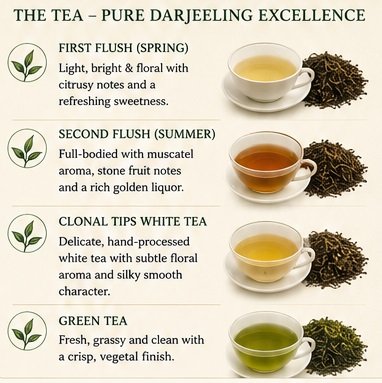
Its first flush teas from china bushes are most famous and much sought after. This tea from the spring season has a light yellowish liquor, is slightly astringent and mellow to taste, which is the characteristics of an excellent Darjeeling tea.
The First flush tea from Giddapahar Tea Estate is the estate’s most celebrated offering — and the one that most powerfully expresses the combination of high altitude, China-bush leaf, cliff-face terroir, and four-generation craftsmanship that defines this garden.
Dry leaf appearance: The wet leaves open to vivid green with some yellow and brown. The dry leaves before steeping show the characteristic first-flush mottling — green, brown, and silver tones from the partial oxidation, with the silver-white tips of the young buds visible throughout the highest-grade lots.
Aroma (dry leaf): Before infusing, the pure aroma from the dry leaves draws you in with an intriguing musky floral freshness. The dry leaf has hints of stone fruit and dry wood bark in its aroma. Aroma muted and delicate (Gong Fu brewing), somewhat wild-flowery, grassy with the vaguest hint of cedar tree bark. The overall impression is one of cleanliness and freshness.
Liquor color: The golden yellow liquor is invigorating — pale to medium gold, sometimes with greenish tints in the most lightly oxidized lots. Beautiful and bright in a glass cup.
Flavor: This is where Giddapahar Tea Estate’s first flush reveals its extraordinary distinctiveness. Tea Trekker’s 2021 Giddapahar Tea Estate ‘Delight’ has very big flavor. It is lush, mouth-filling, and concentrated. It almost tastes sweet, but is not — this is just a tactile misinterpretation due to the incredible full-body that this leaf possesses. While not sweet, it is not astringent either.
Sweet, rich aromas of white flower, rose, and buttered spinach stand out in this bold lot that was produced from older China bush plants. The classic profile is packed with flavors of roots and warming spice (ginseng, ginger), and a lingering, full, bittersweet finish — the strongest of all our first flush picks this year.
The golden yellow liquor is invigorating with sweet corn and wood notes and a creamy mouthfeel reminiscent of ice cream.
The “dry” quality: There is a certain ‘dry’ quality to the steeped tea, reminiscent of the crisp style of Asahi ‘Dry’, for example. This is a taste/style that is hard to pinpoint and describe, but is unmistakeable. This dry, clean, almost mineral crispness is a Giddapahar Tea Estate signature — a direct reflection of the high-altitude, thin-air terroir and the China bush character.
Mouthfeel: A creamy mouthfeel reminiscent of ice cream — an unusual and deeply pleasurable quality in a first flush Darjeeling.
Character summary: Giddapahar first flush is not a delicate, pale, ethereal spring tea in the manner of some other high-altitude Darjeeling gardens. It is bold, concentrated, and layered — with the full-body that china bush leaf at high altitude, manufactured with orthodox skill, can produce. This, coupled with crisp high altitude briskness, is the measure of a stunning 1st Flush Darjeeling tea.
Best enjoyed: Plain, without milk. At 85–88°C for 2–2.5 minutes. Giddapahar Tea Estate is one of Bob’s all-time favorite Tea Darjeeling gardens — their stylish leaf yields mouth-filling, yet fresh, vibrant flavor in the cup.
☀️ Second Flush — The Muscatel Classic
Harvest period: May to mid-June
Oxidation: Full, traditionally oxidized
Leaf grade: SFTGFOP1 / FTGFOP1
Cultivar: China bush varietal, hand-rolled high-grade leaves and tips
Giddapahar Tea Estate is a stalwart producer of orthodox black teas and is one of the few gardens to use original orthodox machinery from the olden days like a 100-year-old rolling machine from Birmingham. Some of the oldest high-elevation bushes are found in the garden’s sections that manifest unique bright and brisk golden liquors and the most splendid Muscatel 2nd flushes in the entire district.
This is an extraordinary claim — “the most splendid Muscatel 2nd flushes in the entire district.” For a garden that produces only 30 tonnes per year and sits in the shadow of Castleton, Jungpana, and Margaret’s Hope, it is a statement that Giddapahar’s most devoted buyers would earnestly support.
Dry leaf appearance: Traditional 2nd Flush Darjeeling leaf with a nicely-mottled coloration and open leaf — classically beautiful, very dark in color, with not a trace of any modern, trendy, green, long-withered leaf. This is traditional Darjeeling second flush in its most classical expression — fully oxidized, dark, complex.
Aroma (dry leaf): Before infusing, the pure muscatel aroma from the dry leaves draws you in. Cacao and the classic aroma of a high quality China bush black tea are the primary elements — the oxidized smell that so distinctively identifies this traditional style of 2nd Flush wither and oxidation, whether from eastern China or from northern India.
Liquor color: Deep, claret amber liquor — rich, luminous, and beautiful. A deeper, more dramatic color than the first flush.
Flavor: The amber liquor is invigorating with muscatel, stone fruit and honey notes, and a hint of hazelnut. A slight astringency rounds out the tea with a velvety mouthfeel. Smooth, deep flavor with no astringency.
The tea has a full taste with a hint of muscatel.
Mouthfeel: Velvety mouthfeel — a word that perfectly captures the smooth, enveloping quality of a well-made China-bush second flush from an old-growth garden.
Food pairings: Pairs well with rich desserts, like Black Forest cake and Baklava.
Best enjoyed: Plain, or with a very small amount of milk. At 90–95°C for 3–4 minutes. Though highly oxidized, this tea is manufactured using China tea bush varietal leaf, so it is easy to over-steep. Try steeping it twice, first for 2 minutes, and then (as you would with an oolong or green tea) steep the leaf again for 3–4 minutes to obtain a second cup.
🍂 Autumnal Flush — Stone Fruit and Himalayan Warmth
Harvest period: October to November
Oxidation: Full
Cultivar: China bush varietal (Chinary)
With roots tracing back to century-old China bushes, its autumn flush teas are a sensory delight — offering bold flavors, luscious stone-fruit notes, and the warm, nutty undertones that define Darjeeling’s elusive autumnal harvests.
Giddapahar Tea Estate’s autumnal flush has been gaining recognition among a growing community of connoisseurs who seek out the quieter, warmer side of Darjeeling’s seasonal character. The post-monsoon coolness and clear Himalayan skies produce a tea of compelling depth.
Liquor color: Rich amber to deep copper
Aroma: Warm stone fruit, dried apricot, autumn spice, wood
Flavor: Bold, full-bodied, luscious stone fruit with warm nutty undertones and a smooth, satisfying finish
Character: Aptly named ‘Eagle’s Mountain’, it embodies the awe-inspiring beauty of its surroundings. The autumnal flush is the estate’s most accessible tea — full-bodied enough for milk, rich enough to stand alone, and complex enough to reward slow, attentive sipping.
Best enjoyed: With or without a small amount of milk. At 90–95°C for 3–4 minutes.
🤍 White Tea — Giddapahar Clonal Tips (Handcrafted)
Processing: Hand-rolled, minimal processing
Cultivar: AV2 clonal
This garden also produces exquisite hand-rolled white teas mostly from its AV2 clonal cultivars. These white teas are named Giddapahar Clonal Tips, have a floral and smooth taste, and are much sought after by tea lovers around the globe.
The Giddapahar Clonal Tips is perhaps the estate’s most distinctive and sought-after specialty product. While most of the garden is China bush, the AV2 clonal cultivar bushes produce the large, downy, silver-white buds that are ideal for white tea production.
They still handcraft the white teas.
Every leaf is hand-rolled — a painstaking, time-consuming process that stands in deliberate contrast to the mechanized processing of the black teas. This handcrafted approach preserves the delicate surface structure of the young bud, maintaining its silver-white appearance and the honeyed, floral character that makes it exceptional.
Appearance: Long, silver-white rolled tips — visually beautiful and immediately identifiable as a premium white tea
Liquor color: Very pale, almost water-clear with the faintest golden tint
Aroma: Floral, honeyed, delicate mountain freshness
Flavor: Smooth, floral, sweet, exceptionally clean — a direct expression of the AV2 clonal bud at high altitude
Best enjoyed: At 75–80°C for 3–4 minutes. Multiple infusions rewarded. Never with milk.
🍃 Green Tea from Giddapahar
Giddapahar’s high-altitude China bushes also produce a green tea — processed immediately after plucking to halt oxidation and preserve the fresh, vegetal character of the spring leaf.
At 4,800 feet, with China-variety bushes that grow slowly and accumulate concentrated flavor compounds through the winter dormancy, Giddapahar’s green tea has a distinctive high-altitude clarity and mineral character quite different from lower-elevation or tropical green teas.
Liquor color: Very pale yellow-green
Aroma: Floral, clean, lightly grassy with mountain freshness
Flavor: Delicate, refined, slightly vegetal with a clean mineral finish
Best enjoyed: At 75–80°C for 1.5–2 minutes. No milk.
Part 5: The 100-Year-Old Birmingham Rolling Machine
No account of Giddapahar Tea Estate would be complete without dedicated attention to the artifact that most perfectly embodies the estate’s character: its century-old orthodox tea rolling machine, manufactured in Birmingham, England, and still in daily operation at the Giddapahar Tea Estate factory.
This machine is close to 100 years old and made in Birmingham, England. It still helps make great tea today.
Birmingham, England’s industrial heartland, was the manufacturing centre for much of the machinery that equipped Darjeeling’s tea factories in the late 19th and early 20th centuries. Rolling machines produced in Birmingham in the early 1900s were the gold standard of orthodox tea processing — engineered with precision, built with durability, and designed to roll withered tea leaves in a specific way that ruptures cell walls evenly, initiates oxidation consistently, and shapes the leaf into the twisted, elegant forms that characterize fine orthodox Darjeeling.
Most of these machines were replaced decades ago as estates modernized. That Giddapahar’s machine — built in Birmingham, shipped across the Empire to the Darjeeling hills, installed in a small family factory on a cliff face in Kurseong, and maintained through four generations of the Shah family — continues to function and continues to produce exceptional tea is extraordinary.
It is a physical embodiment of the estate’s entire philosophy: not every old thing needs to be replaced. Sometimes, what was made with great craft and maintained with great care produces results that newness cannot improve upon.
The rolling machine does not merely connect Giddapahar Tea Estate to history. It actively shapes the character of every cup of orthodox Giddapahar black tea you drink.
Part 6: Leaf Grades and Production Scale
The Grading System
Giddapahar’s orthodox teas are sorted and graded according to the standard Darjeeling classification:
| Grade | Full Name | What It Indicates |
|---|---|---|
| SFTGFOP1 | Super Finest Tippy Golden Flowery Orange Pekoe, Grade 1 | The highest designation — exceptional whole-leaf with maximum tip content |
| FTGFOP1 | Finest Tippy Golden Flowery Orange Pekoe, Grade 1 | Premium whole-leaf, abundant golden tips |
| TGFOP1 | Tippy Golden Flowery Orange Pekoe, Grade 1 | Excellent whole-leaf with significant tip presence |
| BOP | Broken Orange Pekoe | Broken-leaf grade for stronger, faster-brewing cups |
Giddapahar Tea Estate is a stalwart producer of orthodox black teas and is one of the few gardens to use original orthodox machinery from the olden days.
Production: Small by Design
On an average this tea garden produces 30,000 kg of Darjeeling teas annually from its 94 hectares of cultivable land.
Giddapahar Tea Estate produces about 14,000 lbs per year, which sounds like a lot until you realize Margaret’s Hope Tea Garden produces about 600,000 lbs per year.
This translates to approximately 6,350 to 30,000 kg per year (the discrepancy likely reflects different counting periods or the inclusion/exclusion of all flush types). Even at the higher figure, 30,000 kg from 94 hectares is a modest yield for the area — roughly 319 kg per hectare, well below what aggressive production farming would achieve from the same land.
This is not accidental. Giddapahar Tea Estate looms large to tea merchants looking for the best quality. While small in size, they have consistently produced some of the best (and most reasonably priced) Darjeeling teas I have seen.
Micro-Lots: The “Delight” and “Early Wonder” Series
Among the most prized Giddapahar teas are its named micro-lot productions — small, limited batches given evocative names like “Delight,” “China Special Tea” “Early Wonder,” and “Eastern Delight” that reflect the specific character of a particular harvest moment.
This 2026 1st Flush Delight tea is a micro-lot tea, meaning that only a small amount of this tea was made. In the early spring, the tea makers in northern India can have a little fun making small lots of very special tea before the push of the harvest begins in earnest. These teas usually have large leaf sizes and are not graded by leaf size as they usually are. Instead, each lot is given a lovely name suggestive of the happiness that spring brings.
These micro-lots sell out extremely quickly. Specialty retailers who stock them notify their best customers in advance. Collectors track them with the same anticipation applied to limited wine vintages. They represent Giddapahar Tea Estate at its most creative and most personal — the Shah family making tea with joy rather than obligation.
Part 7: ISO Certifications — Quality Without Organic
Giddapahar Tea Estate, which is located in the land of white orchid (Kurseong), is certified as a ISO:9001 and ISO:22000 company.
Unlike Ambootia Tea Estate (biodynamic/organic) or Makaibari (biodynamic/organic), Giddapahar’s primary certifications are ISO quality management standards:
- ISO 9001 — Quality Management System certification, ensuring consistent quality processes, documentation, and continuous improvement across all production activities
- ISO 22000 — Food Safety Management System certification, ensuring that all tea produced at Giddapahar Tea Estate meets international food safety standards for production, handling, and storage
These ISO certifications are the foundation of Giddapahar’s access to international specialty markets — particularly Europe and East Asia, where food safety standards for imported tea are stringent. They reflect a commitment to process integrity and consistency as the basis for quality rather than organic certification.
This does not mean Giddapahar Tea Estate uses excessive chemical inputs — the estate’s small scale, family ownership, and China-bush focus naturally limit the kind of intensive chemical farming associated with large commercial estates. But its quality philosophy is expressed through process excellence rather than certification ideology.
Part 8: The Subhas Chandra Bose Connection — History on the Hillside
One of the most remarkable facts about the Giddapahar Tea Estate locality — rarely discussed in the context of tea but deeply significant in the broader story of this hilltop — is its connection to two of India’s most celebrated freedom fighters.
Sarat Chandra Bose and Giddapahar Kothi
Netaji Subhas Chandra Bose Museum at Giddapahar Tea Estate is associated with the sacred memories of two great patriots — Sarat Chandra Bose and Subhas Chandra Bose. Sarat Bose purchased the house in 1922.
Sarat Chandra Bose — elder brother of Netaji Subhas Chandra Bose and himself a prominent lawyer, politician, and nationalist — purchased a bungalow at Giddapahar Tea Estate in 1922. The house, known as the Giddapahar Kothi, became a retreat and family home in the Darjeeling hills.
Subhas Chandra Bose Under House Arrest
Netaji himself has been interned in Giddapahar Tea Estate for seven months in 1936 and has again lived a few days in this house in October 1937. An interesting aspect of his stay at Giddapahar Tea Estate was his correspondence with Rabindranath Tagore and Jawaharlal Nehru on the controversy that had then developed over the song, Vande Mataram.
Sarat Bose himself was interned in this house for two years in 1933–35. Subhas Bose was placed under house arrest in this house for 7 months in 1936.
During those seven months of house arrest in 1936, Subhas Chandra Bose — who would later become Netaji and lead the Indian National Army — lived on this same Giddapahar Tea Estate hillside where tea bushes were growing in the adjacent garden. He corresponded with Tagore and Nehru from this house. He walked the same mist-covered slopes that the Shah family’s tea workers walked each morning.
The proximity of a tea garden founded by an Indian family and the house where one of India’s most celebrated independence heroes was held under British house arrest is a quiet but powerful coincidence — two expressions of Indian agency on the same Himalayan hillside, at the same historical moment.
The Museum Today
Netaji Subhash Chandra Bose Museum in Kurseong, West Bengal, India, is a repository that pays homage to one of India’s most venerated freedom fighters, Netaji Subhash Chandra Bose. Housed within the Giddapahar Tea Estate bungalow, also known as the Giddha Pahar Kothi, this museum carries the essence of Netaji’s short stay during the mid-1930s, where he was under house arrest by the British. Throughout the museum, visitors can view a collection of artifacts, documents, and photographs that give insight into the life and work of this legendary leader.
The museum is open from 9 AM to 5 PM and is free to enter. It is located approximately 15 minutes from Kurseong town centre. Visiting the tea estate and the Bose Museum together makes for one of the richest single-day cultural and historical experiences in the Darjeeling hills.
Part 9: Giddapahar Viewpoint and the Broader Landscape
The name Giddapahar Tea Estate refers not just to the tea estate but to the entire locality — including one of the most celebrated viewpoints in the Kurseong area.
Giddapahar is 4,864 feet above sea level and provides a stunning perspective of the surrounding valleys. The vista is close to the Giddapahar Seti Mata Temple, which gives this place a spiritual touch. At Giddapahar Viewpoint, visitors may admire the tea estates like Castleton and Ambootia and the winding rails of the UNESCO-designated Darjeeling Himalayan Railway.
From the Giddapahar viewpoint, on a clear morning, you can see:
- The deep green slopes of Castleton Tea Estate below
- The shimmer of Ambootia’s terraced gardens in the valley
- The toy-train tracks of the UNESCO-listed Darjeeling Himalayan Railway curving through the hillside
- The white peaks of the Kanchenjunga massif — the world’s third-highest mountain — on the northern horizon
The viewpoint is also adjacent to the Seti Mata Temple — a sacred site dedicated to Goddess Durga with an ancient carved stone idol, offering a moment of spiritual quiet amid the tea-garden landscape.
Part 10: Brewing Giddapahar Tea Perfectly
The distinctive character of Giddapahar’s China-bush teas — the high-altitude “dry” quality, the creamy body, the thin-air withering effect — requires attentive brewing to express fully. Here is a complete guide:
Brewing Giddapahar First Flush (SFTGFOP1)
| Parameter | Recommendation |
|---|---|
| Water | Fresh, filtered, soft to neutral mineral content |
| Temperature | 85–88°C — never boiling |
| Quantity | 2–3 g per 200 ml |
| Steep time | 2–2.5 minutes for first infusion |
| Vessel | Clear glass or porcelain — to observe the pale golden liquor |
| Milk | Never — destroys the delicate China-bush aromatics |
| Multiple infusions | 2–3 excellent infusions; try 1.5 minutes for the second |
Special note on Giddapahar first flush: The flavor offers lush, big flavor — with no astringency but a classic ‘dry’ style. Do not be surprised by the body and fullness — this is not a thin, delicate first flush. It is concentrated and mouth-filling. Shorter steep times preserve the best of this character.
Brewing Giddapahar Second Flush (SFTGFOP1 / FTGFOP1)
| Parameter | Recommendation |
|---|---|
| Water | Fresh, filtered water |
| Temperature | 90–95°C |
| Quantity | 2–3 g per 200 ml — generous measure recommended |
| Steep time | 2 minutes for first infusion; 3–4 minutes for second |
| Milk | Optional — a small amount works with the fuller body |
| Multiple infusions | Excellent for 2 infusions |
Though highly oxidized, this tea is manufactured using China tea bush varietal leaf, so it is easy to over-steep. Try steeping it twice, first for 2 minutes, and then steep the leaf again for 3–4 minutes to obtain a second cup.
Brewing Giddapahar Clonal Tips (White Tea)
| Parameter | Recommendation |
|---|---|
| Water | Fresh, filtered water |
| Temperature | 75–80°C |
| Quantity | 3–4 g per 200 ml (white teas are less dense) |
| Steep time | 3–4 minutes |
| Milk | Never |
| Multiple infusions | 3–4 infusions — each revealing subtly different notes |
Brewing Giddapahar Autumnal Flush
| Parameter | Recommendation |
|---|---|
| Temperature | 90–95°C |
| Steep time | 3–4 minutes |
| Milk | Yes — works beautifully with the full body |
| Best moment | Evening, cooler weather, a warming cup |
Brewing Giddapahar Green Tea
| Parameter | Recommendation |
|---|---|
| Temperature | 75–80°C |
| Steep time | 1.5–2 minutes |
| Milk | Never |
Part 11: How to Buy Authentic Giddapahar Tea
What to Look For
Authentic Giddapahar Tea Estate tea will clearly state:
- Estate name: Giddapahar Tea Estate, Kurseong, Darjeeling
- Flush and year: First Flush / Second Flush / Autumnal + harvest year
- Leaf grade: SFTGFOP1, FTGFOP1, TGFOP1 etc.
- The Darjeeling GI certification mark — the Tea Board of India logo
- ISO certification logos (ISO 9001, ISO 22000) on premium or export products
- DJ lot number on estate-direct specialty purchases (e.g., DJ 6)
Named Micro-Lots
Giddapahar Tea Estate most sought-after teas carry names rather than just grades:
- “Delight“ — micro-lot first flush, bold and concentrated
- “Early Wonder” — earliest first pluck of the season, biscuit and raisin notes
- “Eastern Delight” — second flush, traditional and muscatel-forward
- “China Delight” — China-bush specific lots emphasizing the varietal character
These named lots are available from specialty retailers internationally and sell out within days of release. Subscribing to estate-specific notifications from specialty tea retailers is the most reliable way to secure them.
Where to Buy
Giddapahar teas are available from:
- International specialty retailers: TeaTrekker (USA), TeaSource (USA), Terroir Tea Merchant (Canada), In Pursuit of Tea (USA), Siam Teas (Germany)
- Indian specialty retailers and online stores with Darjeeling direct-sourcing
- Giddapahar Tea Garden sells tea through tea merchants. The estate does not typically sell direct to consumer in large volumes — specialty importers and merchants are the primary channel.
Pricing
Authentic Giddapahar SFTGFOP1 first flush:
- ₹2,800–10,000+ per 100 grams in the Indian specialty market
- €10–30+ per 100 grams in Europe, depending on retailer and lot
- Named micro-lots command a premium above standard SFTGFOP1 pricing
Part 12: Giddapahar Among Darjeeling’s Estates — Where It Stands
It is worth placing Giddapahar Tea Estate in the context of the broader Darjeeling estate landscape:
| Feature | Giddapahar | Large Commercial Estates |
|---|---|---|
| Annual production | ~30,000 kg | 200,000–600,000+ kg |
| Ownership | Single family, 4 generations | Corporate groups |
| China bush proportion | 75% | Often 30–50% |
| Factory age | ~100+ years, original Birmingham machinery | Modernized |
| White tea processing | Hand-rolled | Machine-rolled |
| Certification | ISO 9001, ISO 22000 | Varies |
| Colonial origin | No — Indian-founded | Yes (most estates) |
| Price-to-quality ratio | Exceptional | Variable |
| Micro-lot culture | Strong | Limited |
This comparison is not to diminish large estates — Castleton and Jungpana next door produce world-class muscatel that Giddapahar Tea Estate would never claim to surpass in volume or brand recognition. It is to clarify the different kind of value that Giddapahar Tea Estate offers: intimacy, lineage, restraint, and the concentrated quality that comes from a small garden tended by people for whom it is everything.
Frequently Asked Questions About Giddapahar Tea Estate
Q: What does Giddapahar mean?
Giddapahar translates from Nepali as “Eagle’s Cliff” or “Falcon’s Cliff” — a reference to the birds of prey that soar above this cliff-face estate in the Kurseong Valley.
Q: When was Giddapahar Tea Estate established?
The estate was formally registered in 1881 with active planting beginning in 1888, when the Shah family cleared the forest and planted the first tea bushes with the help of a manager named Bose.
Q: What altitude is Giddapahar Tea Estate?
The estate’s tea gardens are at altitudes ranging from 4,500 to 5,200 feet (approximately 1,370–1,585 metres), with an average altitude of about 4,800 feet (1,482 metres).
Q: What does Giddapahar first flush taste like?
Bold, concentrated, and mouth-filling — with sweet corn and wood notes, a creamy mouthfeel, floral-woody aromatics, and a characteristic “dry” clean quality unlike most other first flush Darjeelings. It brews to a pale golden yellow liquor and should always be enjoyed without milk.
Q: Who owns Giddapahar Tea Estate?
Giddapahar is owned and managed by brothers Sudanshu (Sudhanshu) Shah and Himangsu (Himanshu) Shah — the fourth generation of the founding Shah family, which has owned the estate since its inception in the late 19th century.
Q: Is Giddapahar a non-colonial tea estate?
Yes. Giddapahar is one of only two non-colonial tea gardens among Darjeeling’s 87 certified estates — founded by an Indian family and remaining in Indian hands, in the same family, for its entire existence.
Q: What makes Giddapahar tea different from other Darjeeling teas?
Giddapahar’s uniqueness comes from: 75% original China-variety tea bushes over 130 years old; a cliff-face location creating a specific “thin-air withering” effect; century-old orthodox Birmingham rolling machinery; handcrafted white teas; four-generation family ownership; and an east-facing orientation that gives its teas a characteristic brightness and clarity.
Q: What does Giddapahar second flush taste like?
Deep amber liquor with pure muscatel aromatics, stone fruit, honey, and a hint of hazelnut. Velvety mouthfeel, smooth with slight astringency, and a clean, elegant finish. One of the most classically beautiful muscatel second flushes in Darjeeling.
Q: What are Giddapahar Clonal Tips?
Q: What are Giddapahar Clonal Tips?
The estate’s signature handcrafted white tea, made from AV2 clonal cultivar buds and hand-rolled by the family. They have a floral, smooth taste and are among the most sought-after white teas in Darjeeling.
Q: Is there a Subhas Chandra Bose connection at Giddapahar?
Yes. The Netaji Subhas Chandra Bose Museum is located at the Giddapahar Kothi — a bungalow near the tea estate where Subhas Chandra Bose was held under British house arrest for seven months in 1936 and briefly in 1937. The museum is open 9 AM–5 PM and entry is free.
Q: Can I visit Giddapahar Tea Estate?
Giddapahar Tea Estate is a small, family-run estate and not a mass-tourism destination, but specialty tea buyers and serious tea travelers who contact the estate in advance have been welcomed. Combined with the nearby Netaji Museum and Giddapahar Viewpoint, it makes a meaningful half-day visit from Kurseong.
The TeaFlush Perspective: What It Means to Tend One Thing, Well, for 140 Years
There is a particular quality of attention that comes from doing one thing in the same place, with the same hands, for four generations. It is not nostalgia — it is not resistance to change for its own sake. It is something quieter and more fundamental: a relationship with land and craft that accumulates depth over decades, the way the roots of a China bush accumulate depth below the surface of a Himalayan cliff.
Sudanshu Shah looks out over the valley at night and wonders what the eagles saw when his great-grandparents first cleared this forest. The Birmingham rolling machine turns and the leaves coil in the same motion they have coiled for a century. The mist comes in from the valley each morning and settles on the same bushes it has settled on since 1888.
And then someone, somewhere — in London, in Tokyo, in Siliguri, in a quiet kitchen in an Indian city at 6 AM — pours hot water over a handful of those leaves and sits with what happens next.
The tea is bold and clean. It has a dry, crystalline quality, like a morning in the mountains. It is full but not heavy. It does not shout. It settles. And if you are paying enough attention, you might feel, just for a moment, the particular quality of stillness that comes from something that has been tended with patience, continuity, and love. Arya Tea Garden
This is what TeaFlush means. This is what Giddapahar Tea Estate tastes like.
Explore more about tea culture, wellness, and mindful living at teaflush.com
Tags: Giddapahar Tea Estate, Giddapahar Darjeeling, Eagles Cliff tea garden, Shaw family tea estate, non-colonial Darjeeling tea, first flush Giddapahar, second flush Giddapahar, Giddapahar Clonal Tips, white tea Darjeeling, China bush tea, Kurseong tea estate, Netaji Bose Museum Giddapahar, small family tea garden Darjeeling, ISO certified Darjeeling tea, Birmingham rolling machine, SFTGFOP1 Darjeeling