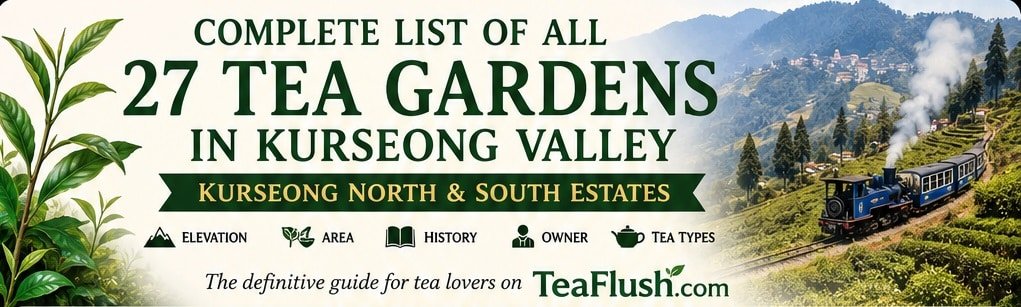
All Tea Gardens in Kurseong Valley. From misty north-facing slopes to sun-drenched southern ridges, Kurseong’s terroir produces a Darjeeling tea unlike any other. This is the most comprehensive, up-to-date list of every tea garden in the Kurseong valley area you’ll find anywhere.
Published on TeaFlush.com | Category: Darjeeling Tea | Reading Time: ~18 minutes
Kurseong — the “Land of White Orchids” — sits at 4,864 feet in the Darjeeling hills and is home to some of the world’s most celebrated tea gardens.
Table of Contents
All Tea Gardens in Kurseong Valley
1. Why Kurseong Produces World-Class Tea
Kurseong subdivision lies in the heart of the Darjeeling district of West Bengal, India. The valley is flanked by the Balason River to the west and feeds into the Teesta River basin to the east. The elevation ranges dramatically — from around 350 metres near the foothills to over 1,800 metres on the upper ridges — giving each estate a unique microclimate and flavour profile.
Several factors combine to make Kurseong a tea lover’s paradise:
- Altitude: Ranging from 365 m to 1,830 m above sea level, the cool temperatures slow the growth of tea leaves, concentrating flavour and aroma.
- Soil: Rich, well-drained loamy soil with a slightly acidic pH, ideal for Camellia sinensis.
- Rainfall: Annual precipitation of 300–400 cm, arriving mostly between June and September, keeps the estates lush year-round.
- Sunshine & Mist: The interplay of intense sunlight and daily cloud cover creates the “Muscatel” character unique to Darjeeling teas.
- Tea Varieties: A mix of Chinese (jat) bush, Assam hybrid, and modern clonal varieties gives Kurseong gardens exceptional versatility across First Flush, Second Flush, Monsoon, and Autumnal harvests.
The Kurseong subdivision is officially divided into Kurseong North and Kurseong South for the purpose of tea estate administration. Together, these zones host 27 registered Darjeeling tea gardens that are certified under the Tea Board of India and may legally label their produce “Darjeeling Tea.”
2. How Kurseong Tea Gardens Are Classified
All tea estates in Kurseong fall under the Kurseong Subdivision of Darjeeling district. For administrative and geographical convenience, they are grouped as:
| Zone | No. of Estates | Elevation Band | General Character |
| Kurseong North | 9 | 950 m – 1,830 m | Floral, muscatel, light-bodied |
| Kurseong South | 18 | 365 m – 1,600 m | Bold, full-bodied, complex |
Estates in Kurseong North tend to sit at higher elevations and border Darjeeling Sadar subdivision. Their teas are prized for delicate floral notes and the coveted Second Flush muscatel flavour. Estates in Kurseong South span wider elevation ranges and often produce more robust, structured teas alongside rare whites and oolongs.
3. Kurseong North Tea Gardens — Complete List
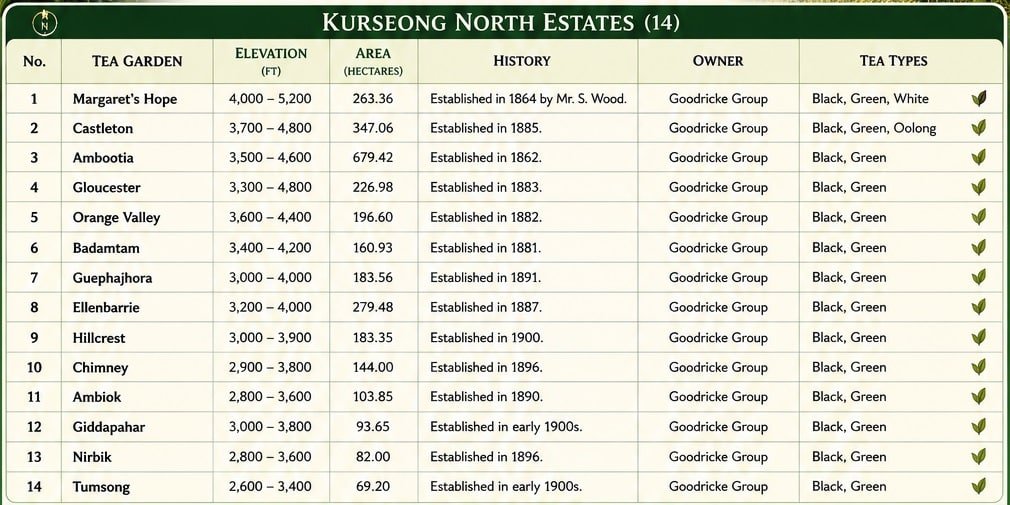
3.1 Ambootia Tea Garden
- Established: 1850s
- Area: ~340 hectares
- Elevation: 950 m – 1,450 m
- Owner/Management: Sanjay Bansal (Ambootia Group)
- Certification: Bio-dynamic, Organic (Demeter certified)
- Tea Types: Black, Green, White, Oolong
- Workers: 900+
- Notable For: One of the oldest estates in Darjeeling, Ambootia is a pioneer of biodynamic farming in Indian tea. The estate follows Rudolf Steiner’s biodynamic calendar for all plucking and processing decisions. Its teas consistently win international awards for complexity and clean flavour. Situated in the northern Kurseong valley, the estate overlooks dense forest corridors that serve as natural windbreakers.
3.2 Balasun Tea Garden
- Established: 1871
- Area: 181.38 hectares (448 acres)
- Elevation: 365 m – 1,375 m
- Owner/Management: Jay Shree Tea & Industries Ltd.
- Tea Varieties: 51% pure China jat, 40% Assam hybrid, 9% Darjeeling clonal
- Temperature Range: 7°C – 30°C
- Named After: The Balason River, which flows past the estate’s lower boundary
- Notable For: Originally established as Nahore Balasun Tea Estate by Devenport & Company Limited, it was renamed after the Balason River and passed through several owners before Jay Shree Tea took over in 2005. The wide elevation range means Balasun produces distinctly different teas from its lower and upper sections — the lower sections produce bolder, more Assam-influenced liquors while the upper sections yield delicate China jat first flushes.
3.3 Dilaram Tea Garden
- Location: 8 km from Kurseong town, along the banks of the Rinchengtong River
- Elevation: 670 m – 1,800 m (2,200 ft – 5,900 ft)
- Owner/Management: Amgoorie India Limited (Goodricke Group)
- Boundaries: Ringtong TE (west), Margaret’s Hope TE (south-west), Edenvale TE (south)
- Notable For: Dilaram sits in a particularly sheltered valley position, giving it a humid microclimate that favours slow leaf development. The Goodricke Group manages it alongside Margaret’s Hope, Castleton, Springside, and Edenvale as a cluster of complementary estates. The garden’s name means “heart’s delight” in Hindi — a reference to its scenic setting amid orchid-covered ridgelines.
3.4 Eden Vale Tea Garden (Maharani)
- Also Known As: Edenvale / Maharani Tea Estate
- Location: North Kurseong, bordering Dilaram to the north
- Owner/Management: Amgoorie India Limited (Goodricke Group)
- Elevation: Mid-to-high range within Kurseong North
- Tea Types: Orthodox black, green
- Notable For: Eden Vale is one of the quieter gems of the Kurseong North belt, often overlooked beside its more famous neighbours. The estate’s proximity to dense forest reserves means a rich biodiversity — avian species, leopards, and red pandas have been recorded in the buffer zones. Its teas are known for clean, bright liquors with a characteristic vegetal freshness.
3.5 Margaret’s Hope Tea Garden
- Established: 1864 (commercially; initial planting dated to 1830s; then known as Bara Ringtrong)
- Area: 585 hectares (1,450 acres)
- Elevation: 950 m – 1,830 m (3,120 ft – 6,000 ft)
- Owner/Management: Goodricke Group (Amgoorie India Limited)
- Factory: Built in 1930 by John Taylor
- Tea Types: Black, Green, White Darjeeling
- Named After: Margaret, daughter of owner Cruickshank, who fell in love with the estate during a visit from England and died of illness on her return voyage. Her father renamed it in her memory.
- Coordinates: 26°55′25″N 88°16′22″E
- Notable For: Margaret’s Hope is one of the most celebrated estates in all of Darjeeling, not just Kurseong. Its Second Flush teas are legend — producing the quintessential muscatel Darjeeling that auction rooms bid fiercely for. The estate is also abundant in wild orchids. At 585 hectares, it is one of the largest in the subdivision.
3.6 Moondakotee Tea Garden
- Location: North Kurseong valley
- Area: ~88 hectares (relatively small estate)
- Elevation: 950 m – 1,700 m
- Certification: Organic
- Tea Types: Primarily Green Darjeeling
- Notable For: Moondakotee’s compact size belies the quality of its output. As an organic estate, it focuses on a limited but premium range. In 2004, the factory was completely destroyed by fire, causing significant damage, but the estate has since rebuilt and restored its operations. Its green teas carry a clean, grassy sweetness that appeals strongly to Japanese and German buyers.
3.7 Oaks Tea Garden
- Location: North Kurseong, within the Kurseong valley
- Owner/Management: Private ownership
- Tea Types: Orthodox Darjeeling black tea
- Notable For: Named for the oak forests that once bordered the estate, Oaks is a mid-sized garden known for producing reliable, well-structured first and second flush teas. While less commercially prominent than Margaret’s Hope or Ambootia, Oaks has a loyal following among specialist UK and European importers who seek consistent orthodox quality.
3.8 Ringtong Tea Garden (Ring Tong)
- Location: North Kurseong, west of Dilaram Tea Estate
- Elevation: Mid-range within Kurseong North
- Owner/Management: Private management
- Tea Types: Orthodox black Darjeeling
- Notable For: Ringtong occupies a ridge-top position in the northern valley, giving it excellent sun exposure on south-facing slopes. The estate produces a classic first flush with characteristic greenish-golden liquor and a pronounced floral character. It neighbours Dilaram and forms part of a belt of contiguous gardens along the upper Rinchengtong valley.
3.9 Springside Tea Garden
- Location: North Kurseong
- Owner/Management: Amgoorie India Limited (Goodricke Group)
- Tea Types: Orthodox black and green Darjeeling
- Notable For: Springside is the most recent addition to the Goodricke cluster in Kurseong North. It gains its name from natural spring water sources within the estate, which planter lore suggests contributes mineral quality to the soil. The garden is smaller in scale but serves as a complementary producer alongside Eden Vale and Dilaram.
4. Kurseong South Tea Gardens — Complete List
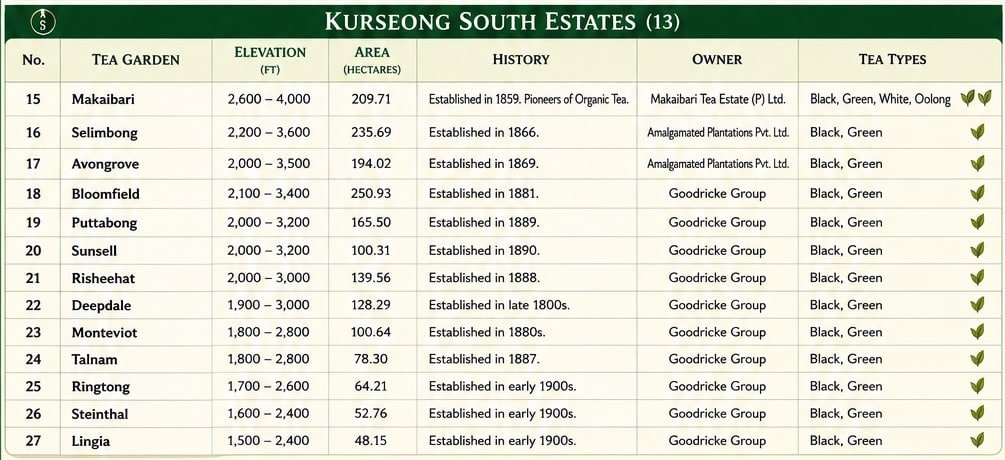
4.1 Castleton Tea Garden
- Established: Early 1880s
- Location: South Kurseong, between Goomtee and Giddapahar
- Owner/Management: Goodricke Group
- Elevation: High altitude, south Kurseong ridge
- Tea Types: Orthodox black, Second Flush muscatel specialty
- Notable For: Castleton is widely considered the crown jewel of the Goodricke Group and one of the most famous tea estates on Earth. Its Second Flush Muscatel teas have broken auction records multiple times at Kolkata Tea Auction and are sought after by collectors globally. The garden produces in small quantities but with extraordinary quality consistency. Castleton’s teas are frequently described by tasters as having notes of ripe apricot, honey, and classic Darjeeling muscatel.
4.2 Giddapahar Tea Garden
- Also Known As: “Eagle’s Cliff”
- Location: Very close to Kurseong town; the town even features a viewpoint called “Eagle’s Craig” connected to this estate’s identity
- Elevation: High elevation; mist-covered for much of the year
- Tea Variety: Nearly 100% pure China jat (Chinese variety)
- Tea Processing: Orthodox, classic-grade production
- Notable For: Giddapahar is one of the most distinctive gardens in Kurseong South. Because the estate sits at high altitude and is shrouded in mist for much of the year, the tea bushes grow extremely slowly. This slow growth concentrates aromatic compounds in the leaves, producing teas with delicate floral bouquets and exceptional aromatic quality. The 100% China jat composition is rare among Kurseong estates and makes Giddapahar teas uniquely light and nuanced.
4.3 Goomtee Tea Garden
- Established: 1899 (planted by Henry Montgomery Lennox)
- Area: 225 hectares (560 acres)
- Elevation: 900 m – 1,800 m (note: coordinates place it at 26°53′08″N 88°19′31″E)
- Owner/Management: Ashok Kumar & Mahabir Prasad (Kejriwal family co-ownership since mid-1950s)
- Certification: Organic
- Accommodation: Planter’s bungalow available for tea tourism (4 double rooms, former British planter’s residence)
- Notable For: Goomtee lies geographically between Jungpana to the east and Castleton to the west, making it part of the legendary “Golden Triangle” of Kurseong South. The estate produces some of the finest orthodox Darjeeling teas in its organic setup. The planter’s bungalow offers sweeping views of the Himalayan range and the surrounding valley, making it a popular high-end tea tourism destination. Originally managed by G.W. O’Brien, it was sold after WWII to the ruling Rana of Nepal before passing to its current ownership.
4.4 Jogmaya Tea Garden (Jogamaya)
- Location: South Kurseong
- Owner/Management: Private
- Tea Types: Orthodox black Darjeeling
- Notable For: Jogmaya is one of the smaller estates in Kurseong South and retains a traditional, family-run character. Named after the Hindu goddess Jogmaya, the estate’s teas have a dedicated following in domestic Indian specialty markets. Its position in the valley gives it a well-balanced terroir — neither too high nor too low — producing teas with medium body and good floral development.
4.5 Jungpana Tea Garden (& Jungpana Upper)
- Location: East of Goomtee, south Kurseong
- Elevation: Mid-to-high range
- Owner/Management: Private family ownership
- Tea Types: Orthodox black; Second Flush muscatel is the star product
- Notable For: Jungpana is perhaps the most storied estate in all of Kurseong South for sheer muscatel intensity. Its Second Flush teas are among the highest-priced Darjeeling teas sold by private treaty. The “Jungpana Upper” section sits at greater elevation and produces even more concentrated leaf. The estate is known for consistency across decades — a hallmark of careful, traditional planting and plucking practices. Jungpana teas regularly appear on curated premium tea lists in Japan, Germany, and the UK.
4.6 Longview Tea Garden (Highlands)
- Also Known As: Longview Highlands
- Location: South Kurseong; Longview town/village is associated with this garden
- Elevation: High altitude position with panoramic valley views (hence “Longview”)
- Owner/Management: Private
- Tea Types: Orthodox Darjeeling black tea
- Notable For: The estate derives its evocative name from the panoramic views it commands over the Kurseong valley and, on clear days, the Kanchenjunga range. Longview teas have a reputation for clean, bright first flushes with greenish liquor and floral top notes.
4.7 Makaibari Tea Garden
- Established: 1852 (factory commissioned 1859 — the first tea factory in all of Darjeeling district)
- Area: ~750 hectares (gross); ~120 hectares under tea cultivation
- Elevation: 600 m – 1,500 m (2,000 ft – 4,900 ft)
- Coordinates: 26°51′20″N 88°16′04″E
- Owner/Management: Luxmi Group (taken over from the Banerjee family in recent years)
- Previous Ownership: Captain Samler (Darjeeling Tea Company) → Girish Chandra Banerjee → Banerjee family → Luxmi Group
- Distance: 45 km from Siliguri/Bagdogra Airport; 37 km from Darjeeling town
- Certification: Biodynamic, Organic, Fair Trade
- Accommodation: Stone House (luxury), workers’ cottages (homestay)
- Tea Types: Black, Green, White, Oolong — full range
- Notable For: Makaibari is arguably the most historically significant tea estate in Darjeeling and the world. The factory, commissioned in 1859, was the first tea factory in Darjeeling district. Founded by Captain Samler of the Darjeeling Tea Company, it was later sold to Girish Chandra Banerjee and remained in Indian hands throughout, one of very few Darjeeling gardens without British colonial ownership. The estate’s literal meaning — “corn field” in Bengali — reflects its agricultural history before tea. Under the fourth-generation planter Swaraj Kumar Banerjee, Makaibari became globally famous for biodynamic farming and fetched record auction prices. Today, under Luxmi Group management, Makaibari has expanded tea tourism significantly.
4.8 Mahalderam Tea Garden
- Location: South Kurseong
- Owner/Management: Private
- Elevation: Mid-range Kurseong South
- Tea Types: Orthodox black Darjeeling
- Notable For: Mahalderam is a relatively lesser-known estate in international markets but produces reliable, quality-focused orthodox teas. The estate name (Mahal = mansion/palace in Hindi) suggests the presence of an old colonial bungalow, and the garden’s terrain features terraced slopes typical of Kurseong South.
4.9 Mohan Majhua Tea Garden
- Location: South Kurseong
- Owner/Management: Private
- Tea Types: Orthodox Darjeeling tea
- Notable For: One of a cluster of smaller “Majhua” estates in Kurseong South (alongside Narbada Majhua), Mohan Majhua produces traditional-style Darjeeling orthodox teas. The estate retains a traditional production setup and serves primarily the bulk auction market at Siliguri and Kolkata.
4.10 Monteviot Tea Garden
- Location: South Kurseong; Monteviot town is associated with this estate
- Owner/Management: Private
- Tea Types: Orthodox Darjeeling; the estate gained attention for a notable 2015 First Flush
- Notable For: Monteviot sits at the lower fringes of the Kurseong South valley and produces teas that tend toward fuller body compared to higher-altitude neighbours. The estate gained attention among tea traders for a particularly well-received 2015 First Flush that circulated in specialist European markets.
4.11 Mullootar Tea Garden
- Location: South Kurseong
- Owner/Management: Private
- Tea Types: Orthodox Darjeeling black tea
- Notable For: Mullootar is among the less-publicised estates in Kurseong South but maintains consistent production across all four seasonal flushes. The estate’s teas appear frequently in blended Darjeeling offerings from European importers.
4.12 Narbada Majhua Tea Garden
- Location: South Kurseong
- Owner/Management: Private
- Tea Types: Orthodox Darjeeling tea
- Notable For: Named after the Narbada (Narmada) river tradition in Indian naming conventions, this estate sits alongside Mohan Majhua in the lower Kurseong South zone. It maintains traditional plucking and orthodox processing practices.
4.13 Nurbong Tea Garden
- Location: South Kurseong
- Owner/Management: Private
- Tea Types: Orthodox Darjeeling black and green
- Notable For: Nurbong is positioned on the south-facing slopes of Kurseong South, giving it generous sunshine exposure that contributes to a richer, more mellow second flush character compared to the muscatel-dominant higher estates.
4.14 Rohini Tea Garden
- Location: South Kurseong; Rohini town is the associated settlement
- Owner/Management: Private
- Tea Types: Orthodox Darjeeling; known for some specialty offerings
- Notable For: Rohini sits at a transitional elevation in Kurseong South, producing a style of tea that bridges the light floral character of the higher-altitude north and the fuller-bodied south. The estate is one of the more commercially active in domestic Indian markets.
4.15 Seepoydhura Tea Garden
- Location: South Kurseong
- Owner/Management: Private
- Tea Types: Orthodox Darjeeling
- Notable For: Seepoydhura (the name references “sepoy” — a historical colonial soldier — and “dhura,” meaning ridge) is positioned on a prominent ridgeline in Kurseong South. The estate is smaller in scale and produces orthodox teas primarily for the Siliguri auction.
4.16 Selim Hill Tea Garden
- Location: South Kurseong
- Owner/Management: Private
- Tea Types: Orthodox Darjeeling black tea; some autumnal specialties
- Notable For: Selim Hill sits on a sunny hillside position in Kurseong South, known particularly for its autumnal flush — a season underrated in Darjeeling compared to the celebrated First and Second Flushes. Its autumn teas display amber-brown liquors with warm, nutty notes.
4.17 Sivitar Tea Garden
- Location: South Kurseong
- Owner/Management: Private
- Tea Types: Orthodox Darjeeling
- Notable For: Sivitar is one of the smaller and lesser-known estates in Kurseong South, operating primarily as a bulk supplier to auction markets. The estate’s tea bushes are predominantly China jat variety, which contributes a characteristic light-medium body to its teas.
4.18 Tindharia Tea Garden
- Location: South Kurseong; Tindharia is a village and railway station on the Darjeeling Himalayan Railway (Toy Train) route
- Owner/Management: Private (Bipra Das Palchoudhuri’s family estate since inception — no British colonial ownership)
- Historical Note: Along with Makaibari, Tindharia is one of the few Darjeeling gardens that has remained continuously with an Indian family without British colonial ownership. The garden is associated with Bipra Das Palchoudhuri, like Gayabari and Mohurgang.
- Tea Types: Orthodox Darjeeling
- Notable For: Tindharia’s unique identity comes from its location at the famous Tindharia railway loop on the UNESCO World Heritage Darjeeling Himalayan Railway. The estate is a heritage landmark in itself. Visitors arriving by Toy Train pass directly through the tea garden.
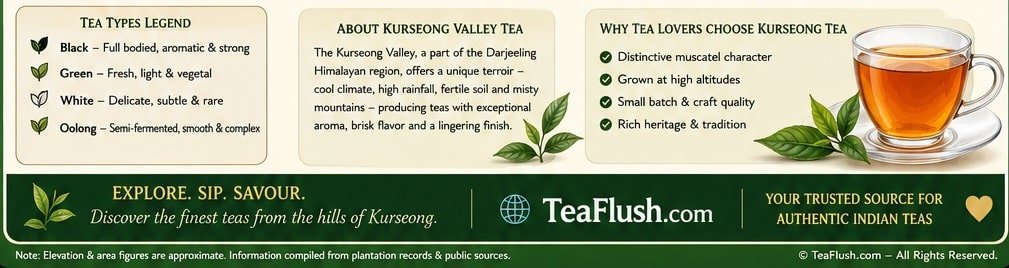
5. Quick Reference Table: All Kurseong Tea Gardens
Kurseong North (9 Estates)
| # | Tea Garden | Established | Approx. Area | Elevation | Current Owner/Group | Key Feature |
| 1 | Ambootia | 1850s | 340 ha | 950–1,450 m | Ambootia Group (S. Bansal) | Biodynamic, Organic, 900+ workers |
| 2 | Balasun | 1871 | 181 ha | 365–1,375 m | Jay Shree Tea | Named after Balason River |
| 3 | Dilaram | — | — | 670–1,800 m | Goodricke (Amgoorie) | Along Rinchengtong River |
| 4 | Eden Vale (Maharani) | — | — | Mid-high | Goodricke (Amgoorie) | Adjacent to Dilaram & Springside |
| 5 | Margaret’s Hope | 1864 | 585 ha | 950–1,830 m | Goodricke (Amgoorie) | Famous muscatel; orchid-rich |
| 6 | Moondakotee | — | 88 ha | 950–1,700 m | Private (Organic) | Green tea specialist; rebuilt after 2004 fire |
| 7 | Oaks | — | Mid-sized | — | Private | Classic orthodox; loyal UK following |
| 8 | Ringtong (Ring Tong) | — | — | Mid-high | Private | Ridge-top, floral first flush |
| 9 | Springside | — | — | — | Goodricke (Amgoorie) | Natural spring water terroir |
Kurseong South (18 Estates)
| # | Tea Garden | Established | Approx. Area | Elevation | Current Owner/Group | Key Feature |
| 1 | Castleton | 1880s | — | High ridge | Goodricke Group | Auction record Second Flush muscatel |
| 2 | Giddapahar | — | — | High/misty | Private | 100% China jat; “Eagle’s Cliff” |
| 3 | Goomtee | 1899 | 225 ha | 900–1,800 m | Kejriwal/Mahabir Prasad | Organic; tea tourism bungalow |
| 4 | Jogmaya | — | Small | — | Private | Traditional, domestic market |
| 5 | Jungpana (+ Upper) | — | — | Mid-high | Private | Finest muscatel Second Flush |
| 6 | Longview (Highlands) | — | — | High | Private | Panoramic views of Kanchenjunga |
| 7 | Makaibari | 1852/1859 | 750 ha gross | 600–1,500 m | Luxmi Group | First factory in Darjeeling (1859) |
| 8 | Mahalderam | — | — | Mid | Private | Traditional terraced slopes |
| 9 | Mohan Majhua | — | Small | — | Private | Bulk auction market |
| 10 | Monteviot | — | — | Lower south | Private | Notable 2015 First Flush |
| 11 | Mullootar | — | — | — | Private | Consistent all-season producer |
| 12 | Narbada Majhua | — | Small | — | Private | Traditional orthodox |
| 13 | Nurbong | — | — | South-facing | Private | Sunny slope; mellow second flush |
| 14 | Rohini | — | — | Transitional | Private | Bridges north/south styles |
| 15 | Seepoydhura | — | Small | Ridgeline | Private | Ridge-top position |
| 16 | Selim Hill | — | — | — | Private | Autumnal flush speciality |
| 17 | Sivitar | — | Small | — | Private | China jat; light-medium body |
| 18 | Tindharia | — | — | Lower south | Palchoudhuri family | On Toy Train route; no British ownership |
6. Tea Tourism in Kurseong
Kurseong is rapidly emerging as one of India’s premier tea tourism destinations. Several estates in both the North and South zones offer visitor experiences:
Stay on the Estate
Makaibari Tea Estate offers the widest range of accommodation in Kurseong. Visitors can stay at the colonial-era Stone House (luxury bungalow), or book a genuine homestay with a tea-garden worker’s family for an immersive, community-level experience. The estate is 45 km from Bagdogra Airport and 37 km from Darjeeling town.
Goomtee Tea Estate operates a four-room planter’s bungalow — the former residence of a British estate manager — offering sweeping Himalayan views. The estate is 48 km from Darjeeling town and 40 km from Siliguri.
Factory Tours
Most Kurseong estates welcome visitors during the flush seasons (March–May for First Flush, June–August for Second Flush). A factory tour typically covers:
- Withering troughs where freshly plucked leaf loses moisture
- Rolling machines that break the leaf cell structure
- Fermentation/oxidation room (for black teas)
- Drying chambers and grading sorters
- Tasting room and direct purchase of estate teas
Best estates for factory tours: Makaibari, Goomtee, Margaret’s Hope, Castleton, Jungpana.
The Toy Train Connection
The UNESCO World Heritage Darjeeling Himalayan Railway (the “Toy Train”) passes directly through or adjacent to several Kurseong South estates including Tindharia and Monteviot. The Tindharia loop is one of the most photographed sections of the railway and runs through the heart of the tea garden.
Best Time to Visit Kurseong Tea Gardens
| Season | Months | Flush | What You’ll See |
| Spring (First Flush) | March – April | First Flush | Fresh leaf sprouting; light floral teas |
| Summer (Second Flush) | May – June | Second Flush | Peak muscatel character; busiest season |
| Monsoon | July – September | Monsoon Flush | Lush green estates; rain walks |
| Autumn | October – November | Autumnal Flush | Amber teas; harvest atmosphere |
| Winter | December – February | Dormant | Quietest; best for landscape views |
7. Frequently Asked Questions
How many tea gardens are there in Kurseong?
There are 27 officially recognized Darjeeling tea gardens in the Kurseong subdivision — 9 in Kurseong North and 18 in Kurseong South.
Which is the most famous tea garden in Kurseong?
Makaibari (the oldest estate with the first factory) and Castleton (known for record-breaking Second Flush muscatel at auction) are the two most internationally celebrated estates. Jungpana is the most revered for pure muscatel quality.
What is the oldest tea garden in Kurseong?
Makaibari Tea Garden was founded in 1852 and its factory — the very first in Darjeeling district — was commissioned in 1859. Ambootia and Balasun also date to the 1850s–1870s.
Is Kurseong good for tea tourism? Absolutely. Kurseong is more accessible and less touristy than Darjeeling town, making it ideal for a deeper tea estate experience. Makaibari and Goomtee in particular have well-developed visitor infrastructure.
What makes Kurseong tea different from other Darjeeling tea? Kurseong estates benefit from a unique combination of elevation range, river valley humidity, and soil composition. The north Kurseong estates sit adjacent to the Darjeeling Sadar zone and share its floral, high-altitude terroir. South Kurseong estates produce more structured, complex teas with greater body — a style that bridges muscatel Darjeeling and fuller Assam-influenced profiles.
Which Kurseong tea gardens are organic or biodynamic? Ambootia (biodynamic & organic, Demeter certified), Makaibari (biodynamic, organic, Fair Trade), Goomtee (organic), and Moondakotee (organic) are among the certified estates. Several others follow sustainable practices without formal certification.
Can I buy tea directly from Kurseong tea gardens? Yes. Estates like Makaibari, Goomtee, and Margaret’s Hope have direct-purchase options at their factory gates or online through their official channels. For rare lots from Castleton and Jungpana, specialist online retailers and the Kolkata Tea Auction are the primary sources.
Conclusion
Kurseong’s 27 tea gardens represent a microcosm of everything that makes Darjeeling tea the most coveted in the world. From the record-breaking muscatel of Castleton to the historic significance of Makaibari, from the organic purity of Ambootia to the misty China jat perfection of Giddapahar — every estate in the Kurseong valley has a story written in its leaves.
Whether you’re a tea connoisseur hunting for the perfect Second Flush, a traveller seeking an authentic Himalayan escape, or a researcher tracing the colonial history of Indian tea, Kurseong’s gardens offer something irreplaceable. The valley has been producing world-class tea for over 170 years, and if its meticulous gardeners have anything to say about it, the next 170 will be equally extraordinary.
Written for TeaFlush.com — Your trusted source for Darjeeling tea knowledge, estate reviews, and flush season updates.
Tags: Kurseong tea gardens · Darjeeling tea estates · Kurseong North tea gardens · Kurseong South tea gardens · Makaibari tea · Castleton tea · Jungpana muscatel · tea tourism Kurseong · Darjeeling tea list · tea gardens West Bengal
Complete list of all 27 tea gardens in Kurseong valley — Kurseong North & South estates with elevation, area, history, owner, and tea types. The definitive guide for tea lovers on TeaFlush.com.
Kurseong tea gardens, Darjeeling tea estates, Kurseong North tea gardens, Kurseong South tea gardens, Makaibari tea, Castleton tea, · Jungpana muscatel,tea tourism Kurseong, Darjeeling tea list,tea gardens West Bengal,